
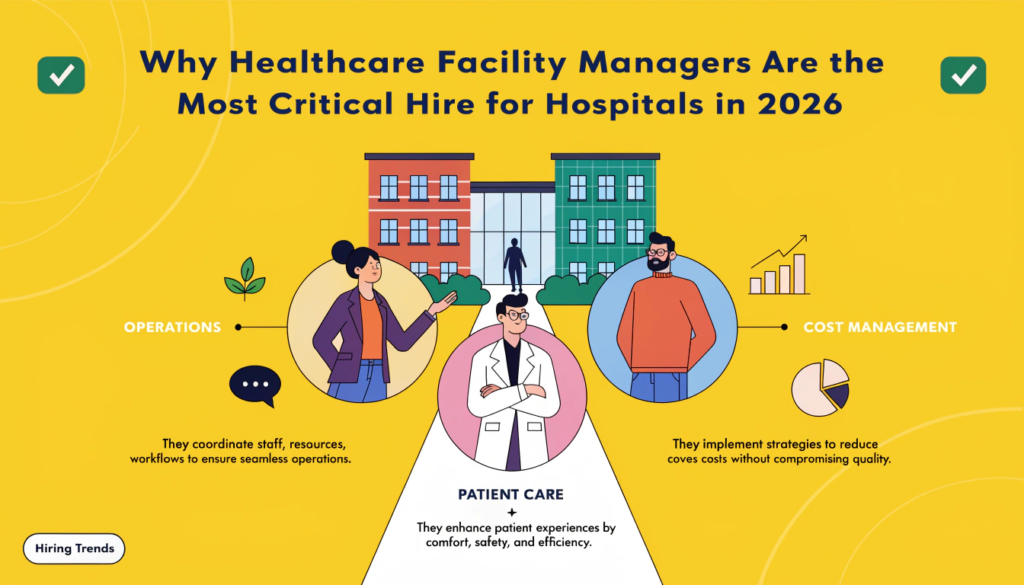
Hospitals in 2026 are facing a more complex operating environment than ever before. Rising energy costs, ageing infrastructure, advanced medical technologies, sustainability targets, cybersecurity concerns, stricter compliance expectations, and growing patient demands are all changing how healthcare facilities must be managed. Behind the scenes, one role connects many of these priorities: the healthcare facility manager.
The healthcare facility manager role 2026 is evolving from a traditional maintenance position into a strategic leadership function. Facility managers are increasingly responsible for ensuring that hospitals remain safe, resilient, efficient, compliant, sustainable, and ready to support high-quality patient care.
While doctors, nurses, and clinical specialists are at the centre of patient care, the infrastructure supporting them must function reliably every day. A power failure, HVAC problem, water-system issue, equipment breakdown, security vulnerability, or poorly maintained clinical environment can directly affect patient safety and hospital operations.
This is why healthcare organisations are placing greater emphasis on finding skilled facility management professionals who can manage both today’s operational challenges and tomorrow’s infrastructure requirements.
The Healthcare Facility Manager Role Is Changing
Traditionally, healthcare facility management was often associated with building maintenance, repairs, utilities, cleaning, and basic operational support. Those responsibilities remain important, but the scope of the position has expanded considerably.
Modern facility managers need to understand building management systems, energy management, infection prevention, emergency preparedness, sustainability, compliance, asset management, digital technologies, and risk mitigation.
They must also work closely with clinical teams, IT departments, finance leaders, contractors, procurement teams, security professionals, and senior hospital management.
This makes the healthcare facility manager role 2026 significantly more strategic than it was in previous years.
A successful facility manager is no longer simply responding when something breaks. Instead, they are expected to identify risks before they become problems, use data to improve performance, plan long-term capital investments, and ensure the facility can adapt to changing healthcare requirements.
Patient Safety Starts With the Built Environment
Patient safety is often discussed in terms of clinical procedures, medication management, and infection control. However, the physical environment also plays a crucial role.
Temperature, humidity, air quality, water systems, electrical infrastructure, emergency power, lighting, fire protection, accessibility, and cleanliness can all influence the safety and comfort of patients and staff.
Healthcare facility managers help ensure these systems operate according to required standards. They coordinate preventive maintenance, monitor critical infrastructure, manage contractors, and establish procedures for dealing with emergencies.
For example, an HVAC failure in a critical-care area is not simply a maintenance inconvenience. It can create operational and patient-safety concerns. Similarly, an unreliable backup power system can become a major risk during an outage.
The facility manager therefore becomes an important link between infrastructure reliability and clinical continuity.
Healthcare Infrastructure Is Becoming More Complex
Hospitals are increasingly becoming technology-driven environments. Advanced imaging systems, robotic surgery, connected medical devices, smart building systems, automated equipment, digital patient services, and sophisticated monitoring technologies all require reliable infrastructure.
This complexity creates a new challenge for healthcare facility managers.
They need to understand how building infrastructure interacts with technology and clinical operations. A new medical technology installation, for instance, may require changes to electrical capacity, cooling systems, floor layouts, networking, ventilation, or emergency power.
Facility managers must therefore be involved earlier in infrastructure planning and capital projects.
The ability to coordinate these requirements makes the modern facility manager an important strategic partner rather than simply an operational support function.
Sustainability Is Becoming a Facility Management Priority
Healthcare organisations consume significant amounts of energy and resources because hospitals operate continuously and rely on energy-intensive equipment and systems.
As healthcare organisations pursue sustainability goals, facility managers are increasingly responsible for translating environmental objectives into practical operational improvements.
Energy-efficient HVAC systems, smart lighting, building automation, water conservation, renewable energy, efficient equipment, waste reduction, and improved energy monitoring are all areas where facility management can make a measurable difference.
However, sustainability cannot come at the expense of patient safety or operational reliability. The facility manager must balance environmental objectives with the demanding requirements of a healthcare environment.
This creates an opportunity for professionals pursuing a hospital FM career. Facility managers who develop expertise in energy management, sustainability, smart buildings, and ESG-related operations can become valuable assets to healthcare organisations.
Smart Hospitals Need Smarter Facility Managers
The rise of smart hospitals is another reason the healthcare facility manager position is becoming increasingly important.
Internet of Things (IoT) sensors, predictive maintenance platforms, computerised maintenance management systems (CMMS), building management systems (BMS), digital twins, automated monitoring, and data analytics are changing how facilities are operated.
Instead of waiting for equipment to fail, facility teams can use real-time information to identify unusual performance and potential failures.
For example, sensors can monitor temperature, humidity, energy consumption, equipment performance, and other building conditions. Facility managers can analyse this information to identify trends and take preventive action.
Technology, however, is only useful when people know how to use it effectively.
A facility manager must understand which data matters, how to interpret it, and how to convert insights into operational decisions. This combination of technology awareness and management experience is becoming a defining characteristic of the modern healthcare facility manager.
Resilience Has Become a Business Requirement
Healthcare facilities cannot simply stop operating when an unexpected disruption occurs.
Extreme weather, power interruptions, supply chain disruptions, equipment failures, cyber incidents, water-system problems, and other emergencies can place significant pressure on hospitals.
Facility managers play a central role in preparing for these scenarios.
Business continuity planning, emergency response procedures, backup power, equipment redundancy, disaster preparedness, contractor management, and regular testing all contribute to healthcare facility resilience.
The best facility managers think beyond the immediate emergency. They ask whether the hospital’s infrastructure can continue supporting critical services under different scenarios.
In 2026, this ability to plan for uncertainty is becoming an increasingly important leadership skill.
Compliance and Risk Management Cannot Be Ignored
Healthcare facilities operate under extensive regulatory, safety, environmental, and accreditation requirements.
Facility managers must understand the standards relevant to their organisation and ensure that infrastructure, documentation, maintenance procedures, emergency systems, and operational processes are appropriately managed.
Compliance should not be treated as an activity that happens only before an inspection. It should be integrated into everyday facility operations.
A proactive facility manager creates systems that make compliance part of normal working practices. Preventive maintenance schedules, inspection records, risk assessments, asset documentation, staff training, and emergency drills can all contribute to stronger compliance performance.
This proactive approach can reduce operational risks while helping hospital leadership maintain confidence in the condition and readiness of the facility.
Cost Efficiency Is Becoming More Important
Hospitals are under constant pressure to manage costs without compromising patient care. Facility management can contribute significantly to this objective.
Poorly maintained equipment can increase energy consumption and lead to expensive emergency repairs. Inefficient systems can raise utility bills. Delayed maintenance can shorten asset lifecycles and increase capital expenditure.
A strategic facility manager looks at the entire lifecycle of an asset rather than focusing only on its immediate repair cost.
Preventive maintenance, energy optimisation, predictive analytics, efficient procurement, asset lifecycle planning, and performance monitoring can help hospitals improve financial efficiency.
This is particularly important in 2026 because facility managers are increasingly expected to demonstrate the business value of their decisions.
Why the Hospital FM Career Is Gaining Importance
The changing healthcare environment is creating new opportunities for professionals interested in a hospital FM career.
Facility management is becoming a multidisciplinary profession that combines engineering, operations, technology, sustainability, finance, compliance, and leadership.
Professionals entering this field can develop expertise across several areas rather than being limited to traditional maintenance functions.
The career path can also extend into senior positions such as facilities director, head of estates, infrastructure director, operations leader, sustainability manager, or healthcare facilities executive.
However, succeeding in this field requires continuous learning. Facility managers need to keep up with smart-building technologies, energy efficiency, healthcare regulations, digital tools, sustainability practices, risk management, and emerging infrastructure trends.
The most successful professionals will be those who can combine technical knowledge with communication and strategic decision-making skills.
The Facility Manager Is a Strategic Partner to Hospital Leadership
One of the biggest changes in the healthcare facility manager role 2026 is the growing importance of strategic collaboration.
Facility managers need to communicate with senior leadership about infrastructure risks, capital requirements, energy performance, maintenance budgets, sustainability goals, and long-term facility planning.
They must be able to explain technical issues in business terms.
For example, rather than simply stating that an HVAC system needs replacement, a strategic facility manager can explain how the existing system affects energy costs, maintenance requirements, patient environments, regulatory compliance, operational resilience, and long-term capital planning.
This ability to connect technical decisions with organisational objectives makes facility management a leadership function.
What Hospitals Should Look for in a Facility Manager in 2026
Hospitals should look beyond traditional technical qualifications when recruiting their next facility management leader.
The ideal candidate should have strong operational knowledge while also demonstrating leadership, communication, analytical thinking, and problem-solving skills. Experience with digital facility management tools and sustainability initiatives can also provide significant value.
Most importantly, hospitals need facility managers who think proactively.
They should be capable of identifying potential risks before they disrupt operations, developing long-term infrastructure strategies, managing multidisciplinary teams, and communicating effectively with executives and clinical stakeholders.
The right hire can help an organisation move from reactive maintenance to proactive, data-driven facility management.
The Future Belongs to Strategic Healthcare Facility Managers
The healthcare facility manager is increasingly becoming one of the most important operational leaders within a modern hospital.
As healthcare facilities become smarter, more connected, more sustainable, and more complex, the need for capable facility management leadership will only increase.
The healthcare facility manager role 2026 represents this shift. It is no longer simply about maintaining buildings and equipment. It is about creating an environment where healthcare professionals can deliver safe, reliable, and efficient patient care.
For hospitals, hiring the right person for this position can influence everything from infrastructure resilience and energy performance to compliance, patient safety, cost management, and long-term strategic planning.
For professionals, the changing role presents an exciting opportunity to build a rewarding hospital FM career at the intersection of healthcare, technology, sustainability, and infrastructure.
As the healthcare sector prepares for the next generation of facilities, organisations that recognise the strategic value of facility management will be better positioned to adapt and thrive.
Recognise Healthcare Facility Management Excellence
Exceptional facility managers deserve recognition for the critical work they do behind the scenes to keep healthcare environments safe, resilient, efficient, and future-ready.
Nominate for BMA Healthcare Awards and recognise professionals and teams making a meaningful contribution to healthcare facility management and infrastructure.