
Manufacturers in 2026 are under increasing pressure to produce more, reduce waste, control costs and maintain consistent quality. At the same time, factories are becoming more connected through industrial IoT, automation, artificial intelligence, predictive maintenance and real-time analytics. Yet even with advanced technologies in place, one fundamental question remains: How effectively is your equipment actually producing?
This is where Overall Equipment Effectiveness, or OEE, becomes valuable.
OEE provides manufacturers with a practical way to understand how much productive capacity is being lost because of equipment downtime, slow production, changeovers, defects and other operational issues. Effective OEE measurement in manufacturing can help organizations identify hidden losses and prioritize improvements based on actual production data rather than assumptions.
In 2026, OEE is no longer simply a maintenance KPI. It can serve as an important performance indicator for smart factories seeking greater productivity, reliability and operational visibility.
This overall equipment effectiveness guide explains how OEE works, how to calculate it, which losses to track and how manufacturers can improve OEE using modern technologies and continuous improvement strategies.
What Is OEE?
Overall Equipment Effectiveness measures how effectively a machine or production line performs compared with its theoretical maximum productive capacity during planned production time.
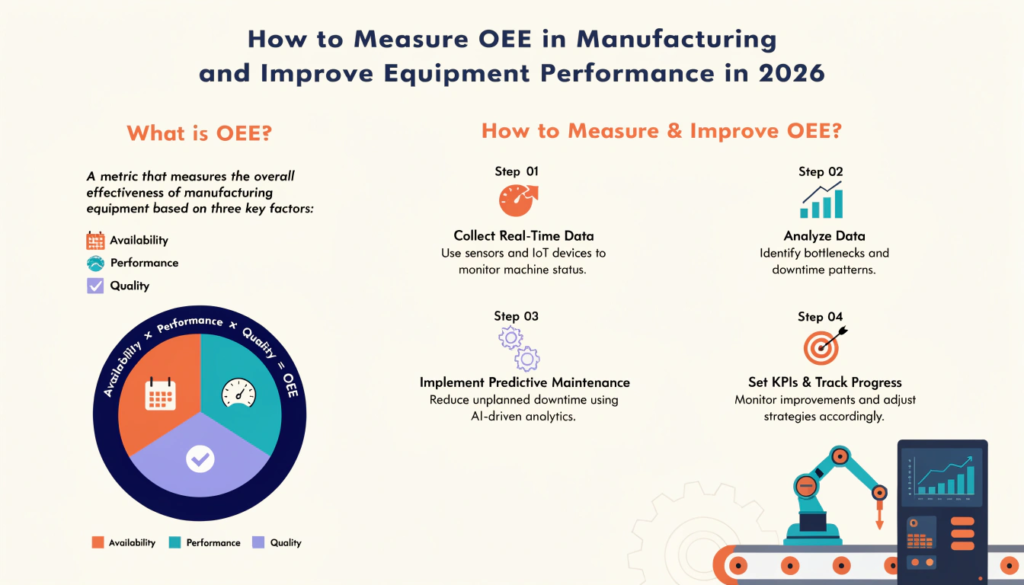
OEE is based on three core factors:
Availability × Performance × Quality = OEE
Availability measures whether equipment is running when it is supposed to run. Performance measures whether the equipment is operating at its designed or ideal speed. Quality measures how much of the production output meets the required quality standard.
For example, a machine may be available for most of a shift but still have a low OEE because it operates below its ideal speed or produces too many defective units.
This is why simply measuring uptime is not enough. OEE measurement in manufacturing brings downtime, speed losses and quality losses into a single performance framework.
The Three Components of OEE
1. Availability
Availability measures the percentage of planned production time during which equipment is actually available for production.
The basic formula is:
Availability = Operating Time ÷ Planned Production Time × 100
Operating time is affected by planned and unplanned downtime. Equipment breakdowns, long changeovers, setup delays, material shortages and waiting for maintenance can all reduce availability.
For example, if a machine is scheduled to operate for 480 minutes but loses 60 minutes to breakdowns and changeovers, its actual operating time is 420 minutes.
Availability would therefore be:
420 ÷ 480 × 100 = 87.5%
Tracking availability helps manufacturers understand where production time is disappearing.
2. Performance
A machine can be running but still not be operating at its ideal production speed. Performance measures this difference.
A simplified formula is:
Performance = Ideal Cycle Time × Total Units Produced ÷ Operating Time × 100
Performance losses can come from reduced machine speed, minor stoppages, idling, inefficient settings, operator interventions or equipment limitations.
For example, if a machine is technically capable of producing a component every 10 seconds but production data shows that it regularly takes 13 seconds, the gap represents a performance loss.
In 2026, real-time machine monitoring can make these losses easier to detect. Instead of relying on operators to manually record production rates, connected equipment can automatically capture cycle times, production counts and stoppage events.
3. Quality
Quality measures the percentage of total production that meets quality requirements.
The formula is:
Quality = Good Units ÷ Total Units Produced × 100
Defective products, rework, scrap and rejected units reduce the quality component of OEE.
For example, if a production line manufactures 10,000 units and 300 require rejection or rework, only 9,700 are considered good units.
Quality = 9,700 ÷ 10,000 × 100 = 97%
Improving quality is particularly important because defects represent more than a production problem. They can increase material consumption, labor requirements, energy usage and delivery delays.
How to Calculate OEE
The OEE calculation combines all three components.
Suppose a production line has:
- Availability: 90%
- Performance: 95%
- Quality: 98%
The calculation is:
OEE = 90% × 95% × 98%
OEE = 83.79%
This means the equipment is effectively delivering about 83.79% of its theoretical productive capability during the measured period.
The value of OEE is not simply the final percentage. The three underlying figures show where the losses are occurring.
If availability is low, manufacturers may need to focus on downtime and changeovers. If performance is low, speed losses and minor stoppages could be the priority. If quality is low, process stability, machine settings or quality controls may require attention.
Why OEE Measurement Matters in Manufacturing in 2026
Modern manufacturing environments are increasingly data-driven. However, collecting large volumes of data does not automatically lead to better production performance.
Manufacturers need meaningful KPIs that connect operational data with business decisions.
This is one reason OEE measurement in manufacturing continues to be relevant in 2026. It helps production, maintenance, engineering and management teams work from a common performance framework.
OEE can help manufacturers:
- Identify hidden production losses
- Prioritize maintenance activities
- Reduce unplanned downtime
- Improve production speed
- Reduce scrap and rework
- Evaluate process improvements
- Compare performance across machines or lines
- Improve capacity utilization
- Support data-driven decision-making
OEE can also become more useful when it is combined with other metrics such as downtime by reason, mean time between failures, mean time to repair, scrap rate, throughput and energy consumption.
How to Start OEE Measurement in Manufacturing
Successful OEE measurement starts with reliable data.
Manufacturers should first define exactly what equipment, production period and operating conditions are being measured. Teams should also establish consistent definitions for downtime, ideal cycle time, good units and defective units.
Without standardized definitions, different shifts may record the same production event differently, making the resulting OEE data difficult to compare.
The next step is to establish a baseline.
Rather than immediately targeting an arbitrary OEE percentage, manufacturers should measure current performance and identify the largest losses. A baseline allows teams to determine whether improvement initiatives are actually producing measurable results.
Data collection can range from manual production sheets to automated manufacturing execution systems, machine sensors and industrial IoT platforms. The goal should be to gradually reduce manual data entry and increase the accuracy and timeliness of production information.
Common OEE Losses Manufacturers Should Track
OEE improvement becomes easier when production losses are categorized.
Downtime losses may include machine breakdowns, equipment failures, lengthy setups, changeovers and material shortages.
Performance losses may include reduced machine speeds, minor stops, idling and inefficient production cycles.
Quality losses can include startup defects, scrap, rejected products and rework.
Manufacturers should avoid looking only at the overall OEE percentage. A plant could have an acceptable OEE score while still experiencing significant losses in one specific category.
For example, a line might maintain good availability but experience excessive quality losses. Another line could have excellent quality but repeatedly lose production time to breakdowns.
The objective is therefore not simply to increase the OEE number. It is to understand why the number is changing.
How to Improve OEE in 2026
Reduce Unplanned Downtime
Unplanned downtime is one of the most visible production losses. Manufacturers can reduce it by combining preventive maintenance with condition monitoring and predictive maintenance.
Sensors can monitor equipment conditions such as vibration, temperature, pressure and power consumption. Analytics can then help maintenance teams identify unusual patterns before they become serious failures.
Instead of waiting for equipment to break, maintenance teams can increasingly move toward condition-based interventions.
This approach can improve equipment reliability while reducing unnecessary maintenance.
Optimize Changeovers
Changeovers can consume valuable production time, particularly in facilities producing multiple product variants.
Manufacturers can analyze setup activities and identify which steps can be performed before the machine stops. Standardized work instructions, better tooling, quick-change systems and operator training can help reduce setup time.
The goal is not merely to make changeovers faster but also to make them more consistent.
Reduce Minor Stops
Small stoppages are easy to overlook because each individual event may last only seconds or minutes. However, repeated minor stops can accumulate into significant production losses over an entire shift.
Automated monitoring can help identify patterns that manual reporting often misses.
If a machine repeatedly stops because of sensor misalignment, material feeding issues or minor jams, teams can investigate the root cause rather than simply restarting the equipment each time.
Improve Machine Speed
If equipment consistently runs below its ideal cycle time, manufacturers should investigate why.
The problem could involve worn components, poor material quality, machine settings, operator practices, process constraints or upstream and downstream bottlenecks.
Improving speed should never come at the expense of quality or equipment safety. The objective is to achieve a stable production rate that can be maintained consistently.
Improve First-Pass Quality
Producing defective products consumes resources without creating usable output.
Manufacturers can improve the quality component of OEE through better process control, automated inspection, operator training and root-cause analysis.
AI-powered computer vision is also becoming increasingly relevant for automated defect detection. By identifying quality problems closer to the point of production, manufacturers can reduce the number of defective units that move further through the process.
Use Predictive Analytics
In 2026, OEE programs can become significantly more powerful when combined with real-time analytics.
Instead of looking at yesterday’s OEE report, production teams can monitor equipment performance as it happens. Dashboards can highlight abnormal downtime, falling production speeds and rising defect rates.
AI and machine learning can further help identify relationships between machine conditions and production losses.
However, technology should support not replace process knowledge. The strongest OEE programs combine reliable data with experienced operators, maintenance teams, and engineers who understand the production environment.
OEE and Smart Manufacturing
The growth of smart manufacturing is changing how factories measure equipment performance.
Connected machines can automatically capture production counts, cycle times, downtime events and machine conditions. Manufacturing execution systems can connect production information with planning and operational workflows, while analytics platforms can convert raw data into actionable insights.
The result is a shift from periodic reporting to continuous performance management.
A smart factory can potentially detect that a machine’s cycle time is increasing, identify an unusual vibration pattern and alert maintenance personnel before a failure occurs.
This creates a more proactive approach to OEE improvement.
BMA’s Smart Manufacturing & AI Automation Convention 2027 reflects this broader shift toward AI, predictive maintenance, IIoT, automation and data analytics. The event is scheduled for February 23–25, 2027, at the DoubleTree by Hilton Dallas Market Center and is designed to bring manufacturing leaders and technology providers together around emerging smart factory solutions. (bmaconventions.com)
Avoid These Common OEE Measurement Mistakes
One of the biggest mistakes is treating OEE as a target that employees must simply increase.
If teams feel pressured to improve the number at any cost, they may change reporting practices rather than improve actual production performance.
Another mistake is collecting inconsistent data. If one shift classifies a 10-minute delay as downtime while another records it as a minor stoppage, comparisons become unreliable.
Manufacturers should also avoid using OEE as the only production KPI. OEE provides a valuable equipment-performance perspective, but it should be considered alongside safety, cost, throughput, delivery performance, energy use and other operational indicators.
Finally, companies should not implement expensive technology before understanding the problem. A basic OEE baseline can often reveal where the biggest losses exist before an organization invests in additional sensors, software or automation.
What Does Good OEE Look Like?
There is no universal OEE number that guarantees a factory is performing well.
OEE depends on the manufacturing process, product mix, equipment, operating environment and measurement methodology.
The more useful approach is to establish a reliable baseline and improve it consistently.
For example, moving OEE from 65% to 72% may represent a meaningful improvement if it results from genuine reductions in downtime, speed losses and defects.
Manufacturers should focus on trends and loss categories rather than obsessing over a single percentage.
The most effective overall equipment effectiveness guide is therefore one that helps teams answer three questions:
Where are we losing production time?
Why are we losing it?
What action will prevent the loss from happening again?
The Future of OEE Measurement
OEE measurement in manufacturing is evolving from a periodic reporting exercise into a connected, real-time performance management system.
As factories adopt AI, industrial IoT, digital twins, robotics and advanced analytics, equipment data will become increasingly accessible. This can help manufacturers identify production losses faster and make more informed decisions.
The future is not simply about achieving a higher OEE score. It is about creating production systems where equipment, people and digital technologies work together to continuously identify and eliminate waste.
Manufacturers that establish strong data foundations today will be better positioned to take advantage of these technologies tomorrow.
Conclusion
OEE remains one of the most practical ways to understand equipment effectiveness in modern manufacturing. By measuring Availability, Performance and Quality, manufacturers can identify the losses preventing machines and production lines from reaching their full potential.
In 2026, the biggest opportunity is to move beyond basic OEE reporting. Connected equipment, IIoT, predictive maintenance, AI-powered analytics and automated quality inspection can make OEE measurement faster, more accurate and more actionable.
The key is to start with a reliable baseline, identify the biggest losses and address their root causes. When OEE becomes part of a broader continuous-improvement culture, it can support higher productivity, lower waste, better quality and stronger operational resilience.
For manufacturing leaders, the next step is not simply to measure OEE—it is to use the data to build smarter, more efficient and more responsive production environments.
Enquire About BMA Sponsorship
Want to position your manufacturing technology, automation, AI or industrial solution in front of industry decision-makers?
Enquire about BMA sponsorship for the Smart Manufacturing & AI Automation Convention 2027 and explore opportunities to connect with manufacturing executives, engineering leaders and technology innovators.