
For the past five years, the corporate technology world embraced a clear and ambitious vision: powering the next generation of cloud computing entirely with wind, solar, and clean battery storage. Silicon Valley tech giants and commercial data center operators made bold public commitments to achieve 100% carbon-free energy by 2030, signing multi-gigawatt renewable energy contracts across North America.
In 2026, however, that clean energy roadmap has collided directly with the staggering power appetite of artificial intelligence. Training next-generation frontier AI models and running high-density GPU clusters requires an immense, uninterrupted supply of continuous electrical power. At the same time, regional electric utilities in major digital hubs, including Northern Virginia, Texas, and Ohio are telling developers that connecting a new 100-megawatt data center to the public electric grid will take between four and seven years due to overloaded transmission lines and backlogged substation queues.
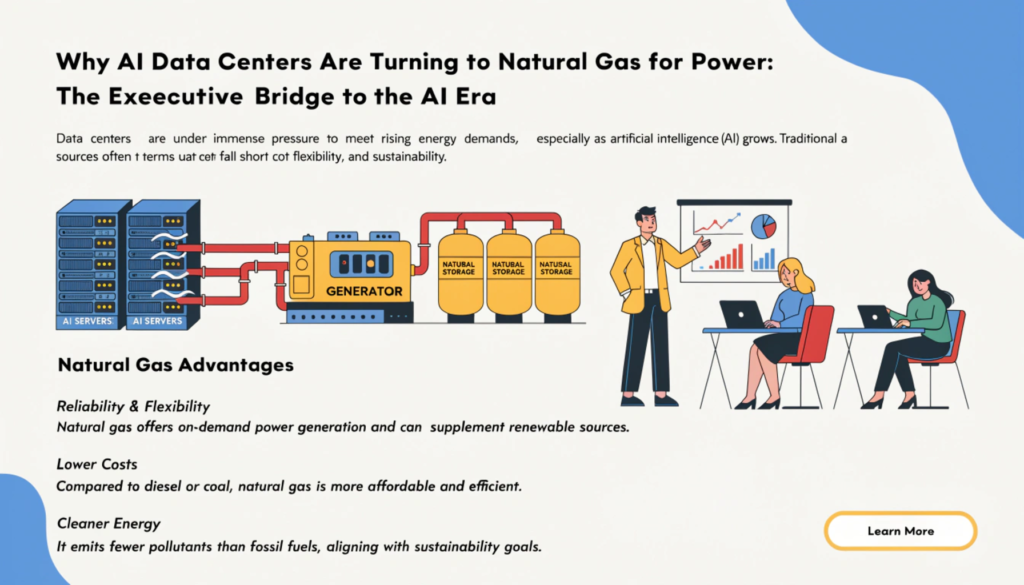
Faced with multi-year grid delays, data center executives can no longer afford to wait for the local utility company. To keep their AI initiatives on schedule, operators are making a pragmatic, high-profile pivot: embracing natural gas powered data centers. By deploying on-site gas turbines, reciprocating engines, and private microgrids right beside their server halls, technology companies are taking control of their own energy destiny. For executive leaders shaping data center on-site power generation strategies, here is why natural gas has become the indispensable bridge fueling the AI revolution.
The Speed-to-Power Imperative: Why Tech Giants Cannot Wait
In the high-stakes race for artificial intelligence leadership, speed to market is everything. A tech company that waits five years for a local electric utility to build a new high-voltage transmission substation risks losing its entire competitive advantage to faster rivals.
Commercial microchip cycles move on eighteen-month timelines, while electric utility planning operates on five- to ten-year bureaucratic cycles. If an AI cloud provider buys $2 billion worth of advanced graphics processors today, leaving those chips sitting in cardboard boxes in a warehouse while waiting for a utility power connection destroys corporate capital return on investment (ROI).
On-site natural gas generation completely eliminates this waiting game. While building a utility transmission line takes up to seven years, installing modular on-site natural gas turbines or fast-start reciprocating engines typically takes just twelve to eighteen months. By generating power directly on-site, a model known as “behind-the-meter” generation operators bypass utility interconnection queues entirely and bring multi-megawatt AI campuses online years ahead of schedule.
The Baseload Dilemma: Why Solar and Wind Aren’t Enough Alone
Corporate sustainability leaders are often asked why tech companies are turning to fossil fuels instead of building massive solar and wind farms. The answer lies in the fundamental physics of computing hardware: AI server clusters demand continuous 24/7/365 “baseload” power.
Unlike a traditional manufacturing plant that can ramp down machinery at night or an office building that turns off lights on weekends, an AI training run cannot stop. If power drops for even a fraction of a second, an AI training cluster containing 50,000 GPUs can crash, corrupting weeks of computational mathematical progress and costing millions of dollars in lost compute time.
While solar and wind are affordable and clean, they are naturally intermittent: solar panels generate zero power at night, and wind turbines stop spinning when weather patterns stall. Modern battery energy storage systems (BESS) are excellent for absorbing brief afternoon peak spikes, but they can only sustain a facility for two to four hours. Providing continuous 100-megawatt power through a four-day winter storm using only batteries is currently cost-prohibitive. Natural gas pipelines provide an uninterrupted, weather-resilient fuel supply that flows reliably regardless of rain, snow, or darkness.
How Natural Gas Generation Is Deployed on the Campus
Modern natural gas power systems are far more advanced, compact, and efficient than the noisy, smoky industrial generators of the past. Technology operators are deploying three primary on-site generation models:
1. Aeroderivative Gas Turbines
Derived from commercial jet aircraft engines, aeroderivative gas turbines are compact, lightweight, and exceptionally powerful. A single trailer-mounted turbine can generate 30 to 50 megawatts of electricity while occupying a tiny physical footprint. They can ramp up from a cold start to full electrical load in less than five minutes, making them ideal for handling sudden spikes in computing demand.
2. High-Efficiency Natural Gas Reciprocating Engines
Large modular natural gas reciprocating internal combustion engines (RICE) resemble massive locomotive engines. Arranged in modular rows inside dedicated power buildings, these engines achieve electrical efficiencies exceeding 48%. Their modularity allows facility managers to turn individual engines on or off as computing demand fluctuates, ensuring maximum fuel efficiency.
3. Combined Heat and Power (CHP) / Cogeneration
One of the smartest applications of natural gas is cogeneration. When gas turbines generate electricity, they produce large volumes of hot exhaust heat. Instead of venting that heat into the atmosphere, operators route exhaust through heat recovery steam generators (HRSGs) to power absorption chillers. The waste heat from making electricity is used directly to cool the server racks, dramatically lowering the facility’s overall energy consumption.
The ESG Reality: Balancing Growth with Carbon Commitments
Turning to natural gas is not without controversy. Many technology companies built their public brand identities around environmental sustainability, and using fossil fuels creates obvious corporate governance challenges.
However, executive teams are structuring their natural gas investments as transitional bridges rather than permanent, dirty solutions:
- Hydrogen-Ready Turbines: Leading turbine manufacturers (such as GE Vernova and Solar Turbines) design modern generation units to burn blends of natural gas and green hydrogen. As regional hydrogen supplies expand, facilities can blend up to 50% or 100% hydrogen without replacing the turbine machinery.
- Renewable Natural Gas (RNG) Offtake: Companies are purchasing certified Renewable Natural Gas derived from agricultural biodigesters and landfill methane capture, offsetting fossil emissions through certified clean fuel credits.
- Carbon Capture and Storage (CCS): Operators building multi-hundred-megawatt gas campuses are partnering with energy developers to install on-site post-combustion carbon capture systems, trapping CO₂ emissions before they reach exhaust stacks and pumping them into deep underground geological formations.
The Geography of Gas: Moving Fabs to the Wellhead
The pivot toward natural gas is also reshaping where data centers are built across the United States. Historically, data centers clustered in Northern Virginia because of dense fiber-optic internet routes.
Today, developers are following energy pipelines. Companies are building massive “wellhead data centers” directly inside oil and gas basins in Texas (the Permian Basin), Pennsylvania and Ohio (the Marcellus Shale), and Louisiana. Placing data centers directly atop major gas pipelines ensures abundant, low-cost fuel without relying on strained municipal gas distribution networks, while high-speed fiber-optic lines are trenched straight to the site.
Executive Blueprint: Evaluating On-Site Power for Your Campus
If your enterprise technology leadership team is evaluating on-site natural gas generation, consider these four strategic principles:
- Treat Power as a Real Estate Priority: Do not buy land for a data center until you have verified both electric utility interconnection timelines and high-pressure natural gas pipeline capacity. In 2026, land without immediate energy access is essentially unusable for computing.
- Design for Islanded Microgrid Capability: Ensure your on-site generation switchgear can run completely independent of the public utility grid (“island mode”). This guarantees 100% computing uptime even during regional grid collapses.
- Build Strong Relationships with Environmental Regulators: Siting gas generation requires strict state and federal EPA Title V air permits. Engaging with local communities and environmental regulators early to demonstrate emissions-scrubbing technology prevents costly legal delays.
- Maintain a Clear Decarbonization Roadmap: Reassure investors and enterprise customers by establishing clear timelines for integrating solar, battery storage, and carbon offsets alongside your gas generation fleet over time.
Conclusion: The Pragmatic Energy Future
The explosion of artificial intelligence is testing the limits of global energy infrastructure. While the transition toward a clean, renewable energy grid remains the ultimate destination, the sheer speed of AI development requires practical, reliable solutions right now.
Investing in natural gas powered data centers represents an executive acknowledgment of physical realities. By leveraging on-site natural gas generation, forward-looking operators solve utility interconnection delays, protect critical computing uptime, and build the dependable physical infrastructure required to power the digital economy. In the demanding landscape of data center on-site power generation, natural gas has emerged as the essential bridge connecting today’s energy constraints with tomorrow’s AI future.
Explore Data Center Energy Strategies at BMA Conventions
Connect with data center operators, energy developers, and utility infrastructure leaders at our upcoming national convention. Discover hands-on case studies on behind-the-meter generation, microgrid switchgear, and navigating grid power constraints.