
For more than half a century, hospital emergency power planning was based on a simple, familiar formula: keep two large diesel generators in the basement, maintain a 72-hour fuel tank, and hope the local fuel distributor can navigate flooded roads during a severe storm. If the regional electric utility grid goes down, the generators roar to life, power the life-safety circuits, and keep patient monitors running.
In 2026, healthcare leadership teams recognize that this diesel-only model is no longer enough. Aging regional electrical grids face unprecedented strain from heat waves, violent winter freezes, and utility wildfire shutoffs. At the same time, severe weather events frequently disrupt supply chains, leaving hospitals stranded without emergency diesel deliveries for days. Furthermore, volatile commercial electricity tariffs and peak demand charges have turned monthly utility bills into a massive financial drain on operating margins.
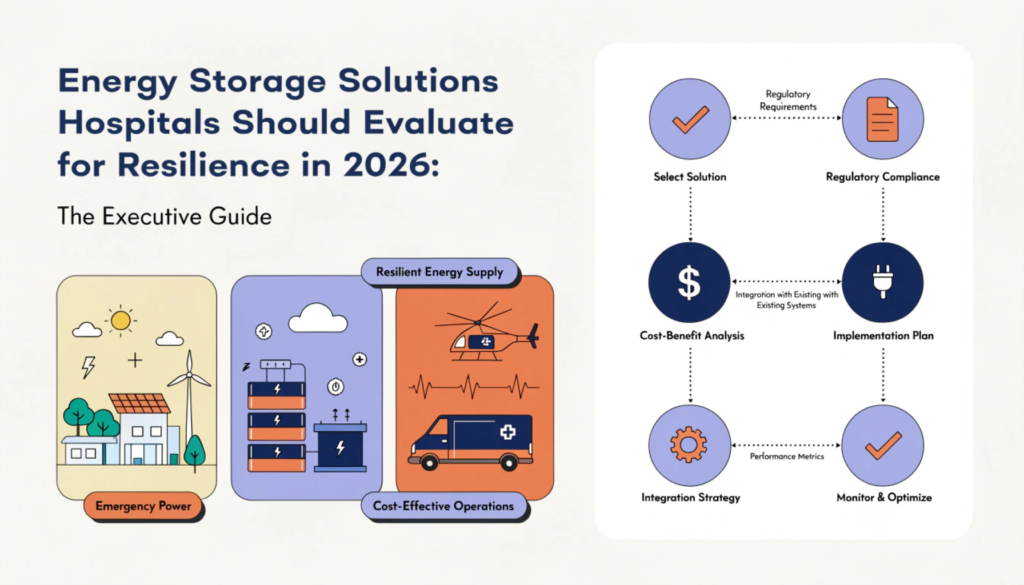
To protect clinical operations and control soaring energy expenses, forward-thinking health systems are transforming their campuses into self-sustaining microgrids. Integrating modern hospital energy storage 2026 systems allows healthcare executives to turn emergency backup power from a passive insurance policy into an active financial asset. For chief executive officers, chief financial officers (CFOs), and operations directors evaluating battery storage healthcare facilities, here are seven modern energy storage solutions reshaping healthcare resilience.
Why Energy Resilience Is an Urgent C-Suite Priority
In an acute care hospital, an electrical blackout is not a mere business inconvenience; it is an immediate threat to human life. Ventilators, neonatal incubators, surgical suites, and intensive care telemetry require completely uninterrupted power. A power failure that lasts even a few seconds can reset sensitive diagnostic imaging systems and jeopardize patient safety.
Beyond clinical safety, the financial equation has shifted dramatically:
- Punishing Peak Demand Utility Charges: Electric utility companies bill commercial customers based on their highest single 15-minute spike in electrical usage each month. Because hospitals run energy-intensive MRI machines, surgical chillers, and sterilizers during hot weekday afternoons, peak demand charges can represent over 40% of a health system’s total electric bill.
- Federal Clean Energy Incentives (IRA Direct Pay): Under the Inflation Reduction Act, non-profit and public health systems can receive direct cash reimbursements covering 30% to 50% of the capital cost of installing battery energy storage and clean microgrids. This unprecedented federal funding significantly shortens project payback timelines.
- Regulatory Evolution (NFPA 99): Recent updates to NFPA 99 (Health Care Facilities Code) officially permit hospitals to use clean battery energy storage and microgrids as recognized emergency power sources, provided they meet strict reliability standards.
Energy Storage Solutions for Modern Health Systems
1. Lithium Iron Phosphate (LFP) Battery Energy Storage Systems (BESS)
While consumer electronics often use nickel-manganese-cobalt (NMC) batteries, healthcare commercial installations have almost entirely shifted to Lithium Iron Phosphate (LFP) chemistry.
LFP batteries offer several major advantages for hospitals: they are chemically stable, highly resistant to thermal runaway (fire), and can handle thousands of full charge-discharge cycles without degrading. Packaged inside outdoor, weatherproof steel containers, an LFP battery system can store 2 to 10 megawatt-hours (MWh) of electricity. During peak afternoon hours when utility rates are highest, the hospital discharges battery power to run building chillers, saving millions in annual demand charges.
2. Fire-Safe Sodium-Ion Battery Systems
One of the fastest-growing storage technologies in 2026 is sodium-ion chemistry. Sodium-ion batteries replace scarce lithium with abundant, inexpensive sodium (derived from simple salt). While slightly heavier than lithium, sodium-ion batteries are virtually non-flammable and operate reliably across extreme temperature ranges.
For urban hospitals with tight physical footprints that must place battery rooms in basements or parking garages near patient towers, sodium-ion systems eliminate local fire department permitting hurdles and reduce insurance liability premiums.
3. Long-Duration Iron-Flow Batteries
Standard lithium batteries are designed to provide energy for two to four hours. But what happens during a week-long ice storm or a hurricane that knocks out utility power for five days?
Flow batteries solve the long-duration storage challenge. Instead of storing energy inside solid chemical cells, flow batteries store energy in large tanks of liquid electrolyte (often iron-chloride and water). To increase storage duration from 4 hours to 12 or 24 hours, you simply install larger liquid tanks. Non-toxic, non-flammable, and capable of operating for 25 years without replacement, iron-flow batteries provide the true multi-day baseline resilience critical care facilities require.
4. Thermal Energy Storage (Ice and Chilled-Water Harvesting)
Air conditioning and space cooling represent nearly 50% of a hospital’s electrical demand during summer months. Thermal energy storage addresses this cooling load directly without using expensive electrical batteries.
During cool overnight hours when grid electricity is cheap, central chiller plants freeze large insulated tanks of water into solid ice. During the blistering heat of the next afternoon, the chillers are turned off, and the melting ice cools the hospital’s air handling coils. This simple mechanical shift slashes peak electrical demand while providing thermal cooling backup if municipal power fails.
5. Solar-Plus-Storage Hybrid Microgrids
Installing solar panels on hospital parking garage canopies and medical office building roofs creates an independent source of clean electricity. However, solar energy is intermittent; clouds pass over, and the sun sets every evening.
Pairing rooftop solar arrays with localized battery storage creates an autonomous microgrid. The solar panels charge the batteries during sunny mornings, and the batteries discharge power during cloudy afternoons or grid outages. If a utility blackout occurs, the microgrid instantly “islands” from the regional grid, keeping essential clinics operational indefinitely.
6. Green Hydrogen Fuel Cell Peakers
For health systems committed to net-zero carbon goals, replacing diesel backup generators entirely requires a clean, energy-dense alternative. Hydrogen fuel cells generate electricity by combining stored hydrogen gas with oxygen, producing only water vapor and heat as byproducts.
Modern hydrogen fuel cell modules deliver instantaneous backup power without local exhaust emissions, engine vibration, or diesel particulate soot that can be pulled into hospital air intakes. As regional green hydrogen distribution hubs expand, fuel cells offer zero-emission emergency power for decades to come.
7. Fleet Vehicle-to-Building (V2B) Integration
As health systems electrify their security vehicles, shuttle vans, and mobile medical clinics, those vehicles represent a massive, untapped battery bank sitting in the parking lot. A fleet of 20 electric patient shuttles carries over 1.5 MWh of combined battery storage.
Installing bi-directional direct-current (DC) fast chargers allows the hospital to pull electricity back from vehicle batteries during an emergency grid event. Fleet batteries can power administrative clinics and emergency lighting during critical hours, transforming parking lots into mobile energy reserves.
The Financial Business Case: Turning a Cost Center into Revenue
Historically, emergency backup power was an expensive capital cost center that generated zero revenue. You bought a diesel generator, paid to service it, and hoped you never had to turn it on.
Investing in hospital energy storage 2026 fundamentally changes this financial dynamic:
- Peak Shaving Savings: By discharging stored battery power for just two hours each weekday during peak utility pricing windows, a mid-sized 300-bed hospital can reduce annual utility bills by $300,000 to $600,000.
- Grid Demand Response Revenue: Electric utility companies offer lucrative annual payments to commercial customers who agree to reduce grid demand during regional heat waves. Batteries allow hospitals to shed grid load automatically without turning off a single light or clinical device.
- Eliminated Diesel Fuel Degradation: Diesel fuel degrades over time, breeding algae and water contamination that requires expensive chemical fuel polishing and periodic tank draining. Battery storage systems have no fuel to spoil.
Executive Implementation Roadmap for Health Systems
If your health system leadership team is planning its capital infrastructure strategy for the next budget cycle, take these four practical steps:
- Conduct a 15-Minute Load Interval Audit: Request raw smart-meter electrical data from your electric utility company. Identify your highest peak electrical spikes over the past 12 months to determine the exact battery size needed for maximum peak shaving.
- Engage with Local Authorities Having Jurisdiction (AHJ): Work closely with local fire marshals early in the design phase to review NFPA 855 battery placement, fire suppression, and outdoor clearance requirements.
- Maximize Federal IRA Clean Energy Credits: Consult with your healthcare finance and tax advisors to ensure project contracts are structured properly to capture direct cash pay incentives under the Inflation Reduction Act.
- Adopt an “All-of-the-Above” Resilience Strategy: You do not need to replace your diesel generators overnight. The smartest health systems deploy batteries alongside existing generators, using batteries to absorb initial electrical shocks and handle daily peak shaving, while retaining generators for catastrophic multi-week emergencies.
Conclusion: The Resilient Healthcare Campus of the Future
The hospital of 2026 cannot afford to be passive when it comes to energy security. As climate volatility and electrical grid constraints intensify, healthcare organizations must take proactive control of their power supply.
By investing in modern hospital energy storage 2026 solutions, healthcare executives protect vulnerable patients from unexpected power disruptions, lower operating overhead, and advance corporate sustainability goals. Adopting a strategic battery storage healthcare facilities framework ensures that your institution remains a beacon of light, healing, and dependable care for your community no matter what challenges hit the electrical grid.
Explore Healthcare Energy Innovations at BMA Conventions
Connect with hospital CEOs, healthcare facility directors, and energy infrastructure pioneers at our upcoming convention in Chicago, Illinois on May 10–11, 2027. Discover live microgrid demonstrations, compare energy storage technologies, and learn how leading health systems are securing federal clean energy funding.
Register for the Smart Healthcare Facilities Convention 2027, Chicago