
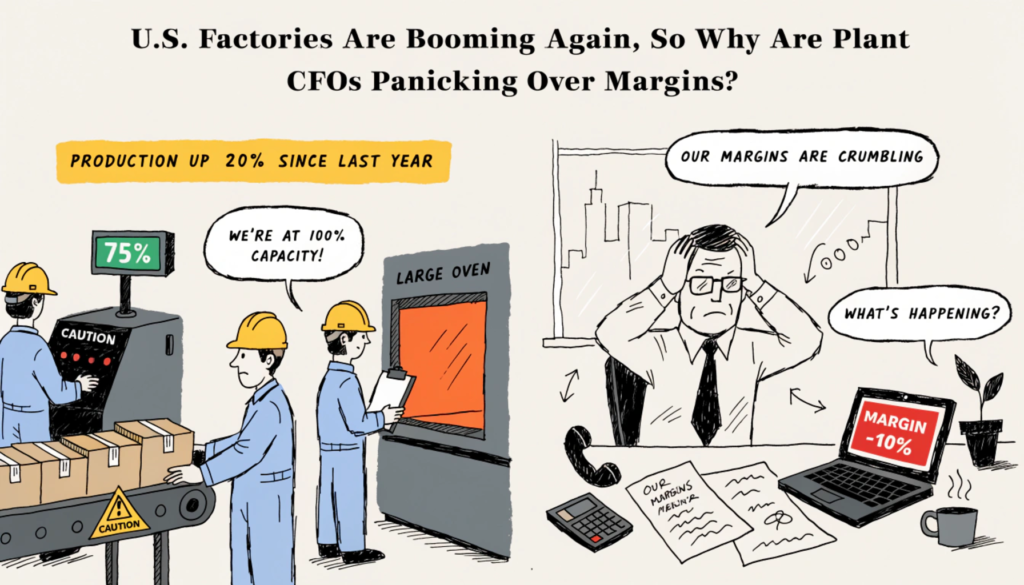
According to the latest Manufacturing Purchasing Managers’ Index (PMI) data reported on October 1, 2026, American industrial activity is surging at its fastest pace in four years. Factory output is accelerating, and customer order books are filling up at remarkable rates across heavy machinery, automotive assembly, electronics, and aerospace manufacturing. On the surface, it looks like a golden era for domestic industry.
Yet, if you walk into the executive offices of plant chief financial officers (CFOs) and manufacturing controllers, you will not find celebration. Instead, you will find widespread anxiety. The reason is a severe, high-stakes tug-of-war between booming customer demand and aggressive manufacturing raw material inflation. While factory production lines are humming at 100% capacity, surging costs for specialty steel, copper wiring, polymers, industrial chemicals, and electrical components are devouring operating profits. For leadership teams navigating factory profit margins 2026, managing this paradox has become the single most urgent operational challenge of the year.
The Anatomy of a “Profitless Boom”
To understand why financial executives are sounding the alarm, you have to look at the lag between quoting a job and delivering the finished product. In custom manufacturing, commercial construction, and capital equipment fabrication, sales contracts are often agreed upon three to nine months before physical assembly begins.
When an industrial equipment maker signs a $5 million contract with a fixed 15% operating margin, that profit calculation assumes raw steel, copper windings, and microchips stay within historical price bands. But when input prices jump 20% to 35% before material delivery arrives, that anticipated $750,000 profit completely evaporates. The company ends up working round-the-clock overtime just to break even or, in worst-case scenarios, absorb a cash loss on completed shipments.
This dynamic creates what economists call a “profitless boom.” Revenues look impressive on quarterly sales charts, factories run at full tilt, and employee headcounts expand. But cash flow turns negative because working capital is tied up in ultra-expensive raw material inventories that cost far more to replace than originally planned.
Key Drivers Behind the Current Cost Surge
The sudden surge in industrial input costs is not caused by general consumer inflation; it is driven by specific structural imbalances in the industrial supply chain:
- Critical Mineral and Metals Demand: The simultaneous expansion of electric vehicle gigafactories, regional semiconductor fabrication plants, and massive AI data centers has created intense competition for copper, aluminum, electrical steel, and nickel. Manufacturers are bidding against hyperscale tech giants for basic electrical raw materials.
- Upstream Energy and Chemical Volatility: Chemical resins, industrial coatings, carbon fiber composites, and synthetic lubricants require significant energy during refining. Fluctuating natural gas and industrial electricity tariffs have driven supplier surcharges through the roof.
- Tier-2 and Tier-3 Supplier Pricing Pressure: Smaller sub-tier suppliers operating on razor-thin margins can no longer absorb rising costs. When a tier-3 fastener or rubber gasket maker raises prices by 30%, those increases cascade rapidly down the entire supply chain.
Why Old Pricing Playbooks No Longer Work
In previous economic cycles, manufacturing leaders had a simple response to rising costs: send out an across-the-board price increase letter to all customers. In 2026, that blunt approach is failing for several reasons.
Large enterprise buyers such as major automotive OEMs, national retailers, and defense primes have invested heavily in automated cost-breakdown analytics. They reject arbitrary blanket price hikes. Furthermore, in competitive bidding environments, passing along 100% of price increases risks driving enterprise clients straight into the arms of competitors.
Instead of relying on blunt price increases, forward-thinking CFOs are adopting dynamic, collaborative pricing strategies:
- Index-Linked Material Adjustment Clauses: Contracts are tied directly to published commodity indices (such as the London Metal Exchange or ICIS chemical benchmarks). If raw aluminum prices rise by 8%, the finished unit price automatically adjusts upward; if aluminum prices fall, the customer gets an automatic discount. This transparency removes emotional friction from contract negotiations.
- Shorter Quote Validity Windows: The days of issuing firm price quotes valid for 90 or 120 days are over. Leading manufacturers now limit quote validity to 14 to 30 days, ensuring bids reflect current market replacement costs.
- Open-Book Target Costing: Suppliers and enterprise buyers work together to analyze the bill of materials (BOM), collaborating on design modifications or alternative materials to offset inflationary spikes without sacrificing product performance.
Managing Cash Flow When Inventory Costs Explode
Beyond pricing strategies, manufacturing raw material inflation creates severe balance sheet strain. When the price of buying a truckload of raw inventory doubles, a plant requires twice as much liquid working capital just to keep the shelves stocked.
Smart financial directors are taking decisive cash-preservation steps:
- Demanding Customer Milestone Deposits: Requiring upfront deposits (often 20% to 35%) at the time an order is placed allows manufacturers to purchase and lock in raw materials immediately, eliminating commodity price exposure during the production cycle.
- Strict Safety Stock Rationalization: The post-pandemic temptation was to stockpile mountains of inventory “just in case.” However, holding bloated inventory at peak prices is dangerous if commodity prices suddenly correct. Plants are returning to lean, demand-driven inventory buffers powered by real-time ERP analytics.
- Consortium Buying and Supplier Hedging: Mid-sized manufacturers are joining regional purchasing consortiums to pool their raw material purchasing volumes, securing the volume discounts and fixed-price futures contracts typically reserved for multi-billion-dollar conglomerates.
The Factory Floor Connection: Protecting Unit Margins Through Operational Efficiency
While CFOs negotiate contracts and manage banking credit lines, the ultimate battle to protect factory profit margins 2026 is fought on the physical factory floor. When raw materials are expensive, every pound of scrap metal, every spilled drop of chemical resin, and every defective finished part represents lost profit.
Finance leaders are partnering closely with plant engineering and operations directors to drive cost-reduction initiatives:
- Aggressive Scrap Reduction: Installing automated in-line machine vision sensors catches defects early in the stamping or molding process, preventing expensive raw material from moving through three subsequent assembly steps before being rejected.
- Material Yield Optimization: Using advanced digital nesting software in sheet metal laser cutting, textile stamping, and composite cutting ensures that raw sheets yield 92% usable parts instead of 80%, directly cutting material waste.
- In-House Scrap Recycling: Installing chip compactors, briquetters, and coolant centrifuges allows machining facilities to separate metal shavings from cutting fluids, selling clean scrap back to mills at premium prices while recycling expensive fluids.
Actionable Blueprint for Manufacturing Executives
If your manufacturing company is experiencing strong top-line sales growth but struggling with tightening net margins, take these four immediate steps:
- Audit Your Unbilled Cost Creep: Review all open orders booked over the last six months. Calculate the actual current replacement cost for all required components. Identify which projects are at risk of turning negative before they hit the assembly floor.
- Implement Material Escalation Clauses Immediately: Update your standard terms and conditions. Never sign a fixed-price contract extending beyond 90 days without an indexed material escalation mechanism.
- Shift from Volume to Margin Optimization: Having an order book filled to 110% capacity is meaningless if those orders deliver zero profit. Review your product portfolio and consider de-prioritizing low-margin, high-material-cost jobs in favor of high-value custom work.
- Align Sales Incentives with Gross Margin, Not Revenue: Sales teams rewarded solely on top-line revenue will discount jobs to close deals, leaving operations to deal with the cost fallout. Tie sales commissions directly to realized gross margin after material delivery.
Conclusion: Mastering the Margin Balancing Act
The resurgence of American industrial production is an exciting and genuine trend. Expanding factory output proves that domestic manufacturing remains a powerful economic engine. But revenue is vanity; profit is sanity.
By pairing strong commercial sales with disciplined contract indexing, strategic cash management, and aggressive shop-floor waste reduction, manufacturing leaders can tame manufacturing raw material inflation. The companies that master this delicate balancing act will ensure that their booming order books translate into healthy, sustainable factory profit margins 2026 for years to come.
Navigate Manufacturing Economics at BMA Conventions
Join manufacturing executives, plant CFOs, and supply chain leaders at our upcoming national convention. Discover practical strategies for contract indexing, automation ROI, raw material risk management, and factory modernization.