
Introduction
Manufacturing is entering a new phase in which automation, artificial intelligence, connected equipment, industrial data and human expertise are becoming increasingly integrated. Factories are no longer simply adding individual automated machines to production lines. Instead, manufacturers are building connected production environments capable of monitoring operations, identifying problems, optimising resources and supporting faster decision-making.
For manufacturers planning investments in 2027, understanding this transformation is becoming increasingly important. The focus is shifting from automation for its own sake toward measurable improvements in productivity, quality, flexibility, energy efficiency and resilience.
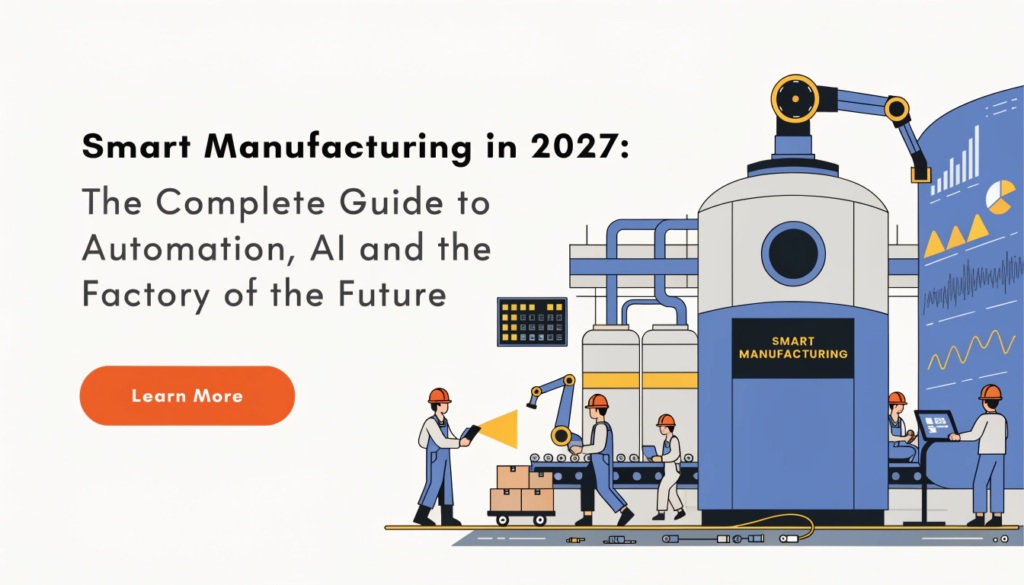
This smart manufacturing guide 2027 explains the technologies, strategies and operational priorities manufacturers should understand when preparing for the next generation of industrial production. From industrial AI and robotics to predictive maintenance, digital twins, cybersecurity and workforce development, smart manufacturing is becoming a broader business strategy rather than simply an IT or engineering initiative.
The companies that benefit most will be those that connect technology investments to clearly defined operational goals.
What Is Smart Manufacturing?
Smart manufacturing is an approach to production that combines connected machinery, industrial data, automation, software, analytics and intelligent decision-making to improve manufacturing operations.
Traditional manufacturing systems often depend on isolated machines, manual inspections and information that is reviewed after an event has occurred. Smart manufacturing aims to create a more connected environment where production data can be collected and analysed continuously.
For example, sensors installed on production equipment can monitor temperature, vibration, pressure, speed and other parameters. That information can be connected to manufacturing software and analytics platforms. Instead of waiting for equipment to fail, maintenance teams can identify unusual patterns and investigate potential problems earlier.
The concept extends beyond machinery. A connected factory can integrate production planning, inventory, quality management, maintenance, energy consumption and supply-chain information.
This makes smart manufacturing both a technology transformation and an operational transformation.
Why 2027 Will Be an Important Year for Manufacturing Transformation
Manufacturers are facing pressure from several directions. Customers expect faster delivery and greater product customisation, while companies are simultaneously dealing with labour shortages, supply-chain uncertainty, rising operating costs and increasing expectations around sustainability.
Automation can help address some of these challenges, but successful transformation requires more than purchasing robots or installing sensors.
In 2027, manufacturers are likely to place greater emphasis on technologies that provide measurable business value. Instead of asking, “What new technology should we buy?”, organisations will increasingly ask:
- Which production problems should we solve?
- Where can automation create the greatest return?
- Which processes require human expertise?
- How can production data support better decisions?
- How can technology improve resilience and flexibility?
This change in mindset is one of the most important themes within the smart manufacturing guide 2027.
The Biggest Manufacturing Automation Trends in 2027
Understanding the major manufacturing automation trends 2027 can help organisations decide where to focus their technology investments.
1. AI-Powered Manufacturing
Artificial intelligence is becoming one of the most important technologies in industrial operations.
Manufacturers can use AI to analyse large amounts of production information, identify patterns and support decision-making. Applications can include quality inspection, demand forecasting, predictive maintenance, process optimisation and production scheduling.
Computer vision systems can inspect products at high speed and identify defects that may be difficult to detect consistently through manual inspection. AI models can also analyse historical machine data to identify conditions associated with equipment failures.
The important development is that AI is increasingly being connected to operational systems rather than operating as an isolated analytical tool.
Manufacturers should therefore consider how AI can be integrated into existing production workflows.
2. Industrial Robotics and Cobots
Robotics will continue to play an important role in manufacturing automation.
Industrial robots are already widely used for applications such as welding, painting, assembly, material handling and packaging. In 2027, manufacturers are expected to continue exploring flexible robotic systems that can be adapted to changing production requirements.
Collaborative robots, commonly known as cobots, can work alongside human operators in suitable environments. They can support repetitive or physically demanding tasks while allowing employees to focus on activities requiring judgement, problem-solving and process knowledge.
The value of robotics is not limited to reducing manual work. Properly implemented robotic systems can improve consistency, production speed and workplace ergonomics.
3. Predictive Maintenance
Unexpected equipment downtime can have a major impact on production schedules and operating costs.
Predictive maintenance uses machine data and analytics to identify signs of potential equipment problems before a major failure occurs.
Sensors can monitor variables such as vibration, temperature, pressure, electrical consumption and operating speed. Analytics systems can then identify abnormal behaviour and provide maintenance teams with information that supports earlier intervention.
This approach can help manufacturers move from reactive maintenance toward more proactive maintenance strategies.
However, predictive maintenance should be implemented selectively. Not every machine requires an advanced monitoring system. Manufacturers should first identify equipment where downtime has significant operational or financial consequences.
4. Digital Twins
Digital twins are another important area of development.
A digital twin creates a digital representation of a physical asset, process, production line or facility. Data from the real-world environment can be used to update the digital model.
Manufacturers can use digital twins to simulate production changes, test process improvements and evaluate potential bottlenecks before implementing changes on the factory floor.
For example, a manufacturer considering a new production-line configuration could model different layouts digitally before physically moving equipment.
Digital twins can therefore support better planning while reducing the risks associated with experimentation in live production environments.
5. Edge Computing and Real-Time Analytics
Smart factories generate enormous amounts of data. Sending every piece of information to a remote cloud environment may not always be practical, particularly when decisions need to be made quickly.
Edge computing enables certain data processing activities to occur closer to machines and production systems.
This can support faster responses in applications such as machine monitoring, automated inspection and process control.
Cloud platforms will remain important for broader analytics, storage and enterprise integration, while edge computing can support time-sensitive industrial applications.
The combination of edge and cloud technologies is likely to become increasingly important in connected manufacturing environments.
Building a Connected Factory
A smart factory depends on connectivity.
Machines, sensors, programmable logic controllers, manufacturing execution systems, enterprise software and analytics platforms need to exchange information effectively.
Many manufacturers, however, operate facilities containing equipment from different generations and vendors. Some machines may have modern connectivity capabilities, while older equipment may not.
This creates one of the practical challenges of smart manufacturing: connecting existing assets without replacing everything.
Manufacturers can use gateways, sensors and industrial connectivity solutions to collect information from legacy equipment. This allows organisations to modernise gradually rather than undertaking a complete factory replacement.
A phased approach can reduce financial risk and make transformation easier to manage.
The Role of the Industrial Internet of Things
The Industrial Internet of Things, or IIoT, is a major foundation of connected manufacturing.
IIoT involves connecting industrial assets and collecting data from them. Sensors can capture operational information and transmit it to systems that analyse or visualise the data.
A manufacturer could use IIoT technology to monitor production speed across multiple machines, track energy consumption, identify downtime patterns or monitor environmental conditions.
However, collecting data is not the same as creating value from data.
Manufacturers need to establish clear use cases before deploying large numbers of sensors. Every data collection project should ideally answer a business or operational question.
Smart Quality Management
Quality management is another area where automation and intelligent technologies can create significant benefits.
Manual inspection can be time-consuming and may produce inconsistent results depending on the product, process and working conditions.
Automated inspection systems can use cameras, sensors and computer vision to identify defects during production.
This can allow manufacturers to detect quality problems earlier rather than discovering them after products have completed the production process.
Data from quality systems can also be analysed to identify recurring causes of defects.
The long-term objective should not simply be to detect more defects. It should be to understand why defects occur and reduce their frequency.
Smart Production Planning
Production planning becomes more complex when manufacturers manage multiple products, machines, suppliers and customer requirements.
AI and advanced analytics can help production teams evaluate large amounts of information and identify more efficient scheduling options.
A smart production planning system may consider machine availability, material availability, labour requirements, maintenance schedules and delivery deadlines.
This can help manufacturers respond more quickly when conditions change.
For example, if a machine unexpectedly becomes unavailable, a connected planning system could help identify alternative production capacity and adjust schedules.
This level of flexibility is becoming increasingly valuable in uncertain operating environments.
Energy Efficiency and Sustainable Manufacturing
Sustainability is increasingly connected to smart manufacturing.
Energy monitoring systems can help manufacturers understand how electricity, gas, water and other resources are being consumed across production operations.
Instead of reviewing energy consumption only at a facility level, manufacturers can analyse consumption by machine, production line, process or operating period.
This can help identify inefficient equipment and unusual consumption patterns.
Automation can also support energy optimisation by adjusting processes based on production requirements.
For manufacturers pursuing sustainability objectives, smart technologies can therefore provide both operational and environmental benefits.
Cybersecurity in Smart Factories
As factories become more connected, cybersecurity becomes increasingly important.
A traditional isolated machine may have limited exposure to external networks. A connected smart factory can have numerous communication points between machines, software platforms, cloud environments and enterprise systems.
This creates additional security considerations.
Manufacturers should consider network segmentation, access controls, software updates, authentication, monitoring and employee awareness as part of their smart manufacturing strategy.
Cybersecurity should not be treated as an afterthought. It should be incorporated into technology planning from the beginning.
A highly automated factory without adequate cybersecurity controls can create significant operational risk.
The Human Role in Automated Manufacturing
Automation does not eliminate the importance of people.
Instead, it changes the types of skills required in manufacturing.
Employees may increasingly need knowledge of robotics, data analysis, industrial software, automation systems and digital troubleshooting.
At the same time, human capabilities such as problem-solving, communication, creativity and decision-making remain essential.
Manufacturers should therefore invest in workforce development alongside technology.
Training programmes can help employees understand new systems and use automation effectively. Involving employees during implementation can also improve adoption because operators often understand production problems that may not be obvious to technology teams.
The future factory will not simply be a factory without people. It will be a factory where people and technology work together more effectively.
How to Start a Smart Manufacturing Programme
A successful transformation does not need to begin with a massive investment.
Manufacturers can start by identifying one operational problem with measurable business impact.
For example, a company may identify excessive machine downtime as its biggest challenge. It could begin with sensors and predictive maintenance on a small number of critical machines.
The organisation can then measure the results before expanding the programme.
A practical implementation process can involve several stages.
First, assess the current manufacturing environment. Understand existing machines, systems, processes, data sources and operational challenges.
Second, identify high-value use cases. Prioritise problems where automation or analytics can deliver measurable improvements.
Third, establish baseline performance. Without baseline data, it becomes difficult to determine whether a technology investment has produced meaningful results.
Fourth, run a controlled pilot. A pilot provides an opportunity to test the technology and identify implementation challenges.
Finally, scale successful solutions across additional machines, lines or facilities.
This approach reduces the risk of attempting too much too quickly.
Measuring the ROI of Automation
Technology investments should be evaluated through business outcomes.
Manufacturers can track metrics such as:
- Overall equipment effectiveness
- Production throughput
- Unplanned downtime
- Scrap and rework
- Labour productivity
- Changeover time
- Energy consumption
- Maintenance costs
- Production lead time
- Quality performance
The right metrics depend on the specific objective of the project.
For example, an automated inspection system should be evaluated through improvements in defect detection, quality consistency, scrap reduction and inspection efficiency.
A robotic material-handling project may be evaluated through throughput, labour productivity, cycle time and workplace safety outcomes.
The key principle is simple: technology should be connected to measurable operational value.
Common Smart Manufacturing Mistakes
Manufacturers can face several challenges when implementing automation.
One common mistake is investing in technology without clearly defining the problem it is intended to solve.
Another is trying to automate a poorly designed process. Automation can make an inefficient process faster without necessarily making it better.
Data quality is another major concern. AI and analytics systems depend on reliable information. Inaccurate, incomplete or inconsistent data can produce misleading results.
Manufacturers should also avoid treating technology implementation as an IT-only project. Production managers, engineers, maintenance teams, operators, IT specialists and business leaders may all need to contribute.
Finally, organisations should avoid attempting a complete transformation in a single step. A phased approach often provides greater control and allows lessons from early projects to influence later investments.
A Practical 2027 Smart Manufacturing Roadmap
A 2027 manufacturing transformation roadmap can begin with a clear assessment of current capabilities.
During the first stage, organisations can evaluate their equipment, connectivity, data infrastructure, automation levels and workforce capabilities.
The next stage should focus on identifying priority use cases. These could include predictive maintenance, automated quality inspection, robotics, energy optimisation or production planning.
After selecting a priority, manufacturers can establish a pilot project with defined objectives and measurable KPIs.
Once the pilot demonstrates value, the solution can be integrated with other systems and expanded.
Over time, manufacturers can build a connected digital ecosystem in which production, maintenance, quality, supply chain and business systems exchange information.
This gradual approach can make the transition more manageable and financially sustainable.
What Manufacturers Should Prioritise in 2027
The manufacturing automation trends 2027 landscape will continue to evolve, but several priorities should remain central to manufacturing strategy.
First, manufacturers should focus on interoperability. New technology should ideally work with existing systems rather than creating another isolated data environment.
Second, companies should prioritise scalable solutions. A pilot that cannot be expanded may have limited long-term value.
Third, cybersecurity should be incorporated into every connected manufacturing project.
Fourth, manufacturers should invest in employees and digital skills.
Finally, businesses should focus on measurable outcomes rather than technology adoption alone.
The most successful factories will not necessarily be those with the greatest number of robots or sensors. They will be the organisations that use technology intelligently to solve important operational challenges.
The Future of Smart Manufacturing
Looking beyond 2027, manufacturing is likely to become increasingly adaptive.
Factories may use AI to continuously analyse production conditions, automated systems to adjust processes and digital twins to test changes before implementation.
Robots may become more flexible, allowing them to handle a wider variety of tasks and production configurations.
Manufacturing systems may also become more interconnected with suppliers, logistics providers and customers.
This could create a more responsive production environment where changes in demand can be translated into production decisions faster.
However, technology alone will not determine the success of this transformation. Leadership, workforce capability, process design, cybersecurity and investment discipline will remain equally important.
Conclusion
Smart manufacturing is moving beyond individual automation projects toward integrated production ecosystems.
The smart manufacturing guide 2027 approach is therefore not simply about installing new equipment. It is about creating a manufacturing environment where machines, data, software and people work together to improve performance.
AI, robotics, IIoT, predictive maintenance, digital twins, edge computing and automated quality systems are creating new opportunities for manufacturers. At the same time, companies must address cybersecurity, workforce development, data quality and technology integration.
The most effective strategy is to begin with clearly defined business problems, establish measurable objectives, test solutions through controlled pilots and scale the technologies that demonstrate value.
For manufacturing leaders, 2027 presents an opportunity to move from disconnected automation toward a more intelligent, flexible and data-driven factory.
As manufacturing automation trends 2027 continue to develop, organisations that prepare early can position themselves to improve productivity, quality, resilience and competitiveness in an increasingly demanding industrial environment.
Register Interest for BMA Manufacturing 2027
Want to explore the latest ideas, technologies and strategies shaping the future of manufacturing and automation?
Register interest for BMA Manufacturing 2027 to connect with industry professionals and stay informed about developments across smart manufacturing, automation, industrial technology and the factory of the future.
Register interest for BMA Manufacturing 2027- https://bmaconventions.com/smart-manufacturing-automation-convention-2027/