
Introduction
For telecom operators, data centers are becoming increasingly important to network performance, cloud services, edge computing, and digital connectivity. At the same time, the energy required to operate these facilities continues to put pressure on operating budgets and sustainability targets.
One US telecom provider faced this challenge at a large data center where the Power Usage Effectiveness (PUE) had reached approximately 1.8. This meant that for every 1.8 units of total facility energy consumed, only one unit was being used directly by IT equipment.
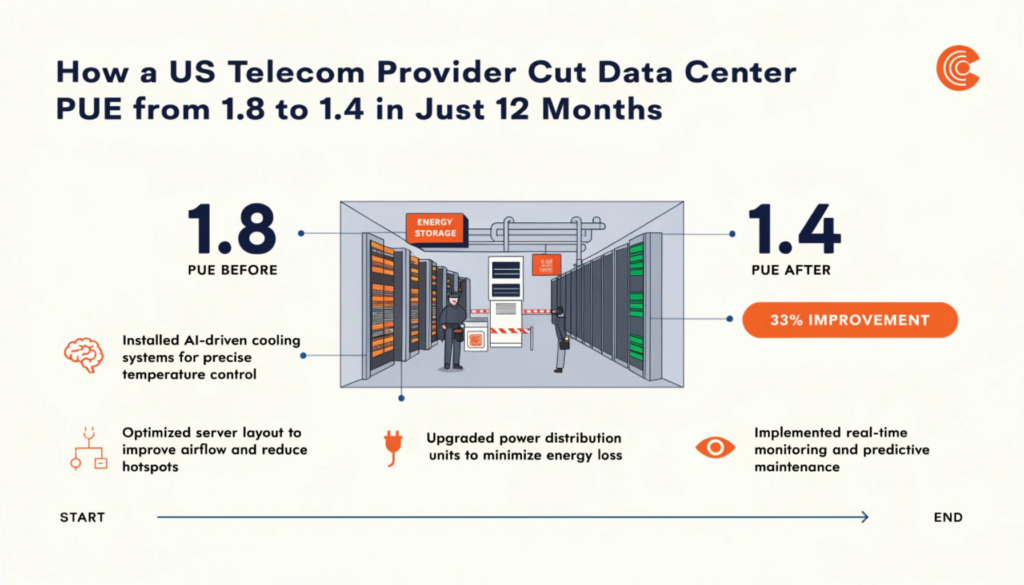
Rather than replacing the entire facility, the operator launched a 12-month optimization program focused on cooling, airflow management, power infrastructure, controls, and operational discipline. By the end of the program, PUE had improved to approximately 1.4.
This data center PUE reduction case study demonstrates an important lesson: significant efficiency gains do not always require a complete data center rebuild. A coordinated approach to existing infrastructure can deliver measurable improvements while reducing energy consumption and operating costs.
Why Was the PUE So High?
The telecom provider operated a data center designed during a period when energy efficiency was not the primary consideration in facility planning. The site had a mixture of legacy servers, newer high-density equipment, conventional cooling systems, and infrastructure that had been expanded over several years.
The initial PUE of 1.8 indicated that a substantial amount of energy was being consumed by systems supporting the IT load.
The first step was therefore not to immediately purchase new equipment. Instead, the facilities team established a baseline and examined where energy was being consumed.
The assessment covered cooling systems, computer room air-conditioning units, pumps, fans, UPS systems, power distribution, lighting, environmental controls, and IT utilization.
The analysis revealed that cooling represented one of the largest opportunities for improvement. The facility was also experiencing inefficient airflow caused by poorly positioned equipment, unmanaged cable openings, and inconsistent use of blanking panels.
In addition, some cooling units were operating at fixed speeds even when the IT load did not require maximum capacity.
Building a 12-Month Efficiency Roadmap
The telecom provider divided the improvement program into several stages rather than attempting to change everything simultaneously.
The objective was simple: reduce non-IT energy consumption without compromising availability, network performance, or equipment reliability.
The team established monthly energy measurements and tracked PUE alongside temperature, humidity, cooling-system performance, IT load, and facility power consumption.
This measurement-driven approach became critical. Instead of assuming that a particular upgrade would deliver savings, the team could compare actual performance before and after each intervention.
The program also involved collaboration between facility managers, network engineers, IT teams, and energy specialists. This avoided a common problem in data center optimization: treating IT and facility systems as completely separate environments.
Fixing Airflow Inefficiencies
One of the earliest improvements involved airflow management.
The data center had areas where hot and cold air were mixing. Some server racks were missing blanking panels, while unused rack spaces allowed conditioned air to circulate inefficiently.
The facilities team reorganized selected racks and improved hot-aisle and cold-aisle separation. Blanking panels were installed where required, and unnecessary openings in the raised floor were sealed.
The team also examined cable pathways and other areas where conditioned air was escaping.
These changes were relatively inexpensive compared with major mechanical upgrades, but they helped improve the effectiveness of the cooling system.
Once airflow became more predictable, cooling equipment could operate more efficiently without creating unacceptable temperature variations.
Optimizing Cooling Systems
Cooling became the central focus of the data center energy efficiency improvement strategy.
The provider reviewed the operating schedules and set points of its cooling equipment. Rather than running cooling units continuously at conservative settings, the facility team used actual environmental data to determine where capacity could be reduced safely.
Variable-speed fans and pumps were optimized so that they responded more closely to real-time demand.
The team also reviewed chilled-water and cooling-system performance, looking for opportunities to improve efficiency while maintaining appropriate conditions for IT equipment.
Importantly, the objective was not simply to increase temperatures. Any change in environmental conditions had to remain within the operating requirements of the equipment and the facility’s resilience strategy.
The combination of airflow improvements and cooling controls produced a larger impact than either measure would have achieved independently.
Improving Temperature and Environmental Controls
Another source of inefficiency was inconsistent environmental control.
Some areas of the facility were being cooled more aggressively than necessary because the system was designed around conservative assumptions rather than actual operating conditions.
The provider introduced better monitoring across the data center and used sensor data to identify areas that were receiving excessive cooling.
Controls were then adjusted to create a more consistent thermal environment.
This helped eliminate unnecessary cooling while also providing facilities personnel with better visibility into potential hot spots.
The lesson was straightforward: energy efficiency depends on accurate information. Without granular temperature and environmental data, operators often compensate for uncertainty by running cooling equipment harder than necessary.
Addressing UPS and Power Distribution Losses
Cooling was not the only source of inefficiency.
The telecom provider also reviewed its electrical infrastructure, particularly UPS systems and power distribution equipment.
Some equipment operated less efficiently at lower loads. The team therefore assessed load distribution and identified opportunities to improve the operating efficiency of the electrical system.
Where practical, loads were balanced more effectively, while unnecessary equipment and inefficient operating configurations were reviewed.
The provider also evaluated opportunities to retire or consolidate underutilized infrastructure.
These changes supported the broader data center energy efficiency improvement program by reducing losses outside the IT environment.
Tackling Underutilized IT Capacity
A PUE improvement program can focus heavily on facilities and overlook the IT load itself. The telecom provider took a different approach.
The IT team examined servers and systems that were consuming energy without delivering proportional computing value.
Some workloads were consolidated, while obsolete equipment was identified for retirement. Virtualization and workload optimization were also considered where technically appropriate.
Reducing unnecessary IT power consumption had a secondary benefit: every watt removed from the IT load also reduced the amount of cooling capacity required to remove the associated heat.
This created a multiplier effect. Better IT utilization reduced both direct energy consumption and some of the supporting energy requirements.
Using Real-Time Monitoring
One of the most important changes was the introduction of stronger energy monitoring.
Instead of relying primarily on monthly utility bills, the facility team tracked power consumption at a more detailed level.
Measurements from power meters, cooling systems, environmental sensors, and building-management systems were brought together to create a clearer view of facility performance.
This allowed the team to identify unusual energy consumption and investigate performance changes more quickly.
The data also helped management establish accountability. Facility teams could see whether efficiency measures were actually producing the expected results.
Over time, energy management became an ongoing operational activity rather than a one-time project.
The 12-Month Result
After 12 months of coordinated improvements, the provider reduced its PUE from approximately 1.8 to 1.4.
That represents a substantial improvement in the amount of facility energy required to support the same level of IT activity.
The achievement did not depend on a single technology. Instead, it resulted from combining several improvements: better airflow, optimized cooling, improved controls, electrical-system optimization, IT consolidation, and continuous monitoring.
This is one of the most important lessons from the data center PUE reduction case study. PUE improvement is usually the result of multiple small and medium-sized improvements working together.
The exact savings will naturally vary depending on electricity prices, facility size, IT load, climate, equipment age, and operating conditions. However, the underlying strategy can be adapted to many existing data centers.
Why the Improvement Was Sustainable
A common problem with energy-efficiency projects is that performance improves temporarily and then gradually declines.
The telecom provider addressed this risk by making efficiency part of normal facility operations.
Teams continued monitoring PUE and investigating unexpected changes. Cooling-system performance was reviewed regularly, while environmental sensors helped identify potential problems before they became significant.
Operational teams were also given clearer responsibility for energy performance.
This matters because data centers are dynamic environments. IT loads change, equipment is added or removed, cooling requirements fluctuate, and operating conditions evolve.
A facility that achieves a PUE of 1.4 today cannot assume that it will maintain that performance indefinitely.
Continuous measurement and optimization are therefore essential.
Key Lessons for Data Center Operators
The biggest takeaway is that PUE reduction should begin with measurement rather than assumptions.
Operators should first establish a reliable baseline and understand where energy is being consumed. Cooling, airflow, electrical infrastructure, IT equipment, lighting, and controls should then be evaluated as parts of one connected system.
Another important lesson is that relatively simple improvements can create meaningful results. Airflow management, equipment consolidation, sensor deployment, and control optimization may not appear as dramatic as a major infrastructure replacement, but collectively they can significantly improve efficiency.
Finally, energy efficiency should not be treated as an isolated sustainability project. It can directly support lower operating costs, better infrastructure utilization, improved equipment management, and stronger long-term resilience.
What Other Telecom Data Centers Can Learn
Telecom facilities face a particularly complex challenge because they must support high availability while handling changing network and computing requirements.
For these operators, efficiency cannot come at the expense of reliability.
The better approach is to combine operational optimization with accurate monitoring and carefully controlled infrastructure changes.
A facility with a high PUE should not automatically conclude that a complete rebuild is necessary. A detailed assessment may uncover opportunities within the existing infrastructure that can deliver significant improvements.
The journey from 1.8 to 1.4 illustrates what is possible when cooling, power, IT, controls, and operations are optimized together.
Conclusion
Reducing data center energy consumption is no longer simply an environmental objective. With energy costs rising and computing demand increasing, efficiency has become an important part of data center strategy.
This data center PUE reduction case study shows how a US telecom provider could achieve a major improvement in 12 months by focusing on practical, measurable changes rather than relying on a single technology.
From airflow containment and cooling optimization to power management, IT consolidation, and real-time monitoring, each improvement contributed to the final result.
The key message for data center leaders is clear: PUE reduction is not a one-time upgrade. It is an ongoing process of measuring, optimizing, testing, and improving.
As AI, edge computing, cloud services, and telecommunications continue to increase infrastructure demand, operators that invest in smarter facility management will be better positioned to control energy costs while maintaining reliable performance.
Sponsor BMA Data Center Convention
Connect with industry professionals, technology providers, and data center leaders to explore practical strategies for improving infrastructure efficiency, sustainability, cooling, power management, and facility operations.