
Introduction
Healthcare facilities are entering a new phase of transformation in 2026. Hospitals are no longer being designed simply around beds, operating rooms, diagnostic departments, and administrative spaces. Instead, healthcare organizations are looking at their buildings as strategic assets that must support patient outcomes, staff efficiency, digital technology, sustainability, resilience, and long-term operational performance.
The latest industry data reflects this shift. Healthcare Design’s 2026 A/E/C survey found that renovation work represented 65% of projects completed in 2025, compared with 35% for new construction. This indicates that healthcare organizations are increasingly choosing to modernize existing facilities rather than relying exclusively on large greenfield developments. (HCD Magazine)
At the same time, new construction remains important. Hospitals need additional capacity, outpatient services are expanding, infrastructure requires modernization, and healthcare providers are investing in technologies that require new approaches to building design.
Understanding the major hospital construction trends 2026 will therefore be essential for hospital executives, facility managers, architects, contractors, engineers, developers, and healthcare technology providers planning projects for the years ahead.
1. Renovation Is Becoming as Important as New Hospital Construction
One of the clearest trends heading into 2026 is the growing importance of renovation.
Many hospitals operate in buildings that were designed decades ago. While these facilities may still provide valuable clinical capacity, their infrastructure may not have been designed for modern medical equipment, advanced digital systems, evolving infection-control requirements, or today’s patient expectations.
Healthcare organizations are increasingly responding through targeted modernization rather than completely replacing existing buildings. The 2026 Healthcare Design A/E/C survey reported that renovation projects accounted for the majority of completed healthcare projects in 2025. (HCD Magazine)
This makes healthcare building renovation a major component of capital planning.
Renovation projects can involve upgrading patient rooms, improving HVAC systems, replacing aging electrical infrastructure, modernizing diagnostic areas, redesigning waiting spaces, upgrading lighting, improving accessibility, and introducing digital building systems.
The challenge is that hospitals cannot simply shut down while construction takes place. Renovation therefore requires careful phasing, infection-control planning, temporary access routes, noise management, and coordination with clinical teams.
In 2026, successful renovation strategies will focus on minimizing disruption while maximizing the operational value of every improvement.
2. Flexible and Adaptable Hospital Spaces
Healthcare needs can change much faster than hospital buildings.
A department that requires a particular configuration today may need to accommodate different equipment, technologies, patient volumes, or clinical services five or ten years from now. This is encouraging designers to create spaces that can be modified without major structural reconstruction.
Flexibility is becoming a central principle in modern healthcare design. Industry experts are highlighting future-ready environments that can respond to changing care models, technology, staffing requirements, and patient expectations. (KI)
Flexible layouts may include standardized room dimensions, movable partitions, accessible utility connections, modular walls, adaptable treatment spaces, and infrastructure designed to support future equipment.
The concept is simple: hospitals should not be designed only for today’s requirements.
Future-ready buildings should provide the ability to expand, reconfigure, or repurpose areas as healthcare delivery changes.
The World Health Organization’s Smart Hospitals Toolkit similarly emphasizes adaptable and modular approaches, including planning for future expansion and designing buildings that can evolve without major disruption. (World Health Organization)
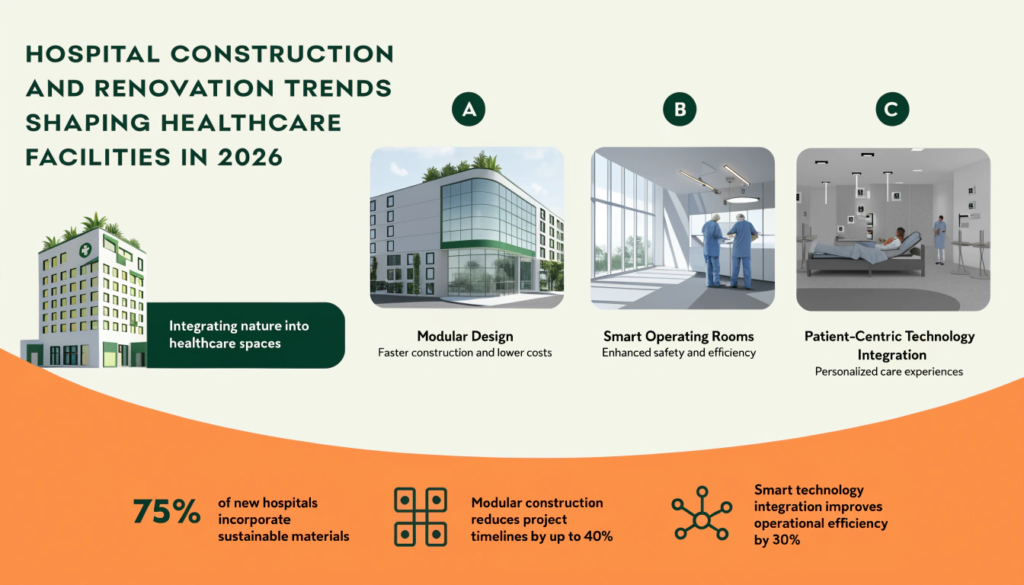
3. Modular and Prefabricated Construction Will Gain Momentum
Construction speed is becoming increasingly important in healthcare.
Hospitals need to expand capacity while dealing with labor shortages, rising costs, operational constraints, and complicated construction schedules. These pressures are encouraging greater interest in modular and prefabricated construction.
Instead of completing every element on-site, components can be manufactured or assembled in controlled environments and then transported to the project location. Modular approaches can potentially reduce on-site work, improve consistency, and shorten project timelines. (KI)
For healthcare projects, modular construction can be particularly useful for standardized spaces and repeatable components.
The approach can also support phased expansion. A healthcare organization may be able to add capacity more quickly without undertaking a completely traditional construction process.
However, modular construction is not automatically the right solution for every hospital. Transportation, site conditions, structural requirements, clinical specifications, regulations, and initial planning costs must all be considered.
The key trend for 2026 is therefore not simply “build everything modular.” Instead, healthcare organizations are likely to evaluate where modular methods can deliver the greatest combination of speed, quality, flexibility, and cost control.
4. Smart Building Technology Will Become Part of the Core Infrastructure
Technology is moving deeper into hospital infrastructure.
Smart building systems can connect HVAC, lighting, energy management, security, equipment monitoring, occupancy data, and other building functions. This allows facility teams to understand how buildings are performing and respond more quickly to operational issues.
AI is also becoming increasingly relevant to healthcare facility planning. Industry discussions around 2026 healthcare design identify AI as both a significant opportunity and an area that could influence space utilization, infrastructure planning, and operational decision-making. (HCD Magazine)
Modern hospitals may therefore need stronger digital foundations than older facilities.
This means construction and renovation projects must consider network infrastructure, sensors, building automation systems, cybersecurity, data integration, and equipment connectivity from the planning stage.
Smart technology should not be treated as an optional layer added after construction. Increasingly, it needs to be incorporated into the building’s core infrastructure.
5. Energy Efficiency and Electrification Will Influence Hospital Infrastructure
Hospitals operate around the clock and typically require substantial energy for HVAC, lighting, medical equipment, sterilization, refrigeration, data systems, and other critical services.
As energy costs and sustainability expectations increase, hospitals are paying greater attention to energy performance.
The 2026 Hospital Construction Survey found increased interest in central energy plants and noted that electrification is contributing to demand for new infrastructure. (HFM Magazine)
Energy-focused construction can include high-efficiency HVAC systems, improved building envelopes, efficient lighting, smart controls, heat recovery, renewable energy integration, energy monitoring, and more efficient central utility systems.
For existing hospitals, this creates a significant opportunity for healthcare building renovation.
An aging facility may not need a complete rebuild to improve energy performance. Strategic upgrades to mechanical systems, controls, lighting, insulation, windows, and electrical infrastructure can potentially improve efficiency while extending the building’s useful life.
Sustainability is also increasingly being considered across the entire building lifecycle rather than only at the point of construction. Research published in 2026 highlights the importance of integrating sustainability into healthcare facility redesign and infrastructure planning. (Springer)
6. Resilience Will Become a Design Requirement
Hospitals cannot afford extended interruptions.
Power failures, extreme weather, cyber incidents, infrastructure breakdowns, supply disruptions, and other emergencies can directly affect patient care. As a result, resilience is becoming a more important consideration in hospital construction.
Modern projects are increasingly evaluating backup power, redundant mechanical systems, emergency utilities, water resilience, communications infrastructure, physical security, and cybersecurity.
The 2026 Hospital Construction Survey reported growing attention to both physical security and cybersecurity, with these considerations increasingly entering planning and design discussions earlier in the project process. (HFM Magazine)
Resilience also means designing spaces that can respond to unexpected changes.
A hospital with adaptable rooms, flexible infrastructure, scalable utilities, and clear emergency pathways may be better positioned to respond to sudden increases in demand.
For healthcare executives, resilience should therefore be viewed as an investment in continuity rather than simply an additional construction cost.
7. Patient-Centered Design Will Shape Renovation Projects
Hospitals are increasingly recognizing that the physical environment influences the patient experience.
Traditional clinical environments often prioritized operational functionality above everything else. While functionality remains essential, modern facilities are also incorporating elements that can reduce stress and make healthcare environments easier to navigate.
Natural light, quieter spaces, improved wayfinding, comfortable waiting areas, accessible entrances, private patient rooms, outdoor views, family spaces, and better circulation can all contribute to a more patient-centered environment.
Renovation provides a particularly important opportunity here.
An existing hospital may not have the ability to completely change its structural layout, but targeted improvements can make significant differences in how patients and families experience the facility.
This is one reason healthcare building renovation will remain important throughout 2026 and beyond.
8. Outpatient and Ambulatory Facilities Will Continue to Grow
Healthcare delivery is becoming less dependent on traditional inpatient hospitals.
Many procedures and services can now be delivered through outpatient facilities, ambulatory surgery centers, specialty clinics, diagnostic centers, and freestanding emergency facilities.
Healthcare Design’s 2026 survey identified a continued shift toward outpatient facilities, targeted renovations, freestanding emergency departments, and behavioral health projects. (HCD Magazine)
This is influencing where healthcare organizations allocate capital.
Instead of putting every investment into large acute-care campuses, providers may increasingly develop smaller, specialized facilities closer to patients.
These projects can support accessibility while potentially reducing the complexity associated with large hospital campuses.
For construction and facility professionals, this means understanding how different care models influence space requirements, infrastructure, patient flow, staffing, and technology needs.
9. Better Infection Control and Indoor Environmental Quality
The lessons of the pandemic continue to influence healthcare design.
Ventilation, air quality, isolation capabilities, clean and dirty circulation, infection-control zoning, and HVAC performance remain important considerations for hospitals.
The 2026 Hospital Construction Survey highlighted the ongoing importance of maintaining and upgrading air-handling infrastructure, particularly in large healthcare facilities where numerous air handlers require continuous maintenance and modernization. (HFM Magazine)
New construction can incorporate these requirements from the beginning.
Renovation projects, however, can be more complicated because existing mechanical systems may have limited capacity or may not support modern requirements.
This makes infrastructure assessment an important part of renovation planning.
Rather than focusing only on visible improvements such as interiors and finishes, hospitals need to evaluate the systems behind the walls that support safe and efficient clinical operations.
10. Infrastructure Modernization Will Become a Bigger Capital Priority
A hospital’s most visible spaces may attract the most attention, but its hidden infrastructure is equally important.
Electrical distribution, plumbing, HVAC, medical gases, central plants, elevators, emergency power, fire protection, and technology networks all play critical roles in hospital operations.
The 2026 Hospital Construction Survey reported increased hospital infrastructure budgets and highlighted the need to address deferred maintenance and aging systems. (HFM Magazine)
This suggests that infrastructure modernization will increasingly compete for capital alongside new clinical spaces.
For hospital leaders, this creates an important planning question: should limited capital be used to build more space or improve the infrastructure supporting existing space?
The answer will vary by facility, but the broader trend is clear. Healthcare construction is moving beyond simply adding square footage.
11. Construction Planning Will Become More Data-Driven
Healthcare projects involve thousands of decisions.
In 2026, organizations will increasingly use data to evaluate those decisions. Energy data, patient-flow information, occupancy patterns, maintenance records, equipment requirements, operational costs, and lifecycle analysis can all influence project planning.
Instead of asking only how much a project will cost to construct, healthcare organizations are increasingly considering its long-term operational value.
This approach can help decision-makers compare renovation versus replacement, prioritize infrastructure upgrades, identify underused spaces, and determine where investments could produce the greatest operational benefits.
The result is a more strategic approach to capital planning.
What These Trends Mean for Healthcare Leaders
The biggest lesson from the hospital construction trends 2026 is that healthcare construction is becoming less about simply building bigger facilities and more about building smarter ones.
New hospitals need to be flexible, resilient, digitally connected, energy efficient, patient-centered, and prepared for future changes.
Existing hospitals face an equally important challenge: modernization.
For many healthcare organizations, the most practical strategy may be a combination of targeted renovation, infrastructure upgrades, technology integration, and selective expansion.
Healthcare Design’s latest industry survey reinforces this direction, with renovation continuing to represent a significant share of healthcare construction activity while organizations also pursue outpatient expansion and flexible facility strategies. (HCD Magazine)
This creates opportunities for architects, engineers, contractors, facility managers, technology providers, equipment manufacturers, and healthcare executives to rethink how capital projects are planned and delivered.
Preparing for the Next Generation of Healthcare Facilities
The hospital of the future will not be defined by architecture alone.
Its success will depend on how effectively its physical infrastructure connects with technology, clinical operations, sustainability objectives, patient needs, workforce requirements, and long-term financial planning.
For organizations preparing new construction or healthcare building renovation, 2026 is an opportunity to move away from short-term fixes and toward future-ready facility strategies.
The most successful projects will likely be those designed with flexibility from the beginning, allowing healthcare organizations to adapt as technologies, patient expectations, regulations, and models of care evolve.
Hospitals should therefore evaluate not only what their facilities need today, but also what they may need five, ten, or twenty years from now.
Conclusion
The healthcare construction sector is entering 2026 with a stronger focus on modernization, adaptability, technology, resilience, sustainability, and patient-centered design.
Renovation is becoming a major part of the industry’s workload, while new construction is evolving toward more flexible and digitally enabled facilities. Modular construction, smart building systems, energy-efficient infrastructure, resilient design, outpatient expansion, and better infection-control strategies are all shaping the next generation of healthcare environments.
For healthcare organizations, the challenge is to balance immediate operational needs with long-term facility performance.
Those that invest strategically in their buildings today can create healthcare environments that are not only more efficient and sustainable, but also better prepared for the rapidly changing demands of tomorrow.
Ready to explore the future of healthcare facilities and connect with industry experts? Enquire about BMA conventions and discover opportunities to engage with professionals shaping the next generation of smart healthcare infrastructure.