
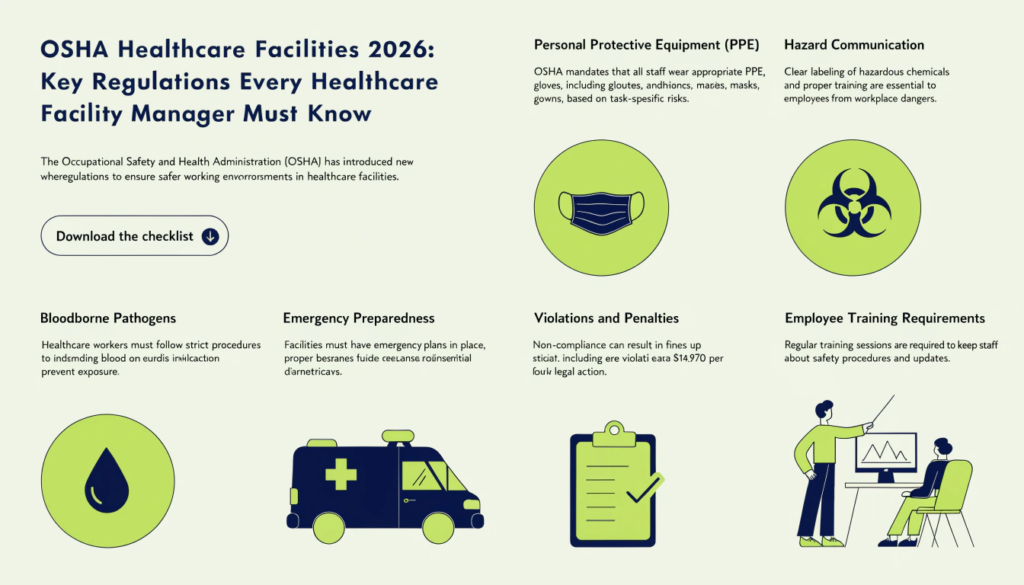
Healthcare facilities are among the most complex workplaces to manage. Hospitals, clinics, nursing homes, outpatient centers, and other healthcare environments bring together clinical operations, hazardous chemicals, infectious materials, medical equipment, electrical systems, emergency situations, and physically demanding tasks. For facility managers, maintaining a safe workplace is not simply a matter of good practice, it is an essential part of operational risk management.
In 2026, understanding OSHA healthcare facilities 2026 requirements is increasingly important as healthcare organizations continue to modernize infrastructure, introduce new technologies, and manage increasingly complex safety risks. OSHA requirements cover areas ranging from bloodborne pathogens and personal protective equipment to respiratory protection, hazard communication, electrical safety, emergency preparedness, and workplace violence.
Healthcare facility managers should also remember that OSHA compliance is only one part of overall hospital safety compliance. State regulations, local requirements, accreditation expectations, internal policies, and other applicable standards may also apply.
This guide explains the major OSHA requirements and safety priorities healthcare facility managers should understand in 2026.
Why OSHA Compliance Matters in Healthcare Facilities
Healthcare workers can face a wide range of occupational hazards during their daily activities. Clinical staff may encounter blood and other potentially infectious materials, while housekeeping teams can be exposed to contaminated surfaces and hazardous chemicals. Maintenance employees may face electrical, mechanical, chemical, and environmental hazards.
OSHA identifies healthcare as an industry with significant workplace safety challenges and provides dedicated resources for hospitals and healthcare employers. (OSHA)
For facility managers, OSHA compliance should therefore be approached as an ongoing process rather than a once-a-year checklist. Regular inspections, employee training, documentation, incident reviews, and corrective actions can help create a stronger safety culture while reducing workplace risks.
1. Bloodborne Pathogens Standard
One of the most important requirements for OSHA healthcare facilities 2026 is the Bloodborne Pathogens Standard.
The standard applies when employees have reasonably anticipated occupational exposure to blood or other potentially infectious materials (OPIM). Healthcare facilities must establish an appropriate Exposure Control Plan and use engineering and work-practice controls to eliminate or minimize employee exposure. (OSHA)
Facility managers should ensure that the plan is reviewed and updated at least annually and whenever changes in technology, procedures, or employee responsibilities affect exposure risks. OSHA also requires employers to consider and implement appropriate safer medical devices and involve non-managerial employees who have direct patient-care responsibilities in selecting effective engineering and work-practice controls. (OSHA)
Sharps safety is another major concern. Facilities should provide appropriate sharps containers, implement safe disposal procedures, and maintain a sharps injury log when required.
Employee training, hepatitis B vaccination availability, post-exposure evaluation and follow-up, appropriate PPE, housekeeping procedures, and recordkeeping are also key elements of the standard. OSHA’s recent healthcare publications continue to emphasize bloodborne-pathogen protections, making this an important area for managers to review in 2026. (OSHA)
2. Personal Protective Equipment Requirements
Personal protective equipment is an important component of hospital safety compliance, particularly in areas where employees may be exposed to infectious materials, chemicals, radiation-related hazards, or other workplace risks.
OSHA’s healthcare standards include general PPE requirements under 29 CFR 1910 Subpart I. (OSHA)
Facility managers should conduct hazard assessments to determine where PPE is necessary and ensure workers receive appropriate equipment and understand how to use it correctly. Depending on the task, PPE can include gloves, gowns, face shields, eye protection, masks, protective footwear, and other equipment.
PPE should not be treated as a substitute for eliminating hazards. Healthcare facilities should follow the hierarchy of controls, prioritizing engineering and administrative measures where feasible before relying solely on PPE.
Managers should also monitor PPE availability, storage, maintenance, replacement, and employee training. A PPE program is effective only when the right equipment is available and workers know when and how to use it.
3. Respiratory Protection Standard
Respiratory hazards can arise in healthcare environments during infectious disease response, certain laboratory activities, hazardous material handling, and other specialized operations.
OSHA’s Respiratory Protection Standard, 29 CFR 1910.134, establishes requirements for workplaces where respirators are necessary to protect employees. The standard includes requirements related to respiratory protection programs, respirator selection, medical evaluation, fit testing, training, and proper use. (OSHA)
Healthcare facility managers should determine whether employees are exposed to respiratory hazards that require respiratory protection. If respirators are required, the facility needs a properly implemented respiratory protection program rather than simply distributing masks.
Fit testing and employee training are particularly important because an improperly fitted respirator may fail to provide the expected level of protection.
4. Hazard Communication Standard
Hospitals use hundreds of chemicals, including disinfectants, sterilizing agents, cleaning products, laboratory chemicals, and certain hazardous pharmaceuticals. The Hazard Communication Standard, 29 CFR 1910.1200, is therefore a major part of OSHA healthcare facilities 2026 compliance.
OSHA’s Hazard Communication Standard requires employers with hazardous chemicals in the workplace to provide appropriate labels and Safety Data Sheets and train exposed workers on chemical hazards and protective measures. (OSHA)
Healthcare facility managers should ensure that chemical inventories are accurate and that Safety Data Sheets are readily accessible to employees. Containers should be appropriately labeled, and employees should understand the hazards associated with the chemicals they handle.
Pharmacy departments may also deal with hazardous pharmaceuticals. OSHA notes that the Hazard Communication Standard applies to hazardous pharmaceuticals when the manufacturer’s classification and workplace exposure conditions meet the requirements of the standard. (OSHA)
Strong chemical management can reduce accidental exposure while supporting broader hospital safety goals.
5. Electrical Safety
Healthcare facilities depend heavily on electrical systems. Medical equipment, patient monitoring systems, lighting, HVAC systems, emergency power infrastructure, and other critical operations all require reliable electrical systems.
OSHA’s electrical requirements under 29 CFR 1910 Subpart S address hazards such as damaged equipment, improper grounding, and unsafe electrical connections.
OSHA’s hospital guidance highlights the importance of properly grounding equipment near water sources, removing damaged portable electrical equipment from service, and ensuring electrical equipment is free from recognized hazards. (OSHA)
Facility managers should incorporate electrical inspections into preventive maintenance programs. Damaged cords, plugs, receptacles, and other equipment should be identified and removed from service until properly repaired.
Electrical safety becomes particularly important during facility renovations and equipment upgrades. Managers should coordinate closely with qualified personnel and contractors to ensure that modifications do not introduce new hazards.
6. Emergency Action Plans and Evacuation Preparedness
A healthcare facility cannot approach emergency planning like an ordinary office. Hospitals may need to protect patients who cannot walk, operate critical systems during emergencies, coordinate staff across multiple departments, and maintain essential services during disruptions.
OSHA’s Emergency Action Plan requirements under 29 CFR 1910.38 include procedures for reporting emergencies and evacuating employees, among other requirements. (OSHA)
OSHA’s healthcare compliance resources also recommend emergency action planning for healthcare employers. (OSHA)
Facility managers should regularly review emergency procedures, exit routes, emergency communication systems, employee responsibilities, and procedures for accounting for personnel.
Drills can also reveal practical weaknesses that may not appear on paper. After every drill or actual incident, managers should document lessons learned and update procedures where necessary.
7. Workplace Violence Prevention
Workplace violence is a major safety concern in healthcare. Emergency departments, psychiatric settings, patient-care areas, and facilities serving individuals experiencing behavioral or substance-related crises can face increased risks.
OSHA does not currently have a specific federal workplace violence standard. However, employers may have obligations under the General Duty Clause when recognized hazards are present and feasible measures exist to address them. (OSHA)
OSHA recommends comprehensive workplace violence prevention programs for healthcare settings. Such programs can include hazard assessments, reporting procedures, security measures, employee training, incident investigation, and administrative and engineering controls. (OSHA)
For facility managers, this means workplace violence should be incorporated into the broader safety management system rather than treated as a security department issue alone.
8. Safe Patient Handling and Ergonomics
Healthcare employees frequently perform physically demanding activities such as transferring, lifting, and repositioning patients. These tasks can contribute to musculoskeletal disorders and other injuries.
OSHA’s safe patient handling resources emphasize the value of mechanical lifting and transfer equipment, hazard assessments, employee participation, training, and program evaluation. (OSHA)
Facility managers should evaluate high-risk patient-handling areas and determine whether appropriate equipment is available. Ceiling lifts, mechanical transfer devices, adjustable beds, and other technologies can help reduce the physical burden on employees.
Training should focus not only on the equipment itself but also on assessing patient-handling risks and choosing the appropriate method for each situation.
Safe patient handling can support both worker safety and patient care, making it an important part of an effective hospital safety compliance strategy.
9. General Duty Clause and Recognized Hazards
Healthcare facility managers should not assume that compliance means simply checking off individual OSHA standards.
The General Duty Clause requires employers to provide employees with a workplace free from recognized hazards that are causing or are likely to cause death or serious physical harm. (OSHA)
This is especially important for hazards that may not be covered by a specific OSHA standard. Managers should conduct comprehensive workplace hazard assessments and identify risks across clinical, maintenance, administrative, and support operations.
OSHA’s hospital eTool highlights a broad range of potential hazards, including slips and falls, workplace violence, infectious diseases, equipment hazards, musculoskeletal risks, and other workplace conditions. (OSHA)
A proactive hazard-identification process can therefore help facilities address risks before they result in injuries or regulatory problems.
Building a Stronger OSHA Compliance Program in 2026
Understanding the regulations is only the first step. The bigger challenge is integrating safety requirements into daily facility operations.
Healthcare facility managers should maintain a centralized compliance system that tracks inspections, training, corrective actions, equipment maintenance, incident reports, exposure events, and policy reviews. Digital facility management systems can help organizations monitor these activities and create a clearer record of compliance activities.
Employee participation is equally important. Staff members who work directly with patients, chemicals, equipment, and hazardous materials often have firsthand knowledge of safety problems. Encouraging employees to report hazards without fear of retaliation can help managers identify issues earlier.
Regular training should also be treated as an operational priority. New employees should receive appropriate safety training during onboarding, while existing employees should receive refresher training when required or when workplace conditions change.
Finally, facility managers should monitor regulatory developments and state-specific requirements. OSHA-approved State Plans may have requirements that differ from federal OSHA standards or may be more stringent. (OSHA)
Conclusion
For healthcare facility managers, OSHA healthcare facilities 2026 compliance requires more than understanding individual regulations. It involves creating an integrated safety culture that protects employees, supports patient care, and strengthens operational resilience.
Bloodborne pathogen controls, PPE, respiratory protection, hazard communication, electrical safety, emergency planning, workplace violence prevention, safe patient handling, and the General Duty Clause all deserve attention as part of a comprehensive safety strategy.
The most effective approach is proactive. Regular risk assessments, employee training, preventive maintenance, incident reviews, documentation, and continuous improvement can help healthcare organizations stay prepared for changing workplace risks.
As healthcare facilities continue adopting smarter technologies and more connected infrastructure, facility managers will increasingly need to combine regulatory awareness with modern facility management strategies. A strong approach to hospital safety compliance can help create safer workplaces while supporting efficiency, reliability, and better patient outcomes.
Interested in learning more about smart healthcare facilities and emerging facility management strategies? Enquire about BMA conventions and explore opportunities to connect with industry professionals and experts.