
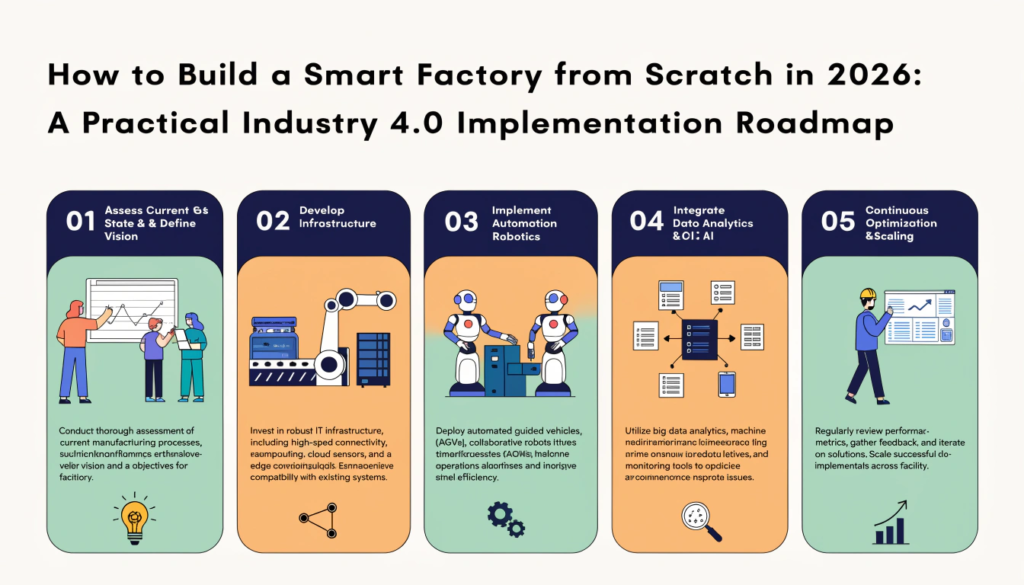
Introduction
Manufacturing is entering a new phase where automation, connected equipment, artificial intelligence, real-time analytics, and intelligent decision-making are becoming essential to operational competitiveness. For manufacturers starting from a traditional production environment, the transition to a smart factory can seem complex. The challenge is not simply installing new technology; it is creating a connected, data-driven manufacturing ecosystem that improves productivity, quality, safety, flexibility, and cost efficiency.
This smart factory implementation guide explains how manufacturers can build a smart factory from scratch in 2026. Whether you are modernizing an existing production facility or designing a new plant, having a structured Industry 4.0 roadmap can help you prioritize investments, avoid unnecessary complexity, and establish a scalable digital foundation.
A successful smart factory does not need to be built overnight. The most effective approach is to begin with business objectives, identify operational gaps, establish connectivity, and gradually introduce advanced technologies based on measurable needs.
What Is a Smart Factory?
A smart factory is a digitally connected manufacturing environment where machines, production systems, workers, software platforms, and business processes work together using real-time data.
Unlike conventional factories that often depend on manual monitoring and disconnected systems, smart factories use technologies such as the Industrial Internet of Things (IIoT), artificial intelligence, machine learning, robotics, cloud computing, edge computing, digital twins, advanced analytics, and automation.
The objective is not technology for its own sake. The goal is to create a manufacturing operation capable of identifying problems earlier, making faster decisions, reducing waste, improving equipment performance, and adapting to changing production requirements.
For example, sensors installed on production equipment can continuously collect information about temperature, vibration, energy consumption, pressure, or operating speed. Analytics platforms can then analyze that information and identify unusual patterns before equipment failure occurs.
This transforms maintenance from a reactive activity into a proactive process.
Why Manufacturers Need a Smart Factory Implementation Guide in 2026
The manufacturing environment in 2026 is increasingly influenced by cost pressures, supply chain uncertainty, labor challenges, sustainability requirements, cybersecurity risks, and customer expectations for faster and more customized production.
Smart manufacturing technologies can help address these challenges, but implementation without proper planning can create expensive technology silos.
A smart factory implementation guide provides a structured approach for connecting technology investments with measurable business outcomes.
Instead of asking, “Which Industry 4.0 technology should we buy?” manufacturers should begin with questions such as:
What production problems are costing us the most?
Where are we losing time or materials?
Which processes require too much manual intervention?
Where are quality problems occurring?
Which equipment failures have the greatest financial impact?
What data do we already have, and where are the gaps?
These questions establish the foundation for an effective Industry 4.0 roadmap.
Step 1: Define Your Smart Factory Vision
Before investing in sensors, robots, AI platforms, or cloud systems, establish a clear vision for what your smart factory should achieve.
Your objectives might include reducing unplanned downtime, increasing overall equipment effectiveness (OEE), improving product quality, reducing energy consumption, shortening production cycles, improving worker safety, or increasing production flexibility.
For example, a manufacturer experiencing frequent machine breakdowns may prioritize predictive maintenance. Another company struggling with inconsistent quality may focus on automated inspection and real-time process monitoring.
The vision should be connected to measurable key performance indicators (KPIs).
Rather than setting a broad objective such as “digitize the factory,” establish measurable targets such as reducing unplanned downtime by a specific percentage, improving production yield, reducing scrap, or decreasing energy consumption per unit.
This creates a business case for the transformation and makes it easier to measure progress.
Step 2: Assess Your Current Manufacturing Environment
The next stage of your Industry 4.0 roadmap should be a detailed assessment of your current operations.
Evaluate production equipment, automation systems, enterprise software, communication networks, data sources, workforce capabilities, cybersecurity controls, and existing digital processes.
Many factories have a mixture of modern and legacy equipment. Some machines may already have digital interfaces, while older equipment may require additional sensors or gateways to connect them to modern systems.
You should also examine existing systems such as Enterprise Resource Planning (ERP), Manufacturing Execution Systems (MES), Supervisory Control and Data Acquisition (SCADA), Computerized Maintenance Management Systems (CMMS), and warehouse management platforms.
The assessment should identify where information is currently trapped in isolated systems.
For example, production data may exist in one platform while maintenance information is stored separately. Quality teams may rely on spreadsheets, while management receives production reports hours or days after the events occur.
The goal is to understand the current state before designing the future state.
Step 3: Build the Digital Infrastructure
A smart factory depends on reliable connectivity and data infrastructure.
This is one of the most important stages of a smart factory implementation guide because advanced technologies cannot perform effectively when the underlying infrastructure is unreliable.
Factories need appropriate industrial networking, secure communication protocols, data storage, computing capabilities, and connectivity between machines and business systems.
Depending on the facility, manufacturers may use industrial Ethernet, wireless networks, edge computing, cloud platforms, or hybrid architectures.
Edge computing can be particularly useful where machines need rapid data processing close to the production environment. Cloud platforms, meanwhile, can support broader analytics, centralized data management, and enterprise-level visibility.
The infrastructure should also be designed for scalability. A network that supports ten connected machines today should not become a limitation when the factory expands to hundreds of connected assets.
Step 4: Connect Machines and Collect Data
Once the infrastructure is ready, begin connecting critical production assets.
This does not mean connecting every machine simultaneously. A more practical approach is to prioritize equipment based on business impact.
For instance, identify machines responsible for significant production volumes or those that frequently experience breakdowns.
Sensors can collect information such as temperature, vibration, pressure, energy consumption, speed, cycle time, and operating conditions.
However, collecting data is only the beginning.
Manufacturers should determine what information is actually useful and how it will be transformed into actionable insights.
A smart factory should not become a “data factory” that collects enormous volumes of information without generating meaningful business value.
Step 5: Integrate ERP, MES, SCADA, and Other Systems
One of the major differences between a digitally connected factory and a collection of isolated technologies is integration.
ERP systems typically provide business-level information such as orders, inventory, procurement, and financial data. MES platforms focus more closely on production execution, while SCADA systems can provide equipment and process visibility.
Connecting these systems allows information to flow across different levels of the organization.
For example, customer demand captured in an ERP system can influence production planning. Production information can then be transferred through MES, while machine-level data provides visibility into actual production performance.
This integration can help manufacturers move toward a unified operational view instead of relying on disconnected reports.
Step 6: Start With a High-Value Pilot Project
A common mistake is trying to transform an entire factory at once.
Instead, choose one production line, process, or equipment category for a pilot project.
The pilot should address a clearly defined business problem.
Predictive maintenance is often a suitable starting point because manufacturers can install sensors on critical assets and use analytics to identify patterns associated with potential failures.
Another possible pilot is automated quality inspection using machine vision.
The purpose of the pilot is to demonstrate measurable value while allowing the organization to identify technical and operational challenges before scaling.
If the pilot delivers positive results, the solution can gradually be expanded to additional production lines.
Step 7: Introduce AI and Advanced Analytics
Once reliable data is available, manufacturers can begin using advanced analytics and artificial intelligence.
AI can support predictive maintenance, quality management, production forecasting, demand planning, anomaly detection, energy optimization, and process improvement.
However, AI should not be the first step in your transformation.
Artificial intelligence requires reliable and appropriately structured data. If a factory has inconsistent data collection or disconnected systems, implementing sophisticated AI models may produce limited results.
The Industry 4.0 roadmap should therefore progress from connectivity and data visibility toward analytics and intelligence.
Start with descriptive analytics to understand what happened. Move toward diagnostic analytics to understand why it happened. Then introduce predictive analytics to determine what may happen next and prescriptive analytics to identify potential actions.
Step 8: Automate Repetitive and High-Risk Processes
Automation is another important element of smart manufacturing.
Robotic systems, collaborative robots, automated guided vehicles, autonomous mobile robots, and automated material-handling systems can reduce repetitive manual work and improve production consistency.
However, automation should be introduced strategically.
Not every manual process needs to be automated. Manufacturers should evaluate whether automation will deliver sufficient improvements in productivity, safety, quality, or cost.
High-volume, repetitive, hazardous, or ergonomically challenging activities are often strong candidates for automation.
Human workers remain essential to smart factories. The objective is to combine human expertise with automation and digital tools rather than simply replacing people with machines.
Step 9: Implement Digital Twins Where They Add Value
Digital twins can provide manufacturers with a virtual representation of physical assets, production lines, or entire facilities.
By combining real-world operational data with digital models, manufacturers can simulate changes and evaluate potential outcomes before modifying physical processes.
For example, a digital twin can help evaluate production-line changes, equipment performance, energy usage, or production capacity.
However, digital twins should be introduced where there is a clear business case. They require reliable data, integration, modeling capabilities, and appropriate technical expertise.
For manufacturers with a mature digital foundation, digital twins can become an important component of an advanced smart factory implementation guide.
Step 10: Make Cybersecurity a Core Requirement
As factories become increasingly connected, cybersecurity becomes more important.
Connected machines and industrial networks can create new attack surfaces. A cybersecurity strategy should therefore be incorporated into the smart factory design from the beginning rather than added later.
Manufacturers should consider network segmentation, identity and access management, device security, software updates, monitoring, backup procedures, incident response, and employee awareness.
Operational technology (OT) environments also have unique requirements because production systems often need to remain operational continuously.
Cybersecurity teams and operational teams should work together to establish appropriate security controls without disrupting manufacturing processes.
Step 11: Develop the Workforce Alongside Technology
Technology alone cannot create a smart factory.
Employees need the knowledge and skills required to operate, maintain, monitor, and improve new systems.
Maintenance professionals may need training in connected equipment and data interpretation. Production managers may need to understand real-time dashboards and analytics. IT and OT teams may need stronger collaboration skills.
Manufacturers should therefore develop a workforce strategy alongside the Industry 4.0 roadmap.
Training should not be limited to technical skills. Employees should also understand why the transformation is happening and how new technologies will affect their roles.
Involving employees early can reduce resistance and encourage adoption.
Step 12: Establish a Scalable Smart Factory Roadmap
After completing the pilot, manufacturers can develop a long-term roadmap for scaling the transformation.
The roadmap should define what happens over the next 12, 24, and 36 months.
Early stages may focus on connectivity and visibility. The next phase could introduce analytics, automation, and predictive capabilities. More advanced stages may involve AI-driven optimization, digital twins, autonomous operations, and integrated supply chain intelligence.
The timeline will differ based on the size, maturity, budget, and objectives of each manufacturer.
The key is to avoid treating smart manufacturing as a one-time technology project.
It should be considered an ongoing transformation that evolves as technologies, customer expectations, and operational requirements change.
Measuring the Success of Your Smart Factory
A successful smart factory implementation guide should always include performance measurement.
Manufacturers can monitor KPIs such as OEE, downtime, production cycle time, scrap rate, first-pass yield, energy consumption, maintenance costs, inventory turnover, and labor productivity.
Financial indicators are equally important.
Track the return on investment from automation projects, predictive maintenance initiatives, energy optimization programs, and other technology investments.
Regular measurement allows manufacturers to determine which initiatives are delivering value and which require adjustment.
Common Mistakes to Avoid
Smart factory transformation can fail when manufacturers focus more on technology than business outcomes.
One common mistake is investing in expensive technologies before identifying the actual operational problem.
Another is attempting to digitize everything simultaneously. This can create integration challenges, overwhelm employees, and make it difficult to identify which initiatives are generating value.
Poor data quality is another major challenge. AI and analytics cannot compensate for unreliable or incomplete data.
Manufacturers should also avoid ignoring cybersecurity and workforce development.
Finally, companies should not treat smart manufacturing as a project owned exclusively by the IT department. Successful transformation requires collaboration between operations, engineering, maintenance, IT, OT, management, cybersecurity, and employees working directly on the factory floor.
The Future of Smart Manufacturing in 2026 and Beyond
The smart factory is moving beyond basic automation toward intelligent, adaptive, and increasingly autonomous production environments.
AI-powered decision-making, industrial robotics, machine vision, edge computing, digital twins, connected worker technologies, and advanced analytics are creating opportunities for manufacturers to optimize operations in real time.
Sustainability is also becoming increasingly connected with digital manufacturing.
Real-time energy monitoring can help identify inefficient equipment and processes. Advanced analytics can optimize resource consumption, while connected systems can help manufacturers track environmental performance.
The factories that benefit most from these developments will not necessarily be those that adopt the greatest number of technologies.
Instead, successful manufacturers will be those that build a strong digital foundation and apply the right technologies to the right operational challenges.
Conclusion
Building a smart factory from scratch in 2026 requires much more than purchasing connected machines or installing automation systems. It requires a structured transformation strategy that connects business objectives, people, processes, data, technology, and cybersecurity.
The best smart factory implementation guide begins with a clear vision and current-state assessment. From there, manufacturers can build digital infrastructure, connect critical equipment, integrate systems, launch focused pilot projects, introduce analytics and AI, automate high-value processes, develop employee capabilities, and gradually scale successful solutions.
A well-designed Industry 4.0 roadmap allows manufacturers to modernize at a manageable pace while keeping investment aligned with measurable business outcomes.
The future of manufacturing belongs to organizations that can turn operational data into intelligent decisions. By starting with the right foundation today, manufacturers can create factories that are more productive, resilient, flexible, sustainable, and competitive for years to come.
Ready to explore the latest smart manufacturing strategies, technologies, and industry insights?
Download convention agenda to discover what’s next in smart manufacturing and automation.