
Healthcare organizations are under growing pressure to improve operational efficiency without compromising patient care. While clinical services naturally receive much of the attention, hospital infrastructure and facility operations represent another major opportunity for cost optimization. Maintenance, energy use, equipment failures, labor, inventory, and emergency repairs can quietly consume millions of dollars every year.
For health systems operating multiple hospitals and outpatient facilities, the challenge becomes even more complex. Facility managers must maintain critical infrastructure, respond to work orders, comply with regulations, manage vendors, and keep essential systems operational around the clock.
This is where data-driven facility management is becoming increasingly important.
By combining a Computerized Maintenance Management System (CMMS) with healthcare facility data analytics, organizations can gain a clearer view of their assets, maintenance costs, equipment performance, and operational inefficiencies. Instead of relying primarily on reactive maintenance, facility leaders can use real-time and historical data to identify problems, prioritize investments, and reduce unnecessary expenditure.
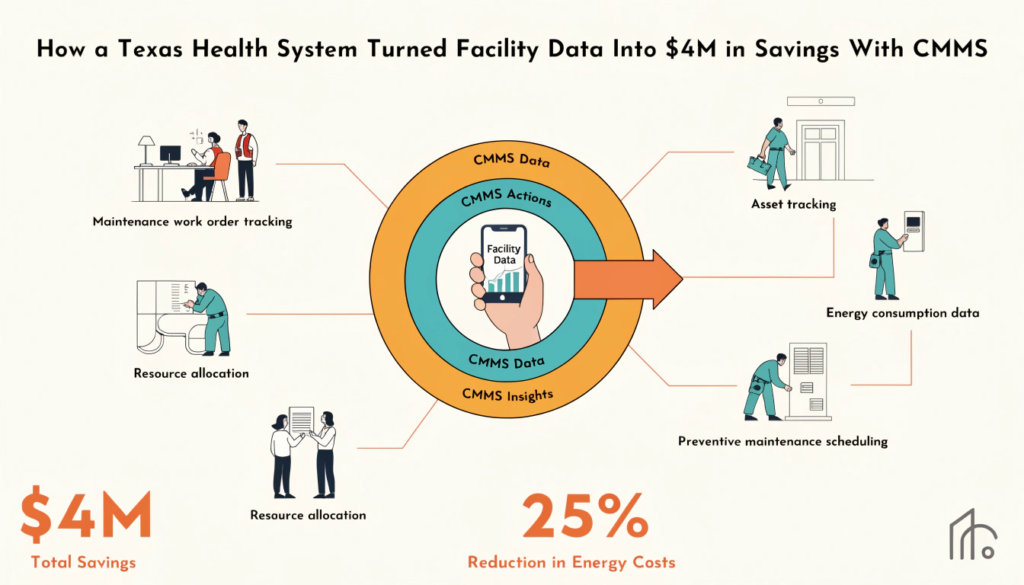
A Texas health system provides a useful example of how this approach can potentially unlock millions in savings. Through a combination of CMMS-based maintenance management, better asset visibility, preventive maintenance, inventory optimization, and data-driven decision-making, the organization identified opportunities that contributed to approximately $4 million in savings.
The real lesson is not simply the $4 million figure. It is how data helped transform facility management from a reactive cost center into a strategic source of operational value.
Why Hospital Facility Management Needs a Data-Driven Approach
Hospitals are among the most infrastructure-intensive facilities in the built environment. They rely on HVAC systems, chillers, boilers, generators, pumps, electrical infrastructure, elevators, plumbing, fire safety systems, building automation, and numerous other assets.
A failure in one of these systems can have consequences far beyond the maintenance department.
For example, an HVAC problem can affect temperature-sensitive areas and patient comfort. A generator failure can create serious operational risks. A malfunctioning pump can disrupt building services. Even a seemingly minor equipment issue can require emergency labor, expedited parts, contractor support, and unplanned downtime.
Traditional maintenance processes often make it difficult to identify these patterns.
Work orders may be stored across spreadsheets, emails, paper records, or disconnected software systems. Facility managers may know which assets cause problems but lack the data necessary to quantify their impact.
A CMMS changes this equation by creating a centralized environment for managing maintenance and asset information.
Instead of simply recording that an asset was repaired, the organization can track how frequently it fails, how much the repairs cost, how long technicians spend working on it, which parts are required, and whether the same problem keeps recurring.
That information becomes extremely valuable when organizations begin applying healthcare facility data analytics.
The Role of CMMS in Hospital Cost Reduction
A CMMS is more than a digital work-order management tool. When implemented effectively, it becomes a source of operational intelligence.
A healthcare organization can use CMMS to maintain asset registers, schedule preventive maintenance, assign work orders, monitor response times, track spare parts, document inspections, and analyze maintenance costs.
This makes it easier to distinguish between routine maintenance and recurring operational problems.
For example, if a particular type of air-handling unit generates dozens of work orders every year, facility leaders can investigate the reason behind the repeated failures. The problem might be related to equipment age, operating conditions, maintenance intervals, component quality, or the need for replacement.
Without centralized data, each repair might be treated as an individual incident.
With CMMS, the organization can see the bigger picture.
This is one of the fundamental ways CMMS hospital cost savings Texas strategies can generate measurable results: they help facility managers identify the root causes behind recurring expenses instead of simply addressing individual failures.
Moving From Reactive to Preventive Maintenance
Reactive maintenance is often one of the most expensive approaches to facility management.
When equipment fails unexpectedly, technicians may have to respond immediately. Replacement parts might need to be purchased at short notice. Contractors may charge emergency rates. Planned maintenance work may be delayed while teams address urgent problems.
In a healthcare environment, the consequences can be even more significant because equipment downtime can affect clinical operations.
A CMMS enables facility teams to schedule preventive maintenance based on manufacturer recommendations, asset criticality, operating hours, historical performance, and organizational requirements.
Instead of waiting for an asset to fail, teams can inspect and service it before problems become major failures.
The objective is not to perform unnecessary maintenance on every piece of equipment. Excessive maintenance can also waste resources. The goal is to establish an optimized maintenance strategy based on asset risk and actual performance data.
Over time, this approach can reduce emergency work orders, improve asset reliability, and extend equipment life.
Finding the Assets That Drain the Most Money
One of the most useful applications of healthcare facility data analytics is identifying high-cost assets.
Not every asset creates the same financial impact. A low-value piece of equipment that rarely fails may require little attention. A critical system that repeatedly fails can become a significant financial burden.
By analyzing CMMS records, facility leaders can identify assets with:
- High repair frequency
- High maintenance costs
- Repeated emergency work orders
- Significant downtime
- High parts consumption
- Poor reliability
Once these assets are identified, leaders can decide whether to repair, upgrade, replace, or change the maintenance strategy.
This approach can also improve capital planning.
Instead of replacing equipment based solely on age, healthcare organizations can consider total lifecycle costs. If an aging chiller requires frequent repairs and consumes excessive energy, replacing it may make greater financial sense than continuing to repair it.
CMMS data provides evidence to support that decision.
How Inventory Optimization Contributes to Savings
Maintenance inventory is another area where healthcare organizations can lose money without immediately noticing it.
Hospitals need spare parts available for critical systems, but excessive inventory ties up capital and requires storage space. At the same time, insufficient stock can delay repairs and force teams to purchase components urgently.
A CMMS can help facility teams track parts usage and identify which components are frequently consumed.
Historical data can reveal patterns such as which parts are used most often, which assets require particular components, and which items remain unused for extended periods.
This information can help facility managers establish more appropriate inventory levels.
Instead of maintaining excessive stock across multiple locations, organizations can make purchasing decisions based on actual usage and asset criticality.
The result can be lower inventory costs, fewer emergency purchases, and faster maintenance response.
Improving Maintenance Team Productivity
Labor is another significant component of hospital facility costs.
Technicians need to spend their time maintaining equipment and resolving problems, not searching through paperwork or trying to determine the maintenance history of an asset.
A centralized CMMS can simplify the entire work-order process.
Facility managers can assign jobs, prioritize requests, track progress, and monitor completion. Technicians can access relevant asset information and document completed work.
This improves visibility for both technicians and managers.
It also creates measurable performance indicators. Organizations can track preventive maintenance compliance, response time, work-order backlog, average completion time, repeat repairs, and other operational metrics.
These metrics help managers identify bottlenecks and allocate resources more effectively.
For a large health system, even modest productivity improvements across multiple facilities can translate into significant financial benefits.
Connecting CMMS With Healthcare Facility Data Analytics
CMMS becomes even more powerful when maintenance data is connected with other facility information.
Healthcare facility data analytics can bring together information from building management systems, energy monitoring platforms, IoT sensors, equipment databases, occupancy data, and maintenance records.
This creates a more comprehensive view of facility performance.
Consider an HVAC system that has increasing maintenance requirements while also showing higher energy consumption. Looking at maintenance data alone may reveal repeated repairs. Looking at energy data alone may show increased consumption.
Combining both datasets can reveal a deeper problem.
The organization may discover that an aging component is not only generating repair costs but also reducing energy efficiency.
This type of insight allows facility leaders to prioritize improvements based on total operational impact.
Data therefore becomes a bridge between maintenance, energy management, sustainability, and capital planning.
Understanding the $4 Million Savings Opportunity
The $4 million savings example illustrates how multiple small improvements can collectively create substantial financial value.
The savings do not necessarily come from one dramatic cost-cutting decision. Instead, they can result from a combination of reduced emergency repairs, better preventive maintenance, improved technician productivity, optimized inventory, improved asset lifecycle planning, and better purchasing decisions.
This is an important distinction for healthcare executives.
A facility management transformation does not have to mean reducing essential maintenance activities or cutting staffing indiscriminately. Instead, it can mean eliminating waste and directing resources toward the areas that have the greatest impact.
For example, preventing a major equipment failure can avoid emergency repair costs. Extending the useful life of an asset can delay a major capital purchase. Optimizing inventory can release unnecessary working capital. Improving technician productivity can allow teams to complete more preventive work within existing resources.
When these improvements are measured consistently across a large health system, the financial impact can become substantial.
Creating a Business Case for CMMS Investment
Healthcare executives often want to understand one key question before investing in facility technology: what is the return on investment?
A strong CMMS business case should go beyond software features.
Facility leaders should establish a baseline for current maintenance performance and costs. This could include emergency work orders, preventive maintenance compliance, repair spending, inventory value, contractor costs, asset downtime, and labor utilization.
Once a baseline is established, the organization can set measurable improvement targets.
For example, a health system may aim to reduce emergency work orders, improve preventive maintenance completion rates, decrease repeat failures, lower inventory carrying costs, and improve technician response times.
The financial value of these improvements can then be measured over time.
This approach turns CMMS from an IT project into a strategic facility management investment.
The Importance of Data Quality
Technology alone does not create a data-driven facility management strategy.
The quality of the information inside the system is equally important.
If asset records are incomplete, maintenance activities are not documented properly, or technicians use inconsistent work-order categories, analytics can produce misleading results.
Healthcare organizations should establish clear standards for asset naming, equipment classifications, maintenance categories, work-order priorities, and cost tracking.
Technicians and facility managers should also understand why accurate data matters.
When employees see CMMS as a tool for improving their work rather than simply another reporting requirement, adoption becomes much stronger.
Over time, reliable data creates a valuable institutional knowledge base that can support maintenance planning, budgeting, procurement, and capital investment decisions.
What Texas Health Systems Can Learn From This Approach
The Texas example demonstrates a broader opportunity for healthcare organizations across the United States.
Facility management teams already generate enormous quantities of operational information. The challenge is turning that information into decisions.
CMMS provides the structure needed to collect and organize maintenance information, while healthcare facility data analytics provides the ability to interpret that information and identify patterns.
Together, they can help answer some of the most important questions facing facility leaders:
Which assets are costing the organization the most?
Where are emergency maintenance costs increasing?
Which equipment should be replaced?
Where can preventive maintenance be optimized?
Which spare parts should be stocked?
How can technicians become more productive?
Where are facility systems consuming excessive energy?
The answers can support a more proactive approach to hospital operations.
The Future of Data-Driven Healthcare Facilities
The next stage of healthcare facility management will likely involve even greater integration between CMMS, IoT sensors, building automation systems, energy platforms, and analytics.
Connected sensors can provide information about temperature, vibration, pressure, energy consumption, equipment runtime, and other operating conditions. When this information is integrated with maintenance records, facility teams can identify early warning signs and potentially address problems before they result in failure.
This moves facility management toward predictive and condition-based maintenance.
For healthcare organizations, the benefits extend beyond cost savings. More reliable infrastructure can support patient safety, staff productivity, energy efficiency, regulatory compliance, and overall operational resilience.
The $4 million savings opportunity therefore represents more than a financial achievement. It demonstrates what can happen when healthcare organizations stop treating facility data as a by-product and start treating it as a strategic asset.
Conclusion: Turning Facility Data Into Financial Value
Hospitals cannot afford to manage complex infrastructure entirely through reactive processes.
The combination of CMMS and healthcare facility data analytics gives facility leaders a clearer understanding of how assets perform, where maintenance costs originate, and which improvements can create the greatest value.
For a Texas health system, a structured data-driven approach can reveal millions of dollars in opportunities through preventive maintenance, better asset lifecycle decisions, inventory optimization, improved productivity, and reduced emergency repairs.
The most successful healthcare organizations will be those that connect maintenance data with broader operational objectives.
The goal is not simply to fix equipment faster. It is to understand why equipment fails, prevent avoidable failures, optimize resources, and build facilities that operate more efficiently over the long term.
As healthcare infrastructure becomes increasingly connected and complex, data-driven facility management will become an increasingly important part of controlling costs while maintaining the reliability that modern patient care demands.
Enquire About BMA Conventions
Want to explore the latest strategies, technologies, and best practices shaping smarter healthcare facilities? Connect with industry professionals and facility leaders to discover new approaches to hospital infrastructure, maintenance, sustainability, and operational efficiency.
Enquire about BMA conventions: https://bmaconventions.com/smart-healthcare-facilities-convention-2026-sep/