
Introduction
Data centers are no longer simply facilities that house servers and networking equipment. They have become critical infrastructure supporting cloud computing, artificial intelligence, digital services, financial transactions, healthcare systems, enterprise applications, and an increasingly connected economy. As workloads become more demanding, operators are under pressure to deliver higher availability, better energy efficiency, stronger security, and greater operational resilience.
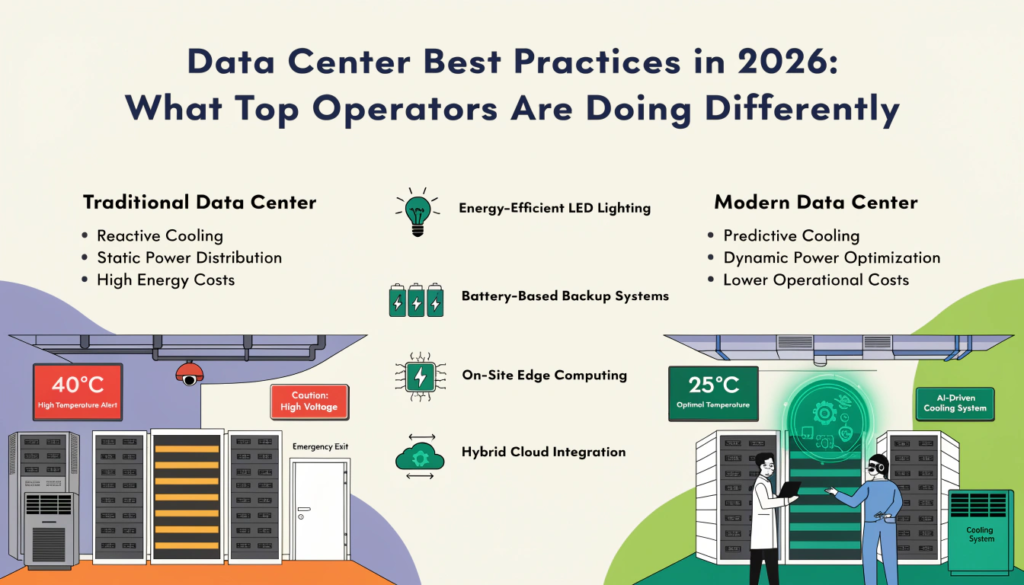
This changing environment makes data center best practices 2026 a critical topic for facility owners, operators, engineers, IT teams, and infrastructure decision-makers. The leading operators are not relying on one technology or a single operational improvement. Instead, they are building integrated strategies around reliability, efficiency, automation, sustainability, security, workforce capability, and continuous improvement.
At the same time, organizations are paying closer attention to data center operations standards to ensure that facilities can perform consistently under normal conditions and during unexpected disruptions.
So, what are top data center operators doing differently in 2026? Here are the practices shaping modern data center operations.
1. Designing for Resilience From the Start
Resilience remains one of the most important priorities for data center operators. Downtime can result in financial losses, service disruption, reputational damage, and regulatory challenges. As digital dependency increases, operators are taking a proactive approach to eliminating single points of failure.
Top facilities consider resilience across power, cooling, networking, physical infrastructure, monitoring, and operational processes. Redundant power paths, backup generators, UPS systems, multiple network connections, and carefully designed cooling systems help reduce the impact of individual equipment failures.
However, resilience is not just about having backup equipment. Operators also need to understand how different systems interact. A failure in one area can create a chain reaction elsewhere. For example, a power disruption can affect cooling, while a cooling problem can quickly threaten IT equipment.
The best operators therefore combine resilient infrastructure with regular testing, preventive maintenance, documented procedures, and trained teams.
2. Making Energy Efficiency an Operational Priority
Energy efficiency has moved from being primarily a sustainability objective to becoming a major operational and financial priority.
Data centers consume significant amounts of electricity, and rising computational requirements are increasing pressure on power infrastructure. Operators are therefore looking for ways to deliver more computing capacity without allowing energy consumption to grow unnecessarily.
Efficient cooling is one of the biggest opportunities. Traditional cooling strategies are increasingly being complemented by advanced airflow management, higher-efficiency cooling equipment, liquid cooling where appropriate, and intelligent temperature management.
Operators are also monitoring metrics such as Power Usage Effectiveness (PUE) to identify opportunities for improvement. However, leading organizations do not treat PUE as the only measure of efficiency. They increasingly consider the relationship between energy consumption, workload performance, equipment utilization, water consumption, and overall facility performance.
The goal is simple: achieve better computing output while using resources more intelligently.
3. Preparing Infrastructure for AI and High-Density Computing
Artificial intelligence is changing data center infrastructure requirements. AI workloads can require significantly greater computing power and create different power and cooling demands compared with conventional enterprise workloads.
As a result, operators are planning for high-density racks, increased power requirements, and advanced cooling technologies.
This means data center design decisions made today need to account for tomorrow’s workloads. Facilities must have sufficient electrical capacity, cooling flexibility, floor-space planning, and network infrastructure to support changing requirements.
Top operators are also considering modularity. Instead of designing facilities around one fixed workload profile, they are building infrastructure that can adapt as computing requirements evolve.
This approach reduces the risk of infrastructure becoming outdated as new processors, accelerators, and computing architectures enter the market.
4. Using Automation to Improve Data Center Operations
Automation is another defining feature of data center best practices 2026.
Modern data centers generate huge amounts of operational information. Monitoring systems can track power consumption, temperature, humidity, equipment performance, network conditions, alarms, and maintenance requirements.
Without automation, teams may struggle to process this information quickly enough.
Leading operators are using Data Center Infrastructure Management (DCIM), Building Management Systems (BMS), artificial intelligence, machine learning, and automated alerting to improve visibility and decision-making.
Automation can help identify unusual equipment behavior before it becomes a serious problem. Predictive maintenance can also allow teams to address potential failures before equipment stops operating.
However, automation should support human decision-making rather than completely replace it. Operators still need trained professionals who understand the facility, validate alerts, manage emergencies, and make decisions when systems behave unexpectedly.
5. Strengthening Preventive and Predictive Maintenance
Reactive maintenance is increasingly viewed as an inefficient approach for mission-critical facilities. Waiting for equipment to fail before repairing it can create unnecessary downtime and operational risk.
Top operators therefore combine preventive maintenance with predictive approaches.
Preventive maintenance involves scheduled inspection, servicing, testing, and replacement based on manufacturer recommendations and operational requirements. Predictive maintenance goes further by using data and equipment performance information to determine when intervention may be necessary.
For example, monitoring changes in vibration, temperature, electrical performance, or equipment behavior can help identify potential problems earlier.
A strong maintenance program should also include clear documentation. Teams need to know what has been inspected, when it was inspected, what issues were identified, and what actions were taken.
This approach supports reliability while also improving accountability.
6. Treating Cybersecurity and Physical Security as One Strategy
Data center security cannot be separated into digital and physical protection.
Cybersecurity threats continue to evolve, while physical risks such as unauthorized access, equipment tampering, environmental incidents, and infrastructure damage remain important.
Top operators are therefore taking a layered security approach.
Physical controls can include controlled entry points, surveillance, visitor management, access credentials, security monitoring, and restricted areas. Digital security can include network segmentation, identity and access management, encryption, endpoint protection, continuous monitoring, and incident response procedures.
The connection between these two areas is becoming increasingly important as operational technology becomes more connected.
A security strategy should also include regular testing. Operators need to know whether their procedures work in practice, not simply whether policies exist on paper.
7. Building Stronger Operational Standards and Documentation
Consistent operations depend on consistent processes.
This is where data center operations standards become particularly important. Operators need clear procedures covering routine activities, maintenance, equipment changes, emergency response, access management, incident reporting, and system recovery.
Standard Operating Procedures (SOPs) help ensure that important tasks are performed consistently, regardless of who is on shift.
Method of Procedure (MOP) documents can also provide structured guidance for planned changes, while Emergency Operating Procedures (EOPs) can help teams respond to unexpected incidents.
Documentation should not become a box-ticking exercise. Procedures need to be practical, regularly reviewed, and tested through drills.
The strongest operators also learn from incidents and near misses. Every disruption should provide an opportunity to improve processes and reduce the probability of repetition.
8. Investing in People and Skills
Technology may be advancing quickly, but skilled people remain central to reliable data center operations.
The industry is facing growing demand for professionals who understand electrical systems, mechanical infrastructure, cooling, networking, cybersecurity, automation, sustainability, and facility management.
Top operators are responding by investing in continuous training.
Training should cover both technical knowledge and operational procedures. Staff need to understand not only how systems work but also what actions to take when something goes wrong.
Cross-training is also valuable. When employees understand multiple systems, teams become less dependent on one individual with specialized knowledge.
Leadership development is another important consideration. Modern data center managers increasingly need to coordinate facilities, IT, vendors, sustainability goals, compliance requirements, budgets, and business priorities.
9. Improving Water and Resource Management
Energy efficiency receives considerable attention, but water management is becoming increasingly important in data center planning.
Cooling systems can require substantial water resources depending on their design and operating environment. Operators are therefore assessing water consumption alongside energy performance.
The right strategy depends on location, climate, facility design, workload, and available infrastructure. Some facilities may prioritize air-based cooling, while others may use advanced liquid or hybrid cooling technologies.
Operators should evaluate the entire resource profile rather than focusing on one metric.
The objective is to create a facility that balances reliability, energy efficiency, water use, operational requirements, and environmental responsibilities.
10. Planning for Disaster Recovery and Business Continuity
Even highly resilient facilities can experience unexpected events. Natural disasters, grid failures, equipment failures, cyber incidents, supply-chain problems, and human errors can all affect operations.
That makes business continuity and disaster recovery essential parts of data center planning.
Top operators regularly test their recovery procedures instead of assuming that documented plans will automatically work during a crisis.
Testing can reveal communication gaps, outdated contact information, unclear responsibilities, missing equipment, or dependencies that were not previously recognized.
A good continuity strategy should define priorities clearly. Teams need to know which systems must be restored first, who has authority to make decisions, how stakeholders will be informed, and what alternative resources are available.
11. Building More Sustainable Data Centers
Sustainability is becoming increasingly integrated into data center strategy.
Operators are looking beyond energy consumption and considering carbon emissions, water usage, equipment lifecycle, waste reduction, renewable energy, and responsible procurement.
Renewable energy procurement and on-site generation may contribute to emissions reduction where practical. Operators are also examining equipment efficiency and opportunities to extend hardware lifecycles through better maintenance and responsible asset management.
Sustainability should be measurable. Establishing targets and monitoring progress allows organizations to understand whether investments are producing meaningful results.
Importantly, sustainability should not compromise reliability. The best strategies balance environmental goals with the availability and resilience requirements of mission-critical infrastructure.
12. Strengthening Vendor and Supply-Chain Management
Data center operations rely on a large ecosystem of suppliers, contractors, technology providers, maintenance specialists, and equipment manufacturers.
Supply-chain disruptions can affect everything from replacement components to construction projects.
Leading operators are therefore strengthening vendor relationships and evaluating suppliers based on more than price. Reliability, technical capability, response times, product quality, cybersecurity, sustainability, and business continuity should all be considered.
Critical components may also require appropriate inventory planning. Keeping essential spare parts available can reduce the impact of equipment failures and supply delays.
Strong vendor management also includes clear service-level agreements, performance reviews, communication processes, and escalation procedures.
13. Measuring Performance Through Meaningful Metrics
What gets measured gets managed.
Top operators use a combination of infrastructure and operational metrics to understand facility performance. PUE is useful for energy efficiency, but it is only one part of the picture.
Operators may also monitor uptime, capacity utilization, cooling performance, energy consumption, maintenance completion, incident frequency, response times, equipment health, water consumption, and sustainability indicators.
The key is not collecting as much data as possible. It is collecting useful information that supports better decisions.
Data should lead to action. If monitoring identifies a recurring issue, teams should investigate the underlying cause and implement corrective measures.
14. Making Continuous Improvement Part of the Culture
Perhaps the most important lesson from top operators is that data center excellence is not a one-time achievement.
Infrastructure changes. Workloads change. Regulations evolve. Technologies improve. Customer expectations increase. Threats develop.
Therefore, operators need a culture of continuous improvement.
After incidents, maintenance activities, upgrades, and major projects, teams should review what worked and what could have been better. Lessons learned should be documented and incorporated into future procedures.
Benchmarking can also help operators understand where they stand and identify opportunities for improvement.
The best facilities are not necessarily those with the newest equipment. They are the ones where infrastructure, processes, technology, people, and management work together effectively.
Conclusion
The data center industry is entering a period of rapid transformation. AI workloads, high-density computing, sustainability expectations, cybersecurity risks, energy constraints, and increasing digital dependency are changing how facilities are designed and operated.
The most effective data center best practices 2026 are therefore focused on more than uptime. Top operators are building resilient, efficient, secure, adaptable, and intelligently managed facilities.
From advanced cooling and automation to preventive maintenance, strong data center operations standards, workforce development, sustainability, and disaster recovery, successful operators are taking a holistic approach to infrastructure management.
For organizations planning new facilities, upgrading existing sites, or preparing for the next generation of workloads, adopting these practices can create a stronger foundation for long-term performance.
The future of data center operations will belong to organizations that can combine technology with disciplined processes and skilled people. Staying connected with industry experts, technology providers, facility leaders, and solution partners can help organizations identify new approaches and prepare for what comes next.
Connect With Data Center Industry Leaders
If your organization provides products, services, technology, infrastructure solutions, or expertise to the data center industry, the right industry platform can help you connect with decision-makers and potential business partners.
Register as a vendor and explore opportunities to showcase your solutions to professionals involved in data center infrastructure, facilities, operations, and technology.