
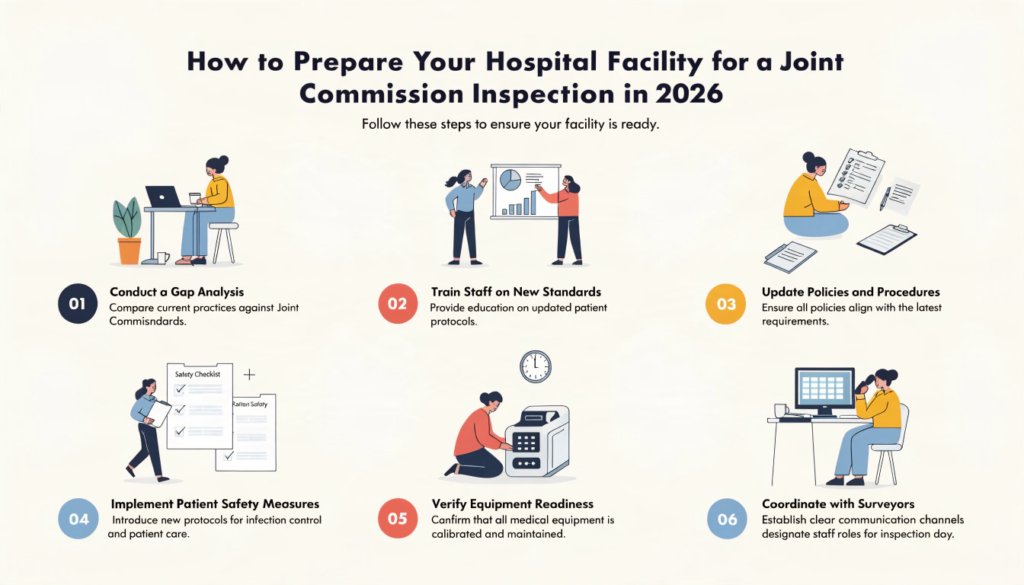
Preparing for a Joint Commission inspection is an ongoing process rather than a last-minute checklist exercise. For hospital facility managers, compliance teams, clinical leaders, and operations professionals, maintaining readiness throughout the year can help reduce disruption, identify risks earlier, and create a safer environment for patients and staff.
In 2026, hospitals are operating in an increasingly complex environment shaped by technology, cybersecurity concerns, patient safety expectations, infrastructure demands, workforce pressures, and evolving regulatory requirements. A successful Joint Commission inspection hospital strategy therefore needs to go beyond documentation. Hospitals must demonstrate that their policies are implemented consistently and that facility operations support safe, high-quality patient care.
The best approach is to build inspection readiness into everyday hospital operations. From emergency preparedness and life safety systems to infection prevention, documentation, staff competency, and facility maintenance, every department has a role to play.
This guide explains practical steps hospital facilities can take to prepare for a Joint Commission inspection in 2026 while strengthening overall hospital compliance 2026 efforts.
Understand What a Joint Commission Inspection Evaluates
Before preparing for an inspection, hospital leaders need to understand what surveyors may look for during their evaluation. The Joint Commission assesses healthcare organizations against established standards designed to support patient safety, quality improvement, and effective healthcare delivery.
For facility managers, this means inspection preparation cannot be limited to administrative records. Surveyors may want to see evidence that the physical environment is safe, critical systems are maintained, emergency procedures are functional, and staff understand their responsibilities.
A strong Joint Commission inspection hospital preparation strategy should therefore connect three areas: policies, implementation, and evidence.
Having a policy that says equipment must be inspected is not enough if maintenance records are incomplete. Similarly, having an emergency preparedness plan is less valuable if employees cannot explain what they should do during an actual emergency.
Hospitals should review their current standards, identify areas of risk, and determine whether their day-to-day practices match their written procedures.
Conduct a Comprehensive Facility Readiness Assessment
One of the most effective ways to prepare is to conduct an internal assessment well before an inspection.
Walk through the hospital as if you were an external surveyor. Examine patient care areas, operating rooms, laboratories, pharmacies, utility spaces, storage rooms, mechanical areas, corridors, emergency exits, and other critical locations.
Look for issues that could become findings during an inspection. These may include damaged equipment, blocked exits, missing signage, expired supplies, poor storage practices, incomplete maintenance records, unsecured hazardous materials, or inconsistent environmental controls.
Facility managers should also assess whether preventive maintenance schedules are being followed. Critical systems such as generators, fire alarms, emergency lighting, HVAC equipment, medical gas systems, electrical systems, and other infrastructure should have appropriate inspection and maintenance documentation.
The objective is not simply to find problems. It is to identify patterns. If a recurring issue appears in multiple departments, it may indicate a process weakness rather than an isolated problem.
Document findings, assign responsibility, establish deadlines, and verify that corrective actions have actually been completed.
Review Life Safety and Environment of Care Requirements
Life safety is one of the most important areas of hospital inspection readiness. A hospital must provide an environment that protects patients, visitors, and employees from preventable hazards.
Facility teams should review fire protection systems, emergency exits, fire doors, alarm systems, emergency power, evacuation routes, medical gas systems, electrical infrastructure, and other life safety components.
Fire extinguishers should be accessible and appropriately maintained. Exit pathways should remain unobstructed. Fire doors should not be improperly propped open. Emergency lighting and backup power systems should be tested according to applicable requirements.
Hospitals should also evaluate storage areas. Supplies, equipment, and other materials should not interfere with sprinkler systems, electrical panels, exits, or required clearances.
Environmental conditions matter as well. Temperature, humidity, ventilation, cleanliness, water systems, and other environmental factors can affect both patient safety and infection prevention.
A successful hospital compliance 2026 strategy should treat life safety as a continuous operational responsibility rather than a survey-specific activity.
Strengthen Preventive Maintenance and Equipment Management
Equipment management is another area where hospitals can demonstrate operational discipline.
Create a clear inventory of critical equipment and ensure that preventive maintenance schedules are current. Maintenance records should show what was inspected, when it was inspected, who performed the work, and whether corrective action was required.
For facility managers, a centralized maintenance system can make this process easier. A computerized maintenance management system (CMMS), for example, can help track work orders, preventive maintenance schedules, equipment histories, inspections, and outstanding issues.
The important factor is not simply having software. Hospitals need processes that ensure maintenance tasks are completed on schedule and that unresolved issues are escalated appropriately.
Equipment that fails inspection or requires repair should be clearly identified and managed until it is safe for use. Staff should also understand how to report equipment problems and what happens after a problem is reported.
During a Joint Commission inspection hospital survey, consistency between physical equipment conditions and maintenance documentation can be particularly important.
Verify Emergency Preparedness Plans
Hospitals must be prepared for emergencies ranging from fires and power failures to severe weather, infrastructure failures, cybersecurity incidents, infectious disease outbreaks, and other disruptions.
Emergency preparedness plans should be reviewed regularly and updated when risks, facilities, technologies, or organizational responsibilities change.
However, having an emergency plan stored on a computer is not enough. Employees need to understand their roles. Hospitals should conduct drills and exercises that test communication, evacuation, emergency power, patient movement, resource availability, and leadership decision-making.
After each exercise, teams should document what worked and what did not. Corrective actions should be assigned and tracked through completion.
Hospital leaders should also review emergency contact lists, backup communication procedures, supply inventories, generator readiness, and continuity plans.
This approach helps turn emergency preparedness from a compliance requirement into a genuine operational capability.
Strengthen Infection Prevention and Environmental Hygiene
Infection prevention remains closely connected to facility operations. Hospital infrastructure, cleaning procedures, ventilation, water management, waste handling, and equipment maintenance can all influence infection risks.
Facility teams should work closely with infection prevention professionals to identify environmental risks. This may include reviewing cleaning schedules, high-touch areas, ventilation systems, water-related risks, construction or renovation activities, and waste management practices.
Construction and renovation projects deserve particular attention. Dust, airflow changes, noise, access restrictions, and construction debris can create risks for vulnerable patients if projects are not appropriately controlled.
Cleaning staff should receive adequate training and understand the procedures applicable to different areas of the hospital. Documentation should support the organization’s claims about training, cleaning processes, and monitoring.
A hospital that integrates facility management and infection prevention is better positioned to demonstrate effective hospital compliance 2026 practices.
Make Documentation Inspection-Ready
One of the easiest ways to create unnecessary inspection challenges is to have strong processes but weak documentation.
Hospital facility teams should organize records so they can be quickly retrieved when needed. Documentation may include preventive maintenance records, inspection reports, fire safety testing, emergency generator testing, equipment records, staff training, corrective actions, risk assessments, emergency exercises, and other relevant evidence.
Records should be accurate, current, and consistent.
If a maintenance task was completed, the documentation should show it. If an issue was identified, there should be evidence that corrective action was taken. If staff training was required, attendance and competency records should be available.
Hospitals should avoid creating documentation solely because an inspection is approaching. Instead, records should be generated naturally as part of daily operational processes.
A well-organized documentation system can significantly reduce stress when surveyors request evidence.
Train Staff to Respond Confidently
Inspection readiness is not only the responsibility of senior management or the compliance department. Frontline employees can have a significant impact on how effectively a hospital demonstrates its safety culture.
Employees should understand the policies relevant to their roles and know how to respond to basic questions about safety procedures.
For example, staff should know how to report safety hazards, what to do during a fire or emergency, how to respond to equipment failures, where emergency procedures are located, and who to contact when a problem occurs.
Training should focus on understanding rather than memorization. Employees should not be encouraged to provide rehearsed answers. Instead, they should be familiar with the hospital’s actual procedures and comfortable explaining how those procedures work in practice.
Managers can conduct informal readiness exercises by asking staff simple questions during routine rounds.
Perform Mock Inspection Rounds
A mock survey can help hospitals identify weaknesses before an actual inspection.
Create a multidisciplinary team that includes representatives from facilities, nursing, infection prevention, quality, safety, environmental services, clinical operations, and other relevant departments.
Conduct the exercise as realistically as possible. Walk through different areas, review documentation, interview employees, inspect equipment, and identify potential risks.
Pay attention to small details. Surveyors may notice whether hallways are obstructed, whether equipment is appropriately maintained, whether staff understand emergency procedures, or whether documentation supports operational claims.
After the mock inspection, categorize findings according to risk and urgency. High-risk issues should be addressed immediately, while lower-priority improvements can be incorporated into an ongoing improvement plan.
The goal of mock inspections is not to make employees nervous. It is to create a culture in which identifying and correcting problems is normal.
Use Technology to Improve Compliance Visibility
Technology can play an increasingly important role in hospital compliance and facility management in 2026.
Digital maintenance systems can provide visibility into preventive maintenance, inspections, work orders, equipment histories, and outstanding issues. Building management systems can help monitor HVAC and environmental conditions, while connected sensors can provide real-time information about temperature, humidity, energy consumption, and other facility parameters.
Data can also help hospital leaders identify recurring problems.
For example, if a particular piece of equipment repeatedly requires corrective maintenance, management may need to evaluate whether replacement is more appropriate than continued repair. If environmental readings repeatedly fall outside acceptable ranges, the facility team can investigate the underlying cause.
The objective is to use technology to support proactive decision-making rather than simply collecting more data.
Create a Continuous Compliance Culture
The strongest hospitals do not prepare for inspections only when a survey is approaching. They create systems that make compliance part of normal operations.
Leadership should establish clear accountability for safety, maintenance, documentation, emergency preparedness, and corrective actions. Departments should communicate regularly about risks and unresolved issues.
Facility managers can also establish routine compliance reviews throughout the year. Monthly or quarterly reviews can help prevent problems from accumulating.
A useful approach is to maintain a centralized action tracker that records identified issues, responsible owners, deadlines, status, and verification of completion.
This creates accountability and makes it easier for leadership to understand where the hospital stands.
Continuous readiness also reduces the pressure associated with an upcoming inspection. Instead of attempting to fix months or years of accumulated issues, teams can focus on maintaining the systems they already use every day.
Build a 2026 Joint Commission Readiness Timeline
Hospitals preparing for an inspection should establish a timeline rather than relying on a last-minute review.
Several months before an anticipated inspection, leadership can conduct a comprehensive risk assessment and review major compliance gaps. Facility teams should then prioritize corrective actions based on patient safety and operational risk.
As the inspection approaches, hospitals can increase the frequency of mock rounds, documentation reviews, staff interviews, and leadership check-ins.
In the final weeks, the focus should shift toward verification. Teams should confirm that corrective actions are complete, records are accessible, emergency systems are functional, and staff understand their responsibilities.
Most importantly, hospitals should avoid creating temporary conditions that disappear after an inspection. Sustainable compliance requires systems that continue to operate effectively after surveyors leave.
Prepare Today for Safer Healthcare Facilities Tomorrow
A successful Joint Commission inspection hospital strategy is ultimately about much more than passing an inspection. It is about creating an environment where patients receive safe care, employees can perform their responsibilities effectively, and facility systems support reliable healthcare delivery.
In 2026, hospital facility managers have an opportunity to combine compliance practices with smarter infrastructure management, preventive maintenance, digital monitoring, emergency preparedness, and continuous improvement.
By conducting regular assessments, strengthening documentation, maintaining critical infrastructure, training staff, conducting mock inspections, and tracking corrective actions, hospitals can approach inspection readiness with greater confidence.
The most effective approach is simple: do not prepare for the inspection; prepare the hospital to remain inspection-ready every day.
Register for the Healthcare Convention 2027.
Healthcare facility leaders need to stay informed about emerging technologies, operational strategies, compliance priorities, and infrastructure solutions that can shape the future of healthcare facilities.
To explore new ideas and connect with professionals working across the healthcare facilities sector, Register for Healthcare Convention 2027 and discover opportunities to strengthen your facility strategy.