
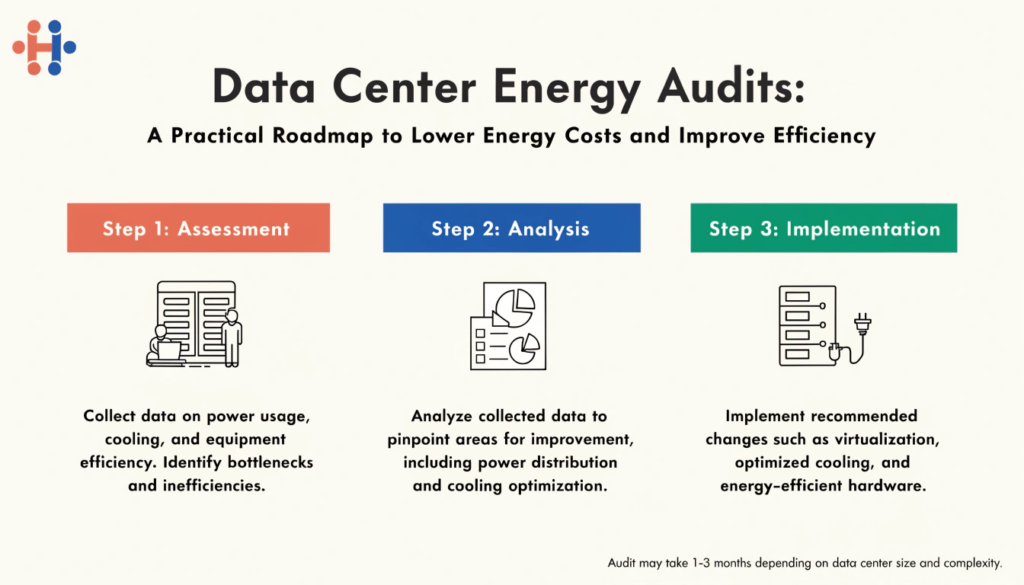
Data centers are the backbone of the modern digital economy. From cloud computing and artificial intelligence to financial services, healthcare platforms, streaming, and enterprise applications, organizations depend on data centers to provide reliable computing power around the clock. However, this reliability comes with a significant energy requirement. As facilities expand and workloads become more demanding, energy consumption has become one of the most important operational and financial concerns for data center operators.
A well-planned data center energy audit provides operators with a structured way to understand where energy is being consumed, identify inefficiencies, and develop practical strategies for reducing unnecessary power usage without compromising uptime or performance.
An energy audit is more than simply reviewing electricity bills. It involves examining the complete facility, including IT equipment, cooling infrastructure, power distribution, lighting, backup systems, building systems, and operational practices. By combining energy data with equipment-level analysis, operators can identify opportunities for improvement and establish measurable efficiency targets.
This guide explains how operators can conduct a data center energy audit step by step and turn the findings into meaningful efficiency improvements.
What Is a Data Center Energy Audit?
A data center energy audit is a systematic assessment of how energy enters, moves through, and is consumed within a data center facility. The objective is to determine where energy is being used efficiently and where losses or unnecessary consumption may be occurring.
The audit typically covers both IT and non-IT systems. Servers, storage systems, and networking equipment are major consumers, but cooling systems, UPS equipment, power distribution units, lighting, pumps, fans, and other building infrastructure can also account for a substantial portion of total energy consumption.
A comprehensive audit should answer several important questions: How much energy does the facility consume? Which systems consume the most? Where are energy losses occurring? How efficiently is cooling being delivered? Are power systems operating within their optimal range? And which improvements can provide the greatest return on investment?
This makes the audit an essential part of a broader data center efficiency assessment.
Step 1: Define the Scope and Objectives
Before collecting data, operators should clearly define what the energy audit is expected to accomplish.
The scope may include the entire facility or focus on a particular area, such as cooling, power distribution, or IT infrastructure. Operators should also establish the period being analyzed. Reviewing at least 12 months of historical energy data can help identify seasonal patterns and changes in facility performance.
Clear objectives make the audit more useful. For example, a facility may want to reduce annual electricity costs, improve Power Usage Effectiveness (PUE), identify inefficient cooling equipment, prepare for capacity expansion, or establish a baseline for sustainability initiatives.
The objectives should also account for reliability. Energy-saving measures must never compromise availability, redundancy, equipment operating conditions, or business continuity.
Step 2: Collect Historical Energy and Utility Data
The next step is to gather as much reliable energy data as possible.
Start with electricity bills, utility records, power monitoring systems, building management systems, and data center infrastructure management platforms. Gather information about total electricity consumption, peak demand, power factor, energy costs, and operating hours.
If available, collect energy readings from different levels of the electrical distribution system. This could include utility incoming power, UPS systems, power distribution units, cooling systems, and individual equipment groups.
Historical data is particularly valuable because it allows operators to compare current performance against previous periods. Unexpected increases in consumption may reveal changes in IT workloads, cooling performance, equipment efficiency, or operating practices.
The more granular the data, the easier it becomes to identify specific opportunities for improvement.
Step 3: Map the Data Center’s Energy Flow
After collecting energy information, operators should create a clear picture of how power moves through the facility.
Energy typically enters from the utility supply and passes through switchgear, transformers, UPS systems, distribution equipment, and ultimately reaches IT equipment. A portion of the energy is also consumed by mechanical and building systems.
Creating an energy-flow map helps identify where energy is being transformed or lost. For example, inefficient UPS systems may create unnecessary electrical losses, while aging transformers or poorly loaded equipment may reduce overall efficiency.
The map should include both direct IT loads and supporting infrastructure. Understanding this complete energy chain is essential because optimizing one system in isolation may not improve overall facility efficiency.
Step 4: Analyze IT Equipment Energy Consumption
IT infrastructure should be a major focus of the audit because servers, storage, and networking equipment represent the productive computing load of the facility.
Operators should review server utilization, rack power consumption, storage requirements, networking equipment, and workload patterns. Underutilized or obsolete servers may continue consuming substantial amounts of electricity even when they provide little business value.
Server consolidation and virtualization can sometimes reduce the number of physical machines required to support workloads. Operators can also examine whether older equipment should be replaced with newer, more energy-efficient alternatives.
However, decisions should be based on workload requirements, performance, availability, and lifecycle costs rather than energy consumption alone.
Step 5: Evaluate Cooling System Performance
Cooling is one of the most important areas of any data center efficiency assessment.
Data centers generate substantial heat, and cooling infrastructure must continuously remove that heat to maintain appropriate operating conditions. However, inefficient cooling can consume significant amounts of energy.
During the audit, operators should assess chillers, cooling towers, computer room air conditioning systems, computer room air handlers, pumps, fans, compressors, and other mechanical systems.
Temperature and humidity levels should be reviewed alongside cooling equipment performance. Operators should also investigate airflow patterns, hot and cold aisle arrangements, containment systems, and potential areas of air mixing.
Airflow problems can cause cooling systems to work harder than necessary. Hot spots may also encourage operators to lower overall temperature settings, increasing energy consumption across the facility.
Improving airflow management and optimizing cooling controls can therefore provide meaningful energy savings without requiring major infrastructure changes.
Step 6: Assess UPS and Power Distribution Efficiency
Power infrastructure should be evaluated carefully during a data center energy audit.
UPS systems protect critical IT equipment from power disturbances, but they also consume energy. Operators should examine UPS efficiency at different load levels, operating modes, redundancy configurations, and maintenance conditions.
A UPS operating significantly below its optimal load range may have lower efficiency than expected. Similarly, oversized electrical equipment can create unnecessary losses.
The audit should also examine transformers, switchgear, power distribution units, busways, cables, and other components. Power factor and electrical losses should be reviewed where relevant.
The objective is not simply to reduce power infrastructure. Instead, operators should ensure that electrical systems are appropriately sized, efficiently operated, and capable of maintaining required resilience.
Step 7: Review Lighting and Building Systems
Although lighting usually represents a smaller energy load than IT and cooling systems, it should still be included in the audit.
Operators can examine lighting schedules, occupancy controls, LED adoption, and unnecessary lighting in areas that are rarely occupied.
Other building systems should also be considered. Ventilation, pumps, elevators, office areas, security systems, and other facility equipment may contribute to overall energy consumption.
Automated controls can help ensure that systems operate according to actual occupancy and operational requirements rather than running continuously at unnecessary levels.
Step 8: Measure Key Efficiency Metrics
Once energy data has been collected, operators should calculate relevant performance metrics.
PUE remains one of the most widely used indicators for understanding data center energy efficiency. It compares total facility energy consumption with the energy consumed by IT equipment.
A higher PUE generally indicates that a greater proportion of energy is being consumed by supporting infrastructure. However, PUE should not be considered in isolation. Operators should also examine IT utilization, cooling performance, energy consumption per workload, peak demand, and other facility-specific indicators.
The most useful metrics depend on the organization’s objectives. An AI-focused facility, for example, may have very different energy characteristics from a traditional enterprise data center.
Step 9: Identify Energy-Saving Opportunities
After analyzing the data, operators can create a list of potential improvements.
These may include airflow optimization, cooling control adjustments, server consolidation, virtualization, equipment replacement, UPS optimization, improved monitoring, lighting upgrades, and changes to operating schedules.
Not every recommendation should be implemented immediately. Each opportunity should be evaluated based on expected energy savings, capital cost, operational impact, payback period, reliability implications, and implementation complexity.
Low-cost operational improvements should generally be considered before large capital projects. For example, improving airflow management may require considerably less investment than replacing an entire cooling system.
Step 10: Prioritize Recommendations by ROI and Risk
The audit becomes much more valuable when its findings are converted into an actionable implementation plan.
Operators can classify recommendations into short-, medium-, and long-term initiatives. Short-term measures might involve configuration changes, maintenance improvements, or operational adjustments. Medium-term projects may include control system upgrades or cooling optimization. Long-term strategies could involve infrastructure modernization, renewable energy integration, or major equipment replacement.
Each recommendation should include an estimated energy impact and financial benefit where possible.
Importantly, reliability should remain a core consideration. A project that delivers significant energy savings but creates unacceptable operational risk may not be suitable for a mission-critical facility.
Step 11: Implement Improvements in Phases
Once priorities have been established, implementation should be approached systematically.
Start with improvements that can be introduced with minimal disruption. Monitor the results before moving to more complex projects.
For example, if airflow optimization is implemented, operators should track temperature distribution, cooling energy consumption, fan performance, and equipment conditions before and after the change.
This approach allows teams to verify whether the expected savings are being achieved.
Major infrastructure projects should be planned around maintenance windows and redundancy requirements. Where possible, improvements should be tested in controlled environments before facility-wide deployment.
Step 12: Monitor Performance Continuously
A data center energy audit should not be treated as a one-time activity.
Data center workloads, equipment, cooling requirements, and operating conditions change continuously. A facility that performs well today may become less efficient as computing demand grows or equipment ages.
Continuous monitoring allows operators to identify performance changes quickly. Smart meters, sensors, DCIM platforms, building management systems, and automated analytics can provide real-time information about energy consumption and system performance.
Operators should establish benchmarks and review them regularly. If energy consumption increases without a corresponding increase in useful IT workload, the change should be investigated.
Periodic audits can also help validate whether previously implemented energy-saving measures are continuing to deliver their expected benefits.
Turning an Energy Audit Into a Long-Term Efficiency Strategy
The biggest value of a data center energy audit comes from using its findings to support long-term decision-making.
Rather than viewing energy efficiency as a collection of isolated projects, operators should integrate it into capacity planning, equipment procurement, maintenance, facility design, and operational management.
For example, energy performance should be considered when selecting new cooling systems or servers. Similarly, future capacity expansions should account for the energy and cooling requirements of higher-density workloads.
This is especially important as artificial intelligence, high-performance computing, and other energy-intensive applications increase rack densities and change traditional data center operating models.
A strong data center efficiency assessment can help operators understand not only current energy performance but also how prepared the facility is for future workloads.
Common Mistakes to Avoid During an Energy Audit
One common mistake is focusing only on electricity bills. Utility bills show total consumption but rarely explain where energy is being wasted.
Another mistake is focusing exclusively on cooling. Cooling is important, but IT equipment, UPS systems, electrical distribution, lighting, and other infrastructure must also be evaluated.
Operators should also avoid implementing efficiency measures without measuring their results. Every significant project should have a baseline and measurable performance indicators.
Finally, energy efficiency should never be pursued at the expense of reliability. Data centers exist to provide continuous service, and energy-saving strategies must support, not undermine, availability and resilience.
Conclusion
Conducting a data center energy audit gives operators a structured method for understanding energy consumption, identifying inefficiencies, and building a practical improvement roadmap. From analyzing IT workloads and cooling systems to evaluating UPS performance, airflow, power distribution, and building systems, each stage contributes to a more complete view of facility efficiency.
The most successful audits do not stop at identifying problems. They translate data into prioritized actions, measurable targets, and long-term operational strategies.
As data center workloads become more energy-intensive, operators will need increasingly sophisticated approaches to efficiency. Regular audits, continuous monitoring, intelligent controls, and proactive infrastructure management can help facilities control costs while maintaining the reliability and performance that modern digital services demand.
For professionals looking to explore emerging technologies, operational strategies, and best practices for improving data center infrastructure and efficiency, industry events provide valuable opportunities to connect with experts and solution providers.
Enquire About Sponsorship
Position your organization in front of data center professionals, facility leaders, technology decision-makers, and industry stakeholders. Enquire about sponsorship for the Data Center Facilities Convention