
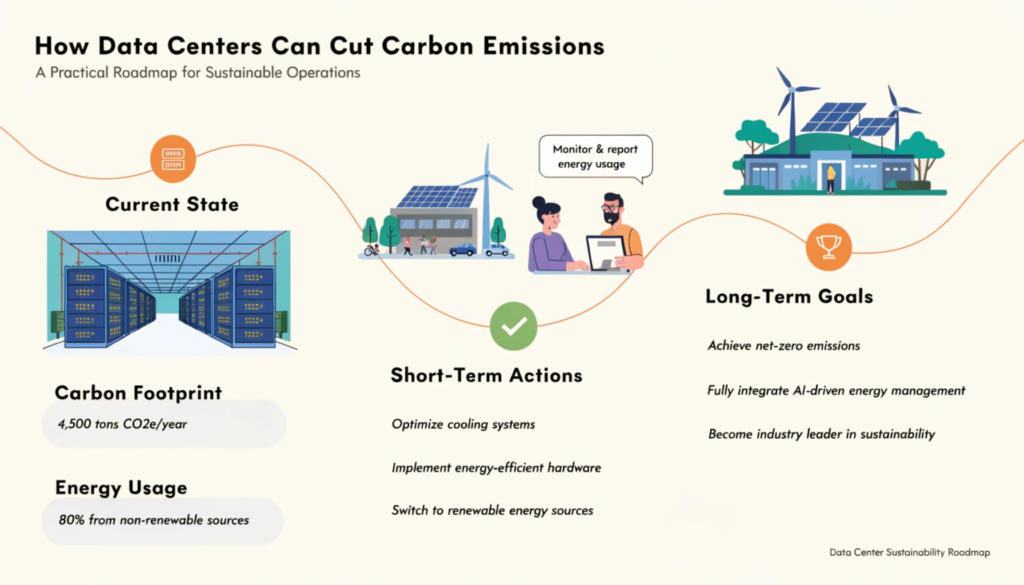
Data centers are becoming the backbone of the digital economy. Cloud computing, artificial intelligence, streaming, enterprise applications, and connected devices are driving unprecedented demand for computing infrastructure. At the same time, this growth is creating a major sustainability challenge: rising electricity consumption and associated carbon emissions.
The International Energy Agency estimates that data centers consumed around 415 TWh of electricity globally in 2024, representing about 1.5% of global electricity consumption. That figure is projected to more than double to approximately 945 TWh by 2030 as AI and other digital services expand. (IEA)
For operators, reducing environmental impact is no longer simply a corporate sustainability initiative. It is becoming an operational, financial, and strategic priority.
A successful data center carbon footprint reduction program requires more than switching to renewable electricity. It involves improving energy efficiency, optimizing cooling, modernizing IT infrastructure, reducing waste, managing water, selecting lower-carbon equipment, and measuring emissions across the facility’s entire lifecycle.
Here is a practical 2026 action plan for data center operators looking to build a lower-carbon and more efficient facility.
Why Data Center Carbon Reduction Matters in 2026
Electricity demand is rising rapidly across the global economy. According to the IEA’s 2026 outlook, global electricity demand is expected to grow at an average rate of 3.6% annually from 2026 through 2030, with data centers among the important sources of this growth. (IEA)
The challenge is particularly significant for AI-focused facilities. High-performance computing requires more powerful processors and increasingly dense server racks. The result is greater electricity demand as well as more heat that must be removed through cooling systems.
This means operators cannot depend on simply purchasing more electricity as demand grows. They need to make every unit of electricity work more efficiently.
A well-designed green data center strategy can help organizations control operating costs while reducing emissions and improving long-term resilience.
Step 1: Measure Your Current Carbon Footprint
The first step in carbon reduction is understanding where emissions come from.
Data center emissions typically involve direct emissions from fuel combustion, indirect emissions from purchased electricity, and broader value-chain emissions associated with equipment, construction, transportation, suppliers, and waste.
Start by creating a baseline covering electricity consumption, backup generators, cooling systems, water consumption, refrigerants, IT equipment, construction materials, and waste.
Energy meters should be installed at major electrical loads so operators can understand how power is being consumed across IT equipment, cooling, UPS systems, lighting, pumps, and other infrastructure.
The baseline should also include metrics such as Power Usage Effectiveness (PUE), Water Usage Effectiveness (WUE), and Carbon Usage Effectiveness (CUE), where appropriate.
Once the baseline is established, operators can identify the largest sources of emissions and prioritize investments accordingly.
Step 2: Reduce Electricity Consumption Through Better Efficiency
Energy efficiency should be the foundation of any data center carbon footprint reduction program.
Improving efficiency does not always require replacing an entire facility. Operators can begin by identifying underutilized equipment, inefficient power distribution, excessive cooling, and unnecessary energy consumption.
Server utilization is particularly important. Running lightly utilized servers continuously can result in significant wasted electricity. Virtualization, workload consolidation, containerization, and automated resource allocation can help organizations run computing resources more efficiently.
AI-based energy management systems can also analyze facility data and identify opportunities to optimize power and cooling.
However, efficiency should be evaluated carefully. AI and automation technologies can themselves consume additional energy. The objective should be to use intelligent technologies where their efficiency gains exceed their energy requirements.
Step 3: Modernize Cooling Systems
Cooling is one of the most important areas for reducing data center energy consumption.
Traditional air-cooling systems can become less effective as rack densities increase. AI and high-performance computing environments may require significantly greater cooling capacity than conventional enterprise facilities.
Operators should evaluate options such as hot-aisle and cold-aisle containment, variable-speed fans, optimized airflow, economization, liquid cooling, and advanced thermal management.
Liquid cooling is becoming increasingly relevant for high-density computing because it can transfer heat more efficiently than traditional air-based approaches.
The right solution depends on facility design, climate, rack density, equipment requirements, and operational priorities. A cooling upgrade should therefore begin with a detailed thermal assessment rather than simply replacing existing equipment.
Reducing cooling energy has a double benefit: it lowers operational costs while reducing the electricity-related carbon footprint of the facility.
Step 4: Improve PUE Without Sacrificing Reliability
PUE remains one of the most widely used indicators for evaluating data center infrastructure efficiency.
A lower PUE generally means that a greater proportion of the facility’s electricity is being delivered to IT equipment rather than supporting infrastructure.
Operators should continuously monitor PUE rather than treating it as a one-time certification metric. Seasonal variations, changing workloads, equipment upgrades, and cooling requirements can all influence performance.
The goal should not simply be to achieve a particular number. Instead, organizations should establish realistic performance targets based on their facility’s location, age, design, and workload.
Real-time monitoring can help identify sudden increases in auxiliary energy consumption and allow facility teams to investigate problems before they become expensive.
Step 5: Transition to Cleaner Energy
Improving efficiency reduces electricity demand, but the carbon intensity of that electricity also matters.
A facility powered by a carbon-intensive grid can have a considerably larger emissions footprint than an equally efficient facility supplied by lower-carbon electricity.
Data center operators can therefore explore renewable energy procurement through power purchase agreements, green tariffs, onsite solar generation, and other clean-energy arrangements where available.
The IEA expects renewables to meet a substantial share of the additional electricity demand created by data centers through 2030. (IEA)
However, renewable procurement should be approached strategically. Organizations should consider additionality, location, timing, contractual structure, grid conditions, and the actual carbon intensity of the electricity being consumed.
Combining energy efficiency with credible clean-energy procurement creates a stronger green data center strategy than relying on either approach independently.
Step 6: Optimize Backup Power
Backup generators are essential for reliability, but they can also contribute to direct emissions.
Operators should examine generator testing schedules, fuel consumption, maintenance requirements, and opportunities for lower-carbon backup technologies.
Battery energy storage systems can play a growing role in modern data center power architecture. They can provide backup support, help manage short-duration interruptions, and potentially support grid services depending on local regulations and infrastructure.
As battery technology develops, operators should assess whether energy storage can complement traditional backup systems without compromising reliability.
The transition should always prioritize uptime and resilience. Sustainability improvements are valuable only when they preserve the reliability standards required by critical digital infrastructure.
Step 7: Make IT Hardware More Energy Efficient
The carbon footprint of a data center does not come exclusively from facility infrastructure.
Servers, networking equipment, storage systems, and other IT hardware also have significant energy and embodied-carbon impacts.
Operators should establish lifecycle-based procurement criteria when purchasing new equipment. Energy efficiency, performance per watt, equipment lifespan, repairability, upgradeability, and responsible end-of-life management should all be considered.
Modern processors can deliver significantly greater computing performance per unit of energy, but simply purchasing new hardware is not always the most sustainable solution. Organizations should evaluate whether upgrading, consolidating, or extending the useful life of existing equipment provides a better environmental outcome.
IT asset management should therefore become part of the wider carbon reduction program.
Step 8: Reduce Embodied Carbon
Operational electricity receives considerable attention, but construction and equipment manufacturing can create substantial embodied emissions.
Concrete, steel, electrical equipment, cooling systems, batteries, servers, and other components all carry emissions associated with manufacturing and transportation.
For new facilities, operators should work with designers and contractors to evaluate lower-carbon materials and construction methods.
For existing facilities, extending equipment life, repairing components, refurbishing hardware, and responsibly recycling retired equipment can reduce waste and avoid unnecessary manufacturing impacts.
Sustainability should therefore be considered from design and procurement through operation, refurbishment, and eventual decommissioning.
Step 9: Manage Water Alongside Carbon
Carbon reduction should not happen at the expense of other environmental priorities.
Data center cooling can require significant quantities of water, depending on the cooling technology and climate. As facilities expand into regions facing water stress, water management is becoming increasingly important.
Operators should monitor WUE and evaluate cooling technologies that reduce freshwater consumption.
Water recycling, rainwater harvesting where practical, optimized cooling tower operation, and alternative cooling designs can help reduce water requirements.
The best green data center strategy considers energy, carbon, water, waste, and resilience together rather than treating each environmental metric independently.
Step 10: Use Software and AI to Optimize Workloads
Software optimization can contribute to data center carbon footprint reduction without requiring major physical infrastructure changes.
Workloads can potentially be scheduled according to energy availability, grid carbon intensity, cooling conditions, and capacity.
Non-urgent computing tasks may be shifted to periods when renewable electricity is more abundant or grid emissions are lower, where application requirements allow.
AI-powered infrastructure management can also identify inefficient workloads and recommend changes to cooling, power distribution, and server utilization.
At the same time, operators should measure the energy consumption of optimization technologies themselves. The objective is not to deploy AI everywhere, but to use digital intelligence where it produces measurable efficiency improvements.
A Practical 2026 Implementation Roadmap
The most effective approach is to treat sustainability as a continuous operational program rather than a one-time project.
During the first quarter, operators should establish their carbon baseline, identify major energy consumers, measure PUE and other relevant performance indicators, and determine their most significant emissions sources.
During the second quarter, attention can shift toward quick operational improvements. These may include airflow optimization, server consolidation, equipment scheduling, temperature optimization, lighting controls, and improved monitoring.
The third quarter can focus on larger investments such as cooling upgrades, renewable energy procurement, battery storage, high-efficiency UPS systems, and energy-efficient IT infrastructure.
By the fourth quarter, organizations should evaluate results against their baseline, document carbon reductions, review supplier performance, and establish targets for the following year.
This approach creates accountability and allows sustainability teams to demonstrate measurable progress rather than relying on broad environmental claims.
Build Sustainability Into Every Data Center Decision
Reducing emissions should not be the responsibility of the sustainability department alone.
Facilities teams influence cooling and power efficiency. IT teams control workload optimization and hardware selection. Procurement teams influence supplier emissions and equipment lifecycle decisions. Finance teams evaluate investment returns. Leadership determines long-term sustainability targets.
When these departments collaborate, carbon reduction becomes part of normal data center decision-making.
This is especially important as global data center electricity consumption continues to rise. The IEA projects that data center electricity use could reach roughly 945 TWh by 2030, driven significantly by AI and other digital services. (IEA)
The facilities that succeed will be those that combine reliability, performance, cost efficiency, and environmental responsibility.
The Business Case for Data Center Carbon Reduction
Sustainability investments are often viewed primarily as environmental initiatives, but they can create significant operational benefits.
Lower electricity consumption can reduce utility costs. Efficient cooling can reduce infrastructure requirements. Better equipment utilization can improve IT capacity. Renewable energy can reduce exposure to certain energy-price risks. Modern monitoring can identify operational problems faster.
Carbon reduction can also strengthen corporate sustainability reporting and help organizations respond to growing expectations from customers, investors, employees, and regulators.
The key is to focus on measurable improvements rather than sustainability messaging alone.
A strong program should answer simple questions: How much energy was saved? How much carbon was avoided? Which systems improved? What was the return on investment? What should happen next?
Conclusion: Make 2026 the Year of Measurable Progress
Data centers will continue to play a central role in the digital economy, and their energy requirements will continue to grow. The answer is not to slow digital transformation, but to make data center infrastructure more efficient, resilient, and sustainable.
A successful data center carbon footprint reduction program begins with measurement and continues through efficiency improvements, optimized cooling, cleaner energy, smarter IT infrastructure, responsible procurement, water management, and continuous monitoring.
The organizations that develop a comprehensive green data center strategy today will be better positioned to manage rising energy demand and sustainability expectations tomorrow.
2026 is an opportunity to move beyond sustainability goals and focus on measurable action. By combining technology, operational discipline, and long-term planning, data center leaders can reduce emissions while creating facilities that are more efficient and resilient for the future.
Nominate for BMA Awards
Is your organization implementing innovative solutions in energy efficiency, sustainable infrastructure, cooling optimization, renewable energy, or data center operations? Nominate for BMA Awards and highlight the teams and projects helping shape a more sustainable data center industry.