
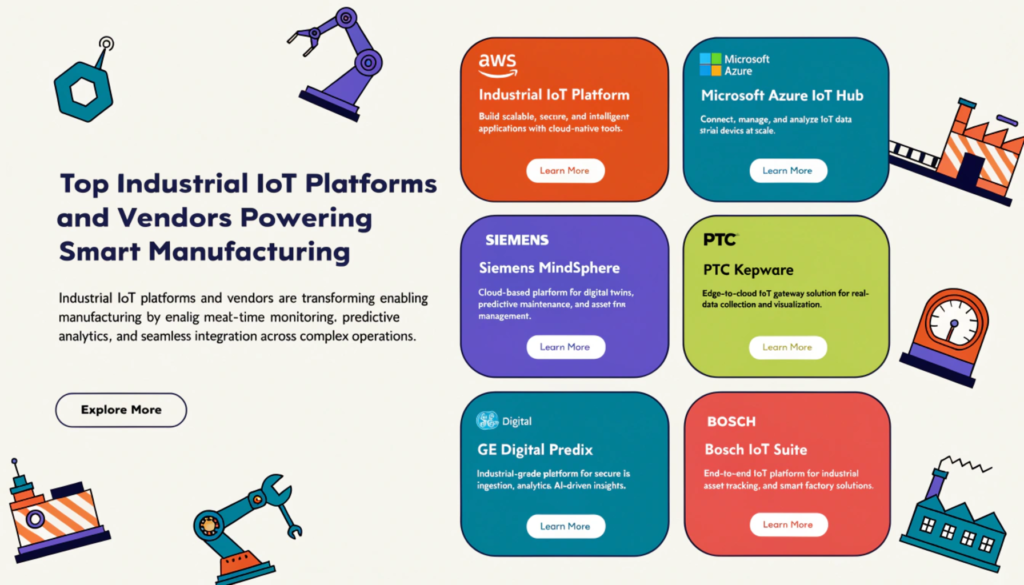
The modern factory floor is undergoing a profound digital transformation driven by connected machinery, edge analytics, and real-time operational visibility. Manufacturers across the United States are moving beyond isolated automation pilots to deploy unified digital architectures that connect shop-floor programmable logic controllers (PLCs) directly to enterprise resource planning systems. Selecting the right platform partner is now a pivotal decision for manufacturing executives.
The Critical Role of Connected Factory Platforms
Industrial Internet of Things (IIoT) platforms serve as the operational backbone for intelligent manufacturing. By aggregating telemetry from vibration sensors, thermal monitors, CNC machines, and autonomous robots, these platforms provide actionable intelligence to prevent downtime, improve overall equipment effectiveness (OEE), and optimize production schedules.
As enterprise adoption accelerates, the market for industrial IoT platforms is defined by seamless interoperability, edge-to-cloud scalability, and built-in artificial intelligence. Rather than locking factories into proprietary silos, leading architectures support open communication standards like OPC UA and MQTT, allowing facilities to integrate modern software with legacy mechanical assets. This flexibility enables manufacturers to modernize at their own pace without discarding existing capital investments.
Leading Platforms and Technology Ecosystems
Prominent industrial technology providers are delivering comprehensive suites tailored to high-mix, discrete, and process manufacturing environments. Platforms such as Siemens MindSphere (Siemens Xcelerator), PTC ThingWorx, Rockwell Automation FactoryTalk, and GE Vernova Proficy continue to establish benchmarks for operational excellence. These enterprise ecosystems excel at contextualizing complex machine data and integrating with computer-aided design and product lifecycle management tools.
Concurrently, cloud hyperscalers partnering with specialized IIoT vendors USA are offering robust edge computing capabilities. AWS IoT SiteWise and Microsoft Azure IoT Operations provide industrial developers with scalable tools to train machine-learning models locally on the plant floor. These platforms empower operations teams to analyze high-frequency vibration data in real time, detecting micro-fractures in motor bearings weeks before mechanical failure occurs.
Key Selection Criteria for Manufacturing Leaders
When evaluating vendor ecosystems, operations directors must prioritize cybersecurity and ease of integration. With connected plant floors facing heightened threat environments, platforms must incorporate zero-trust network access, encrypted data pipelines, and robust device authentication.
Furthermore, platforms that offer no-code visualization tools and intuitive mobile interfaces ensure that frontline operators and maintenance technicians can act on alerts immediately without waiting for central IT support. Leading industrial organizations are pairing platform rollouts with targeted workforce upskilling programs, empowering plant personnel to interpret predictive machine diagnostics and maintain seamless collaboration between operational engineering and enterprise IT teams.
Deep Dive: Core Components of Next-Generation IIoT Architectures
To fully appreciate the impact of industrial IoT platforms, it is essential to unpack the core architectural layers that turn raw, noisy shop-floor signals into enterprise intelligence. A modern manufacturing platform is far more than a simple data pipeline; it is a highly integrated framework that bridges operational technology (OT) and information technology (IT).
At the foundation lies edge connectivity and protocol translation. Factory floors are complex ecosystems populated by legacy machinery, vintage PLCs, modern CNC machines, and standalone environmental sensors. Next-generation IIoT platforms employ lightweight edge gateways equipped with multi-protocol translation engines. These gateways convert proprietary industrial protocols such as Modbus, PROFIBUS, and Ethernet/IP into standardized data formats like JSON or Protocol Buffers, transmitting them via OPC UA or MQTT. By standardizing data at the edge, organizations break down OT data silos without needing expensive equipment overhauls.
Edge Analytics vs. Cloud Processing: Achieving Optimal Balance
A central strategic decision for smart manufacturing architects is determining where data processing should occur. While early IIoT implementations attempted to push all raw telemetry to central cloud repositories, the sheer volume, velocity, and latency requirements of modern industrial applications have rendered full cloud dependence impractical.
Edge analytics processes data directly at the machine or gateway level, delivering near-zero latency for mission-critical feedback loops. Applications such as automated visual quality inspection, high-frequency vibration anomaly detection, and emergency safety shutdowns rely on local processing speeds of less than ten milliseconds. Edge nodes filter out noise and transmit only aggregated summaries or high-priority anomaly alerts upstream.
Conversely, cloud platforms excel at heavy compute tasks, cross-facility benchmarking, long-term trend analysis, and enterprise-wide supply chain optimization. By storing multi-year historical datasets across multiple plant locations, cloud platforms train complex machine learning models that can then be compiled and deployed back down to edge devices. This hybrid edge-cloud paradigm balances real-time responsiveness with macro-level intelligence.
Real-World Case Studies: Smart Manufacturing Success Stories
To understand the practical impact of IIoT deployment, consider the following real-world implementation examples across key manufacturing sectors in North America:
1. Precision Automotive Stamping: Eliminating Unplanned Downtime
A major tier-one automotive supplier operated a facility with high-tonnage stamping presses that experienced frequent, costly hydraulic valve failures. By retrofitting the presses with high-frequency acoustic emission sensors and linking them to an edge-enabled IIoT platform, the facility established continuous baseline monitoring. Within three months, the system detected ultrasonic micro-signatures indicative of cavitation three weeks before a physical breakdown occurred. Predictive maintenance interventions saved the plant an estimated $420,000 in lost production time during a single operating quarter.
2. High-Mix Electronics Assembly: Dynamic Quality Control
A Midwest electronics contract manufacturer implemented an AI-powered visual inspection pipeline connected via an IIoT architecture. High-resolution camera sensors installed along the surface-mount technology (SMT) line stream video feeds directly to edge gateways running computer vision models. The system instantly detects solder bridging, component misalignment, and missing parts at full line speed. Defect rates fell by 38%, while manual re-inspection labor costs decreased by over 50% across six active production lines.
3. Continuous Chemical Processing: Energy & Resource Optimization
A specialty chemical producer integrated environmental telemetry and power monitoring smart meters across steam boilers and cracking furnaces. By analyzing process variables alongside real-time energy prices via a cloud-based IIoT dashboard, plant operators dynamically optimized boiler load distribution. This real-time resource allocation strategy lowered annual energy consumption by 14% and reduced carbon emissions, demonstrating how digital transformation advances operational efficiency and sustainability goals simultaneously.
Robust Cybersecurity for Industrial Control Systems
The convergence of operational IT networks and shop-floor machinery dramatically expands the attack surface for cyber threats. Ransomware attacks, malware targeting industrial control systems (ICS), and unauthorized parameter modifications represent severe risks to physical safety, operational continuity, and proprietary IP.
Establishing robust cybersecurity in a connected plant requires moving beyond traditional perimeter security to a comprehensive Zero Trust Network Architecture (ZTNA). Key elements include:
- Micro-Segmentation: Dividing the plant network into isolated security zones using industrial firewalls so an infection in a business office network cannot traverse into critical PLC networks.
- Public Key Infrastructure (PKI) & Device Identity: Assigning cryptographic identities to every connected sensor, edge gateway, and controller to ensure only authenticated hardware can publish data or receive control commands.
- End-to-End Encryption: Enforcing TLS 1.3 encryption for all data in transit between edge gateways and cloud brokers, alongside AES-256 encryption for data at rest.
- Continuous Anomaly Monitoring: Deploying OT-native network intrusion detection tools that analyze industrial protocol traffic in real time to spot unauthorized configuration changes or abnormal packet floods.
By embedding security directly into the platform architecture, manufacturers can scale smart operations without compromising safety or uptime.
Future Trends Shaping Industry 4.0 and Beyond
Looking ahead, several pioneering technologies are set to redefine the next decade of smart manufacturing and industrial software development:
Generative AI for Factory Operations
Large language models (LLMs) and multi-modal generative AI are being integrated into IIoT platforms to serve as intelligent co-pilots for technicians. Maintenance staff can interact with plant data using natural language queries such as asking, “What caused the pressure spike on Line 3 during the second shift?” and immediately receive diagnostic breakdowns, troubleshooting steps, and relevant manual excerpts.
Autonomous Industrial Digital Twins
While current digital twins provide 3D visual monitoring and predictive simulations, next-generation digital twins will feature closed-loop autonomous optimization. Connected twins will continuously run real-time simulations, adjusting machine parameters, conveyor speeds, and environmental controls automatically to optimize throughput and energy usage without requiring manual operator intervention.
Private 5G Networks in Industrial Operations
The deployment of ultra-reliable low-latency communication (URLLC) over private industrial 5G networks is replacing physical cabling on the shop floor. Private 5G provides high bandwidth, ultra-low latency, and dense connectivity, enabling hundreds of autonomous mobile robots (AMRs), automated guided vehicles (AGVs), and untethered wearable AR displays to operate seamlessly across massive plant environments.
Experience the Future of Industrial Automation
Connect with leading technology vendors, manufacturing pioneers, and automation engineers showcasing next-generation industrial software and robotics.