
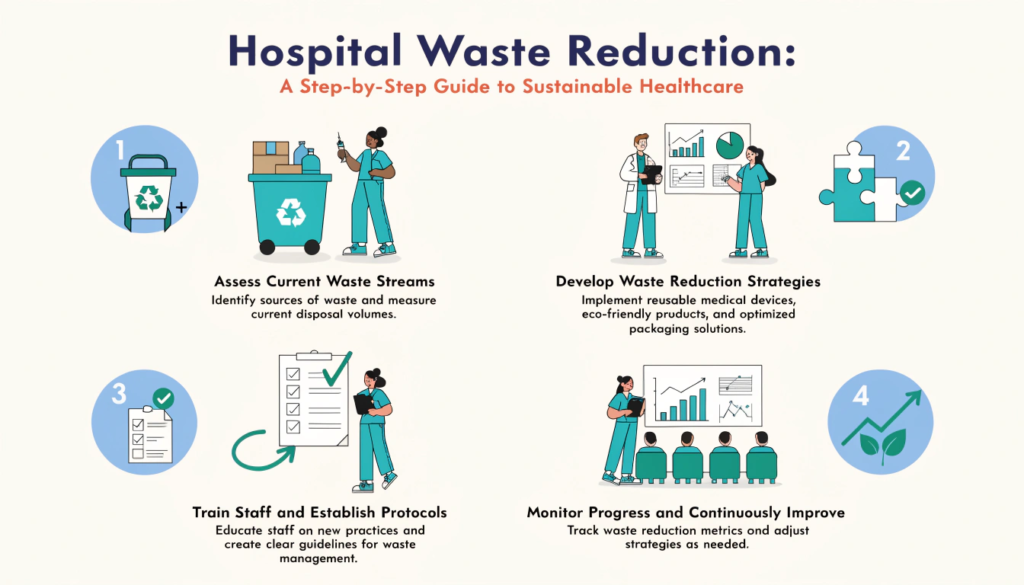
Hospitals are designed to protect and improve human health, but their daily operations can generate significant quantities of waste. From single-use medical products and packaging to food waste, pharmaceuticals, paper, plastics, and general refuse, healthcare facilities must manage complex waste streams while maintaining strict hygiene and safety standards.
For hospital facility managers, sustainability teams, and healthcare leaders, reducing waste is no longer simply an environmental initiative. A well-designed hospital waste reduction programme can support operational efficiency, reduce unnecessary purchasing and disposal costs, improve regulatory compliance, and contribute to broader sustainability objectives.
The challenge is finding the right balance between waste reduction and patient safety. Hospitals cannot simply eliminate products or processes that are essential for infection prevention and clinical care. Instead, waste reduction needs to focus on smarter procurement, better segregation, improved staff awareness, efficient processes, and data-driven decision-making.
This guide explains how healthcare facilities can develop and implement a practical waste reduction programme while integrating sustainability into everyday hospital operations.
Why Hospital Waste Reduction Matters
Healthcare waste is not one single category. Hospitals typically produce a mixture of general waste, recyclable materials, infectious waste, sharps, pharmaceutical waste, chemical waste, food waste, and other specialised streams.
Treating all waste as hazardous or medical waste can significantly increase disposal costs. At the same time, poor segregation can create safety risks and make recycling or recovery more difficult.
A structured hospital waste reduction programme helps facilities identify where waste is being generated, determine which waste streams can be reduced or recovered, and establish processes for managing unavoidable waste safely.
Waste reduction can also become an important component of healthcare sustainability operations. Sustainability is most effective when it is incorporated into routine procurement, facility management, clinical processes, supply chain decisions, and staff responsibilities rather than treated as a separate project.
Step 1: Establish a Waste Reduction Team
The first step is to create clear ownership.
Hospital waste affects multiple departments, so the programme should not be managed by facilities or environmental services alone. A cross-functional team can provide a more complete understanding of where waste is generated and why.
The team may include representatives from facilities management, nursing, clinical departments, infection prevention, procurement, housekeeping, food services, finance, environmental services, and senior management.
The team should define the programme’s objectives, responsibilities, reporting structure, and timeline.
For example, the hospital could aim to reduce non-hazardous waste by a specific percentage over 12 months, improve recycling rates, reduce unnecessary use of disposable materials, or decrease the volume of waste sent to landfill.
Clear targets help transform sustainability from an abstract objective into a measurable operational programme.
Step 2: Conduct a Hospital Waste Audit
Before implementing solutions, understand the current situation.
A waste audit provides a baseline for measuring improvement. It should examine how much waste the facility generates, what types of waste are produced, where they originate, and how they are currently handled.
Look at major areas such as operating rooms, emergency departments, patient rooms, laboratories, pharmacies, kitchens, offices, and outpatient facilities.
The audit should identify the most significant waste streams and determine whether waste is being correctly segregated.
For example, a hospital may discover that recyclable packaging is frequently being placed in general waste bins or that non-hazardous materials are entering regulated medical waste streams.
The audit should also consider procurement practices. Excess packaging, expired products, unused supplies, and unnecessary single-use items can contribute substantially to waste generation.
Once the baseline is established, facility managers can prioritise the areas with the greatest potential for improvement.
Step 3: Categorise Waste at the Source
One of the most important principles of a successful hospital waste reduction programme is segregation at the point where waste is generated.
Waste that is mixed together is much more difficult and expensive to recover. Proper segregation allows recyclable and general waste to remain separate from infectious or hazardous materials.
Hospitals should make waste segregation straightforward for employees. Clearly labelled containers, consistent signage, appropriate bin placement, and simple instructions can help reduce confusion.
The system should also be aligned with applicable healthcare waste regulations and local requirements.
The objective is not simply to increase recycling. It is to ensure that each material enters the correct waste stream from the beginning.
Step 4: Focus on Procurement and Packaging
Waste reduction often starts before a product enters the hospital.
Procurement teams can play a major role by considering packaging, product durability, recyclability, supplier practices, and lifecycle costs when purchasing products and equipment.
Hospitals can work with suppliers to reduce unnecessary packaging or consolidate deliveries where practical. Purchasing products in appropriate quantities can also reduce expired or unused inventory.
This approach connects waste management with healthcare sustainability operations because procurement decisions affect both environmental performance and operational costs.
However, sustainability should never override clinical requirements. Products must continue to meet safety, quality, infection-control, and performance standards.
Step 5: Reduce Unnecessary Single-Use Materials
Single-use products are an important consideration in healthcare waste management, but reduction must be approached carefully.
Not every disposable item can or should be replaced. Infection prevention and patient safety must remain the priority.
Instead, hospitals can identify areas where unnecessary consumption occurs without compromising clinical outcomes.
For example, staff may open supplies before confirming that they are required, resulting in unused products being discarded. Standardising supply kits, improving inventory management, and introducing more accurate demand forecasting can help reduce unnecessary waste.
Where clinically appropriate and permitted by applicable standards, facilities can also evaluate reusable alternatives.
The key is to focus on avoidable waste rather than simply reducing the number of disposable products.
Step 6: Improve Inventory Management
Expired and unused medical supplies represent both financial and environmental waste.
Poor inventory management can lead to over-ordering, stock duplication, products expiring before use, and emergency purchases caused by inaccurate forecasting.
Hospitals can use inventory management systems to track product quantities, expiry dates, consumption patterns, and reorder levels.
First-expiring, first-out practices can help ensure that products approaching their expiry dates are prioritised for appropriate use.
Better inventory visibility can also help procurement teams understand actual demand.
This makes waste reduction part of operational efficiency rather than a separate sustainability activity.
Step 7: Introduce Recycling and Recovery Where Appropriate
Recycling can play an important role in a hospital waste reduction strategy, particularly for non-contaminated materials.
Common opportunities can include cardboard, paper, selected plastics, metals, packaging materials, and other recyclable items depending on local infrastructure and regulations.
However, hospitals should avoid assuming that every plastic or medical product can be recycled. Contamination, material composition, local recycling capacity, and healthcare regulations all need to be considered.
The facility should identify realistic recycling opportunities based on its local waste management infrastructure.
Clear communication is equally important. Employees need to understand which materials belong in recycling containers and which do not.
Step 8: Address Food and Organic Waste
Hospital kitchens and cafeterias can generate substantial quantities of food waste.
A waste reduction strategy can begin with measuring how much food is being discarded and why.
Food waste may come from overproduction, expired ingredients, incorrect portioning, plate waste, or inefficient storage.
Kitchen teams can use demand forecasting and production data to better align food preparation with actual requirements.
Where appropriate, facilities can also explore food donation programmes, composting, or other recovery options that comply with health and safety requirements.
Reducing food waste can support both sustainability goals and cost control.
Step 9: Train Employees and Build a Waste-Conscious Culture
Even the best waste management infrastructure will not work effectively if employees do not understand how to use it.
Staff training should explain why waste reduction matters, how different waste streams should be separated, and what employees are expected to do in their specific work areas.
Training should be practical rather than overly theoretical.
A nurse, laboratory employee, housekeeping worker, and kitchen employee may interact with very different waste streams. Training should therefore be tailored to departmental responsibilities.
Hospitals can reinforce learning through signage, onboarding sessions, refresher training, departmental meetings, and internal sustainability campaigns.
Recognition can also help. Departments that demonstrate measurable improvement can be acknowledged for their contribution.
Step 10: Use Technology and Data to Track Progress
Measurement is essential for maintaining momentum.
Hospitals should establish key performance indicators that demonstrate whether the waste reduction programme is working.
Useful metrics may include total waste generated, waste generated per patient day, recycling volume, regulated medical waste volume, landfill diversion rate, disposal costs, and the percentage of waste correctly segregated.
Digital waste tracking systems can make it easier to collect and analyse this information.
Facility managers can compare performance between departments, identify unusual increases, and determine where additional intervention is needed.
Data also helps healthcare leaders demonstrate the financial benefits of sustainability initiatives.
Step 11: Collaborate With Waste Management Partners
Hospitals do not operate independently from their waste management ecosystem.
External waste contractors, recyclers, suppliers, equipment manufacturers, and other partners can influence the effectiveness of waste reduction efforts.
Hospitals should review contractor capabilities and ensure that waste is transported, treated, recovered, or disposed of according to applicable requirements.
Supplier partnerships can also support packaging reduction and product take-back initiatives where available.
Long-term collaboration can help hospitals move from simply disposing of waste to thinking about waste throughout the product lifecycle.
Step 12: Monitor Results and Continuously Improve
A hospital waste reduction programme should not be treated as a one-time campaign.
After establishing baseline data and introducing initial measures, facility managers should regularly review performance.
If one department is generating unusually high waste volumes, investigate the underlying cause. If recycling rates remain low, determine whether the problem is staff awareness, bin placement, contamination, collection frequency, or the availability of recycling infrastructure.
Continuous improvement allows hospitals to refine their strategies based on actual results.
A useful approach is to test changes on a small scale before implementing them across the entire facility. A pilot programme in one department can reveal operational challenges and help teams improve the process before wider rollout.
Connecting Waste Reduction With Healthcare Sustainability Operations
Waste reduction should ultimately become part of a broader approach to healthcare sustainability operations.
A hospital’s environmental performance is influenced by interconnected areas including energy, water, procurement, waste, transportation, building systems, food services, and clinical operations.
Waste reduction initiatives can therefore be integrated into wider sustainability plans.
For example, better procurement can reduce packaging waste while also improving supply chain efficiency. Improved inventory management can reduce waste while lowering purchasing costs. Digital documentation can reduce paper consumption while streamlining administrative processes.
This integrated approach makes sustainability more practical and measurable.
Rather than treating sustainability as an additional responsibility, healthcare leaders can embed it into existing operational decision-making.
Overcoming Common Challenges
Implementing a waste reduction programme can involve resistance.
Healthcare employees may be concerned that new processes will create additional work or compromise patient care. Procurement teams may have concerns about product availability, while facility managers may face limited budgets.
The solution is to demonstrate that sustainability and operational efficiency can support each other.
Start with practical changes that have measurable benefits. Use data to demonstrate savings and communicate results to employees.
Most importantly, avoid creating complicated processes. Waste segregation, recycling, inventory management, and procurement improvements should be simple enough to become routine.
Leadership support is also essential. When hospital executives actively communicate the importance of sustainability, departments are more likely to participate.
Building a Long-Term Waste Reduction Strategy
The most successful programmes are designed for long-term improvement.
Hospitals should establish annual targets, regularly review performance, update training, evaluate new technologies, and maintain communication with employees.
The programme should also evolve as healthcare practices and sustainability technologies change.
As hospitals adopt smarter building management systems, digital inventory tools, advanced analytics, and new procurement models, they can identify additional opportunities to reduce waste and improve resource efficiency.
The ultimate objective is to create a healthcare environment where waste reduction becomes part of everyday decision-making.
Conclusion
A successful hospital waste reduction programme requires more than adding recycling bins. It involves understanding waste streams, improving segregation, strengthening procurement, reducing unnecessary consumption, managing inventory efficiently, training employees, measuring results, and continuously improving processes.
When these strategies are integrated into broader healthcare sustainability operations, hospitals can reduce environmental impact while also improving efficiency and controlling operational costs.
For healthcare facility leaders, the opportunity is significant. By treating waste as both an environmental challenge and an operational issue, hospitals can build more resilient, efficient, and sustainable facilities without compromising patient safety.
The next step is to move from isolated initiatives to a structured, measurable programme supported by leadership, employees, suppliers, and facility management teams.
Nominate for BMA Healthcare Awards
Recognise healthcare professionals and organisations that are driving innovation, sustainability, and smarter facility operations.