
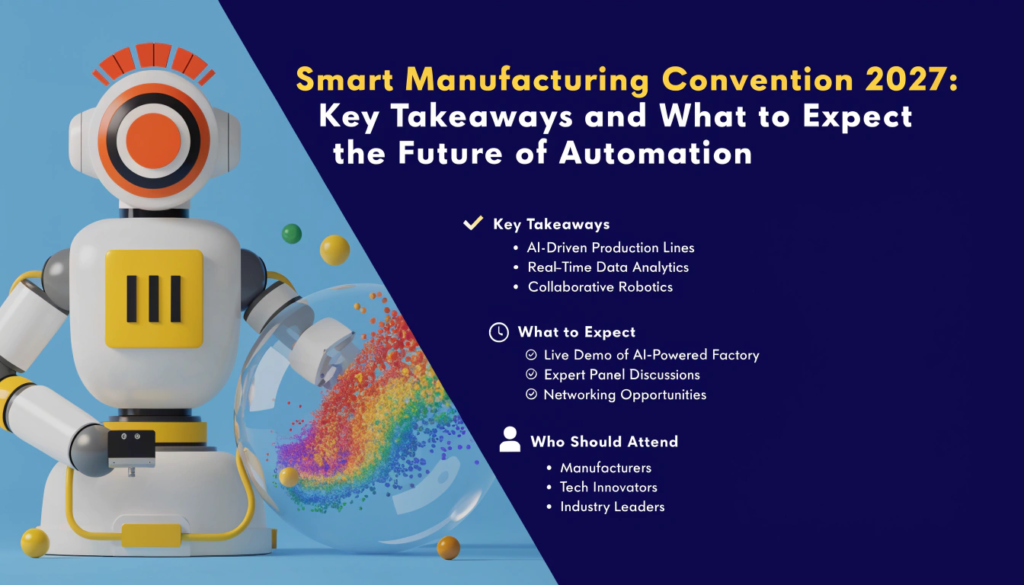
Manufacturing is entering a new phase where artificial intelligence, automation, connected systems, robotics, and real-time data are becoming central to operational success. As manufacturers look for ways to improve productivity, reduce downtime, strengthen supply chains, and build more resilient facilities, industry events are becoming important platforms for understanding what comes next.
The Smart Manufacturing Convention 2027 is positioned as a major gathering for manufacturing executives, engineering leaders, plant managers, technology innovators, and solution providers looking to explore the next generation of smart factory technologies. Scheduled for February 23–25, 2027, at the DoubleTree by Hilton Dallas Market Center, the convention will bring together industry professionals to discuss practical approaches to digital transformation and industrial automation. (BMA Conventions)
Rather than focusing only on emerging technologies, the event is designed around how manufacturers can apply these technologies to real operational challenges. From AI-powered production and predictive maintenance to advanced robotics, supply chain visibility, sustainability, and cybersecurity, the Smart Manufacturing Convention 2027 offers a broad view of how factories are evolving.
Why the Smart Manufacturing Convention 2027 Matters
The manufacturing industry is under pressure to achieve more with fewer resources. Rising operational costs, skills shortages, supply chain uncertainty, sustainability requirements, and increasing competition are encouraging companies to modernize their facilities.
Smart manufacturing provides an opportunity to address these challenges by connecting machines, people, processes, and data. However, implementing new technology is not simply a matter of purchasing equipment or software. Manufacturers need the right strategy, workforce capabilities, infrastructure, cybersecurity measures, and change-management processes.
This is where the Smart Manufacturing Convention 2027 becomes particularly relevant. The event is expected to connect approximately 150 senior decision-makers with more than 25 solution providers, creating opportunities for technology demonstrations, networking, case-study discussions, and knowledge exchange. (BMA Conventions)
The convention will explore how technologies such as AI, Industrial Internet of Things (IIoT), robotics, cloud platforms, analytics, and digital twins can move beyond experimentation and deliver measurable operational improvements.
Key Takeaway 1: AI Is Moving Deeper Into Manufacturing
Artificial intelligence is becoming one of the most important technologies shaping modern manufacturing. Its role is expanding beyond basic automation into predictive maintenance, quality inspection, production optimization, forecasting, and decision-making.
At the Smart Manufacturing Convention 2027, AI-driven maintenance and automation are among the important areas of discussion. AI systems can analyze equipment data to identify unusual patterns, detect potential failures, and support predictive or prescriptive maintenance strategies. This can help organizations reduce unexpected downtime and improve asset reliability. (BMA Conventions)
AI-powered computer vision is another important application. Automated inspection systems can analyze products and processes in real time, helping manufacturers identify quality issues faster and more consistently.
The broader lesson is that AI is becoming an operational tool rather than simply an experimental technology. Manufacturers that successfully integrate AI with existing production systems can potentially improve productivity, quality, maintenance, and decision-making.
Key Takeaway 2: Connected Factories Will Become the New Standard
A modern smart factory depends on connectivity. Machines, sensors, enterprise systems, production lines, and employees increasingly need access to accurate information in real time.
IIoT technologies are therefore expected to remain a major part of manufacturing transformation. Sensors can collect information about equipment performance, temperature, energy consumption, production speed, and other operational parameters. This data can then be processed through edge computing, cloud platforms, and analytics systems.
One of the major manufacturing conference takeaways is that connectivity is not valuable simply because more data is collected. The real value comes from turning that data into actionable information.
For example, a plant manager should not have to wait until a machine breaks down to discover that its performance has been deteriorating. A connected system can identify warning signs earlier and support proactive intervention.
This shift from reactive to proactive operations can help manufacturers create more transparent, agile, and responsive production environments.
Key Takeaway 3: Predictive Maintenance Can Reduce Operational Disruptions
Unexpected equipment failures can result in production delays, maintenance expenses, missed deadlines, and lost revenue. Predictive maintenance aims to reduce these risks by using equipment data and analytics to identify potential problems before major failures occur.
The Smart Manufacturing Convention 2027 highlights predictive maintenance and AI-driven asset health monitoring as important areas within plant management and maintenance. (BMA Conventions)
Connected sensors can continuously monitor machinery, while analytics and AI models can help maintenance teams identify abnormal behavior. Instead of replacing components according to fixed schedules or waiting for breakdowns, organizations can make maintenance decisions based on actual equipment conditions.
This approach can support better maintenance planning, improve asset utilization, and potentially extend equipment life.
For facility managers and plant leaders, predictive maintenance is therefore more than a technology upgrade. It can become an important part of an overall reliability strategy.
Key Takeaway 4: Robotics and Human-Machine Collaboration Will Expand
Automation is changing the relationship between people and machines. Industrial robots are increasingly being used for repetitive, hazardous, precision-based, and high-volume tasks.
The convention will explore advanced robotics, collaborative robots, and human-robot interfaces across areas such as assembly, logistics, and quality control. (BMA Conventions)
One important manufacturing conference takeaway is that automation does not necessarily mean eliminating the human workforce. Instead, it can allow employees to move away from repetitive manual activities and focus more on supervision, analysis, maintenance, problem-solving, and process improvement.
Collaborative robots, often called cobots, are particularly relevant because they are designed to work alongside human employees in appropriate industrial environments.
The successful factories of the future are likely to combine automation with human expertise rather than treat them as competing forces.
Key Takeaway 5: Digital Twins Will Improve Planning and Optimization
Digital twin technology is another important area to watch. A digital twin creates a virtual representation of a physical asset, process, or manufacturing environment.
Manufacturers can use digital twins and simulation technologies to evaluate processes, test scenarios, identify bottlenecks, and support predictive maintenance without necessarily making changes directly to physical equipment.
According to the convention’s published topics, digital twins can support product development, process optimization, predictive maintenance, and scenario testing. (BMA Conventions)
This can be particularly valuable when manufacturers are considering major operational changes. Instead of immediately implementing a change across a production environment, teams can model possible outcomes and identify potential issues beforehand.
As manufacturing becomes increasingly data-driven, digital twins could become a powerful bridge between physical operations and digital decision-making.
Key Takeaway 6: Cybersecurity Must Be Part of Smart Manufacturing
More connectivity creates more opportunities but it can also create additional cybersecurity risks.
Connected factories rely on industrial networks, IoT devices, remote access systems, cloud platforms, and other digital technologies. If these systems are not adequately protected, cyber incidents could affect production, data, safety, and business continuity.
Cybersecurity in manufacturing is therefore expected to be an important discussion area at the Smart Manufacturing Convention 2027. Topics include risk assessment, network segmentation, zero-trust approaches, and real-time threat detection and response. (BMA Conventions)
One of the most important lessons for manufacturers is that cybersecurity cannot be treated as an IT-only responsibility. As operational technology becomes more connected to enterprise systems, security needs to be integrated into the entire manufacturing strategy.
Key Takeaway 7: Sustainability and Energy Efficiency Are Becoming Operational Priorities
Sustainability is no longer limited to corporate reporting. Manufacturers are increasingly looking at energy consumption, waste, resource efficiency, emissions, and renewable energy as part of operational performance.
The convention will examine energy management, sustainable operations, carbon reduction, renewable energy integration, and environmentally responsible manufacturing practices. (BMA Conventions)
Smart technologies can help companies understand where energy is being consumed and where improvements may be possible. Connected monitoring systems, analytics, automation, and intelligent facility management can provide greater visibility into plant performance.
This creates an important connection between digital transformation and sustainability. The same data-driven technologies that improve productivity can also help manufacturers identify inefficiencies and reduce unnecessary resource consumption.
Key Takeaway 8: Workforce Upskilling Will Be Essential
Technology alone cannot create a smart factory. Employees need the skills required to operate, maintain, manage, and improve increasingly digital manufacturing environments.
As robotics, AI, analytics, IIoT, and connected systems become more common, workforce roles will continue to evolve. Employees may need stronger digital skills, data literacy, technical knowledge, and problem-solving capabilities.
The Smart Manufacturing Convention 2027 includes workforce upskilling and human-machine collaboration among its areas of focus. It also highlights technologies such as AR/VR training and reskilling initiatives as part of workforce transformation. (BMA Conventions)
For manufacturers, investing in people can be just as important as investing in equipment. A technically advanced factory will only deliver value if employees understand how to use its systems effectively.
Key Takeaway 9: Supply Chain Visibility Will Become More Important
Recent disruptions have demonstrated how quickly supply chain problems can affect production. Manufacturers therefore need greater visibility into suppliers, inventory, logistics, and potential risks.
Digital technologies such as AI, IoT, and advanced analytics can help manufacturers improve supply chain visibility and respond faster to disruptions.
The convention’s focus on supply chain visibility and resilience reflects the growing need for manufacturers to build systems that can identify risks and support faster decision-making. (BMA Conventions)
A smarter factory, therefore, cannot operate in isolation. Manufacturing companies need to connect production data with procurement, inventory, logistics, suppliers, and other parts of the value chain.
What Attendees Can Expect From the Convention
The Smart Manufacturing Convention 2027 is designed to combine learning with networking and practical industry engagement. The published program includes expert talks, panel discussions, networking sessions, workshops, technology showcases, and opportunities to interact with solution providers. (BMA Conventions)
The event’s smart technology showcase is expected to feature solutions involving robotics, IIoT, automation, cloud integration, and AI/ML platforms. This can give attendees an opportunity to understand how technologies are being applied to operational efficiency, quality control, and other manufacturing challenges.
Networking is another important component. Bringing together executives, plant managers, engineering leaders, technology providers, and other professionals can create opportunities for exchanging experiences and exploring potential partnerships.
For professionals evaluating their digital transformation roadmap, these conversations can be just as valuable as formal presentations.
Turning Manufacturing Conference Takeaways Into Action
Attending an industry event is only the first step. The real value comes from applying what you learn.
Manufacturing leaders can use their manufacturing conference takeaways to evaluate their current operations and identify areas where digital transformation could create measurable value. Instead of trying to implement every emerging technology at once, companies can begin by identifying specific challenges.
For example, a plant experiencing frequent equipment failures might prioritize predictive maintenance. A facility struggling with quality consistency could explore AI-powered inspection. An organization facing energy inefficiencies could focus on intelligent energy monitoring.
The key is to connect technology investments with measurable business outcomes.
Manufacturers should also consider workforce readiness, cybersecurity, integration requirements, implementation costs, and long-term scalability before deploying new systems.
Conclusion
The future of manufacturing is not defined by one technology. It is being shaped by the convergence of AI, automation, robotics, IIoT, analytics, digital twins, cybersecurity, sustainability, and human expertise.
The Smart Manufacturing Convention 2027 provides an opportunity for manufacturing professionals to explore these developments and understand how they can be applied to real-world industrial environments. From predictive maintenance and connected factories to workforce transformation and supply chain resilience, the event covers many of the priorities shaping the next generation of manufacturing.
For executives, plant managers, engineers, technology leaders, and solution providers, the biggest takeaway is clear: smart manufacturing is moving from a long-term vision toward practical implementation.
Those who start preparing today will be better positioned to build efficient, resilient, connected, and sustainable manufacturing operations for tomorrow.
Register Early for 2027
Ready to explore the technologies, strategies, and manufacturing conference takeaways shaping the future of industrial operations?
Register early for 2027 and connect with manufacturing leaders, technology innovators, and solution providers at the Smart Manufacturing & Automation Convention 2027.
Event: Smart Manufacturing & Automation Convention 2027
Date: February 23–25, 2027
Venue: DoubleTree by Hilton Dallas Market Center
Location: Dallas, Texas, USA