
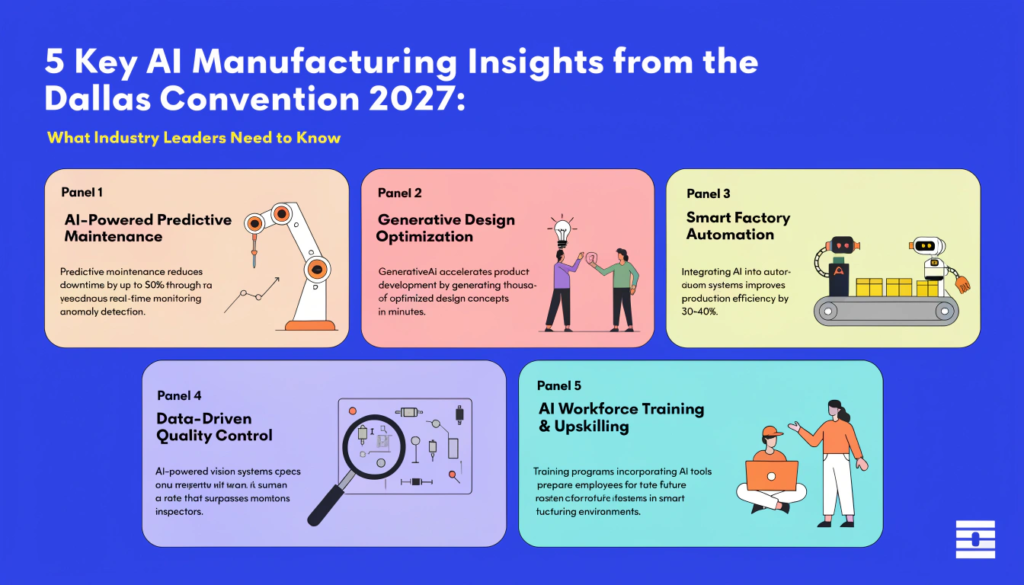
Artificial intelligence is rapidly changing the way manufacturers design products, operate factories, manage supply chains, and make business decisions. At the Dallas Convention 2027, industry professionals, technology leaders, and manufacturing experts explored how AI is moving beyond experimentation and becoming an important part of everyday industrial operations.
The discussions offered valuable AI manufacturing insights 2027, particularly around automation, predictive maintenance, intelligent decision-making, workforce transformation, and the importance of responsible AI adoption. Rather than treating AI as a futuristic technology, manufacturers are increasingly looking at it as a practical tool for improving productivity, reducing downtime, controlling costs, and creating more resilient operations.
The Dallas event also highlighted why attending a manufacturing AI conference can be valuable for companies looking to understand where industrial technology is heading. Here are five major lessons from the event that manufacturers can apply as they prepare for the next phase of smart manufacturing.
1. AI Is Moving from Experimentation to Real Manufacturing Applications
One of the strongest AI manufacturing insights 2027 is that AI is no longer limited to pilot projects or technology demonstrations. Manufacturers are increasingly applying AI to real operational challenges across the factory floor.
Traditional manufacturing systems generate enormous volumes of information through machines, sensors, production lines, enterprise software, and quality-control systems. AI can analyse these datasets much faster than traditional manual methods, helping businesses identify patterns and make informed decisions.
For example, AI-powered systems can analyse machine performance and identify unusual behaviour before it develops into a major equipment failure. Similarly, AI can help production teams identify bottlenecks, detect quality issues, forecast demand, and improve scheduling.
The key lesson is that manufacturers do not necessarily need to completely rebuild their existing facilities to benefit from AI. Many organisations can begin by identifying one specific operational challenge where AI can deliver measurable value.
A manufacturer experiencing frequent equipment downtime, for example, could begin with predictive maintenance. Another organisation struggling with inconsistent product quality could explore AI-powered visual inspection.
This practical approach makes AI adoption easier to measure and scale.
2. Predictive Maintenance Is Becoming More Intelligent
Machine downtime can be extremely expensive for manufacturers. Unexpected equipment failures can interrupt production schedules, increase maintenance expenses, delay deliveries, and affect customer relationships.
At the Dallas Convention 2027, predictive maintenance emerged as one of the important areas where AI can provide immediate operational value.
Traditional preventive maintenance often follows a fixed schedule. Equipment may be serviced after a certain number of operating hours, regardless of its actual condition. AI-powered predictive maintenance takes a different approach by analysing real-time and historical equipment data.
AI systems can identify patterns associated with equipment deterioration and alert maintenance teams when intervention may be required. This allows manufacturers to move from reactive maintenance towards a more proactive strategy.
The benefit goes beyond simply preventing machine breakdowns. AI can help maintenance teams prioritise which equipment requires attention first, optimise maintenance schedules, and potentially reduce unnecessary servicing.
These developments represent another important part of the AI manufacturing insights 2027 conversation: AI creates the greatest value when it is connected to actual operational data.
Manufacturers considering AI should therefore evaluate the quality, availability, and accessibility of their machine data before implementing advanced solutions.
3. AI and Automation Are Working Together
Another major takeaway from the Dallas event was that AI and automation should not be viewed as completely separate technologies.
Automation has already transformed manufacturing by enabling machines and robotic systems to perform repetitive and highly precise tasks. AI adds another layer of intelligence by allowing systems to analyse information, recognise patterns, adapt to changing conditions, and support more complex decisions.
This combination is helping create smarter production environments.
For example, an automated production line can use AI-powered vision systems to inspect products as they move through the manufacturing process. Instead of relying entirely on manual inspections, AI can identify defects, inconsistencies, or abnormalities in real time.
AI can also support robotic systems by helping them respond to changing production conditions. This creates opportunities for more flexible manufacturing environments where automation can adjust to different products, production volumes, or operational requirements.
However, successful implementation requires manufacturers to think beyond purchasing robots or AI software. Companies need to consider how technologies will communicate with one another, how data will move between systems, and how employees will interact with increasingly intelligent equipment.
This was an important message reinforced by the manufacturing AI conference discussions: the future of manufacturing is not simply about replacing people with machines. It is about creating connected systems where people, automation, and AI work together.
4. AI Is Changing the Role of the Manufacturing Workforce
The rise of AI naturally raises questions about the future of manufacturing jobs. One of the most important AI manufacturing insights 2027 is that workforce transformation will be just as important as technology implementation.
AI can automate repetitive data analysis and support routine decision-making, but human expertise remains essential. Experienced engineers, operators, maintenance professionals, managers, and technicians understand the context behind manufacturing problems in ways that technology alone cannot always replicate.
As AI adoption grows, employees may increasingly spend less time on repetitive tasks and more time on problem-solving, process improvement, system monitoring, and strategic decision-making.
This means manufacturers need to invest in workforce development alongside technology.
Employees may need training in areas such as data interpretation, AI-assisted decision-making, automation systems, cybersecurity, and digital manufacturing platforms. Managers may also need to understand how to evaluate AI recommendations and determine when human intervention is necessary.
Companies that prepare their workforce early can potentially create a smoother transition towards smart manufacturing.
The lesson from the Dallas Convention 2027 is clear: AI adoption should be treated as both a technology strategy and a people strategy. Organisations that focus exclusively on technology may struggle if their employees are not prepared to use and manage new systems effectively.
5. Responsible AI Adoption Will Become a Competitive Advantage
AI can deliver significant benefits, but manufacturers also need to think carefully about cybersecurity, data quality, privacy, reliability, and governance.
Connected factories create more opportunities for data-driven decision-making, but they can also create additional digital risks. A manufacturing organisation may have AI systems connected to machines, operational technology, cloud platforms, enterprise software, and supply-chain applications.
This makes cybersecurity increasingly important.
Another concern is the quality of information used to train or operate AI systems. If the underlying data is inaccurate, incomplete, or inconsistent, AI-generated recommendations may not be reliable.
Manufacturers therefore need clear processes for data management, system monitoring, human oversight, and cybersecurity.
Responsible implementation can also improve employee confidence. Workers are more likely to embrace AI when they understand how it works, why it is being introduced, and how it will affect their responsibilities.
This is why one of the most valuable AI manufacturing insights 2027 is that successful AI adoption requires more than technology. It requires governance, accountability, employee engagement, and continuous evaluation.
Turning Dallas Convention Insights into Action
The lessons from the Dallas Convention 2027 provide manufacturers with a useful roadmap for approaching AI. Instead of adopting AI simply because it is a major technology trend, businesses should begin by identifying problems where intelligent systems can deliver measurable improvements.
A practical starting point could include evaluating current production data, identifying operational bottlenecks, reviewing maintenance challenges, and assessing existing automation systems.
From there, manufacturers can select a focused AI application and establish measurable goals. These might include reducing machine downtime, improving product quality, increasing production efficiency, reducing waste, or improving forecasting accuracy.
Once the initial project demonstrates value, the organisation can consider expanding AI into other areas.
Manufacturers should also encourage collaboration between IT teams, operations professionals, engineers, maintenance teams, and leadership. Cross-functional collaboration can help ensure that AI solutions address genuine business requirements rather than becoming isolated technology projects.
Industry events and a specialised manufacturing AI conference can also help decision-makers stay informed about emerging technologies, implementation strategies, and real-world applications.
Preparing for the Next Stage of Smart Manufacturing
The Dallas Convention 2027 demonstrated that AI is becoming an increasingly important component of modern manufacturing. From predictive maintenance and intelligent automation to workforce development and responsible technology adoption, AI is influencing almost every part of the industrial ecosystem.
The biggest takeaway is that manufacturers do not need to wait for a perfect future technology environment before beginning their AI journey. The organisations most likely to benefit are those that start with practical challenges, build strong data foundations, train their employees, and scale successful solutions over time.
These AI manufacturing insights 2027 also show that the future of manufacturing will be defined by collaboration between people and intelligent technologies. AI can analyse data, identify patterns, automate processes, and support decisions, while human expertise remains essential for strategy, creativity, judgment, and leadership.
As manufacturers prepare for the next wave of Industry 4.0, staying connected with experts and peers will become increasingly important.
Register for the next BMA event and discover the latest ideas, technologies, and strategies shaping the future of smart manufacturing.