
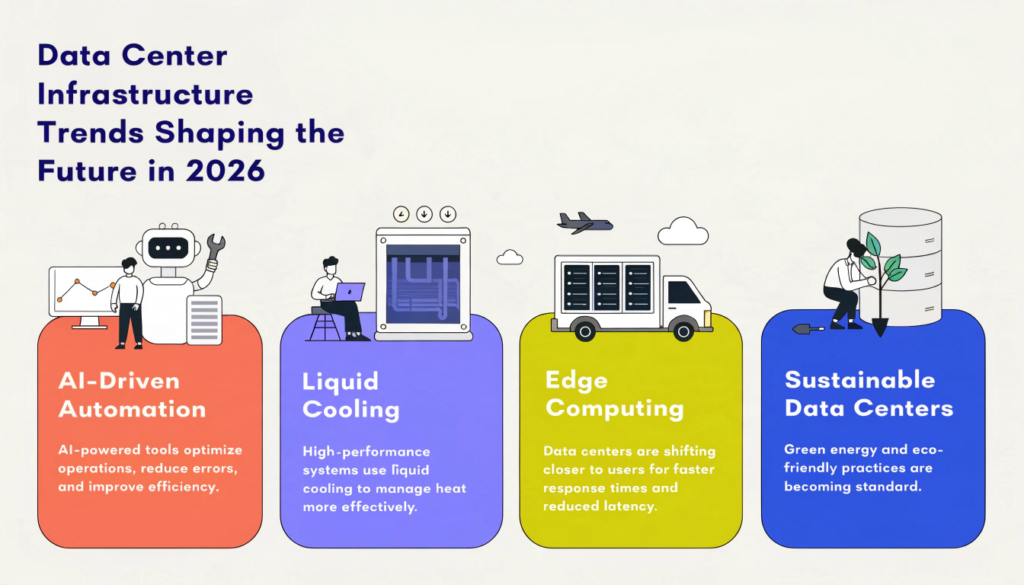
The data center industry is entering a period of rapid transformation. Rising AI workloads, increasing data volumes, sustainability requirements, power constraints, and growing demand for low-latency computing are changing how modern facilities are designed, built, operated, and upgraded. For data center owners, operators, facility managers, and technology leaders, keeping pace with these changes is becoming essential for maintaining efficiency, resilience, and competitiveness.
The second half of 2026 is expected to bring even greater attention to infrastructure modernization. Organizations are moving beyond traditional capacity expansion and focusing on intelligent, energy-efficient, flexible, and highly automated facilities. From liquid cooling and AI-ready infrastructure to digital twins and renewable energy integration, several technologies are becoming central to the future of data center operations.
Understanding the latest data center infrastructure trends 2026 is therefore important for businesses planning new facilities or upgrading existing environments. These trends can help decision-makers identify where investment is likely to deliver the greatest operational value while preparing facilities for future computing requirements.
Here are 10 major data center infrastructure trends 2026 that facility and technology leaders should watch during the second half of the year.
1. AI-Ready Data Center Infrastructure
Artificial intelligence is one of the biggest forces reshaping data center infrastructure. Generative AI, machine learning, large language models, and advanced analytics require significantly more computing power than many conventional enterprise workloads.
AI infrastructure typically involves high-density servers, specialized GPUs, faster networking, and increased power requirements. As organizations deploy more AI applications, data centers need to accommodate higher rack densities while maintaining reliable thermal management.
This is driving data center operators to rethink facility design. Traditional infrastructure designed for relatively moderate rack densities may not be sufficient for AI clusters. Power distribution, cooling capacity, floor layouts, network connectivity, and backup systems all need to be considered together.
In the second half of 2026, AI-ready infrastructure is likely to remain one of the most important data center infrastructure trends 2026, particularly for hyperscale facilities, cloud providers, colocation operators, and enterprises investing heavily in AI.
2. Liquid Cooling Becomes More Mainstream
As rack power densities increase, conventional air cooling can become increasingly challenging. This is making liquid cooling an important part of modern data center technology strategies.
Liquid cooling can transfer heat more efficiently than traditional air-based approaches, making it particularly suitable for high-performance computing and AI workloads. Direct-to-chip cooling, rear-door heat exchangers, and other liquid-assisted technologies are being considered as facilities prepare for higher-density deployments.
The growing adoption of liquid cooling does not necessarily mean that air cooling will disappear. Instead, many facilities are likely to adopt hybrid approaches based on workload requirements, rack density, existing infrastructure, and expansion plans.
For facility managers, the key consideration is not simply whether liquid cooling should be adopted but how cooling infrastructure can be designed to support future equipment. Planning for cooling flexibility can prevent expensive retrofits later.
As AI and high-performance computing continue expanding, liquid cooling will remain a critical trend to monitor in the second half of 2026.
3. Greater Focus on Data Center Energy Efficiency
Energy consumption is becoming a major operational and financial concern for data center operators. As facilities grow larger and computing workloads become more intensive, organizations are looking for ways to improve energy efficiency without compromising performance or availability.
Energy-efficient infrastructure can involve improvements across the entire facility. High-efficiency power systems, advanced cooling controls, efficient UPS technologies, optimized airflow, intelligent lighting, and better workload management can all contribute to lower energy consumption.
Data center operators are also paying closer attention to Power Usage Effectiveness (PUE) and other operational metrics. However, efficiency is increasingly being viewed as a broader objective that includes water consumption, carbon emissions, equipment utilization, and overall resource efficiency.
The second half of 2026 is likely to see more investment in intelligent energy management systems that provide facility teams with real-time visibility into where energy is being consumed and where improvements can be made.
4. Renewable Energy and Sustainable Power Strategies
Sustainability is moving from a corporate objective to an infrastructure planning priority. Data centers require enormous amounts of electricity, creating pressure on operators to reduce environmental impact while securing reliable power.
Renewable energy procurement, onsite solar generation, battery storage, power purchase agreements, and other low-carbon energy strategies are becoming increasingly important.
However, sustainability cannot be separated from reliability. Data center operators must ensure that renewable energy strategies are integrated with dependable backup power and resilient grid connections.
Energy storage is also becoming more relevant. Advanced battery systems can support backup requirements while potentially helping facilities manage peak energy demand.
During the second half of 2026, sustainable power strategies are likely to become an increasingly important part of data center planning, particularly as customers, investors, regulators, and communities pay closer attention to environmental performance.
5. AI-Powered Data Center Management
Artificial intelligence is not only increasing demand for data centers; it is also changing how facilities are managed.
AI and machine learning can analyze large amounts of operational information from sensors, building management systems, power equipment, cooling infrastructure, and IT systems. This data can be used to identify unusual patterns, predict potential failures, optimize energy consumption, and improve overall facility performance.
AI-powered monitoring can help facility teams move from reactive maintenance toward predictive and condition-based maintenance. Instead of waiting for equipment to fail, operators can identify warning signs and schedule interventions before a major disruption occurs.
AI can also help optimize cooling and power distribution based on real-time workloads. This creates a more dynamic operating environment where infrastructure responds to actual demand rather than relying entirely on fixed settings.
As data center technology becomes more intelligent, AI-powered management is expected to become an important part of modern facility operations in 2026 and beyond.
6. Digital Twins for Data Center Planning and Operations
Digital twin technology is gaining attention as data center operators search for better ways to understand complex physical infrastructure.
A digital twin creates a virtual representation of a physical facility and can incorporate data from systems such as power distribution, cooling equipment, environmental sensors, and building management platforms.
For data centers, digital twins can support planning, simulation, monitoring, and optimization. Before implementing a major infrastructure change, operators can potentially model different scenarios and evaluate their impact.
For example, a facility team could assess how adding high-density racks might affect cooling capacity, power distribution, airflow, and available capacity. This can provide valuable insights before physical modifications are made.
Digital twins can also support staff training and emergency planning by allowing teams to visualize facility conditions and test different operational scenarios.
As data center environments become more complex, digital twins are likely to become an increasingly useful element of data center infrastructure trends 2026.
7. Edge Data Centers and Distributed Infrastructure
The demand for real-time digital services is driving organizations to process data closer to where it is generated and consumed.
Applications such as autonomous systems, industrial IoT, smart cities, connected healthcare, content delivery, and real-time analytics can benefit from lower latency. Instead of sending every workload to a centralized hyperscale facility, organizations may use smaller edge facilities positioned closer to end users or devices.
This is creating a more distributed data center ecosystem.
Edge facilities introduce unique infrastructure challenges because they may operate in locations with limited space, staffing, power availability, or cooling resources. Remote monitoring and automated management therefore become particularly important.
In the second half of 2026, edge infrastructure is expected to continue complementing centralized data centers rather than replacing them. The result will be a more distributed architecture where workloads are placed according to latency, capacity, security, and performance requirements.
8. Data Center Automation and Remote Operations
Data center operations are becoming increasingly automated. With facilities growing larger and more complex, manual monitoring and intervention can create operational inefficiencies and increase the risk of human error.
Automation can be applied to multiple areas, including environmental monitoring, cooling optimization, equipment alerts, maintenance scheduling, capacity management, and security.
Remote operations are especially valuable for distributed and edge data centers. Facility teams can monitor equipment and respond to alerts without being physically present at every location.
Automation can also help standardize operational processes. Instead of relying solely on individual expertise, organizations can use predefined workflows and intelligent systems to manage routine activities.
This does not eliminate the need for skilled professionals. Instead, automation allows facility teams to spend more time on strategic planning, infrastructure optimization, and complex problem-solving.
As a result, automation will remain a major component of data center technology and infrastructure modernization throughout 2026.
9. Advanced Power Management and Grid Resilience
Power availability is becoming one of the most important constraints for data center development. Rapid growth in AI and cloud computing is increasing electricity demand, while suitable grid capacity is not always immediately available.
This is encouraging data center operators to rethink how power infrastructure is designed and managed.
Modern facilities are exploring advanced UPS systems, battery energy storage, onsite generation, microgrids, intelligent power distribution, and improved energy monitoring. These technologies can help improve resilience while providing greater flexibility in managing electricity demand.
Grid-interactive systems may also become more important as data centers look for opportunities to manage energy consumption during periods of peak demand.
Power infrastructure planning will therefore increasingly need to consider both reliability and flexibility. Data center operators that understand their future power requirements and engage with utilities early may be better positioned to support long-term growth.
For this reason, power management and grid resilience are among the most important data center infrastructure trends 2026 to monitor.
10. Modular and Scalable Data Center Design
The traditional approach of constructing large facilities and filling capacity over time is evolving. Increasing uncertainty around workload growth, power availability, technology changes, and customer requirements is encouraging organizations to consider more flexible infrastructure models.
Modular data center design can allow operators to expand capacity in stages rather than building the entire facility at once. This can potentially reduce upfront investment and allow infrastructure to scale according to actual demand.
Prefabricated power and cooling modules can also simplify deployment and standardize construction processes.
Scalability is especially valuable for facilities supporting rapidly evolving workloads. AI infrastructure requirements, for example, can change quickly as hardware generations and computing models evolve.
Modular design therefore provides an opportunity to create infrastructure that can adapt to changing technology requirements rather than becoming constrained by today’s assumptions.
What These Trends Mean for Data Center Facility Managers
The major data center infrastructure trends 2026 are connected by a common theme: data centers are becoming more dynamic, intelligent, energy-intensive, and complex.
Facility managers need to think beyond individual equipment upgrades. A new cooling system, for example, can affect power consumption, rack density, maintenance requirements, water use, and facility design. Similarly, AI deployments can affect electrical infrastructure, cooling requirements, network architecture, and operational processes simultaneously.
This means infrastructure planning needs to become increasingly integrated.
Facility managers should evaluate their current infrastructure against future workload requirements. Questions around power availability, cooling capacity, energy efficiency, automation, physical space, network connectivity, backup systems, and sustainability should be considered together.
Another important priority is workforce readiness. Advanced data center technology requires professionals who understand both traditional facility operations and emerging technologies. Training teams in automation, energy management, digital systems, predictive maintenance, and high-density cooling can help organizations get greater value from new infrastructure investments.
Preparing for the Second Half of 2026
The second half of 2026 presents an opportunity for data center leaders to reassess infrastructure strategies and prepare for long-term growth.
Rather than adopting every new technology, organizations should focus on technologies that align with their workloads, business requirements, facility constraints, and future expansion plans. A data center supporting AI workloads may prioritize high-density cooling and power infrastructure, while an edge facility may place greater emphasis on automation, remote monitoring, and compact modular design.
The most successful data center strategies will likely combine several trends rather than relying on a single technology. For example, an AI-ready facility may require liquid cooling, advanced power management, renewable energy, intelligent automation, and digital twin capabilities working together.
This integrated approach can help operators create facilities that are not only capable of handling today’s workloads but are also prepared for tomorrow’s demands.
Conclusion
The data center industry is entering a new phase defined by AI, high-density computing, sustainability, automation, and increasingly sophisticated infrastructure. From liquid cooling and renewable energy to digital twins, edge computing, and modular design, the data center infrastructure trends 2026 highlight how rapidly the sector is evolving.
For data center owners and facility managers, staying informed is no longer optional. Infrastructure decisions made today can influence efficiency, resilience, scalability, and operating costs for many years.
The second half of 2026 will therefore be an important period for organizations looking to modernize their facilities and understand the next generation of data center technology. By tracking these trends and evaluating how they apply to individual facilities, organizations can make more informed infrastructure investments and build data centers capable of supporting increasingly demanding digital workloads.
Connect With Data Center Industry Leaders
Want to explore the latest technologies, strategies, and solutions shaping the future of data center facilities?
Register for Data Center Facilities Convention 2026:
https://bmaconventions.com/data-center-facilities-convention/