
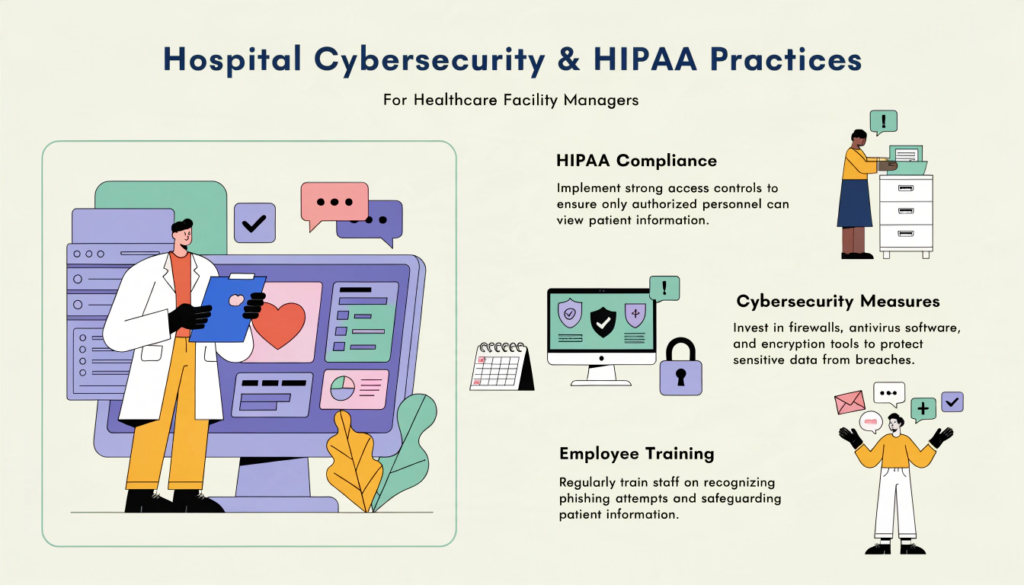
Hospitals are becoming increasingly connected. From electronic health records and connected medical devices to building management systems, digital technologies now support almost every aspect of healthcare delivery. While this connectivity improves efficiency and patient care, it also creates more opportunities for cyber threats.
For hospital facility managers, cybersecurity is no longer solely an IT department responsibility. Facility teams increasingly oversee connected infrastructure, access control systems, surveillance equipment, environmental monitoring, smart building technologies, and other systems that can become entry points for attackers.
A strong hospital cybersecurity HIPAA strategy therefore requires collaboration between facility management, IT, clinical teams, security professionals, and hospital leadership. At the same time, protecting patient information must remain a priority through effective healthcare data protection practices.
Here are eight cybersecurity practices every hospital facility manager should understand and help implement.
1. Conduct Regular Cybersecurity Risk Assessments
The first step toward stronger hospital cybersecurity HIPAA compliance is understanding where vulnerabilities exist.
Hospitals operate complex environments containing servers, computers, medical devices, HVAC systems, building management systems, access control systems, security cameras, IoT sensors, wireless networks, and third-party platforms. Each connected device or system can potentially introduce cybersecurity risks.
Facility managers should work with IT and cybersecurity teams to regularly identify connected assets and assess their security posture. The assessment should consider what information each system handles, how it connects to the hospital network, who has access, and what could happen if the system were compromised.
Risk assessments should also account for physical infrastructure. An unsecured server room, poorly protected network cabinet, or accessible control panel can create physical vulnerabilities that lead to digital security incidents.
Regular assessments help hospitals prioritize their cybersecurity investments rather than reacting only after an incident occurs.
2. Maintain an Accurate Inventory of Connected Devices
You cannot protect systems you do not know exist.
Modern hospitals may have hundreds or even thousands of connected devices, including smart sensors, medical equipment, computers, printers, access control systems, surveillance cameras, and facility automation technologies.
Maintaining a current asset inventory is therefore an important part of healthcare data protection. Facility managers should coordinate with IT departments to document connected equipment, its location, responsible department, software version, network connection, and maintenance status.
This becomes especially important when hospitals adopt IoT-enabled infrastructure. A connected HVAC controller or smart environmental sensor may not appear to be a cybersecurity concern, but if it communicates with a hospital network, it needs appropriate security controls.
The inventory should be updated whenever equipment is installed, replaced, relocated, or retired.
Hospitals should also establish a secure process for decommissioning equipment. Old devices should not simply be disconnected and discarded if they contain stored credentials, configuration information, or sensitive data.
3. Control Access to Critical Systems
Unauthorized access remains one of the biggest risks facing healthcare organizations.
Facility managers often oversee physical access to areas containing critical infrastructure, while IT teams manage digital access to systems. These two areas are closely connected.
Strong hospital cybersecurity HIPAA practices should therefore combine physical and digital access controls.
Only authorized personnel should be able to access server rooms, network closets, medical equipment areas, security control rooms, and building automation systems. Access cards, biometric authentication, visitor management, surveillance systems, and access logs can help restrict unauthorized physical entry.
Digital access should follow the principle of least privilege. Employees and contractors should receive only the permissions necessary to perform their responsibilities.
Multi-factor authentication should also be implemented wherever appropriate, particularly for systems containing sensitive information or allowing remote access.
Access privileges should be reviewed regularly. When employees change roles or leave the organization, their access should be updated or removed promptly.
4. Segment Hospital Networks and Connected Systems
Network segmentation can significantly reduce the impact of a cybersecurity incident.
A hospital’s IT environment can contain multiple categories of connected systems. Patient records, administrative computers, medical devices, security systems, and building management technologies do not necessarily need unrestricted communication with one another.
Separating networks or creating appropriate security zones can limit how far an attacker can move if one system is compromised.
For example, a compromised smart building device should not automatically provide access to systems containing protected health information.
Facility managers should work closely with IT and network security teams to understand how building systems connect to the broader hospital network. This includes HVAC controls, energy management platforms, elevators, access control systems, surveillance systems, and other smart infrastructure.
As hospitals expand their use of connected technologies, segmentation becomes an increasingly important part of healthcare data protection and overall operational resilience.
5. Keep Systems Updated and Properly Patched
Outdated software and firmware can create significant cybersecurity vulnerabilities.
Hospitals frequently operate equipment that has long lifecycles. Some medical and facility systems may remain in service for many years, making patch management more challenging than in a typical office environment.
Facility managers should maintain communication with IT teams, vendors, and equipment manufacturers to understand available security updates and maintenance requirements.
Software, firmware, operating systems, and security applications should be updated according to an established patch management process.
However, healthcare environments require careful planning before updates are deployed. A patch applied without considering clinical or facility operations could potentially disrupt critical services.
For this reason, hospitals should maintain documented procedures for testing and deploying updates while ensuring essential systems remain operational.
Where legacy equipment cannot be patched, hospitals should consider additional controls such as network isolation, restricted access, enhanced monitoring, and replacement planning.
6. Strengthen Vendor and Third-Party Security
Hospitals rarely operate entirely on their own. They depend on vendors, contractors, technology providers, equipment manufacturers, cloud platforms, maintenance companies, and other third parties.
These relationships can create cybersecurity risks if external organizations have access to hospital systems or sensitive information.
Effective hospital cybersecurity HIPAA programs should therefore include third-party risk management.
Before providing vendors with access, hospitals should evaluate their security practices, contractual obligations, access requirements, and data-handling processes. Where applicable, organizations should establish appropriate agreements and clearly define responsibilities related to protected health information.
Remote access deserves particular attention. Vendors maintaining elevators, HVAC systems, medical devices, building automation systems, or other infrastructure may require remote connectivity.
That access should be limited, monitored, authenticated, and disabled when it is no longer required.
Facility managers should also maintain a record of vendors with access to critical infrastructure and review these permissions periodically.
7. Train Facility Staff and Strengthen Cybersecurity Awareness
Technology alone cannot protect a hospital.
Employees, contractors, and facility personnel interact with physical and digital systems every day. A simple mistake, such as sharing login credentials, connecting an unauthorized device, clicking a malicious link, or leaving a workstation unsecured, can create serious security risks.
Cybersecurity awareness should therefore extend beyond IT employees.
Facility teams should receive training on recognizing suspicious activity, protecting credentials, handling sensitive information, reporting incidents, and following access control procedures.
Training should also address physical security. Employees should understand why they should not allow unauthorized individuals into restricted areas, share access cards, or leave sensitive equipment unsecured.
Regular awareness sessions can reinforce good practices and help employees understand how their actions contribute to healthcare data protection.
Hospitals should also establish clear reporting procedures. Staff should know whom to contact if they discover a suspicious device, unusual system behavior, lost access card, unauthorized visitor, or potential security incident.
A culture where employees feel comfortable reporting potential problems early can help minimize damage.
8. Develop and Test a Cybersecurity Incident Response Plan
Even the strongest cybersecurity strategy cannot eliminate every risk.
Hospitals should prepare for the possibility of ransomware, unauthorized access, system outages, data breaches, compromised devices, and other cybersecurity incidents.
An incident response plan should define what happens when a threat is identified. It should clarify responsibilities among IT, cybersecurity, facility management, clinical leadership, communications, legal teams, security personnel, and senior management.
Facility managers have an important role because cyber incidents can quickly become physical and operational problems.
For example, if a cyberattack affects building automation, access control, elevators, environmental controls, or critical infrastructure, facility teams may need to activate backup procedures or manual operating processes.
Hospitals should regularly test their response plans through tabletop exercises, simulations, and other drills. These exercises can reveal communication gaps and operational weaknesses before a real incident occurs.
Business continuity and disaster recovery planning should also be connected to cybersecurity preparedness. Hospitals must be able to continue delivering essential services even when digital systems become unavailable.
Building a Stronger Culture of Hospital Cybersecurity HIPAA Compliance
Cybersecurity in healthcare is not simply about protecting computers. It is about protecting patients, staff, clinical operations, critical infrastructure, and sensitive information.
For facility managers, this means taking a broader view of security. Building systems, connected devices, access controls, vendor relationships, and physical infrastructure can all influence the cybersecurity posture of a hospital.
A successful hospital cybersecurity HIPAA strategy requires continuous assessment, collaboration, employee awareness, technology management, and preparedness.
At the same time, healthcare data protection should be treated as an ongoing organizational responsibility rather than a one-time compliance project. Hospitals need to regularly review their systems as new technologies are introduced and operational environments change.
The growing adoption of smart hospitals, IoT devices, cloud platforms, AI-enabled systems, and connected building technologies makes this even more important. As healthcare facilities become smarter, cybersecurity must become more integrated with facility planning and management.
Preparing Hospitals for the Next Generation of Cybersecurity
The future hospital will be increasingly connected. Intelligent building management systems, real-time monitoring, connected medical devices, automation, digital twins, and data-driven facility operations can improve patient care and operational efficiency.
But every new connection introduces another element that needs to be protected.
Hospital facility managers are in a unique position to bridge the gap between physical infrastructure and digital security. By partnering with IT teams, cybersecurity specialists, clinical departments, and technology vendors, they can help create facilities that are not only efficient and intelligent but also resilient.
The most effective approach is proactive: identify vulnerabilities before they become incidents, control access, keep systems updated, monitor connected infrastructure, train employees, and regularly test response procedures.
Ultimately, strong cybersecurity supports the hospital’s most important objective—providing safe and reliable care.
Register as a Delegate
Healthcare leaders and facility professionals can explore emerging strategies, technologies, and best practices shaping modern healthcare infrastructure.
Register as a delegate:
https://bmaconventions.com/smart-healthcare-facilities-convention-2026-sep/