
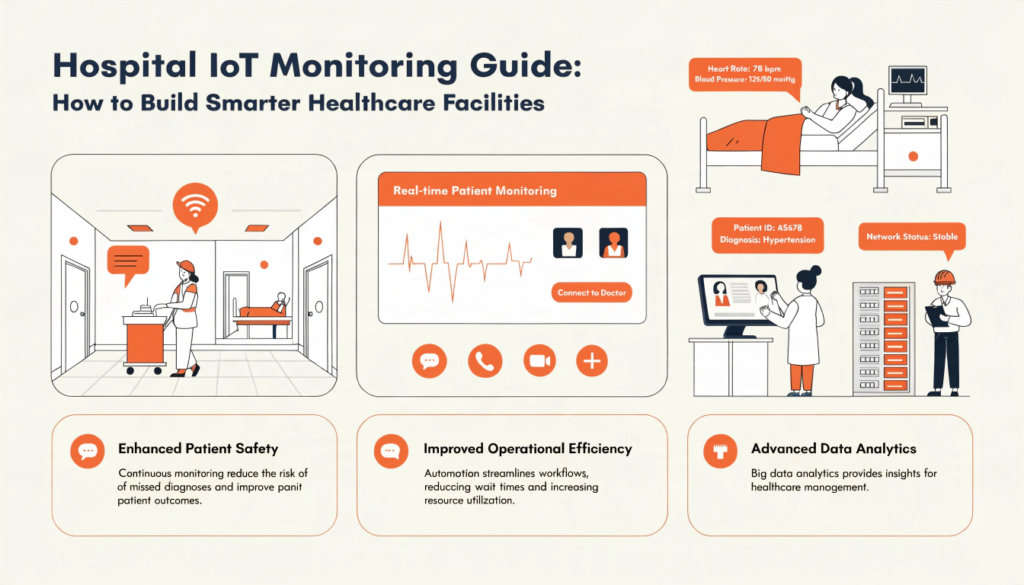
Hospitals are becoming increasingly connected. From smart medical devices and real-time patient monitoring to connected HVAC systems and intelligent energy management, the Internet of Things (IoT) is changing how healthcare facilities operate. However, simply installing connected devices is not enough. Hospitals need a structured strategy to ensure that IoT technology delivers measurable improvements in patient care, operational efficiency, safety, and facility management.
Hospital IoT monitoring provides healthcare organizations with the ability to collect, analyze, and act on real-time data from connected devices and systems. When implemented correctly, it can help clinical and facility teams identify problems faster, improve resource utilization, monitor critical environments, and make more informed decisions.
For hospitals planning their digital transformation journey, understanding how to implement IoT monitoring step by step is essential. This guide explains the key stages involved, from identifying objectives and selecting devices to integrating data, strengthening cybersecurity, and measuring results.
What Is Hospital IoT Monitoring?
Hospital IoT monitoring refers to the use of connected sensors, devices, equipment, and software platforms to continuously collect and analyze information across a healthcare environment.
These systems can monitor everything from patient-related metrics and medical equipment to temperature, humidity, air quality, energy consumption, room occupancy, and equipment performance.
For example, connected temperature sensors can alert facility teams when a vaccine refrigerator moves outside its acceptable temperature range. Smart HVAC sensors can identify unusual changes in airflow or room conditions. Connected medical equipment can provide information about utilization and maintenance requirements.
The goal is not simply to collect more data. The real value comes from transforming that data into actionable information that helps hospital teams respond quickly and make better operational decisions.
Why Hospitals Need IoT Monitoring
Modern healthcare facilities are complex environments containing thousands of assets, multiple departments, critical infrastructure, and strict safety requirements. Traditional monitoring methods often depend on manual inspections and periodic reporting, which can leave gaps between an issue occurring and someone identifying it.
IoT can help close those gaps by providing continuous visibility.
With hospital IoT monitoring, facility managers can receive real-time information about building systems and critical infrastructure. Clinical teams can gain better visibility into connected equipment, while administrators can use data to identify operational trends and inefficiencies.
IoT monitoring can also support predictive approaches. Instead of waiting for equipment to fail, hospitals can use sensor data to identify abnormal performance patterns and schedule maintenance before a major breakdown occurs.
This shift from reactive to proactive management can reduce downtime, improve asset reliability, and support better patient experiences.
Step 1: Define Your Hospital’s IoT Objectives
The first step is to determine exactly what the hospital wants to accomplish.
IoT implementation should not begin with purchasing devices. It should begin with identifying specific operational or clinical problems that need to be addressed.
A hospital might want to reduce energy consumption, improve equipment utilization, monitor environmental conditions, reduce maintenance costs, improve patient safety, or strengthen visibility across critical infrastructure.
Start by documenting existing challenges. For example, are maintenance teams spending too much time performing manual inspections? Are there frequent HVAC problems? Is medical equipment underutilized? Are critical storage areas being monitored manually?
Once these challenges are documented, establish measurable goals.
Instead of saying, “We want to improve facility monitoring,” a stronger objective would be, “We want to reduce unexpected HVAC failures by 20% within 12 months.”
Clear objectives make it easier to determine which IoT technologies are necessary and how success will be measured.
Step 2: Identify the Systems and Areas to Monitor
Once objectives are established, determine where IoT monitoring can create the greatest value.
Hospitals can deploy IoT technologies across a wide range of areas. These may include patient rooms, operating rooms, intensive care units, laboratories, pharmacies, equipment storage areas, mechanical rooms, energy systems, and other critical infrastructure.
For facility management, monitoring may include HVAC systems, air quality, temperature, humidity, lighting, water systems, power consumption, elevators, generators, and other building infrastructure.
Medical equipment can also be connected to provide information about usage, performance, location, and maintenance needs.
However, hospitals should avoid trying to connect everything at once. A phased approach is often more practical. Begin with a high-value use case where measurable improvements can be achieved, learn from the implementation, and then expand the program.
Step 3: Select the Right IoT Devices and Sensors
The next stage is selecting sensors and connected devices that meet the hospital’s requirements.
The technology should be appropriate for the environment in which it will operate. Hospitals may require devices capable of continuous monitoring, high reliability, secure connectivity, and accurate measurements.
Depending on the use case, hospitals may deploy temperature sensors, humidity sensors, occupancy sensors, pressure sensors, air-quality monitors, energy meters, equipment sensors, water leak detectors, and other connected devices.
Compatibility should also be considered. Devices should integrate effectively with the hospital’s existing technology ecosystem rather than creating isolated data silos.
Before deploying devices throughout a facility, test them in a controlled environment. This can help identify connectivity issues, inaccurate readings, battery limitations, or installation challenges before the system is scaled.
Step 4: Build a Reliable Connectivity Infrastructure
IoT monitoring depends on reliable connectivity. If devices cannot communicate consistently with the central platform, the quality of the monitoring system will suffer.
Hospitals should evaluate their existing network infrastructure before deployment. Depending on the application, IoT devices may communicate through Wi-Fi, Bluetooth, cellular connectivity, Ethernet, or other networking technologies.
Connectivity requirements can differ significantly between a temperature sensor in a storage room and a critical monitoring device in a clinical environment.
Network capacity, coverage, latency, redundancy, and reliability should therefore be assessed carefully.
Hospitals should also consider what happens when connectivity is temporarily interrupted. Devices may need local data storage or alternative communication mechanisms so that critical information is not permanently lost.
Step 5: Integrate IoT Data Into a Central Platform
Connecting devices is only one part of the process. Hospitals also need a way to manage and interpret the data being generated.
A centralized IoT platform can bring information from different sensors and systems into a common environment. Instead of facility managers checking individual devices or disconnected dashboards, they can view relevant information through a unified interface.
Integration with existing hospital technologies is particularly important. Depending on the use case, IoT platforms may need to work alongside building management systems, computerized maintenance management systems, electronic health record environments, asset management platforms, or other operational technologies.
The objective should be to create a connected flow of information that allows teams to understand what is happening and take appropriate action.
Step 6: Configure Real-Time Alerts and Notifications
One of the biggest advantages of IoT monitoring is the ability to identify problems as they happen.
However, simply generating thousands of notifications can overwhelm hospital staff. Alerts should therefore be designed around the importance and urgency of each event.
For example, if a critical medical storage area reaches an unsafe temperature, the system should immediately notify the responsible team. A less urgent change in energy consumption may instead be included in a daily or weekly report.
Alert thresholds should be carefully configured and reviewed over time. Poorly designed alerts can result in notification fatigue, causing staff to ignore important warnings.
Effective hospital IoT monitoring should provide the right information to the right person at the right time.
Step 7: Strengthen IoT Cybersecurity
Cybersecurity must be a core component of any hospital IoT strategy.
Connected devices create additional entry points into a hospital’s technology environment. If these devices are not properly secured, attackers may exploit vulnerabilities to access systems, disrupt operations, or compromise sensitive information.
Hospitals should establish strong device authentication, access controls, network segmentation, encryption, secure configuration, and regular software updates.
Organizations should also maintain an inventory of connected devices. Knowing which devices exist, where they are located, what software they use, and who manages them is essential for effective security.
Third-party vendors should also be evaluated carefully. Hospitals should understand how vendors handle device security, software updates, data protection, and vulnerability management.
Cybersecurity should not be treated as something that is added after IoT deployment. It needs to be incorporated from the design and planning stages.
Step 8: Train Staff and Establish Clear Responsibilities
Even the most advanced IoT system will not deliver results if hospital employees do not understand how to use it.
Training should be tailored to different teams. Facility managers may need to understand dashboards, environmental alerts, and equipment trends. Maintenance teams may require training on predictive maintenance notifications. Clinical teams may need to understand relevant device alerts and escalation procedures.
Hospitals should also establish clear responsibilities.
When an alert is generated, who receives it? Who investigates the issue? Who escalates it? What happens if the primary person is unavailable?
Creating clear procedures prevents important alerts from falling through the cracks.
Staff feedback should also be collected during the early stages of deployment. Employees working directly with the system can identify usability problems and suggest improvements that may not be obvious during initial planning.
Step 9: Start With a Pilot Project
Rather than implementing IoT monitoring throughout an entire hospital immediately, organizations should consider starting with a pilot.
Choose one department, building system, or operational challenge where IoT can demonstrate measurable value.
For example, a hospital could begin with environmental monitoring in pharmaceutical storage areas or predictive monitoring for critical HVAC equipment.
During the pilot, track technical performance as well as operational outcomes. Look at sensor accuracy, connectivity, alert response times, maintenance requirements, staff adoption, and cost savings.
The pilot provides an opportunity to identify problems before scaling the technology across the wider facility.
Step 10: Measure Performance and Scale the Program
After the pilot has been completed, evaluate whether the system delivered the expected results.
Useful metrics can include equipment downtime, maintenance costs, energy consumption, alert response times, asset utilization, environmental compliance, and operational efficiency.
The results should be compared with the objectives established at the beginning of the project.
If the pilot produces measurable benefits, the hospital can gradually expand IoT monitoring into additional areas.
Scaling should remain strategic. Hospitals should prioritize use cases based on potential value, risk, implementation complexity, and available resources.
Over time, data from different IoT systems can be combined to provide a more comprehensive view of hospital operations.
Common Challenges When Implementing IoT in Healthcare Facilities
Implementing IoT across healthcare environments can involve several challenges. Legacy infrastructure is one common issue. Older hospital systems may not have been designed to communicate with modern connected devices.
Data interoperability can also become difficult when different vendors use different technologies and communication standards. Without appropriate integration, hospitals can end up with multiple isolated platforms.
Another challenge is data volume. IoT systems can generate enormous amounts of information. Hospitals need to determine which data is useful and how it should be analyzed.
Cybersecurity and privacy concerns also require continuous attention. As the number of connected devices increases, security teams need appropriate visibility and controls.
Budget considerations should not be overlooked either. The cost of an IoT project includes more than sensors. Hospitals may need to invest in network infrastructure, software, integration, cybersecurity, maintenance, training, and ongoing support.
A well-designed implementation plan can help address these challenges while ensuring that IoT investments are aligned with measurable business and healthcare outcomes.
The Future of IoT Healthcare Facilities
IoT adoption is likely to become increasingly important as healthcare organizations look for smarter ways to manage complex facilities.
Future IoT healthcare facilities may rely more heavily on artificial intelligence, predictive analytics, digital twins, automation, and advanced building management systems.
Instead of simply reporting that equipment has reached a certain temperature or vibration level, advanced systems can analyze historical and real-time data to identify patterns and predict potential failures.
IoT can also contribute to smarter energy management. Connected systems can analyze occupancy, environmental conditions, and equipment performance to optimize heating, cooling, ventilation, and lighting.
The long-term opportunity is to move from connected monitoring toward intelligent facility management, where data continuously supports better decisions.
Building a Smarter Hospital With IoT Monitoring
Successful IoT implementation requires more than installing sensors. Hospitals need a structured strategy that connects technology with measurable operational and clinical objectives.
The process begins by identifying the right problems to solve. From there, healthcare organizations can select appropriate devices, establish reliable connectivity, integrate data, configure meaningful alerts, strengthen cybersecurity, train staff, test solutions through pilot projects, and measure performance.
When implemented strategically, hospital IoT monitoring can give healthcare organizations greater visibility into their facilities, assets, and operations. It can help teams respond faster, identify potential problems earlier, and create more efficient and resilient healthcare environments.
As healthcare facilities continue to evolve, IoT will play an increasingly important role in creating connected, data-driven, and intelligent hospitals.
Explore the Future of Smart Healthcare Facilities
Want to learn how emerging technologies are transforming modern healthcare infrastructure? Connect with industry professionals and explore the latest strategies, technologies, and solutions shaping smarter healthcare environments.
Download our event agenda to discover what is next for smart healthcare facilities.