
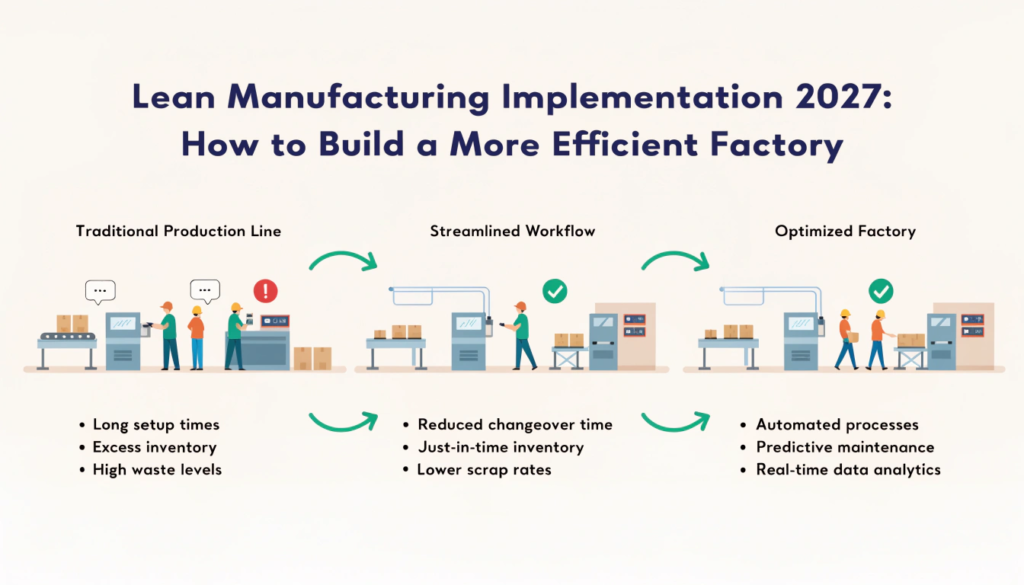
Manufacturers are entering 2027 under increasing pressure to improve productivity, control costs, reduce waste, and respond faster to changing customer expectations. At the same time, factories are adopting automation, connected equipment, artificial intelligence, robotics, and real-time analytics. In this environment, lean manufacturing remains highly relevant because it provides a structured approach to improving processes while creating greater value for customers.
However, successful lean manufacturing implementation 2027 requires more than introducing 5S, Kanban, or value stream mapping. Manufacturers need to connect lean principles with modern technologies, workforce development, data-driven decision-making, and long-term operational goals.
This practical lean production guide explains how manufacturers can build a lean manufacturing strategy in 2027, from identifying waste and mapping processes to implementing continuous improvement and measuring results.
What Is Lean Manufacturing?
Lean manufacturing is an operational approach focused on maximizing customer value while minimizing activities that consume resources without creating value. The fundamental objective is to produce the right product, at the right time, in the right quantity, while using as few unnecessary resources as possible.
Lean thinking traditionally focuses on identifying and eliminating different forms of waste, including overproduction, waiting, unnecessary transportation, excess inventory, unnecessary motion, defects, overprocessing, and underutilized employee capabilities.
The principles behind lean manufacturing can be applied to production lines, warehouses, maintenance operations, procurement, quality management, and other manufacturing functions.
In 2027, however, lean manufacturing is increasingly connected with digital transformation. Sensors, manufacturing execution systems, industrial IoT platforms, artificial intelligence, predictive analytics, and automation can provide the visibility needed to identify inefficiencies faster.
This makes lean manufacturing implementation 2027 a combination of established operational principles and modern digital capabilities.
Why Lean Manufacturing Matters in 2027
Manufacturers are dealing with several challenges simultaneously. Labor availability, supply chain disruptions, rising operating costs, quality expectations, energy consumption, and demand volatility can all affect production performance.
Lean manufacturing provides a framework for addressing these challenges systematically.
Instead of immediately investing in expensive equipment or adding more resources, manufacturers can first examine how existing processes work. A bottleneck may be caused by excessive movement, poor scheduling, unnecessary approvals, inconsistent work instructions, equipment downtime, or inefficient material flow.
By identifying the actual source of the problem, manufacturers can make targeted improvements.
Lean also supports a culture of continuous improvement. Rather than treating operational improvement as a one-time project, companies can encourage employees and managers to continuously identify problems, test solutions, and standardize successful changes.
Step 1: Define Your Manufacturing Objectives
The first step in implementing lean manufacturing is to establish clear business and operational objectives.
A manufacturer should determine what it wants to improve. The objective might be reducing production lead time, lowering scrap, increasing equipment availability, improving first-pass yield, reducing inventory, or increasing on-time delivery.
Avoid starting with vague objectives such as “make the factory more efficient.” Instead, establish measurable targets.
For example, a company may aim to reduce production lead time by 15%, decrease scrap by 10%, improve overall equipment effectiveness, or reduce work-in-progress inventory over a specific period.
These objectives provide a foundation for the rest of the lean program.
They also help management determine whether lean initiatives are actually producing measurable improvements.
Step 2: Understand Your Current State
Before changing a process, manufacturers need to understand how it currently operates.
This involves collecting information about production flow, material movement, equipment performance, labor requirements, inventory levels, quality issues, downtime, and process times.
One of the most useful tools is value stream mapping. It provides a visual representation of how materials and information move through the manufacturing process.
A value stream map can reveal delays, bottlenecks, excess inventory, unnecessary transportation, long changeover times, and other sources of waste.
In 2027, manufacturers can enhance traditional value stream mapping with real-time operational data. Connected equipment and digital systems can help validate assumptions with actual performance information.
This combination of employee knowledge and production data can provide a more accurate picture of the current state.
Step 3: Identify and Prioritize Waste
After understanding the current process, the next step is identifying waste.
Lean manufacturing traditionally identifies eight major categories of waste: defects, overproduction, waiting, non-utilized talent, transportation, inventory, motion, and extra processing.
However, not every problem needs to be addressed simultaneously.
Manufacturers should prioritize waste according to its impact on safety, quality, delivery, cost, and customer value.
For example, a production line may have excessive material movement but also experience frequent equipment downtime. If downtime is responsible for significantly greater production losses, it may deserve immediate attention.
This prioritization prevents lean programs from becoming overwhelmed by too many improvement projects.
Step 4: Engage Employees From the Beginning
A successful lean production guide cannot focus only on technology and management decisions. Employees who work directly with machines, materials, and processes often have the clearest understanding of operational problems.
Operators may know why a machine frequently stops, why materials are difficult to access, or why a particular process regularly causes rework.
Manufacturers should therefore involve employees in identifying problems and designing improvements.
Training should cover lean principles, problem-solving methods, standard work, root-cause analysis, 5S, and continuous improvement.
Employee involvement also helps reduce resistance to change. When workers understand why a process is changing and have an opportunity to contribute, they are more likely to support the transformation.
Step 5: Implement 5S for Workplace Organization
5S is one of the most practical starting points for lean manufacturing.
The methodology focuses on organizing the workplace, removing unnecessary items, establishing consistent arrangements, maintaining cleanliness, and creating standards that support long-term discipline.
A well-organized workplace can reduce unnecessary movement, improve safety, make abnormalities easier to identify, and help employees find tools and materials faster.
However, 5S should not become merely a cleaning exercise.
The objective is to create a workplace where problems become visible. For example, clearly marked storage locations can make missing tools or excess inventory easier to identify.
Manufacturers should also establish routines for maintaining the improvements rather than treating 5S as a one-time activity.
Step 6: Improve Workflow and Material Flow
Once obvious workplace waste has been addressed, manufacturers should examine the movement of materials and products.
An inefficient production layout can result in unnecessary transportation, excessive motion, long production cycles, and increased handling risks.
Manufacturers should evaluate whether equipment, workstations, storage areas, and inspection points are positioned logically.
Where possible, production processes should be arranged to support smooth flow.
Kanban and pull-based production systems can also help manufacturers manage material replenishment according to actual demand rather than producing excessive inventory.
The objective is not simply to reduce inventory. Instead, manufacturers should develop a balanced system where materials are available when required without creating unnecessary accumulation.
Step 7: Standardize Work Processes
Continuous improvement becomes difficult when employees perform the same task differently every time.
Standard work establishes a consistent method for completing a process while documenting important information such as sequence, timing, quality requirements, and safety considerations.
Standardization provides a baseline against which improvements can be measured.
If a process changes and performance improves, manufacturers can compare the new results with the previous standard.
Standard work should not prevent improvement. Instead, it provides a foundation for identifying better methods.
When employees discover a more effective approach, the organization can test it, verify its results, and update the standard where appropriate.
Step 8: Use Technology to Strengthen Lean Operations
Technology will play an increasingly important role in lean manufacturing implementation 2027.
Manufacturers can use sensors, connected machines, industrial IoT systems, manufacturing execution systems, digital dashboards, and analytics platforms to improve operational visibility.
For example, real-time machine data can help identify recurring downtime patterns. Analytics can highlight quality trends, while predictive maintenance technologies can help identify potential equipment failures before they cause significant disruption.
Artificial intelligence can also support forecasting, quality inspection, process optimization, and decision-making.
However, manufacturers should avoid adopting technology simply because it is available.
A digital tool should solve a clearly defined operational problem. Automating an inefficient process without addressing its underlying issues can simply make waste occur faster.
The best approach is to identify the problem first and then determine whether technology can provide an effective solution.
Step 9: Apply Root-Cause Problem Solving
Lean manufacturing focuses on solving problems at their source rather than repeatedly addressing symptoms.
Tools such as the 5 Whys, fishbone diagrams, Pareto analysis, and PDCA can support structured problem-solving.
For example, if a production line experiences frequent defects, the organization should investigate why those defects occur. The underlying issue may involve machine settings, raw material variation, employee training, environmental conditions, or unclear work instructions.
The 5 Whys approach encourages teams to repeatedly question why a problem is occurring until they identify a deeper cause.
Manufacturers should also use data whenever possible. Combining employee observations with measurable production information can make root-cause analysis more reliable.
Step 10: Measure Lean Performance
A lean transformation needs measurable performance indicators.
Manufacturers should establish KPIs that connect improvement activities with business objectives. Common measures include cycle time, lead time, scrap rate, first-pass yield, downtime, inventory turnover, on-time delivery, changeover time, and overall equipment effectiveness.
The most useful metrics depend on the organization’s priorities.
For example, a manufacturer struggling with customer delivery performance may prioritize lead time and on-time delivery. A manufacturer experiencing high production costs may focus more heavily on scrap, downtime, productivity, and equipment utilization.
Dashboards can make these metrics easier to monitor. However, manufacturers should avoid creating too many KPIs. A smaller set of meaningful indicators is often more useful than a large collection of metrics that employees cannot act upon.
Step 11: Start Small and Scale Successful Improvements
One of the biggest mistakes companies can make is trying to transform the entire factory simultaneously.
Instead, manufacturers can select a pilot production area and test their lean approach.
A pilot project allows the organization to identify implementation challenges, demonstrate measurable results, gather employee feedback, and refine its approach.
Once successful practices have been established, they can be expanded to additional production lines or facilities.
This approach can also help management demonstrate the financial and operational value of lean manufacturing before making larger investments.
Step 12: Build a Culture of Continuous Improvement
The final step is also the most important: making lean a part of the organization’s culture.
Lean manufacturing cannot depend solely on occasional improvement projects. It should become part of everyday management and employee behavior.
Regular improvement meetings, employee suggestions, performance reviews, problem-solving sessions, and leadership involvement can help maintain momentum.
Managers should recognize employees who identify problems and contribute practical solutions. At the same time, organizations should view failures from improvement experiments as learning opportunities when they are approached responsibly.
The goal is to create an environment where employees are encouraged to ask questions such as, “Why is this process performed this way?” Can this step be simplified? Is there unnecessary movement? Can quality problems be prevented rather than detected later?
This mindset is at the heart of continuous improvement.
Combining Lean Manufacturing With Industry 4.0
The future of lean manufacturing will increasingly involve the integration of operational excellence and Industry 4.0 technologies.
Smart factories can combine lean principles with automation, robotics, artificial intelligence, digital twins, connected equipment, cloud platforms, and advanced analytics.
For example, lean thinking can identify unnecessary production delays, while real-time data can reveal exactly when and where those delays occur.
Similarly, lean principles can identify excessive preventive maintenance activities, while predictive analytics can help maintenance teams determine when equipment actually requires attention.
This combination can make lean manufacturing implementation 2027 more data-driven, responsive, and scalable.
The important point is that technology should support lean principles rather than replace them.
Common Mistakes to Avoid
Manufacturers should also recognize the common barriers that can undermine lean initiatives.
One common mistake is treating lean as a cost-cutting program. While lean can reduce costs, its broader purpose is to improve customer value, flow, quality, and operational performance.
Another mistake is focusing exclusively on tools. Implementing 5S, Kanban, or value stream mapping without developing a culture of problem-solving is unlikely to produce sustainable results.
Lack of leadership involvement can also weaken lean programs. Employees need to see that management is committed to continuous improvement and willing to provide the necessary resources.
Finally, manufacturers should avoid expecting immediate results from every initiative. Sustainable lean transformation requires experimentation, measurement, employee involvement, and continuous refinement.
The Future of Lean Manufacturing in 2027
Lean manufacturing will continue to evolve as factories become more connected and automated.
The fundamentals, however, will remain highly relevant: understand customer value, identify waste, improve flow, solve problems at their root, standardize successful processes, and continuously improve.
The difference in 2027 is that manufacturers have access to more data and technology than ever before. When these capabilities are combined with proven lean principles, companies can build more flexible, efficient, resilient, and responsive manufacturing operations.
A successful lean transformation does not require every technology available on the market. It requires a clear understanding of operational problems and a disciplined approach to solving them.
Manufacturers that begin with measurable objectives, involve employees, improve processes systematically, and use technology strategically can create a strong foundation for long-term operational excellence.
Conclusion
Implementing lean manufacturing in 2027 is about more than reducing waste. It is about building a production system capable of delivering greater customer value with fewer unnecessary resources.
The journey starts by defining objectives and understanding the current state. From there, manufacturers can identify waste, improve workplace organization, optimize material flow, standardize processes, use technology strategically, solve root causes, and measure performance.
Most importantly, lean manufacturing should become a continuous process rather than a one-time project.
As manufacturing becomes increasingly digital and connected, organizations that combine lean thinking with smart technologies can improve productivity while creating more resilient and adaptable operations.
View the Manufacturing Convention Agenda: https://bmaconventions.com/smart-manufacturing-automation-convention-2027/
Connect with manufacturing leaders, technology innovators, plant managers, and industry experts to discover practical strategies shaping the future of modern manufacturing.