
Ask any bedside nurse at a major hospital what frustrates them most during a busy shift, and you will rarely hear about charting software or medical protocols first. Instead, you will hear a universal complaint: spending twenty to forty-five minutes searching empty hallways, clean utility rooms, and supply closets just to find a working intravenous (IV) infusion pump, a specialized bariatric wheelchair, or a mobile bladder scanner.
For hospital chief executive officers, chief nursing officers (CNOs), and chief operating officers, this daily equipment hunt is an operational disaster. Highly paid clinical nurses are wasting valuable bedside care hours playing hide-and-seek with medical hardware. At the same time, biomedical engineering departments often purchase or rent 30% more mobile medical equipment than the hospital actually needs because nobody knows where the existing machines are located.
To solve this chronic operational bottleneck, health systems are accelerating investments in RFID hospital asset tracking. But when evaluating modern systems, leadership teams face a critical technology decision: should you deploy active or passive RFID tags? Understanding the business trade-offs of active vs passive RFID healthcare systems is essential for maximizing capital return on investment (ROI), improving clinical workflow efficiency, and eliminating phantom inventory. Here is an executive guide to choosing the right tracking technology for your health system.
The Hidden Costs of “Phantom Inventory” in Hospitals
In most 300-bed acute care hospitals, the mobile medical equipment fleet consists of several thousand individual items. This includes smart infusion pumps, enteral feeding pumps, sequential compression devices (SCDs), telemetry transmitters, and mobile computer workstations on wheels (COWs).
Studies consistently reveal alarming statistics regarding hospital asset utilization:
- Sub-40% Average Utilization: In un-tracked hospitals, mobile medical assets are typically utilized less than 40% of the time. The remaining 60% of the fleet sits idle, hidden in patient rooms, tucked away in clean utility closets, or stuck waiting for preventive maintenance.
- Clinical Hoarding Habits: When floor nurses struggle to find equipment during emergency admissions, they develop defensive hoarding habits. Nurses will intentionally hide clean infusion pumps inside empty closets or behind curtains to ensure they have equipment ready for their next incoming patient. This hoarding behavior starves adjacent floors of gear.
- Runaway Rental Equipment Invoices: When departments report equipment shortages, supply chain managers panic and order rental pumps from third-party leasing vendors. Many hospitals spend hundreds of thousands of dollars annually renting equipment they already own but simply cannot locate.
- Asset Shrinkage and Theft: Mobile hardware frequently walks out the back door. Small telemetry boxes, pulse oximeters, and patient monitors get accidentally rolled into commercial laundry bins, packed into patient discharge bags, or stolen.
Understanding the Basics: Active vs. Passive RFID Explained Simply
Radio Frequency Identification (RFID) uses wireless radio waves to identify and locate physical items. While both active and passive technologies eliminate manual clipboard audits, they operate on completely different principles and price points.
What Is Passive RFID?
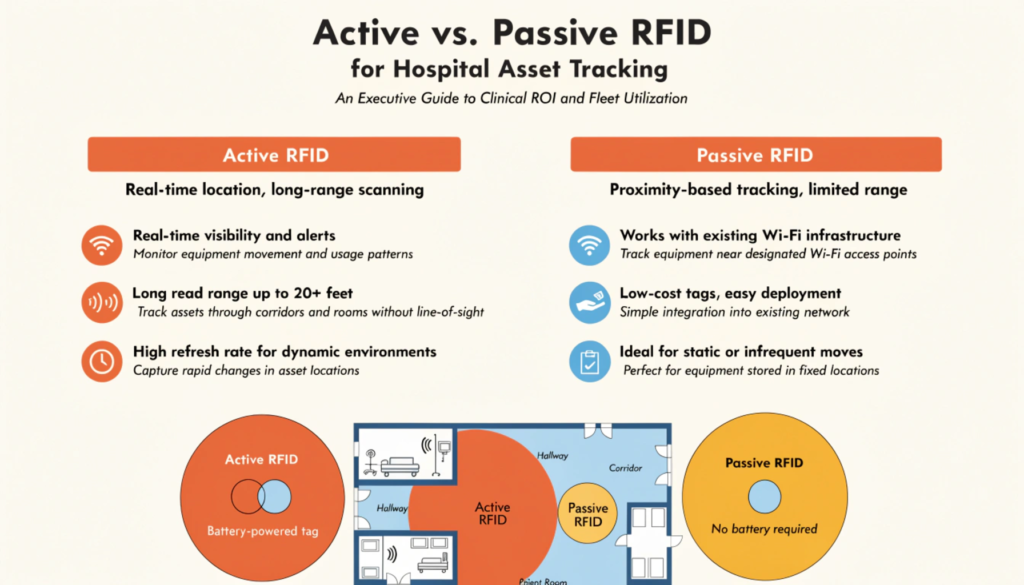
Passive RFID tags have no internal battery. The tag consists of a tiny microchip attached to a flat printed antenna, usually packaged inside an adhesive paper sticker or durable plastic label. The tag stays completely dormant until it passes through the electromagnetic field generated by a specialized RFID reader antenna.
The reader antenna broadcasts radio waves that wirelessly energize the tag’s microchip, and the tag broadcasts its unique serial number back to the reader. Passive tags are tiny, lightweight, and cost pennies to a few dollars each. However, their detection range is limited (typically 5 to 20 feet), meaning they can only report an item’s location when the item physically passes through a designated doorway, portal, or hallway choke point.
What Is Active RFID (Real-Time Location Systems – RTLS)?
Active RFID tags contain their own internal lithium battery and an active radio transmitter. These tags do not wait to be scanned; they continuously broadcast a wireless beacon signal every few seconds using technologies like Bluetooth Low Energy (BLE), Wi-Fi, or Ultra-Wideband (UWB).
Ceiling-mounted sensors located throughout the hospital pick up these continuous signals, measuring signal strength and arrival angles to triangulate the tag’s exact physical position in real time. An active RFID tag can show an operator that an infusion pump is sitting specifically in Room 412, Bed B. Active tags are larger (resembling a key fob) and cost between $15 and $50 each, with batteries that last three to five years.
Comparing the Business Models: The Executive Trade-Offs
Choosing between active and passive systems is not a matter of which technology is “better.” It is a question of matching technology costs to the operational value of the asset being tracked.
| Feature | Passive RFID | Active RFID (RTLS) |
|---|---|---|
| Location Precision | Zone / Choke-point (e.g., “Left 4th Floor Storage”) | Room/sub-room level (e.g., “Room 304, Bed A”) |
| Tag Cost | $0.20 to $3.00 per tag | $15.00 to $50.00 per tag |
| Infrastructure Cost | Lower (readers placed at doorway portals only) | Higher (dense ceiling beacon/gateway network) |
| Tag Lifespan | Indefinite (no battery to deplete) | 3 to 5 years (requires battery maintenance) |
| Best Use Case | High-volume, lower-cost items (linens, surgical trays, wheelchairs) | High-value, time-critical assets (infusion pumps, ventilators, defibrillators) |
The Hybrid Solution: How Progressive Health Systems Win
In previous years, hospitals often made the mistake of trying to choose a single technology for the entire building. They either deployed passive RFID everywhere and became frustrated that nurses still couldn’t pinpoint which room had an infusion pump, or they tried to stick expensive active tags onto every hospital bedsheet and wheelchair, blowing their capital budgets.
In 2026, leading healthcare systems adopt a sensible hybrid architecture:
- Active RTLS for High-Velocity Clinical Assets: Active tags are assigned to the top 20% of high-value, high-demand mobile assets. Infusion pumps, ventilators, crash carts, mobile ultrasound units, and specialized wound vacs get active BLE tags. A nurse can glance at an iPad screen at the nursing station and instantly see that an infusion pump is sitting directly inside Room 214.
- Passive RFID for Volume Inventory and Choke Points: Inexpensive passive RFID tags are affixed to thousands of secondary items: surgical instrument trays, commercial linen carts, standard wheelchairs, and specialty medical supply bins. Passive doorway antennas at loading docks, elevator lobbies, and soiled utility rooms track when items move between departments or leave the building.
- Unified Software Dashboard: Both tag technologies feed their location telemetry into a single enterprise dashboard integrated directly into your Electronic Health Record (EHR) and Computerized Maintenance Management System (CMMS).
Measuring Hard Financial ROI for the C-Suite
Deploying an enterprise RFID hospital asset tracking system delivers quantifiable financial returns across multiple operational departments:
- Immediate Fleet Right-Sizing (15% to 25% Reduction): Once hospitals gain visibility into actual asset utilization, they discover they own plenty of equipment. Many facilities safely cancel annual leasing contracts, saving hundreds of thousands of dollars in year one alone.
- Recovered Nursing Hours: Giving nurses an instant digital map that shows where mobile equipment is parked saves 20 to 30 minutes per nurse per shift. For a hospital with 400 bedside nurses, that recovers thousands of productive clinical hours every month, boosting nurse retention and lowering overtime pay.
- Preventive Maintenance (PM) Compliance: Biomedical engineering technicians spend half their time walking floors trying to find pumps overdue for annual safety inspections. With real-time location tracking, technicians walk directly to the machine, driving Joint Commission PM compliance rates up to 99%.
- Eliminated Asset Loss: Automated alerts notify security whenever a tagged hospital asset approaches an exterior exit door or laundry chute, ending expensive hardware shrinkage.
Strategic Implementation Roadmap for Hospital Executives
If your health system is preparing to evaluate active vs passive RFID healthcare solutions over the next budget cycle, follow this phased executive roadmap:
- Start with a Pain-Point Audit: Meet with nursing managers and biomedical directors. Ask them to identify the top three pieces of equipment that take the longest to find or generate the highest rental invoices.
- Evaluate Existing Wi-Fi and Low-Voltage Infrastructure: Many modern hospital Wi-Fi 6E access points already have built-in Bluetooth Low Energy (BLE) antennas. You may be able to deploy an active RTLS system without installing thousands of new ceiling sensors.
- Standardize Tag Attachments: Ensure tag cases are rated to withstand aggressive hospital disinfection chemicals, including bleach and quaternary ammonium wipes.
- Integrate with Bedside Workflows: Make sure asset location maps are accessible from the mobile smartphones and workstation screens nurses already carry, rather than requiring them to log into separate computer systems.
Conclusion: The Smart Hospital Foundation
In the challenging healthcare landscape of 2026, hospital executives cannot afford to let valuable clinical staff spend their shifts searching for lost hardware. Investing in a thoughtfully designed RFID hospital asset tracking ecosystem transforms chaotic equipment management into a streamlined, automated process.
By balancing the high-precision clinical benefits of active tracking with the cost-effective scalability of passive tags, healthcare leaders solve equipment shortages, eliminate wasteful rental spending, and give nurses back what matters most: time to care for patients.
Explore Smart Hospital Innovation at BMA Conventions
Connect with hospital CEOs, chief nursing officers, and healthcare facilities directors at our upcoming national convention. Discover hands-on demonstrations of healthcare IoT, RTLS asset tracking, and smart hospital infrastructure.