
If you manage digital infrastructure or invest in enterprise technology in 2026, one acronym comes up in almost every boardroom discussion: PUE. While power usage effectiveness was once a niche metric tracked only by facilities engineers in boiler rooms, it has suddenly become a central metric for chief executive officers, financial directors, and sustainability leaders.
The reason for this intense executive focus is simple: the explosive growth of artificial intelligence and high-performance computing has created an unprecedented global power crunch. Data center operators can no longer afford to waste electricity on inefficient cooling systems or aging electrical transformers. Understanding how to optimize your PUE data center performance is now vital for lowering operating expenses, complying with strict environmental regulations, and securing scarce electrical grid capacity. Here is power usage effectiveness explained from an executive, practical business perspective.
What Is PUE? A Simple Breakdown for Business Leaders
Power Usage Effectiveness (PUE) was created by The Green Grid, a global industry consortium, to measure how efficiently a computer data center uses its electricity. In plain English, PUE tells you how much overhead power the building consumes just to keep the servers running.
The mathematical formula is straightforward:
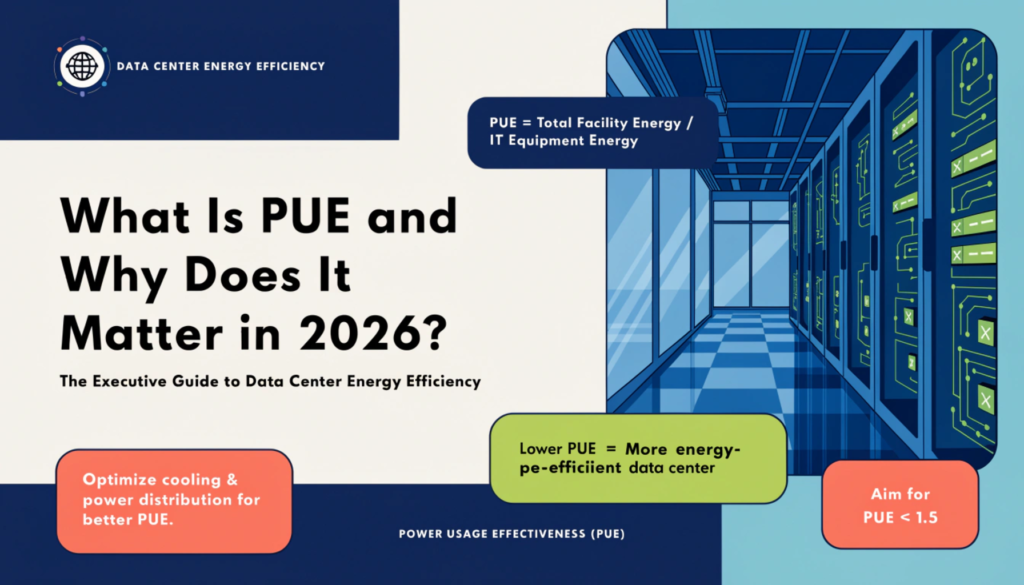
PUE = Total Facility Energy / IT Equipment Energy
To understand what these two numbers mean in practice, think of a household restaurant kitchen:
- IT Equipment Energy: This is the electricity consumed directly by your computers, storage disks, and network switches. These are the productive machines actually doing useful digital work—like the ovens and stoves in a kitchen cooking food for customers.
- Total Facility Energy: This includes the IT power PLUS all the supporting building utilities: giant air conditioners, water chillers, ventilation fans, uninterruptible power supply (UPS) battery systems, transformers, and building lights. These are like the kitchen exhaust hoods, dining room air conditioning, and walk-in freezer cooling systems.
If your data center draws 2,000 kilowatts (kW) of total utility power from the electric company, and your server racks consume 1,000 kW of that electricity, your PUE is 2.0 (2,000 divided by 1,000). That means for every watt of power used to run a server, another full watt is wasted on cooling, fans, and power losses.
What Does a Good PUE Look Like in 2026?
The ideal theoretical PUE score is 1.0. A score of 1.0 would mean that 100% of the electricity entering the building goes straight into the computer servers, with zero energy lost to fans, cooling, or power conversion. While a perfect 1.0 is physically impossible, the industry has made remarkable progress:
- Legacy Enterprise Data Centers (PUE 1.6 to 2.0): Many older corporate server rooms built ten to fifteen years ago still operate in this range. At a PUE of 1.8, nearly 45% of the total monthly electric bill goes toward air conditioning and mechanical overhead rather than computing.
- Modern Colocation Facilities (PUE 1.3 to 1.4): Well-maintained commercial data centers using hot-aisle containment and modern chillers usually operate around 1.35. This represents a solid industry baseline for traditional workloads.
- State-of-the-Art Hyperscale Campuses (PUE 1.1 to 1.2): Leading cloud providers and modern colocation operators routinely achieve annual PUE scores between 1.10 and 1.18. They do this by using direct evaporative cooling, advanced economizers, and intelligent airflow management.
- Next-Generation Liquid-Cooled Facilities (PUE under 1.10): New facilities engineered specifically for high-density AI clusters use direct-to-chip liquid cooling. By eliminating massive air-moving fans, these facilities achieve astonishing PUE ratings between 1.05 and 1.08.
Why PUE Matters More Than Ever in 2026
A few years ago, achieving a lower PUE was primarily viewed as a sustainability badge or an environmental public relations win. Today, it has become an existential business priority driven by three major economic forces:
1. The Electrical Grid Bottleneck
In major data center hubs like Northern Virginia, Silicon Valley, Dallas, and Phoenix, local electric utility companies are struggling to deliver new multi-megawatt connections. Power substations are overloaded, and interconnection queues often stretch out four to seven years. If your company is granted a 50-megawatt power allocation from the utility, you want as much of that capacity as possible powering revenue-generating AI servers not burned up, running inefficient mechanical chillers.
2. Multi-Million-Dollar Operating Cost Savings
Electricity prices have climbed steadily across North America and Europe. For a large 20-megawatt data center, dropping your PUE from 1.5 to 1.2 saves approximately 6 megawatts of continuous power. Over the course of a single year, that efficiency improvement slashes several million dollars directly from the facility’s utility bills, dramatically accelerating capital payback.
3. Strict Sustainability Laws and Corporate ESG Mandates
Governments worldwide are implementing mandatory energy reporting and efficiency minimums for digital infrastructure. In the European Union, the Energy Efficiency Directive mandates that large data centers report their PUE, water consumption, and heat reuse publicly. In the United States, major enterprise clients and institutional investors now refuse to sign leasing contracts with facilities that fail to meet modern efficiency benchmarks.
Beyond PUE: The Rise of WUE and CUE
While PUE remains the foundational benchmark, sophisticated technology leaders in 2026 recognize that measuring power alone doesn’t tell the whole environmental story. In fact, optimizing only for PUE can sometimes create unintended environmental side effects.
For example, some facilities lower their electrical PUE by running massive evaporative cooling towers that spray water into outdoor air streams. While this cuts fan electricity, it can consume millions of gallons of drinking water every week in drought-prone regions. To address this, modern operators track a broader trio of efficiency metrics:
- WUE (Water Usage Effectiveness): Measures annual water consumption relative to IT power (liters per kilowatt-hour). A sustainable facility balances low PUE with zero or minimal water consumption.
- CUE (Carbon Usage Effectiveness): Measures the total greenhouse gas emissions generated per unit of compute power (kilograms of CO₂ equivalent per kilowatt-hour). A facility powered by nuclear or solar energy can achieve superior CUE even if its PUE is slightly higher.
- Heat Reuse Ratio: Measures what percentage of waste thermal energy exiting server racks is captured and redirected to warm nearby municipal buildings, greenhouses, or district heating networks.
Practical Strategies to Lower Your PUE Today
Improving energy efficiency does not always require spending hundreds of millions of dollars on a brand-new building. Operations directors can lower their PUE data center scores significantly through targeted retrofits:
- Install Aisle Containment: Mixing hot exhaust air with cold supply air is the single biggest cause of energy waste in legacy facilities. Installing plastic strip curtains or rigid metal roof panels to physically isolate hot aisles from cold aisles can instantly drop PUE by 0.15 to 0.20 points.
- Raise Server Room Temperatures: Decades ago, data center operators kept server rooms as cold as meat lockers (around 65°F or 18°C). Modern server equipment certified under ASHRAE TC 9.9 standards can run safely and reliably at intake temperatures between 75°F and 80°F (24°C to 27°C). Raising room temperatures reduces chiller runtime dramatically.
- Adopt Variable Speed Drives (VFDs): Older cooling fans and water pumps run at 100% full speed all the time, even during cold winter nights. Adding VFDs allows motors to slow down automatically during cooler weather, saving massive amounts of electricity.
- Transition to Liquid Cooling for AI: For high-density racks exceeding 40 kW, retrofitting with direct-to-chip liquid cooling eliminates the need for high-velocity room fans and delivers industry-leading PUE performance.
Conclusion: Energy Efficiency as a Competitive Moat
In the digital economy of 2026, computing power is the lifeblood of modern commerce. But compute power is entirely constrained by energy availability. The companies that understand power usage effectiveness explained and implement disciplined energy management will be the ones who secure grid allocations, control operating expenses, and scale their AI infrastructure sustainably.
Optimizing your PUE data center score is no longer a technical chore to delegate to maintenance technicians; it is a core business strategy that directly determines enterprise profitability, regulatory compliance, and future market leadership.
Explore Energy Efficiency Sessions at BMA Conventions
Connect with data center operators, cloud architects, and energy efficiency innovators at our upcoming convention. Discover practical strategies for lowering PUE, comparing liquid cooling architectures, and navigating grid power constraints.