
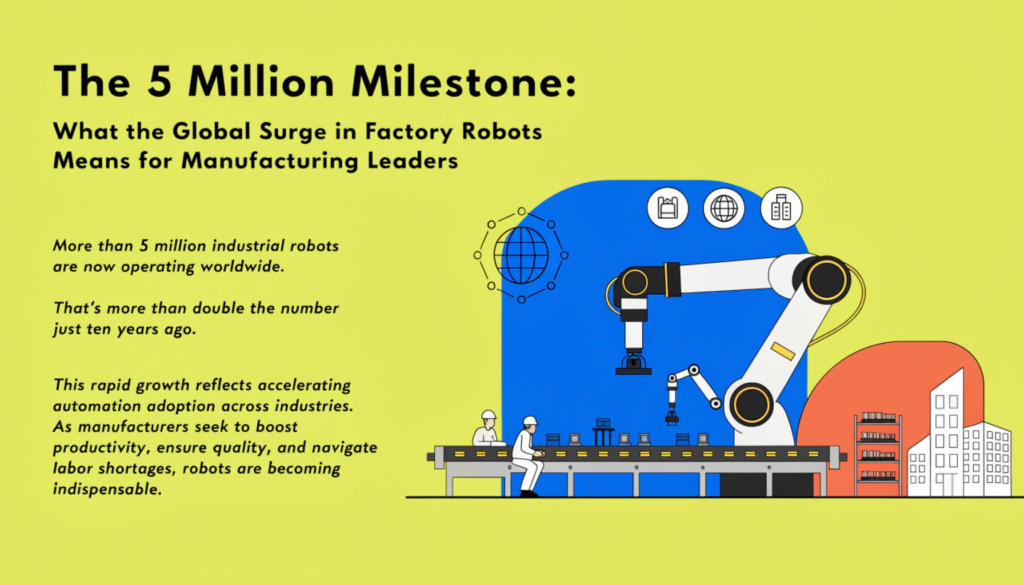
The global manufacturing sector has officially crossed a monumental and historic milestone. According to the latest comprehensive World Robotics report published by the International Federation of Robotics (IFR), the worldwide operational stock of industrial factory robots has surged by 9% year-over-year, officially surpassing 5 million active units operating across global shop floors. This record-breaking figure represents far more than a statistical curiosity; it stands as definitive proof that modern industrial manufacturing has permanently crossed the threshold into a new era defined by widespread, intelligent, and flexible physical automation.
To fully appreciate the velocity of this transformation, one must examine the historical trajectory of robot adoption over the past two decades. It took the global manufacturing sector several decades to reach its first million operational robots in the late 2000s. The journey from one million to two million took approximately seven years, while the leap from three million to five million occurred in a brief window driven by compounding technological advancements and unprecedented global supply chain disruptions. Today, operational densities are accelerating not just in traditionally automated nations like Japan, South Korea, and Germany, but across emerging manufacturing hubs throughout Southeast Asia, Latin America, and Eastern Europe.
For C-suite executives, plant directors, and operations managers, reaching 5 million active units signals a profound structural shift in how goods are produced, packaged, and distributed globally. It underscores how rapidly industrial robots manufacturing ecosystems are migrating beyond heavy capital automotive body shops into high-mix, flexible production environments. Across consumer electronics, food and beverage processing, pharmaceuticals, aerospace, and general precision engineering, implementing factory floor automation 2026 strategies has transitioned from a competitive advantage into an absolute operational necessity for survival in a volatile global economy.
Beyond the Headlines: Are Robots Really Taking Over?
Sensational news headlines and popular culture often portray the relentless rise of industrial automation as a disruptive wave of cold steel displacing human livelihoods. However, an empirical examination of modern production facilities reveals a radically different dynamic. The global surge toward robotic deployment is fueled primarily by a chronic, structural shortage of skilled industrial labor rather than a deliberate strategy to trim human headcount.
Demographic shifts across major industrial nations are creating unprecedented headwinds for plant managers. Aging workforces in North America, Western Europe, and East Asia mean that highly experienced CNC operators, certified welders, toolmakers, and assembly specialists are retiring at a rate that vastly exceeds the influx of younger workers entering vocational trades. Demographic data indicates that for every three industrial workers retiring today, only one qualified candidate enters the manufacturing talent pipeline. This widening skills gap threatens to leave millions of critical industrial roles permanently vacant over the next decade.
Compounding these demographic realities is a fundamental transformation in consumer expectations. The global boom in e-commerce, localized supply chain resilience, and hyper-customization has forced manufacturers to accelerate cycle times while maintaining flawless quality standards. Facilities are expected to handle smaller lot sizes, frequent product changeovers, and variable demand spikes without increasing lead times or labor overhead.
Industrial automation directly solves this capacity equation by stepping into the labor void. Modern robots excel at taking over tasks characterized by the traditional ‘3Ds’: dull, dirty, and dangerous. By entrusting heavy machine tending, repetitive palletizing, toxic spray coating, and high-speed sorting to robotic systems, manufacturers safeguard human operators from ergonomic injuries and occupational hazards. Far from eliminating human value, this shift elevates human workers into higher-tier roles such as automation supervisors, quality assurance analysts, predictive maintenance technicians, and systems programmers.
The Evolution from Rigid Machines to Smart Cobots
To understand why robotic adoption has reached a tipping point, one must look at the remarkable technological leap that industrial machinery has taken over the past decade. A generation ago, integrating a robot required installing a massive, heavy-payload mechanical arm fixed behind rigid perimeter fencing. These traditional industrial robots operated on deterministic, rigid programming routines; if a part shifted by a few millimeters on a conveyor belt, the machine would crash or stall, halting the entire line. Furthermore, programming required specialized robotics engineers writing thousands of lines of low-level vendor code.
The modern automation landscape bears little resemblance to those monolithic setups. Today’s robotic ecosystem is characterized by intelligence, adaptability, and seamless human-machine collaboration, lowering the barrier to entry for small and medium-sized enterprises (SMEs) that previously viewed automation as cost-prohibitive.
Today, the technology has changed dramatically, making automation accessible to small and mid-sized businesses:
- Collaborative Robots (Cobots) & Force Sensing: Unlike traditional arms that operate blindly at full speed, cobots are outfitted with high-precision force-torque sensors at every joint. These sensors continuously monitor resistance and contact pressure. If a cobot detects unexpected physical contact with an operator or obstacle, it brings its motion to a complete halt within milliseconds. This built-in safety architecture eliminates the need for expensive physical caging and safety light curtains, allowing humans and machines to work side-by-side on shared assembly tables.
- AI Vision & Spatial Perception: Advances in 3D machine vision and neural network algorithms have endowed robots with visual perception comparable to human sight. Equipped with structured light sensors and spatial AI models, modern robots can perform random 3D bin-picking identifying, orienting, and grasping unstructured components stacked haphazardly in totes. This capability bypasses the need for costly custom mechanical feeders and complex parts positioning fixtures.
- Intuitive No-Code & Low-Code Interfaces: Software paradigms have shifted from cryptic script-based environments to graphical drag-and-drop interfaces on tablet teach pendants. Furthermore, hand-guided lead-through programming allows shop-floor technicians to physically teach a robot desired motion paths by guiding its end-effector with their hands. This dramatically simplifies re-tooling and decreases changeover times from days to mere minutes.
- Autonomous Mobile Robots (AMRs): Material movement inside modern facilities has been revolutionized by AMRs equipped with LiDAR and Simultaneous Localization and Mapping (SLAM) technology. Unlike older Automated Guided Vehicles (AGVs) that relied on magnetic floor tape or fixed wires, AMRs dynamically navigate complex factory floors, safely steering around pedestrians, forklifts, and temporary obstructions to transport work-in-progress materials automatically.
The Economics of Automation: Faster Payback and Lower Risks
Historically, capital expenditure models for industrial robotics required rigorous financial scrutiny. High upfront engineering costs, custom tooling fabrication, and long integration timelines meant that projects often carried paybacks stretching out three to five years. In today’s dynamic business environment, capital paybacks of that duration present unacceptable risk profiles for many mid-market executives.
Fortunately, the economic dynamics surrounding automation have fundamentally shifted. Standardized modular robotic cells, off-the-shelf software packages, and flexible end-effectors have sharply curtailed upfront integration costs. Simultaneously, the rising cost of manual labor and scrap materials has shortened payback timelines dramatically across virtually every industry vertical.
Several financial factors are driving widespread adoption of industrial robots manufacturing solutions:
- Accelerated Sub-18-Month ROI: Thanks to lower hardware price points and standardized pre-engineered cell designs, off-the-shelf robotic solutions routinely achieve full return on investment in 12 to 18 months. When factoring in multi-shift operations, payback periods frequently drop below one year, creating immediate positive cash flows for operating teams.
- Robotics-as-a-Service (RaaS) Financial Models: Operational expenditure (OpEx) flexible models are expanding access to cutting-edge automation. Through RaaS subscriptions, businesses can lease fully integrated robotic systems on a monthly or usage-based model without committing heavy capital expenditure (CapEx). System maintenance, software upgrades, and performance guarantees are bundled in, shifting technology depreciation risks back to the equipment provider.
- Quality Assurance & Waste Elimination: While labor savings are easy to quantify, the true financial driver often lies in repeatability and scrap reduction. Robotic arms perform precise motions with sub-millimeter repeatability over long shifts, eliminating inconsistencies caused by operator fatigue. This consistency translates into immediate material savings, reduced rework expenses, and lower warranty claim liabilities.
- Energy Efficiency & Facility Footprint Optimization: Modern robotic cells require significantly smaller physical footprints than legacy machinery. Additionally, automated work cells can run under ‘lights-out’ conditions, operating during off-peak hours without full ambient heating, cooling, or overhead lighting, generating substantial long-term utility cost reductions.
How Industry Sectors Are Putting 5 Million Robots to Work
While the automotive sector historically bought the vast majority of industrial robots, other industries are now driving rapid growth:
1. Electronics and Semiconductor Packaging
The global demand for microchips, high-density printed circuit boards (PCBs), consumer smartphones, and EV battery packs demands cleanroom manufacturing capabilities and microscopic precision that exceed human physical limits. High-speed SCARA (Selective Compliance Articulated Robot Arm) and parallel delta robots execute delicate pick-and-place operations at extreme speeds without risk of electrostatic discharge or airborne particle contamination. In semiconductor packaging, AI-guided micro-robots handle silicon wafers with nanometer-level alignment accuracy, driving higher chip yields and enabling next-generation computing hardware.
2. Metal Fabrication and Welding
Metal fabrication shops across the globe face acute shortages of certified welders. Compact robotic welding cells equipped with adaptive seam tracking, real-time laser profiling, and multi-pass torch trajectory planning have emerged as critical force multipliers. A single technician supervising multiple cobot welding stations can achieve the daily output of four manual welders while maintaining pristine, defect-free weld joints across steel, aluminum, and exotic alloys.
3. Food, Beverage, and Consumer Packaging
Food and beverage processing presents unique automation challenges due to delicate, irregularly shaped products and stringent washdown sanitation standards. Soft-robotic end-effectors constructed from food-grade polymers can gently grasp fragile bakery goods, soft cheeses, and fresh produce without bruising. In primary and secondary packaging, vision-guided delta robots sort, box, and palletize products at blistering speeds, eliminating repetitive strain injuries for workers while guaranteeing strict compliance with international food safety regulations.
4. Pharmaceuticals, Life Sciences, and Medical Devices
In pharmaceutical compounding and medical device manufacturing, precision, traceability, and sterility are paramount. Robotic arms operating inside aseptic cleanrooms automatically fill vials, cap syringes, and assemble intricate surgical tools without human intervention, minimizing contamination risks. Full digital logging of every robot motion ensures flawless regulatory audit trails and batch traceability.
The Human Side: Upskilling Your Workforce for the Robot Age
Deploying industrial robots is fundamentally a human-centric transformation. Organizations that treat automation purely as a equipment upgrade often encounter cultural friction, worker anxiety, and operational bottlenecks. Conversely, market leaders who view automation as a tool to empower and upskill their human workforce experience smoother deployments, higher operational resilience, and superior long-term performance. Transitioning to factory floor automation 2026 requires intentional change management, transparent internal communication, and structured upskilling frameworks.
Smart manufacturing leaders follow three practical guidelines when introducing robotics:
- Early Frontline Inclusion & Co-Design: Engaging floor operators during the initial planning stage is essential. Operations leaders should solicit direct input from workers to identify tasks that cause physical fatigue or repetitive motion injuries. When technicians see that robotic assistants are being introduced to relieve back-breaking workloads rather than eliminate headcount, initial skepticism transforms into genuine enthusiasm.
- Structured Internal Upskilling & Apprenticeships: Progressive manufacturers partner with vocational institutes and equipment vendors to create internal training pathways. Line operators learn cell operation, routine sensor calibration, and basic troubleshooting, ascending into higher-paying roles as certified automation specialists. This upskilling strategy boosts employee retention while solving internal technical skill deficits.
- Pacing & Incremental Implementation Wins: Rather than attempting to automate an entire assembly line overnight, successful teams start with focused, low-complexity applications such as end-of-line palletizing or basic machine tending. Securing quick, highly visible wins establishes operational confidence, refines internal engineering expertise, and builds momentum for broader automation initiatives.
Strategic Next Steps for Business Leaders
Crossing the threshold of 5 million active industrial robots makes one truth abundantly clear: automation is no longer an optional experimentation area reserved for multi-billion-dollar conglomerates. It is the core operating baseline for running a efficient, resilient, and profitable manufacturing enterprise in the 21st century.
If your leadership team is evaluating where to invest over the next 12 to 24 months, begin with these steps:
- Conduct a Holistic Operations & Ergonomics Audit: Systematically audit your facility floor to map out high-volume, low-variability tasks that suffer from high employee turnover, quality defects, or throughput bottlenecks. Identify priority candidates for cobot cell integration.
- Prioritize Open, Interoperable Software Architectures: Avoid lock-in to rigid, vendor-proprietary protocols. Standardize on hardware platforms that support standard industrial Ethernet protocols and integrate cleanly into your existing Enterprise Resource Planning (ERP) and Manufacturing Execution Systems (MES).
- Design for Reconfigurability & Scalability: Select modular tooling, flexible grippers, and mobile platforms that can be easily redeployed as product lifecycles change, preserving your capital investment over long operational horizons.
Conclusion: Thriving in the Automated Era
Surpassing 5 million active operational robots marks a pivotal milestone in industrial history. As organizations globally step up their modernization efforts, strategic investment in industrial robots manufacturing systems empowers human workers, strengthens regional supply chain stability, and unlocks extraordinary levels of productivity. By adopting factory floor automation 2026 with a balanced, human-centered strategy, forward-thinking manufacturing leaders can guarantee their facilities remain agile, competitive, and highly profitable for decades to come.
Explore Industrial Robotics & Automation at BMA Conventions
Join executive leaders, plant directors, and robotics innovators at our upcoming national convention. Discover hands-on automation demos, hear real-world case studies, and build practical strategies for modernizing your production line.