
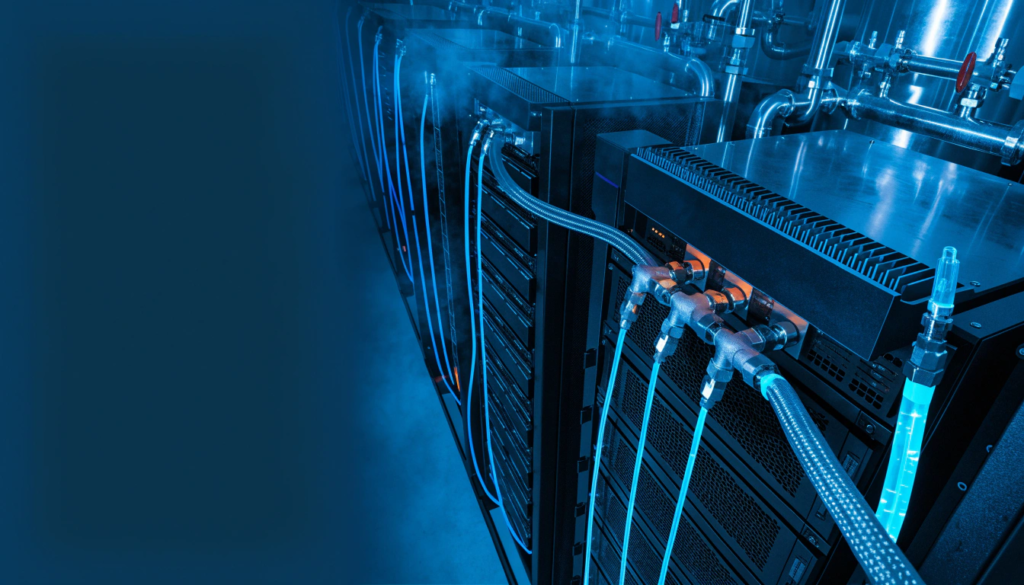
For more than two decades, keeping computer servers cool was relatively straightforward. Massive air conditioning units pushed chilled air under raised floors, circulated it through server racks, and blew the hot exhaust air out through ceiling plenums. It was simple, reliable, and well understood by every IT facility manager.
Today, that traditional air-cooled model has hit a physical brick wall. The explosion of artificial intelligence, high-performance computing, and cloud services has packed enormous processing power into standard server racks. Where a typical enterprise rack once consumed 5 to 10 kilowatts (kW) of electricity, modern AI server clusters routinely require 40 kW, 80 kW, or even more than 100 kW per cabinet. At these heat levels, relying only on moving air is no longer practical.
Across the technology sector, adopting liquid cooling data centers has rapidly shifted from an exotic luxury reserved for scientific supercomputers into an absolute operational necessity. For data center operators, enterprise executives, and colocation providers, understanding modern data center cooling solutions 2026 is now essential for protecting capital investments, ensuring high uptime, and controlling soaring energy bills.
The Physics Problem: Why Air Can No Longer Keep Up
To understand why air cooling is falling behind, you only need to look at basic physics. Water transfers heat roughly 3,000 times more effectively by volume than ambient air. Air is essentially a thermal insulator. Trying to cool a 100 kW rack with air fans is like trying to cool a boiling engine block using a handheld paper fan.
When high-density graphics processing units (GPUs) and central processors (CPUs) run complex AI calculations, they generate concentrated heat inside microscopic silicon chips. If that heat cannot escape fast enough, the processors automatically slow down (a process called thermal throttling) to avoid burning out. In worst-case scenarios, the servers shut down entirely.
Pumping enough chilled air through dense racks to prevent throttling requires enormous, noisy fans running at full speed. These fans draw massive amounts of electricity, creating an energy penalty that eats directly into operational margins. Liquid cooling solves this challenge by carrying heat away directly from the chip surface with quiet efficiency.
Beyond the physical limitations of forced air, there is also the critical issue of acoustic noise pollution and mechanical vibration. High-speed fans operating continuously at maximum capacity generate severe ambient noise levels that often require hearing protection for facility technicians working on the data hall floor. Furthermore, high-frequency vibrations from hundreds of spinning fans inside server chassis can contribute over time to micro-fretting and degraded mechanical interconnects among sensitive high-speed digital circuit boards.
Liquid cooling mitigates these collateral issues by removing or significantly slowing down local chassis fans. The resulting quiet operational environment improves occupational health for technicians while reducing micro-vibration hazards, helping fragile electronic pin connections maintain signal integrity across long service cycles.
The Three Main Types of Liquid Cooling Explained Simply
While the phrase “liquid cooling” might sound intimidating to executives who worry about leaks near expensive electronics, modern systems are engineered with closed loops and dielectric fluids. Today, three main technologies dominate the market:
1. Direct-to-Chip (Cold Plate) Cooling
Direct-to-chip cooling is the most popular starting point for modern facilities. In this setup, sealed copper or aluminum blocks called “cold plates” sit directly on top of the hottest silicon processors. A treated cooling fluid flows through tiny micro-channels inside the plate, absorbs the processor’s heat, and carries it out of the server chassis through flexible, leak-proof tubes.
Because direct-to-chip systems can be installed inside standard server racks, operators can upgrade existing facilities without rebuilding their entire data hall floor.
Modern direct-to-chip architectures often feature dual, redundant loop configurations and quick-disconnect valves that automatically seal off liquid flow when a server module is unlatched for maintenance. This design minimizes human error and reduces potential downtime during component replacements, making it seamless to integrate into existing maintenance workflows.
2. Rear-Door Heat Exchangers (RDHx)
A rear-door heat exchanger replaces the standard perforated back door of a server rack with a specialized radiator coil. As server fans push hot air out the back of the equipment, the air immediately passes through chilled liquid coils inside the door. The heat is absorbed by the liquid, and room-temperature air exits into the data center aisle.
Rear-door systems act as a great stepping stone. They allow facilities to cool racks up to 40 or 50 kW without modifying the internal components of individual servers.
Because rear-door heat exchangers absorb thermal energy right at the back of the rack before heat enters the hot aisle, they eliminate hot spots entirely. This allows operators to run uniform aisle temperatures throughout the entire data center room without requiring physical containment barriers or complex airflow baffle systems.
3. Immersion Cooling (Single-Phase and Two-Phase)
Immersion cooling takes thermal management to the highest level. Entire server motherboards are submerged directly into tanks filled with specialized, non-conductive dielectric fluids. Because the fluid does not conduct electricity, servers run normally while completely submerged.
In single-phase systems, the fluid circulates through external heat exchangers. In two-phase systems, the liquid boils on hot components, turns into vapor, rises to a condenser coil, turns back into liquid, and drips down again. Immersion cooling can support massive power densities exceeding 150 kW per rack while eliminating all internal server fans.
Additionally, immersion tanks protect server hardware from airborne contaminants, moisture, and dust oxidation. By operating in an oxygen-free, sealed dielectric liquid bath, delicate components are completely isolated from environmental degradation, which drastically extends hardware component life compared to traditional air-cooled environments.
The Business Case: Lower Power Bills and Faster Payback
While retrofitting for liquid cooling data centers requires upfront capital, the return on investment (ROI) is often much faster than leadership teams anticipate. The financial savings come from several key areas:
- Dramatically Lower PUE (Power Usage Effectiveness): PUE measures how efficiently a data center uses electricity. A typical air-cooled facility operates at a PUE around 1.4 to 1.6, meaning 40% to 60% of the facility’s power goes to running chillers and fans rather than compute servers. High-performance liquid cooling systems can push PUE down to 1.1 or even 1.05, cutting millions of dollars in annual power costs.
- Floor Space Savings: Because liquid cooling allows racks to pack 4 to 8 times more computing power into the same physical footprint, companies can deliver massive compute capacity without buying more land or constructing extra building shells.
- Longer Hardware Lifespan: Electronic chips run at stable, lower temperatures without the constant thermal expansion and contraction that causes micro-cracks in solder joints. Stable thermal environments also mean fewer hardware failures and less unplanned downtime.
- Water Conservation: Traditional evaporative cooling towers consume millions of gallons of municipal water every month. Many closed-loop liquid systems use dry coolers, saving precious water resources in drought-prone regions.
- Heat Reuse Opportunities: Liquid cooling systems capture high-grade waste heat directly from the fluid loop at warm, stable temperatures. This waste heat can be diverted to district heating networks, nearby commercial greenhouse facilities, or adjacent office spaces, providing valuable municipal integration opportunities and offsetting local building heating expenses.
- Reduced Chiller Infrastructure Capital Costs: Because liquid can absorb and dissipate heat at higher fluid temperatures, data centers can rely more heavily on warm-water cooling or outdoor dry coolers rather than capital-intensive energy-hungry mechanical chillers, driving down initial greenfield facility construction costs.
Overcoming Operational Hurdles: Piping, Training, and Clean Rooms
Adopting new technology always introduces operational questions. When evaluating data center cooling solutions 2026, management teams should plan for three practical considerations:
- Coolant Distribution Units (CDUs) and Pumping Infrastructure: Plants must install dedicated CDUs that regulate liquid flow, pressure, and temperature between the main facility loop and server racks. Redundant dual pumps (N+1) ensure uninterrupted circulation if a primary pump requires maintenance.
- Leak Detection and Quick-Disconnect Fittings: Modern liquid loops use blind-mate drip-free connectors and non-conductive fluids. Continuous moisture-sensing ropes installed beneath piping manifolds automatically trigger alerts if even a single drop escapes.
- Staff Upskilling: Data center technicians who are used to swapping air filters need training on fluid testing, pressure balancing, and quick-disconnect servicing. Building strong vendor partnerships ensures your internal team feels confident maintaining new fluid systems.
- Coolant Chemistry and Fluid Management: Maintaining correct fluid pH levels, biocide dosing, and glycol concentrations is paramount to preventing biological growth or corrosion inside micro-channel cold plates over multi-year cycles. Operators should establish quarterly fluid sampling protocols with qualified chemical analytics partners.
- Weight and Structural Floor Loading Considerations: High-density liquid-cooled server racks and fluid-filled immersion tanks are considerably heavier than traditional air-cooled cabinets. Facilities engineering teams must evaluate concrete slab load-bearing capacities and structural engineering limits prior to deploying ultra-high-density deployments.
Conclusion: Building Future-Ready Digital Infrastructure
The transition toward high-density computing is not a temporary trend; it is the permanent reality of the AI-driven economy. Facilities that continue to rely solely on legacy air conditioning will find themselves unable to host next-generation server clusters or satisfy corporate energy efficiency mandates.
Investing in liquid cooling data centers transforms thermal management from an operational bottleneck into a major competitive advantage. By embracing proven data center cooling solutions 2026 today, forward-looking operators protect their bottom line, reduce their carbon footprint, and ensure their facilities are ready for the computing demands of tomorrow.
Strategic Roadmap: Steps to Transitioning Your Facility
Transitioning an operational enterprise data center or colocation facility to liquid cooling does not have to happen overnight. A phased approach allows leadership teams to validate performance, train operational staff, and align capital expenditure with immediate compute growth needs.
- Thermal Assessment & Density Audit: Identify high-power racks housing recent GPU cluster deployments or upcoming hardware refreshes. Map out existing power feeds and structural floor capacity to establish baseline targets.
- Pilot Deployment Phase: Deploy a hybrid solution such as direct-to-chip or rear-door heat exchangers across a single row or pod. Evaluate key performance metrics including PUE improvements, CPU/GPU core temperatures, and operational maintenance workflows.
- Full-Scale Integration & Standardization: Standardize CDU specifications, quick-disconnect hardware, and monitoring sensor telemetry into your central Data Center Infrastructure Management (DCIM) software platform for seamless, unified facility management.
Connect with Data Center Leaders at BMA Conventions
Join data center operators, facility directors, and thermal management innovators at our upcoming convention. Discover real-world case studies, compare liquid cooling architectures, and build actionable strategies for high-density infrastructure.