
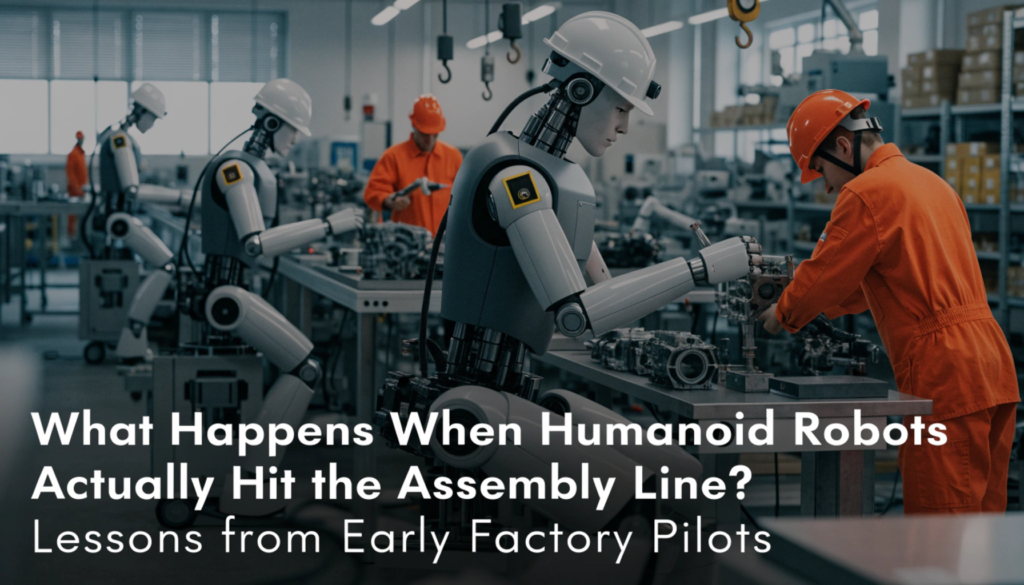
For the past few years, social media feeds have been filled with polished videos of bipedal humanoid robots doing backflips, sorting colored plastic blocks, and walking through pristine research laboratories. Technology executives have predicted that these walking machines would quickly walk onto factory floors, grab standard hand tools, and seamlessly replace human assemblers on day one.
In 2026, those lab experiments finally entered real-world industrial environments. Automotive manufacturers, aerospace contractors, and commercial logistics hubs across North America have launched live pilots testing bipedal machines on active production shifts. But what actually happens when companies deploy humanoid robots on assembly line stations alongside human workers? The reality is far more nuanced, practical, and interesting than the marketing hype suggests. For business leaders building a modern factory robotics workforce 2026, early plant trials reveal important operational lessons about cycle times, job redesign, and human teamwork.
The First Reality Check: Speed and Assembly Takt Times
In a modern manufacturing plant, everything revolves around “takt time,” the precise speed at which parts must move down the line to meet customer demand. In an automotive plant, a new vehicle often rolls off the line every 60 seconds. Every worker at every station has exactly 50 to 55 seconds to complete their specific task, whether that is tightening four bolts, snapping in a wire harness, or setting a glass panel.
When plant managers place their first humanoid robot at a workstation, the immediate challenge is speed. While dedicated industrial robot arms move at lightning speeds, often finishing a task in under three seconds, bipedal robots move much more deliberately. A humanoid robot must constantly calculate its physical balance, adjust its foot placement on concrete, evaluate camera feeds through artificial intelligence, and carefully coordinate finger movements.
In early trials, picking up a stamped metal bracket, verifying its orientation, and pressing it into a fixture often took a humanoid robot 12 to 18 seconds. A trained human assembler performs that identical sequence in four seconds. Placing a bipedal robot directly on a fast-moving, high-speed assembly line can quickly create an expensive bottleneck unless industrial engineers redesign the workstation workflow.
Finding the Right Jobs: Where Bipedal Robots Actually Excel
Because humanoid robots are slower than specialized machines, successful plants do not use them to replace high-speed spot welders or fast packaging conveyors. Instead, operational leaders are assigning humanoid robots to the awkward, irregular, and physically punishing tasks that traditional machines could never handle.
Early factory deployments highlight three ideal use cases:
- Uncrating and Kitting Irregular Parts: Parts arriving from suppliers rarely sit in perfectly organized rows. Humanoid robots equipped with AI vision models can reach into deep wooden crates, grasp awkwardly shaped parts, and place them neatly into organized kitting trays for assembly workers.
- Ergonomic Relief for Repetitive Lifting: Many assembly stations require workers to repeatedly bend, reach overhead, or hold heavy components in place while fasteners are secured. Having a robot hold a 30-pound heat shield in place eliminates shoulder and back strain for human assemblers.
- Sub-Assembly Feeder Stations: Instead of standing directly on the main moving vehicle line, humanoid robots perform exceptionally well in offline sub-assembly cells. They can assemble small sub-components at their own steady pace and feed finished kits to the main line just in time.
The Human Reaction: From Anxiety to Practical Collaboration
One of the biggest concerns for executives planning robotics rollouts is how frontline workers will react. Do employees view walking robots as competitors stealing their jobs, or as helpful tools?
Plant floor trials consistently show that worker perception depends entirely on how leadership introduces the technology. When companies communicate openly and explain that robots are being brought in to take over the most physically exhausting tasks, employee attitudes change rapidly.
Within a few weeks of live operation, workers often start naming the robots and viewing them like heavy-duty shop assistants. When an assembler realizes that the robot takes away five miles of daily walking back and forth to fetch parts or eliminates continuous heavy lifting, collaboration becomes natural. Assemblers quickly transition into supervisory roles, monitoring the robot’s work bins, clearing minor jams, and managing quality inspections.
Operational Challenges You Don’t See in Tech Demos
Taking a robot from a university lab to an active factory floor uncovers dozens of practical maintenance hurdles that tech demos never show:
1. Battery Swaps and Shift Endurance
Most bipedal humanoid robots run on lithium-ion batteries that last between two and four hours under continuous physical exertion. In a factory operating two or three continuous eight-hour shifts, a robot cannot simply leave the line and plug in for two hours. Plants must design automated quick-swap battery kiosks or assign technicians to perform three-minute battery hot-swaps during scheduled shift breaks.
2. End-of-Arm Tooling and Gripper Wear
Human hands are soft, sensitive, and naturally adaptable. Robotic fingers, by contrast, are made of metal, silicone, and delicate motor tendons. In harsh industrial environments filled with metal burrs, stamping oils, and abrasive dust, robot finger pads wear down quickly. Facilities must establish regular inspection and replacement schedules for robotic grippers to prevent dropped parts.
3. Slip and Trip Hazards
A human walking across a factory floor easily steps over minor expansion joints, metal floor plates, or stray air hoses. For a bipedal robot, a small puddle of machine coolant or a sudden 1/4-inch bump in the floor slab can cause an inertial balance fault, causing the machine to freeze in place as a safety precaution. Housekeeping standards on the plant floor must be immaculate.
The Real Financial Equation: Calculating Practical ROI
Investing in humanoid robots on assembly line stations requires a realistic look at total cost of ownership. Beyond the initial hardware purchase price, companies must budget for software licensing, custom gripper engineering, safety certifications, and regular maintenance.
However, the business case becomes very clear when viewed through the lens of workforce retention and operational agility:
- Lower Turnover and Injury Costs: By eliminating high-injury lifting tasks, companies reduce workers’ compensation claims and curb high employee turnover in physically demanding roles.
- Re-Programmable Flexibility: A dedicated hard-automation machine designed to stamp a single car fender often becomes scrap metal when the car model changes. A humanoid robot can simply be taught a new task with a software update, protecting capital investments across product cycles.
- Predictable Multi-Shift Capacity: When sudden spikes in demand require adding a weekend shift, staffing factories has become nearly impossible due to labor shortages. Automated workcells can run overtime and night shifts without recruiting bottlenecks.
How Manufacturing Leaders Should Prepare Today
If your manufacturing leadership team is planning its automation roadmap for the next two to five years, now is the time to lay the groundwork:
- Start with Ergonomic Bottlenecks: Review your company’s OSHA logs and worker complaints. Identify the top three jobs that cause the most physical strain or repetitive stress injuries. Those are your primary candidates for robotics pilots.
- Prepare Your Industrial Engineers: Train your plant layout and industrial engineering teams on collaborative robotics safety standards and line-balancing techniques that accommodate mixed-speed human-robot cells.
- Invest in Your Frontline Team: Create internal training pathways to help curious assembly workers learn basic robot troubleshooting, maintenance, and task programming.
Conclusion: Evolution, Not Revolution
Humanoid robots are not going to magically replace entire factory workforces overnight. The reality of manufacturing is too complex, dynamic, and demanding for that. What is happening instead is a steady, practical evolution.
When companies deploy humanoid robots on assembly line tasks strategically, they solve genuine labor shortages, protect human health, and build more resilient production facilities. As the foundation for building a competitive factory robotics workforce 2026 solidifies, the manufacturers who embrace collaborative automation with clear, grounded expectations will lead the next industrial century.
Explore the Future of Smart Manufacturing at BMA Conventions
Connect with executive leaders, plant directors, and industrial robotics pioneers at our upcoming national convention. Discover live automation demonstrations, hear real-world case studies from automotive and aerospace leaders, and learn practical strategies for modernizing your factory floor.