
Introduction
The global healthcare landscape is experiencing unprecedented pressure, characterized by a rapidly growing and aging population, changing climate profiles, and an urgent demand for advanced medical technologies. To keep pace, healthcare providers must expand their capacity, modernize outdated facilities, and construct new clinical spaces. However, traditional construction methods are often plagued by significant delays, skyrocketing budgets, and massive environmental footprints. In this environment of escalating demand and shrinking timelines, a paradigm shift is occurring. The healthcare sector is increasingly turning to innovative building methodologies that challenge the conventions of brick-and-mortar development.
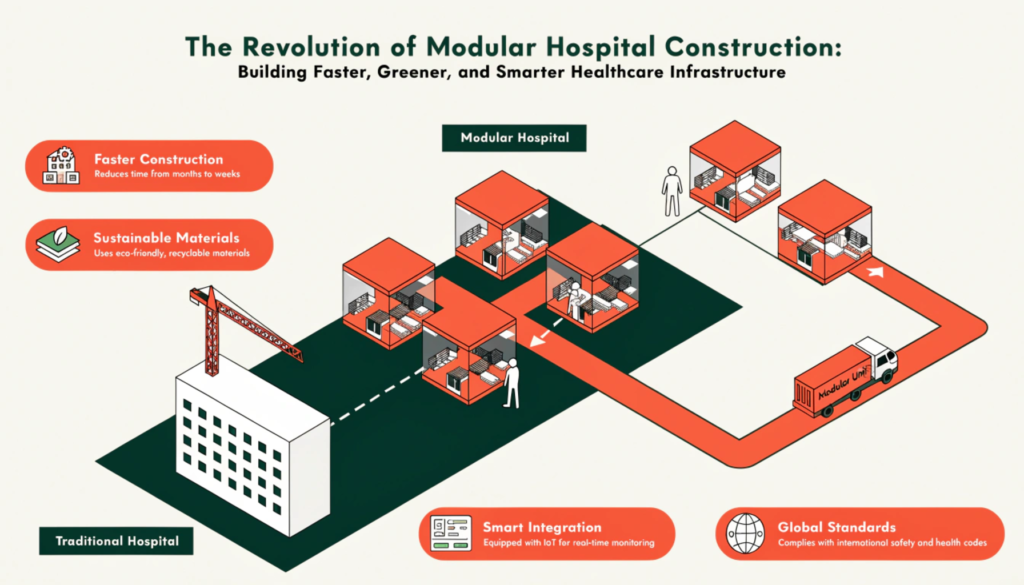
At the forefront of this physical transformation is modular hospital construction 2026, a cutting-edge approach that is redefining how medical spaces are planned, manufactured, and assembled. By shifting a substantial portion of the construction process from the unpredictable environment of a physical job site to the controlled, precise conditions of an off-site factory, healthcare organizations can achieve unprecedented efficiency. This methodology does not merely offer a faster way to build; it represents a comprehensive evolution in engineering that delivers greener, smarter, and far more adaptable care environments. As health systems worldwide look to future-proof their operations, the case for prefabricated medical infrastructure becomes not just compelling but essential.
The Need for Speed: Compressing Build Timelines
Time is one of the most critical variables in healthcare. A delay in opening a new clinical wing, emergency department, or ambulatory clinic does not just represent lost revenue; it can directly impact patient outcomes and access to vital care. Traditional construction is notoriously slow, vulnerable to weather delays, labor shortages, permitting bottlenecks, and the complex logistical choreography of coordinating dozens of trades on an active hospital campus.
Modular hospital construction 2026 directly addresses these bottlenecks by decoupling site preparation from building fabrication. In a traditional project, foundation work must be entirely complete before structural framing, electrical rough-ins, and interior finishes can begin. Conversely, the modular approach allows site excavation, foundation pouring, and utility hookups to occur concurrently with the factory production of the building modules. While civil engineers prepare the physical plot, technicians in a state-of-the-art facility are already constructing, insulating, and pre-wiring the actual rooms.
This concurrent workflow significantly compresses overall construction timelines, often reducing the path to occupancy by 30% to 50%. Prefab healthcare facilities can be shipped to the site nearly complete, with wall finishes, flooring, plumbing fixtures, and even heavy medical equipment brackets already installed. Once on-site, these modules are rapidly craned into place, connected structurally, and tied into the main utility grid. This rapid assembly process minimizes the noisy, disruptive, and dusty on-site construction phases that typically disturb healing patients and complicate hospital operations. For rapidly expanding regional healthcare markets experiencing sudden hyper-growth, this speed of deployment is a game-changer, allowing health systems to scale capacity dynamically in response to real-time community needs.
The Green Imperative: Sustainability and Reduced Environmental Impact
As major contributors to global carbon emissions, healthcare systems are under immense pressure to decarbonize their operations. From energy-intensive heating, ventilation, and air conditioning (HVAC) systems to the massive carbon footprint of traditional construction materials, the healthcare industry is actively seeking ways to align clinical excellence with environmental stewardship. Building green is no longer a luxury or a public relations exercise; it is a regulatory and moral imperative.
Opting for prefab healthcare facilities offers an exceptionally effective pathway to achieving these aggressive sustainability goals. Traditional construction sites are inherently wasteful, with excessive materials ordered, damaged by weather, or discarded due to site-specific errors. Factory-based modular manufacturing, by contrast, operates on a highly optimized, resource-efficient model. Material demands are calculated with extreme mathematical precision, and any excess steel, drywall, or copper wire is immediately recycled within the facility. Additionally, indoor manufacturing protects building materials from rain and humidity, preventing mold formation and ensuring a healthier building envelope from day one.
Furthermore, modular hospital construction 2026 incorporates sustainable design principles from the ground up. Because modules must withstand the physical stresses of transport and craning, they are engineered with high-strength structural systems that naturally enhance building durability and thermal performance. This tight structural sealing allows for superior insulation and energy efficiency, helping hospitals lower their long-term heating and cooling costs. These facilities are ideally suited to integrate renewable energy infrastructure, such as solar panels, energy storage systems, and advanced microgrid controls, supporting the broader healthcare transition toward carbon-neutral operations. By minimizing environmental disruption at the assembly site and optimizing resources during manufacturing, modular construction delivers high-performance facilities that support both community health and global environmental goals.
Smarter Infrastructure: Engineering the Adaptable Hospital of Tomorrow
Modern medical technology is advancing at an exponential rate. From artificial intelligence and IoT-enabled patient monitoring to real-time clinical diagnostics, the digital demands placed on hospital buildings have never been higher. Unfortunately, a vast majority of legacy hospital buildings were simply not engineered to support this level of connected, high-density data infrastructure. Retrofitting an older facility with the fiber optics, edge computing power, and smart sensors required for modern clinical AI is an expensive and invasive endeavor.
The strict engineering discipline required for modular hospital construction 2026 turns this challenge into an opportunity. Because modular units are designed using sophisticated Building Information Modeling (BIM) software prior to fabrication, every component of the building’s digital and physical infrastructure is precisely mapped. This allows manufacturers to pre-install intelligent systems directly into the walls and ceilings during factory assembly. Cat-6 or fiber-optic cabling, smart sensors, and automated climate controls are seamlessly integrated, creating an “AI-ready” hospital room before the module even arrives at the site.
Moreover, this structured design discipline leads to highly adaptable care environments. Healthcare facilities must be capable of evolving; a space that serves as a low-acuity outpatient clinic today may need to be converted into an intensive care unit or an isolation ward tomorrow. Traditional construction makes such retrofits incredibly difficult due to rigid, load-bearing concrete and masonry. In contrast, modular layouts are inherently flexible. Prefabricated modules can be easily rearranged, expanded, or even disassembled and relocated to meet changing operational demands. This modular flexibility ensures that the hospital remains a living, evolving infrastructure asset that can adapt to future pandemics, technological breakthroughs, or shifting patient demographics without requiring costly, disruptive demolition.
The Economics of Prefabrication and Quality Control
Beyond speed and sustainability, the financial predictability of modular construction makes a compelling business case for healthcare executives. Traditional construction projects are notorious for budget overruns, often caused by unexpected site conditions, weather delays, and scheduling conflicts among subcontractors. These financial risks are heavily mitigated when building with prefabricated modules. Because the majority of the construction occurs in a controlled factory setting, labor costs, material prices, and manufacturing schedules are locked in advance. This high level of predictability provides health systems with greater financial security and a faster return on investment, as facilities can begin admitting patients and generating revenue months ahead of schedule.
Simultaneously, the factory setting guarantees a level of quality control that is virtually impossible to replicate on a traditional outdoor job site. In a manufacturing plant, every single module is subjected to rigorous, multi-stage quality checks at dedicated inspection stations. Welding, wiring, insulation, and plumbing are verified against exact engineering specifications by specialized quality control technicians. This standardized oversight ensures that every room meets or exceeds building codes and clinical standards, reducing the risk of costly post-construction defects or operational failures. Additionally, factory construction allows for the seamless integration of specialized infection-control features, such as advanced HVAC filtration and antimicrobial surfaces, ensuring a safer clinical environment for vulnerable patients.
Shaping the Future of Care at the Smart Healthcare Facilities Convention
The shift toward modular construction represents more than just a change in building techniques; it is a fundamental transformation in how we conceptualize, fund, and deliver healthcare infrastructure. To successfully navigate this evolving landscape, healthcare executives, facilities managers, and design professionals must come together to share insights, explore cutting-edge technologies, and build strategic partnerships.
The upcoming Smart Healthcare Facilities Convention in Virginia is the premier venue for these critical discussions. Hosting senior healthcare leaders and technology innovators near Washington Dulles Airport from November 17th to 19th, 2026, this exclusive event offers a deep dive into the forces reshaping hospital infrastructure. From exploring AI-driven facility operations to mapping the path to net-zero campuses, the convention provides the actionable strategies and connections needed to build the smart, resilient hospitals of tomorrow.
Do not miss your opportunity to be at the forefront of this architectural and clinical revolution. Engage with industry-leading experts, discover groundbreaking solutions, and help shape the next generation of healthcare environments.
Register as a delegate today to secure your place at this essential industry event and join the visionary voices transforming healthcare infrastructure.