
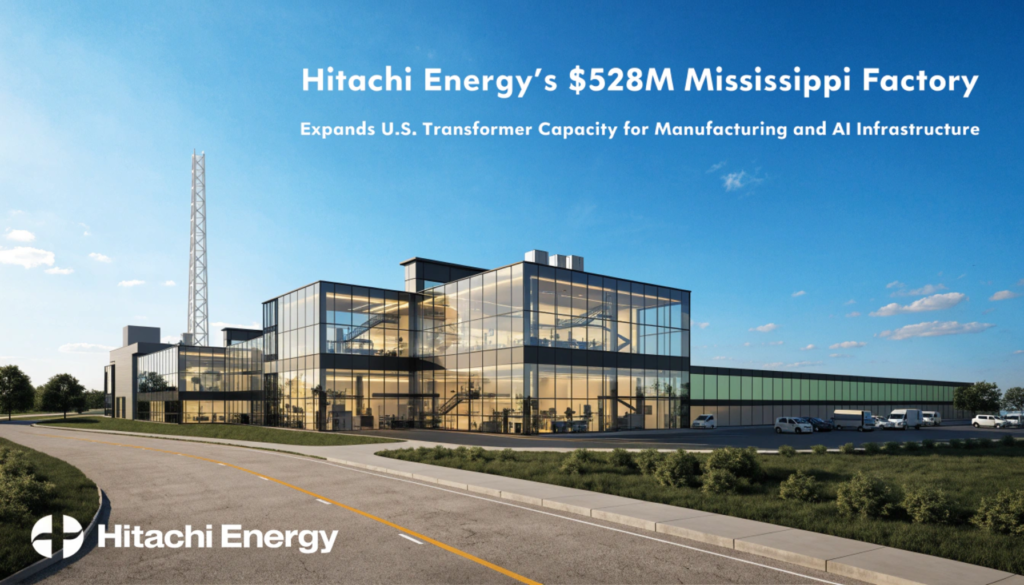
In mid-September 2026, Hitachi Energy finalized plans for its largest single manufacturing investment in North America to date: a $528 million capital project in Crystal Springs, Mississippi, dedicated to domestic power transformer manufacturing. The massive industrial complex will engineer and produce high-voltage power transformers specifically configured to expand the nation’s strained electric grid, accommodate the surging power requirements of hyperscale artificial intelligence data centers, and integrate large-scale renewable generation. For industrial planners and commercial facility operators across the nation, this milestone represents a pivotal turning point in resolving the single most severe infrastructure supply chain bottleneck in modern American industry.
The U.S. energy grid and industrial manufacturing sectors have reached a precarious juncture. Lead times for large electrical transformers have ballooned from an average of 12 to 18 months prior to 2021 to an unprecedented 36 to 48 months in 2026. This shortage has delayed industrial plant startups, stalled semiconductor fabs, and postponed clean energy interconnections across the country. Hitachi Energy’s landmark commitment directly addresses this vulnerability, representing a flagship case study in the current wave of U.S. manufacturing investment 2026.
Deconstructing the $528 Million Capital Commitment
On September 15, 2026, Hitachi Energy formally announced that it is establishing a state-of-the-art manufacturing campus in Crystal Springs, Mississippi. The facility is engineered to produce high-voltage transformers ranging from 115 kV up to 765 kV transmission-level units. Designed with automated coil-winding machines, vapor-phase drying chambers, and comprehensive testing laboratories, the plant will create hundreds of skilled engineering and advanced manufacturing jobs while tripling Hitachi’s regional output capacity.
State and federal stakeholders have strongly supported the project, recognizing that domestic manufacturing of electrical substations is vital to national economic resilience. With the rapid expansion of industrial automation, electrified automotive manufacturing, and gigawatt-scale data center corridors in Northern Virginia, Ohio, and Texas, access to heavy electrical equipment has evolved into a strategic industrial imperative.
Why the Transformer Shortage Chokes American Industry
To appreciate the urgency of this development, manufacturing executives must examine the unique structural factors governing high-voltage power equipment:
- Grain-Oriented Electrical Steel (GOES) Constraints: Large power transformers rely on specialized GOES cores to minimize magnetic hysteresis losses. Tight global supplies and trade restrictions have constrained core assembly speeds worldwide.
- Explosion in AI Data Center Power Demands: Hyperscale AI computing clusters require substation connections consuming between 200 MW and 1 GW per campus, competing directly with industrial manufacturing plants for transmission transformer allocations.
- Aging Legacy Grid Infrastructure: More than 70% of the U.S. power transmission grid is over 25 years old, creating an urgent baseline replacement cycle that coincides with industrial electrification.
- Labor-Intensive Precision Craftsmanship: Transformer assembly cannot be entirely automated. Winding multi-ton copper conductor coils and securing high-dielectric cellulose insulation requires skilled, certified technicians.
Strategic Implications for U.S. Manufacturing Facilities
The establishment of Hitachi Energy’s Mississippi production base signals vital operational benefits for plant engineers, real estate developers, and corporate facility directors:
1. Compressed Project Lead Times and Reduced Risk
Domesticating transformer production will gradually compress lead times for industrial substations, allowing manufacturers to schedule facility expansions and greenfield construction with greater predictability. Long procurement delays that previously jeopardized capital budgets will begin to ease as domestic output ramps up through 2027.
2. Strengthening Regional Power Quality and Resilience
Modern advanced manufacturing spanning semiconductor fabrication, precision CNC machining, and automated pharmaceutical packaging is acutely vulnerable to utility voltage sags, harmonic distortions, and power interruptions. Access to modern, digitally monitored transformers equipped with real-time dissolved gas analysis (DGA) sensors will bolster industrial substation reliability.
3. Catalyzing Upstream Industrial Supply Chains
A $528 million assembly campus produces a significant multiplier effect across domestic supply chains. Demand will surge for American copper rod drawing, insulating oil refining, structural steel fabrication, and specialized freight transport, reinforcing regional industrial ecosystems throughout the Southeast.
Key Takeaways for Industrial Facility Leaders
While Hitachi’s investment represents a major leap forward, supply chain equilibrium will not materialize overnight. Facility executives planning major expansions over the next 18 to 36 months must maintain rigorous electrical procurement discipline:
- Lock in Substation Equipment Early: Place long-lead transformer and switchgear orders during the preliminary engineering and architectural schematic phases, well ahead of general construction bidding.
- Evaluate On-Site Energy Buffers: Deploy battery energy storage systems (BESS) and microgrid switchgear to manage peak demand and bridge delays in utility interconnection upgrades.
- Implement Predictive Fleet Health Monitoring: Upgrade existing on-site substation transformers with continuous oil temperature, moisture, and vibration sensors to extend asset life and avert catastrophic failures.
Conclusion: Powering the Next Era of Industrial Growth
Hitachi Energy’s $528 million commitment to Crystal Springs, Mississippi, affirms that American industrial resurgence relies fundamentally on electric power infrastructure. By expanding domestic power transformer manufacturing, the United States takes an essential step toward securing the electrical backbone required for advanced manufacturing, artificial intelligence, and clean energy independence.
Stay Ahead of Industrial Infrastructure Trends with BMA Conventions
Connect with leaders in energy distribution, heavy manufacturing, and industrial facilities planning. Discover upcoming dates, speaker lineups, and registration details.