
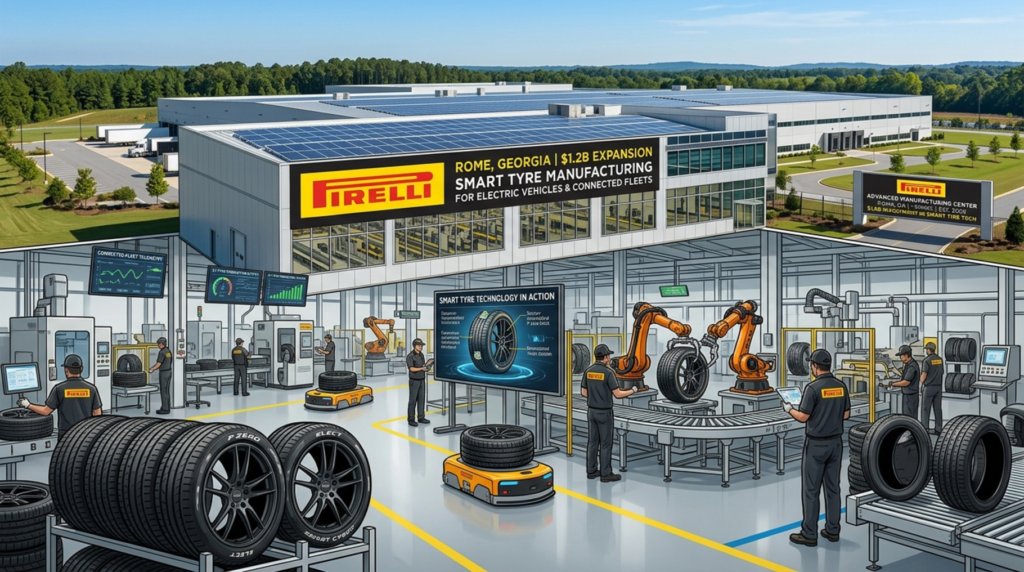
On September 22, 2026, the Board of Directors of Pirelli & C. S.p.A. formally approved a landmark multi-year investment program of approximately €1 billion (over $1.2 billion USD) dedicated to expanding its industrial manufacturing complex in Rome, Georgia. This massive capital expansion will scale the Rome plant’s capacity to 6 million car tyres annually by 2033, creating roughly 1,000 advanced manufacturing jobs. Crucially, the expansion is engineered to establish North America’s foremost hub for smart tyre manufacturing USA, centering production on sensor-embedded Cyber Tyre technology, dedicated high-load electric vehicle (EV) fitments, and highly automated production architectures.
For executive leaders and supply chain strategists across the automotive and industrial sectors, Pirelli’s multi-billion-dollar commitment represents far more than regional economic development. It signals a profound realignment in North American automotive manufacturing, where localized production, real-time vehicle telemetry, and specialized EV engineering are reshaping traditional supply chains. This announcement stands out as a defining flagship of U.S. manufacturing investment 2026.
Deconstructing Pirelli’s $1.2 Billion Capital Commitment
Pirelli first established its manufacturing presence in Rome, Georgia, in 2002 with the launch of its innovative Modular Integrated Robotized System (MIRS). The newly approved expansion represents a multi-phase industrial evolution that transforms the Floyd County site into an ultra-modern, high-throughput mega-facility. Production will focus predominantly on high-value, large-diameter premium tyres (18 inches and above) tailored specifically for the North American market.
Supported by state and local economic development partnerships, the investment will deploy next-generation automated guided vehicles, continuous rubber compounding extruders, automated bead-winding robotics, and clean-energy electric curing presses. The facility is structured to capture surging original equipment (OE) and replacement demand from automotive assembly corridors across Georgia, Tennessee, Alabama, and the Carolinas.
The Technological Shift: Cyber Tyre and the Internet of Vehicles
The traditional tyre has long been viewed as a passive, mechanical consumable made of vulcanized rubber, steel belts, and synthetic fabric cords. However, modern automotive platforms, particularly software-defined electric vehicles and autonomous fleet systems require tyres to act as intelligent data sensors. Pirelli’s expanded Rome campus is engineered specifically to scale proprietary Cyber Tyre production.
Understanding the impact of smart tyre manufacturing USA requires looking at the technological capabilities embedded into every unit:
- Embedded Direct-Contact Telemetry Sensors: Microscopic, ruggedized sensors bonded directly to the interior tyre tread monitor real-time contact patch dynamics, vertical tire loading, lateral grip margins, road temperature, and micro-tread wear.
- Vehicle Control Unit (VCU) Synchronization: Telemetry streams wirelessly via high-frequency Bluetooth and Ultra-Wideband (UWB) protocols directly into the vehicle’s central electronic stability control (ESC) and anti-lock braking systems (ABS), allowing vehicle computers to adapt braking distances and torque vectoring to exact road grip conditions.
- Fleet Optimization and Predictive Maintenance: For commercial transport fleets and autonomous mobility providers, continuous pressure and temperature data prevents sudden roadside blowouts, maximizes battery range, and automates retreading scheduling.
Addressing the Unique Structural Demands of Electric Vehicles
Electric vehicles present radical challenges to tire performance that legacy manufacturing processes cannot easily satisfy. The instant peak torque of electric drivetrains accelerates tread wear up to 30% faster than internal combustion engines, while heavy battery packs impose sustained vertical mechanical loads that demand reinforced sidewall structures.
Additionally, without the masking sound of an internal combustion engine, high-frequency tyre-cavity acoustic resonance becomes the primary source of passenger cabin noise. Pirelli’s Rome facility utilizes specialized robotic manufacturing cells that bond polyurethane acoustic foam rings to the inner tyre liner (Pirelli Noise Cancelling System) and employ sustainable, bio-based silica compounds to reduce rolling resistance without sacrificing wet braking traction.
Strategic Implications for the North American Industrial Ecosystem
Pirelli’s landmark expansion provides vital strategic insights for manufacturing executives and corporate leaders across the industrial landscape:
1. Reshoring High-Value Automotive Supply Chains
Over-reliance on trans-Pacific maritime shipping for critical automotive components exposed severe vulnerabilities during recent logistics shocks. Localizing advanced tyre manufacturing within 300 miles of major automotive assembly plants dramatically lowers transport freight emissions, reduces port tariff exposures, and guarantees just-in-time delivery schedules.
2. The Multiplier Effect on Regional Industrial Infrastructure
A $1.2 billion manufacturing campus catalyzes extensive upstream and downstream economic activity. Demand will surge for regional chemical feedstocks, sustainable synthetic rubbers, recycled carbon black, industrial automation integrators, and heavy logistics distribution centers throughout Georgia and the broader Southeast.
3. Workforce Evolution from Manual Labor to Digital Automation
The creation of 1,000 jobs in Rome highlights the ongoing structural shift in American manufacturing employment. The facility requires automation robotics programmers, machine vision calibration specialists, chemical process engineers, and predictive maintenance technicians, reinforcing the need for regional vocational training partnerships.
Key Takeaways for Industrial Executives
As corporate leaders chart their capital investment strategies for 2027 and beyond, Pirelli’s bold expansion offers several actionable principles:
- Marry Physical Products with Digital Intelligence: The highest-margin industrial growth exists at the intersection of heavy mechanical engineering and digital sensor telemetry. Evaluate how smart IoT capabilities can transform your traditional physical product lines.
- Invest in Flexible, Modular Automated Workcells: Design factory lines capable of rapidly adjusting compound formulations and geometric tooling without incurring weeks of retooling downtime.
- Anchor Capital Expansion in Sustainability: Pirelli’s plant design integrates high-efficiency heat recovery, zero-landfill industrial waste protocols, and renewable electrical sourcing, proving that sustainable manufacturing and operational profitability are mutually reinforcing.
Conclusion: Paving the Way for Smart Industrial Leadership
Pirelli’s $1.2 billion investment in Rome, Georgia, marks a transformative chapter in modern industrial history. By expanding domestic smart tyre manufacturing USA, the company reinforces the American automotive backbone, pioneers digital vehicle connectivity, and sets a powerful benchmark for the broader wave of U.S. manufacturing investment 2026.
Explore Automotive & Smart Manufacturing at BMA Conventions
Connect with executive leaders, industrial automation pioneers, and automotive supply chain directors at our upcoming national convention.