
A data center can have redundant power, sophisticated cooling, advanced monitoring and multiple layers of security, but none of these measures eliminate the possibility of disruption. Equipment failures, cyberattacks, extreme weather, utility outages, human errors and network failures can still affect critical infrastructure.
That is why having a data center disaster recovery plan is no longer simply an IT best practice. In 2026, it is an essential part of operational resilience and long-term business strategy.
Modern organizations depend on data centers for applications, cloud services, databases, communications, customer platforms and business-critical workloads. Even a short outage can create financial losses, customer dissatisfaction, regulatory problems and reputational damage.
A successful disaster recovery strategy therefore needs to go beyond keeping backup copies of data. It should define how an organization will detect a disruption, protect critical workloads, restore operations and continue serving customers under difficult circumstances.
The real question is not whether your organization has a disaster recovery document. The question is whether that plan would actually work during a major incident.
Why Data Center Disaster Recovery Matters More in 2026
Data center environments are becoming increasingly complex. Organizations are managing a combination of physical infrastructure, cloud platforms, hybrid environments, distributed workloads, AI applications and interconnected systems.
This complexity creates more potential points of failure.
At the same time, businesses are becoming less tolerant of downtime. Customers expect digital services to remain available around the clock, while employees depend on business applications and cloud platforms for daily operations.
Cybersecurity is another major consideration. Ransomware and other cyber incidents can make traditional recovery methods difficult because backups themselves may be targeted or compromised.
Extreme weather and infrastructure disruptions also require greater attention. Flooding, storms, heat events, fires and power-grid instability can affect data center facilities and supporting infrastructure.
A modern data center disaster recovery plan must therefore address both conventional failures and emerging risks. It should combine technology, people, processes and communication into one coordinated recovery strategy.
Start With a Business Impact Analysis
The first step in creating an effective disaster recovery strategy is understanding what needs to be protected.
A business impact analysis helps identify critical applications, systems, databases, services and infrastructure components. Instead of treating every workload as equally important, organizations can classify systems according to their business value.
For example, a customer-facing application may need to be restored within minutes, while an internal reporting system might tolerate several hours of downtime.
This assessment should answer important questions such as:
Which systems are business-critical? Which applications depend on other systems? How much data can the organization afford to lose? How quickly must each service be restored? What would happen financially and operationally if a particular application remained unavailable?
The answers provide the foundation for two important recovery targets: the Recovery Time Objective (RTO) and Recovery Point Objective (RPO).
RTO defines how quickly a system needs to be restored after an incident. RPO defines how much data loss, measured in time, the organization can tolerate.
For example, an application with a 30-minute RTO needs to be restored within 30 minutes, while an RPO of 10 minutes means the organization should aim to recover data with no more than approximately 10 minutes of potential loss.
Without clearly defined RTOs and RPOs, recovery planning can become vague and ineffective.
Identify the Most Likely Risks
A strong plan begins with realistic risk assessment rather than generic assumptions.
Data center operators should evaluate risks across physical, technological, environmental, cybersecurity and human factors.
Power failure is one obvious risk, but the analysis should go further. Consider UPS failures, generator problems, fuel availability, electrical distribution faults and utility disruptions.
Network connectivity should also be examined. A data center may remain operational while customers cannot access applications because of a carrier failure, routing problem or network equipment malfunction.
Cooling failures can be equally serious. If temperature or humidity moves beyond acceptable limits, equipment performance and availability may be affected.
Cybersecurity incidents require a dedicated recovery strategy. Organizations should consider ransomware, credential compromise, malicious insiders, data corruption and attacks against management systems.
Environmental risks should be assessed according to the facility’s location. Flooding, severe storms, earthquakes, wildfire and extreme heat can all influence recovery requirements.
The goal is not to predict every possible disaster. It is to identify realistic high-impact scenarios and create practical responses for them.
Build Redundancy Into the Recovery Architecture
A disaster recovery plan becomes significantly stronger when the infrastructure itself is designed for resilience.
Redundancy can exist at multiple levels, including power, cooling, network connectivity, storage, servers and geographic locations.
However, redundancy should be evaluated carefully. Having two systems in the same facility does not necessarily provide protection against a site-wide disaster.
Geographic diversity can be particularly important for critical workloads. If a primary facility becomes unavailable because of flooding, fire or a prolonged power disruption, a geographically separate recovery environment can provide an alternative location for operations.
Organizations may use a secondary data center, colocation facility, cloud environment or hybrid architecture depending on their requirements.
The right approach depends on workload criticality, budget, compliance obligations and recovery objectives. The goal should be to create enough resilience to meet business requirements without paying for unnecessary complexity.
Protect Backups From the Same Disaster
Backups are one of the most important elements of any data center disaster recovery plan, but simply having backups does not guarantee recoverability.
A backup strategy should consider where backups are stored, how frequently they are created, how long they are retained and whether they can be restored successfully.
Organizations should avoid relying entirely on backup infrastructure located within the same environment as production systems. If a major incident affects the primary environment, those backups could potentially become unavailable as well.
Cybersecurity is also critical. Backup systems should be protected against unauthorized access and ransomware. Depending on the organization’s risk profile, immutable or offline backup strategies can provide additional protection.
Most importantly, backups should be tested.
A backup that has never been restored is an assumption rather than proven recovery capability. Regular restoration tests help organizations discover corrupted data, missing dependencies, outdated credentials and configuration problems before an actual emergency occurs.
Create Clear Roles and Responsibilities
Technology alone cannot execute a disaster recovery strategy.
During a major incident, employees need to know who has authority to make decisions, who communicates with customers, who coordinates technical recovery and who works with external suppliers.
A good plan should clearly establish responsibilities for IT teams, data center operations, cybersecurity, facilities management, business leadership, communications and relevant third-party providers.
Contact information should be regularly updated. Recovery procedures should also account for situations where key employees are unavailable.
This is particularly important for facilities operating around the clock. Teams working different shifts need access to the same procedures and escalation processes.
A clear chain of command can prevent confusion when decisions must be made quickly.
Integrate Disaster Recovery With Data Center Business Continuity
Disaster recovery and business continuity are closely connected but are not identical.
Disaster recovery primarily focuses on restoring technology, systems and infrastructure after disruption. Data center business continuity focuses more broadly on keeping essential business operations running during and after an incident.
For example, restoring a database is a disaster recovery activity. Making sure employees can continue serving customers while that database is being restored is part of business continuity.
The two strategies should therefore be developed together.
A complete approach should consider alternative work arrangements, communication channels, critical suppliers, customer communications and temporary operating procedures.
This integration ensures that technical recovery supports actual business needs rather than becoming an isolated IT exercise.
Plan for Cybersecurity Incidents
Cyber incidents require special attention because the objective may not simply be to restore systems as quickly as possible.
If ransomware has infected the environment, immediately restoring compromised systems could reintroduce the threat.
The recovery process should therefore work closely with cybersecurity and incident response teams. Systems may need to be isolated, evidence preserved and environments validated before restoration.
Organizations should define how they will determine whether systems are safe to bring back online.
Identity and access management should also be part of the plan. Emergency recovery accounts should be controlled carefully, while privileged access should be monitored and reviewed.
Cyber recovery procedures should be tested alongside technical recovery procedures so that security does not become an afterthought during a crisis.
Test the Plan Regularly
One of the biggest weaknesses of disaster recovery programs is that organizations create plans but rarely test them properly.
A document may look comprehensive on paper but fail when employees try to execute it under pressure.
Testing should happen regularly and should become more sophisticated over time.
A basic tabletop exercise can simulate a scenario such as a power failure or ransomware attack and allow stakeholders to discuss their response.
More advanced exercises can test actual failover procedures, backup restoration, network recovery and communication processes.
Testing can reveal practical issues that may otherwise remain hidden. Perhaps a recovery server has insufficient capacity. Perhaps a vendor contact is outdated. Maybe a critical application depends on another system that was not included in the recovery sequence.
These discoveries are valuable because they allow organizations to improve the plan before a real disaster occurs.
Keep Documentation Current
A recovery plan is only useful if it reflects the current environment.
Data center infrastructure changes continuously. New servers are installed, applications are migrated, network architectures evolve and vendors change.
A recovery plan that was accurate two years ago may no longer reflect today’s infrastructure.
Organizations should establish a review process for disaster recovery documentation. Major infrastructure changes should trigger a review of relevant recovery procedures.
Documentation should be clear enough for trained employees to follow under stressful conditions. Instead of relying on complicated technical language alone, procedures should provide logical steps, escalation contacts, dependencies and recovery priorities.
Version control is also important. Teams should know which version of the plan is current and where authorized copies can be accessed during an incident.
Measure Recovery Performance
A strong data center disaster recovery plan should be measurable.
Organizations can track metrics such as actual recovery time versus RTO, actual data recovery versus RPO, backup success rates, restoration test results and the percentage of critical systems covered by tested recovery procedures.
These metrics can help management identify weaknesses and prioritize investments.
For example, if a critical application consistently takes longer to recover than its target RTO, the organization may need additional infrastructure, automation or process improvements.
Recovery metrics can also demonstrate whether investments in resilience are delivering measurable business value.
Use Automation Where It Makes Sense
Automation can make disaster recovery faster and more consistent.
Automated backup processes, infrastructure-as-code, monitoring, failover mechanisms and predefined recovery workflows can reduce the number of manual steps required during an incident.
However, automation should not eliminate human oversight.
Organizations need to understand what automated processes do, when they should be triggered and what happens if the automation itself fails.
The best approach combines automation for repetitive tasks with human decision-making for complex or high-risk situations.
Make Disaster Recovery an Ongoing Process
The most effective disaster recovery programs are not one-time projects.
They are continuously improved as infrastructure, threats and business requirements change.
In 2026, organizations should review their disaster recovery strategy whenever they introduce major technologies, move workloads to the cloud, change data center architecture, adopt AI-intensive applications or significantly change business operations.
Regular training is equally important. Employees should understand their responsibilities before an emergency occurs, not during one.
The objective is to create a culture where resilience becomes part of everyday data center operations.
Final Thoughts
A reliable data center disaster recovery plan is not simply a document stored in an IT folder. It is a practical framework for protecting critical services, recovering technology and maintaining business operations when unexpected events occur.
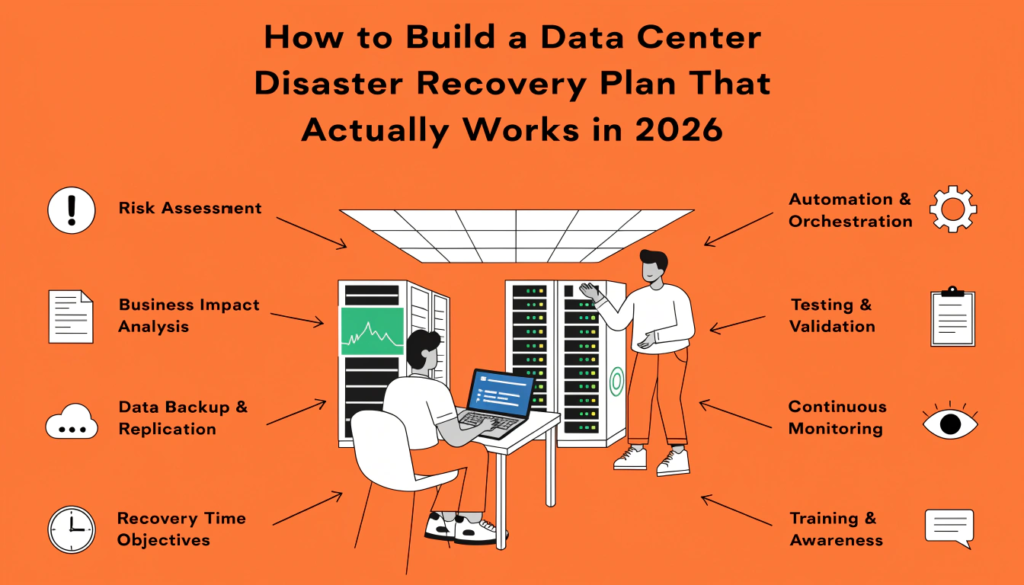
The strongest plans begin with business impact analysis, establish realistic RTOs and RPOs, identify key risks, build appropriate redundancy, protect and test backups, define responsibilities and integrate technical recovery with data center business continuity.
Most importantly, organizations need to test their assumptions.
A recovery strategy that works only on paper is not enough. In 2026, data center resilience requires continuous testing, regular updates, strong cybersecurity and close coordination between technology, facilities and business teams.
As data center environments become more complex and businesses become increasingly dependent on always-on digital infrastructure, disaster recovery should be treated as a strategic priority rather than an emergency document.
Enquire About BMA Conventions
Stay informed about the latest data center infrastructure, facilities, resilience and operational strategies by connecting with industry professionals and experts at BMA Conventions.
Enquire about BMA conventions:
Data Center Facilities Convention