
Introduction
Manufacturing scrap and rework can quietly drain profitability. Materials are wasted, production capacity is consumed, delivery schedules are disrupted, and employees spend valuable time correcting problems that could have been prevented. As manufacturers face increasing pressure to improve efficiency while maintaining consistent quality, traditional approaches to identifying production problems are no longer enough.
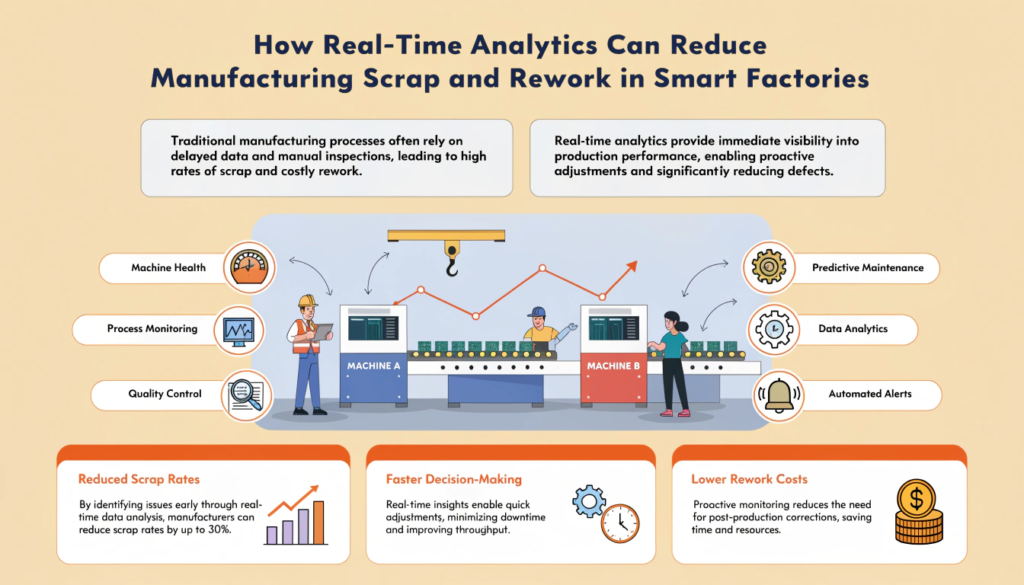
This is where real-time analytics can make a significant difference. Instead of discovering quality issues after a production batch has been completed, manufacturers can monitor processes continuously, identify deviations as they happen, and take corrective action before defects multiply.
The ability to reduce manufacturing scrap analytics provides manufacturers with a practical way to connect production data with quality improvement. When integrated into a smart factory environment, real-time analytics can help production and quality teams understand why defects occur, where waste originates, and which process variables require immediate attention.
From machine performance and material usage to environmental conditions and operator inputs, manufacturers can turn large volumes of production data into actionable insights. The result is a more proactive approach to quality, lower waste, reduced rework, and stronger operational performance.
Why Manufacturing Scrap and Rework Remain Major Challenges
Scrap refers to materials or products that cannot be used or sold because they fail to meet required specifications. Rework, on the other hand, involves correcting a product so that it meets the required standard. While rework may recover some of the value that would otherwise be lost, it still consumes additional labor, energy, machine capacity, and materials.
The causes of scrap and rework can vary significantly. Incorrect machine settings, tool wear, inconsistent raw materials, temperature fluctuations, calibration issues, human error, and process variation can all contribute to defects.
One of the biggest challenges is that these causes are not always immediately visible. A machine may gradually move outside its optimal operating range without producing an obvious warning. By the time a quality inspection identifies the issue, hundreds or thousands of defective units may already have been produced.
Traditional quality management often relies on periodic inspections and historical reports. These methods remain useful, but they can create a time gap between when a problem occurs and when it is detected.
Real-time analytics helps close this gap.
How Real-Time Analytics Helps Reduce Manufacturing Scrap
Real-time analytics collects and analyzes production information as processes are taking place. Data can come from sensors, machines, programmable logic controllers, manufacturing execution systems, enterprise systems, inspection equipment, and other connected sources.
Instead of simply recording what happened, analytics platforms can identify patterns and deviations that require attention.
For example, imagine a production machine that normally operates within a specific temperature and pressure range. If temperature begins rising gradually while pressure fluctuates, the analytics system can detect the deviation before the resulting products fail inspection.
Operators can then investigate the machine, adjust the process, or schedule maintenance before a larger quantity of material becomes scrap.
This approach changes quality management from a reactive process into a proactive one.
Detect Process Deviations Before They Become Defects
One of the strongest benefits of real-time analytics is early detection.
Manufacturing processes usually have operating ranges in which machines and materials perform reliably. When variables move outside those ranges, the probability of defects can increase.
Real-time monitoring allows manufacturers to establish thresholds and continuously compare actual production conditions against expected performance.
If a critical variable starts moving in the wrong direction, the system can generate an alert. Production teams can investigate the issue before it results in a major quality failure.
This is particularly useful in processes where small variations can create significant downstream problems. Early intervention can prevent a minor deviation from becoming an expensive production issue.
Identify the Root Causes of Scrap and Rework
Reducing scrap requires more than knowing how much waste is being produced. Manufacturers need to understand why the waste is occurring.
Real-time analytics can help connect quality outcomes with production variables. Instead of looking at defect rates in isolation, teams can analyze relationships between defects and machine speed, temperature, pressure, raw material batches, tooling conditions, shift patterns, production lines, or other relevant factors.
For example, analytics may reveal that a particular defect occurs more frequently when a machine operates above a certain speed. Another analysis might show that defects increase after a tool reaches a specific number of operating hours.
These insights provide a stronger foundation for root-cause analysis.
Rather than relying entirely on assumptions or manual investigation, quality teams can use production data to identify patterns and prioritize the factors most likely to be responsible for defects.
Predict Quality Problems Before They Happen
Real-time analytics becomes even more powerful when combined with predictive analytics and machine learning.
Historical production and quality data can be used to identify patterns associated with defective products. Predictive models can then evaluate current production conditions and estimate the likelihood of a quality issue.
For instance, a system may recognize that a combination of rising vibration, increasing temperature, and declining machine performance has previously been associated with defective output.
If similar conditions appear again, the system can alert the relevant team.
This allows manufacturers to move from detecting defects to predicting potential defects.
The objective is not to eliminate human decision-making. Instead, predictive analytics gives operators and engineers better information at the right time, allowing them to investigate potential problems before they lead to substantial scrap or rework.
Supporting Quality Management in a Smart Factory
A strong quality management smart factory strategy depends on connecting production, quality, maintenance, and operational data.
In a traditional environment, these functions may operate using separate systems and reports. Production teams monitor output, maintenance teams track equipment performance, and quality teams analyze inspection results. When these datasets are disconnected, it can be difficult to understand the full relationship between equipment conditions and product quality.
A smart factory creates greater visibility by connecting these information sources.
When machine data is linked with quality data, manufacturers can identify relationships that may otherwise remain hidden. A quality defect can be traced back to specific production conditions, equipment states, or material characteristics.
This integrated view helps organizations build a more effective quality management process.
Use Real-Time Dashboards for Faster Decisions
Real-time dashboards can provide operators, supervisors, engineers, and managers with a shared view of production performance.
Instead of waiting for end-of-shift or weekly reports, teams can monitor important quality indicators as production continues.
Dashboards may display scrap rates, rework volumes, defect categories, production output, machine conditions, process deviations, and other key performance indicators.
The value is not simply visualizing data. The real benefit comes from making information understandable and actionable.
For example, if scrap suddenly increases on one production line, a supervisor can immediately investigate. If a specific defect begins appearing more frequently, the quality team can examine the associated process conditions.
This reduces the delay between identifying a problem and responding to it.
Connect Analytics with Predictive Maintenance
Equipment condition has a direct relationship with product quality.
Worn tooling, damaged components, poor calibration, vibration, overheating, and other equipment problems can gradually affect manufacturing output.
Predictive maintenance uses machine and sensor data to identify signs of equipment deterioration before a failure occurs. When combined with quality analytics, manufacturers can identify whether equipment degradation is also contributing to product defects.
For example, if defect rates begin increasing as machine vibration rises, the organization can investigate the equipment before the issue produces a larger volume of scrap.
This creates a connection between maintenance and quality management. Instead of treating equipment reliability and product quality as separate objectives, manufacturers can address them as interconnected parts of operational performance.
Improve Supplier and Material Quality
Not every quality problem originates inside the manufacturing process. Raw material variation can also create scrap and rework.
Real-time analytics can help manufacturers compare production performance against different material batches, suppliers, or incoming material characteristics.
If a particular batch consistently results in higher defect rates, quality teams can investigate the material specification or supplier performance.
Over time, these insights can support better supplier evaluation and incoming quality control.
Manufacturers can also use historical data to identify which material characteristics are most strongly associated with successful production outcomes. This can improve purchasing decisions while reducing the risk of production disruption caused by inconsistent inputs.
Give Operators Better Information
Technology alone does not reduce scrap. People use technology to make decisions.
Operators are often the first people to notice unusual machine behavior, process changes, or quality concerns. Real-time analytics can strengthen their ability to respond by providing relevant information directly at the point of production.
Instead of relying solely on experience or manual checks, operators can receive alerts when a process variable moves outside its acceptable range.
Clear instructions and standardized responses can also help ensure that similar problems are handled consistently.
This combination of human expertise and real-time data can create a more responsive manufacturing environment.
Measure the Financial Impact of Scrap Reduction
Manufacturers should measure scrap reduction in financial as well as operational terms.
Reducing scrap does not only save raw materials. It can also reduce energy consumption, labor costs, machine utilization, disposal costs, inspection costs, and production delays.
Rework creates similar hidden costs. A product that requires additional processing consumes resources that could have been used for new production.
Real-time analytics can help organizations quantify these improvements by tracking changes in scrap rates, rework percentages, first-pass yield, defect rates, and other quality indicators.
This creates a stronger business case for continued investment in analytics and smart manufacturing technologies.
Building a Practical Real-Time Analytics Strategy
Manufacturers do not need to transform every part of their operation at once.
A practical approach is to begin with a process where scrap or rework has a measurable financial impact. Establish a baseline for current performance, identify the most important quality variables, and determine which data sources can provide useful information.
The next step is to connect relevant machine and production data and create clear performance indicators. Once the organization understands the process, it can introduce alerts, predictive models, and automated responses where appropriate.
Employee involvement is equally important. Operators, engineers, maintenance professionals, and quality teams should understand what the analytics system is measuring and how its insights should be used.
The objective should be continuous improvement rather than technology implementation for its own sake.
The Future of Scrap Reduction in Manufacturing
As smart manufacturing continues to develop, real-time analytics will become increasingly important for companies seeking to improve quality and efficiency.
Artificial intelligence, machine learning, industrial IoT devices, digital twins, edge computing, and advanced automation can expand the ability of manufacturers to monitor processes and predict quality outcomes.
Future systems will increasingly move toward autonomous quality management, where production data is continuously analyzed and corrective actions can be initiated with minimal delay.
However, the foundation remains the same: reliable data, connected processes, strong quality standards, and people capable of turning insights into action.
Conclusion
Manufacturing scrap and rework are not simply unavoidable costs of production. With the right technology and processes, organizations can identify many sources of waste earlier and take action before defects become expensive.
Real-time analytics provides manufacturers with the visibility required to monitor production conditions, detect deviations, identify root causes, predict quality problems, and improve decision-making.
When integrated into a broader quality management smart factory strategy, analytics can connect machine performance, production data, maintenance information, material quality, and inspection results into a more complete view of manufacturing performance.
For manufacturers looking to reduce manufacturing scrap analytics, the priority should be clear: move from reacting to defects after they happen toward identifying and preventing the conditions that create them.
The result can be lower waste, less rework, better resource utilization, improved product quality, and a more efficient manufacturing operation.
Register as a delegate to explore the latest ideas, technologies, and strategies shaping the future of smart manufacturing and industrial automation.