
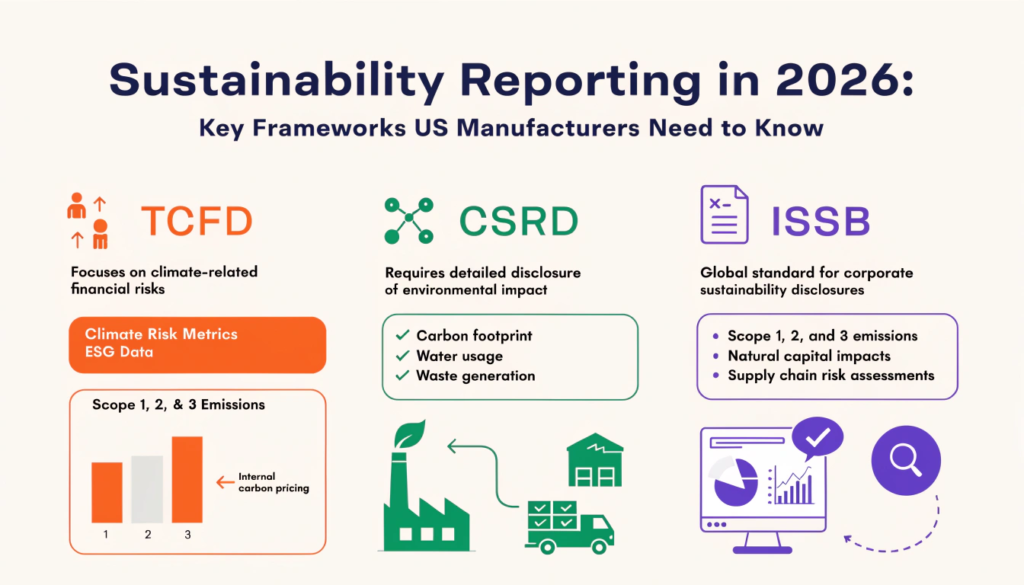
Sustainability reporting has moved from being a voluntary corporate communications exercise to becoming an increasingly important part of business strategy, risk management and regulatory planning. For US manufacturers, 2026 is a particularly important year. Companies are facing growing expectations from regulators, investors, customers, lenders and global supply-chain partners to provide reliable information about emissions, climate risks, resource use, workforce practices and governance.
The challenge is that there is no single sustainability reporting framework that applies to every manufacturer. Instead, companies may need to navigate a combination of regulatory requirements and widely used reporting frameworks depending on their size, industry, location, investors and international exposure.
For companies planning their manufacturing sustainability reporting 2026 strategy, understanding the differences between these frameworks is essential. A strong reporting program can also help manufacturers improve data quality, identify operational risks and prepare for changing ESG expectations.
Why Sustainability Reporting Matters More for Manufacturers in 2026
Manufacturers have a particularly large sustainability reporting footprint because their operations often involve energy consumption, greenhouse gas emissions, raw materials, waste, water usage, transportation and complex supplier networks.
At the same time, sustainability information is increasingly being connected to financial and operational decision-making. Investors may want to understand how climate risks could affect a company’s long-term performance, while customers may request emissions information from suppliers as part of their own ESG programs.
The regulatory environment is also evolving. In California, for example, large US-based companies doing business in the state are subject to climate disclosure laws. Under SB 253, companies above the applicable $1 billion annual revenue threshold are required to report greenhouse gas emissions, with initial reporting covering Scope 1 and Scope 2 emissions in 2026 and Scope 3 beginning in 2027. (California Air Resources Board)
This means manufacturers should not treat sustainability reporting as simply an annual report-writing exercise. The underlying data, controls, methodologies and accountability need to be established well before disclosure deadlines.
1. GRI Standards: A Broad Framework for Sustainability Impacts
The Global Reporting Initiative (GRI) Standards remain one of the most widely recognized frameworks for sustainability reporting. GRI focuses on an organization’s impacts on the economy, environment and people rather than only on information that may affect investors financially.
The GRI framework uses Universal Standards, Sector Standards and Topic Standards. This modular structure allows companies to identify and report on sustainability topics that are material to their operations and stakeholders. (Global Reporting Initiative)
For manufacturers, GRI can be particularly useful when reporting on areas such as energy, emissions, waste, water, occupational health and safety, labor practices, human rights and supply-chain impacts.
GRI can also provide a useful foundation for companies that want their sustainability report to communicate with a broad stakeholder audience. A manufacturer may use GRI to explain not only its climate performance but also how its operations affect employees, communities and the environment.
For companies developing their ESG manufacturing compliance strategy, GRI can therefore provide a comprehensive impact-oriented reporting structure.
2. ISSB Standards: Connecting Sustainability With Financial Information
The International Sustainability Standards Board (ISSB) has introduced another important direction in sustainability reporting.
ISSB issued IFRS S1, General Requirements for Disclosure of Sustainability-related Financial Information, and IFRS S2, Climate-related Disclosures, in 2023. These standards are designed to provide investors and other capital-market participants with decision-useful information about sustainability-related risks and opportunities. (IFRS)
IFRS S1 focuses broadly on sustainability-related risks and opportunities that could reasonably be expected to affect a company’s prospects. IFRS S2 specifically addresses climate-related risks and opportunities.
The standards are structured around four major areas: governance, strategy, risk management, and metrics and targets. They also emphasize industry-specific information, which is highly relevant for manufacturers because sustainability risks can vary significantly between industries. (IFRS)
A manufacturing company could use ISSB-aligned reporting to explain how extreme weather, energy prices, carbon regulations, supply-chain disruption or changing customer preferences could affect its business model and financial outlook.
Even when ISSB standards are not directly mandatory for a US manufacturer, understanding them can help companies prepare for international investor expectations and evolving reporting requirements.
3. SASB Standards: Industry-Specific Information for Manufacturers
The Sustainability Accounting Standards Board (SASB) Standards are particularly relevant to manufacturers because they focus on industry-specific sustainability risks and opportunities.
SASB standards are now maintained under the IFRS Foundation, and the ISSB incorporates SASB concepts into its approach. IFRS S1 requires companies to consider SASB Standards when identifying sustainability-related risks and opportunities where relevant. (IFRS)
The industry-specific nature of SASB makes it useful for manufacturers that need to determine which sustainability issues are most financially relevant to their sector.
For example, sustainability issues that matter to an automotive manufacturer may differ from those affecting an electronics, chemical, machinery or building-materials manufacturer. A standardized industry lens helps companies avoid collecting large amounts of sustainability information that has little relevance to their business.
Manufacturers can therefore use SASB as a practical bridge between operational sustainability data and investor-focused reporting.
4. TCFD: A Foundation for Climate Risk Reporting
The Task Force on Climate-related Financial Disclosures, commonly known as TCFD, has played a major role in shaping modern climate reporting.
Although the TCFD framework has been incorporated into the ISSB approach, its concepts remain highly relevant. TCFD organizes climate-related disclosures around governance, strategy, risk management, and metrics and targets—the same four core areas reflected in IFRS S1 and S2. (IFRS)
For manufacturers, this means climate reporting should go beyond simply calculating carbon emissions.
Companies should consider questions such as: Who is responsible for climate-related risks? How could climate change affect production facilities? Could flooding, heat, drought or severe storms disrupt operations? How resilient is the company’s supply chain? What investments are required to transition toward lower-emission operations?
These questions help transform sustainability reporting from a compliance activity into a strategic risk-management process.
5. California SB 253 and SB 261: Critical US Requirements to Monitor
For US manufacturers, California’s climate disclosure laws deserve particular attention because their applicability is based on doing business in California and revenue thresholds rather than simply being headquartered there.
SB 253, the Climate Corporate Data Accountability Act, applies to US-based entities with more than $1 billion in annual revenue that do business in California. The program requires annual greenhouse gas emissions reporting. CARB’s 2026 implementation materials specify that first-year reporting covers Scope 1 and Scope 2 emissions, with Scope 3 reporting following in 2027. (California Air Resources Board)
SB 261 addresses climate-related financial risk. It applies to US companies doing business in California with annual revenue above $500 million and requires climate-related financial risk reporting on a biennial basis. (California Air Resources Board)
However, manufacturers should monitor the latest CARB guidance and legal developments rather than relying solely on older implementation assumptions. CARB has continued developing the regulatory framework, and reporting requirements and implementation details have evolved. (California Air Resources Board)
For a manufacturer with significant California operations, sustainability data collection should therefore be designed with these requirements in mind.
6. SEC Climate Disclosure Rules: Why Manufacturers Should Still Pay Attention
The US federal regulatory environment is more uncertain in 2026.
The Securities and Exchange Commission adopted climate-related disclosure rules in 2024, but the SEC subsequently proposed rescinding those rules in May 2026. The SEC’s current rulemaking activity lists the rescission as a proposed rule, meaning manufacturers should not assume that the federal framework is settled. (SEC)
For publicly traded manufacturers, this uncertainty is an important reason to maintain strong internal sustainability data systems even while regulatory requirements evolve.
A company that already has reliable emissions data, documented methodologies, governance controls and review procedures will be better positioned if disclosure requirements change. It will also be better prepared to respond to investors, customers and other stakeholders.
The key lesson is simple: regulatory uncertainty should not become an excuse for poor data management.
7. ESRS and CSRD: Important for Manufacturers With European Connections
US manufacturers with European subsidiaries, customers, investors or significant business relationships should also understand the European sustainability reporting landscape.
The European Union’s Corporate Sustainability Reporting Directive (CSRD) requires companies within its scope to report using European Sustainability Reporting Standards (ESRS). The framework covers environmental, social and governance topics, including climate change, biodiversity and human rights. (European Commission Finance)
The EU reporting landscape has also been changing during 2026. In July 2026, the European Commission adopted revised ESRS designed to simplify reporting and reduce administrative burdens. The revised standards reduce mandatory data points substantially and introduce additional flexibility, although the measures still require completion of the applicable EU approval process before taking effect. (European Commission Finance)
For US manufacturers with European exposure, this reinforces the importance of mapping customer, subsidiary and regulatory requirements before selecting a single reporting approach.
Building a Practical Sustainability Reporting Strategy
The biggest mistake manufacturers can make is trying to create a sustainability report before creating a reliable sustainability data system.
A better approach starts by identifying which frameworks and regulations actually apply to the organization. A private manufacturer selling entirely within the US may have a different reporting profile from a publicly traded manufacturer with operations in California and customers throughout Europe.
Next, companies should establish clear ownership for sustainability data. Environmental teams may manage emissions and waste information, operations may control energy and production data, procurement may manage supplier information, and finance may need to validate data that could influence financial reporting.
Manufacturers should then establish consistent methodologies. For example, emissions data should have a defined organizational boundary, calculation methodology, source documentation and review process. Data should be traceable from the original source through the final disclosure.
Technology can also play an important role. Manufacturing execution systems, energy-management platforms, enterprise resource planning systems and environmental management software can help collect operational information. Integrating these systems can reduce spreadsheet-based reporting and improve consistency.
The objective should be to create a centralized sustainability data architecture that can support multiple reporting frameworks rather than building separate systems for every framework.
Avoiding the Biggest Reporting Mistake: Treating Every Framework as the Same
GRI, ISSB, SASB, TCFD and ESRS are not interchangeable.
GRI primarily focuses on an organization’s impacts on people, the environment and the economy. ISSB is more focused on sustainability-related information useful to investors and capital markets. SASB provides industry-specific guidance, while TCFD has provided a foundational structure for climate-related financial disclosures. ESRS provides the reporting architecture for companies within the applicable European framework.
A manufacturer may therefore need to use more than one framework.
The solution is not to create five separate sustainability reporting systems. Instead, companies should build a core data platform and map relevant information to the different frameworks.
For example, one emissions dataset could potentially support internal sustainability management, GRI reporting, ISSB-aligned disclosures, customer questionnaires and applicable California requirements.
This approach can reduce duplication and improve consistency.
What US Manufacturers Should Prioritize in 2026
The priority for manufacturers should be readiness rather than simply report production.
Companies should first determine which laws and frameworks apply to their operations, revenue, industry and geographic footprint. They should then identify gaps in emissions, energy, waste, water, workforce, supply-chain and governance data.
Manufacturers should also establish documentation and internal controls around sustainability information. As sustainability disclosures become more structured, unsupported numbers and inconsistent methodologies can create reputational and compliance risks.
Another important priority is Scope 3 emissions. Even where Scope 3 reporting is not yet required, manufacturers may increasingly receive requests from major customers seeking information about purchased goods, transportation, use of sold products and other value-chain emissions.
Preparing supplier data now can make future reporting significantly easier.
The Future of Manufacturing Sustainability Reporting
The direction of sustainability reporting is becoming clearer even though the exact regulatory requirements remain in flux.
Manufacturers are moving toward more standardized, comparable and decision-useful information. Investors want information connected to business risks. Customers want supply-chain transparency. Regulators want credible emissions data. Employees and communities increasingly expect companies to demonstrate measurable progress.
This means sustainability reporting will increasingly become integrated with finance, operations, procurement, risk management and corporate strategy.
For manufacturers, the winning approach is not to chase every new reporting framework independently. Instead, companies should build a flexible reporting system based on high-quality data, strong governance and clear accountability.
The manufacturing sustainability reporting 2026 landscape may continue to change, but organizations that establish these fundamentals now will be in a stronger position to respond to new requirements.
Conclusion
Sustainability reporting is becoming an important business capability for US manufacturers. In 2026, companies need to understand frameworks including GRI, ISSB, SASB, TCFD and ESRS while closely monitoring US regulatory developments such as California’s SB 253 and SB 261.
The right reporting strategy depends on a manufacturer’s size, industry, geographic presence, ownership structure and customer base. What remains consistent is the need for reliable data, documented methodologies and strong internal governance.
Rather than viewing sustainability reporting as another compliance burden, manufacturers can use it to identify energy inefficiencies, reduce operational risks, improve supply-chain visibility and strengthen long-term business resilience.
As regulations and market expectations continue to evolve, manufacturers that invest in their sustainability reporting infrastructure today will be better prepared for tomorrow’s requirements.
Ready to explore the latest developments in smart manufacturing, automation and industry transformation? Enquire about BMA conventions and connect with industry professionals shaping the future of manufacturing.