
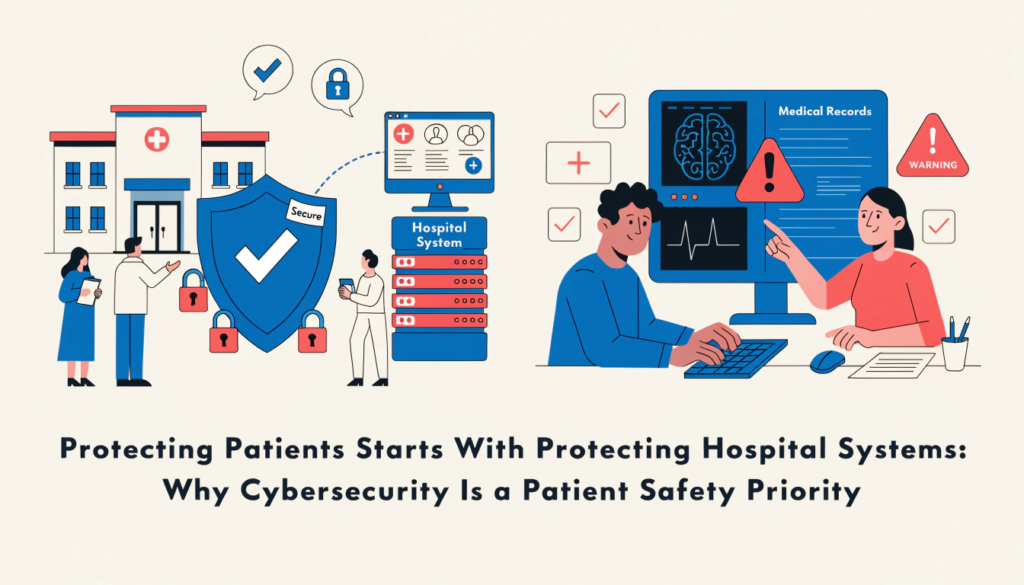
Cybersecurity is no longer simply an IT responsibility for hospitals. As healthcare becomes increasingly connected, digital systems now influence almost every part of patient care, from appointment scheduling and electronic health records to diagnostic imaging, medication administration and critical-care equipment. When those systems are disrupted, the consequences can extend far beyond lost data or financial damage.
This is why hospital cybersecurity patient safety must be treated as a single, connected priority rather than two separate concerns.
A cyberattack against a hospital can prevent clinicians from accessing medical histories, delay diagnostic procedures, disrupt communication and force staff to rely on manual processes. In a serious incident, technology failure can affect how quickly and safely a patient receives care.
Compliance requirements remain important, but meeting regulations should be considered the starting point not the final destination. Hospitals need a security strategy designed around resilience, continuity and, ultimately, patient outcomes.
Why Hospital Cybersecurity Is Now a Patient Safety Issue
Modern hospitals operate as complex digital ecosystems. Patient information may move between electronic health record platforms, laboratories, pharmacies, imaging systems, medical devices, cloud applications and external healthcare providers.
This connectivity improves efficiency and enables better care, but it also creates more opportunities for cyber threats to interfere with clinical operations.
Consider a ransomware incident that makes an electronic health record system unavailable. Clinicians may suddenly struggle to access a patient’s medication history, allergies, previous diagnoses or test results. A hospital may have backup procedures, but if systems remain unavailable for hours or days, clinical teams can face significant operational pressure.
The issue is therefore not only whether confidential information has been stolen. The bigger question is whether healthcare professionals can continue delivering safe and timely care.
That is the core connection between cybersecurity and patient safety.
The Real Healthcare Data Breach Consequences
When discussing cybersecurity, organisations often focus on the financial and reputational impact of a breach. These are serious concerns, but healthcare data breach consequences can be much broader.
A breach can expose highly sensitive patient information, including medical records, insurance information and personally identifiable details. The organisation may face investigation, legal costs, regulatory penalties, remediation expenses and damage to public trust.
However, the consequences can become even more serious when a cyber incident disrupts healthcare delivery.
A compromised system can contribute to appointment cancellations, delayed procedures, diverted emergency patients, disrupted laboratory services and reduced access to clinical information. Staff may have to switch to paper-based processes, increasing administrative workloads and creating additional opportunities for human error.
In other words, cybersecurity failures can create operational risks that eventually become clinical risks.
Compliance Alone Is Not Enough
Healthcare organisations operate under extensive regulatory and privacy requirements. These frameworks encourage hospitals to protect sensitive information, control access and maintain appropriate security measures.
But compliance does not automatically mean an organisation is cyber resilient.
A hospital can have policies, procedures and security controls in place and still be vulnerable to sophisticated attacks. Cyber threats evolve continuously, while healthcare environments often contain legacy systems, third-party applications and connected medical devices that may be difficult to update.
This creates a gap between being technically compliant and being operationally prepared.
A stronger approach asks more practical questions:
Can the hospital continue providing critical care if its main IT systems become unavailable?
Can clinicians access essential patient information during an outage?
How quickly can affected systems be isolated?
Are backups protected and regularly tested?
Do clinical teams know what to do during a cyber incident?
Can the organisation communicate effectively with patients, employees, suppliers and emergency partners during a disruption?
These questions move cybersecurity from a compliance exercise into a patient safety strategy.
The Growing Role of Connected Medical Technology
The expansion of connected medical technology has made cybersecurity even more important.
Hospitals increasingly depend on network-connected equipment and digital platforms to monitor patients, support diagnosis and coordinate care. These technologies can deliver enormous benefits, but every connected device can potentially introduce another security consideration.
Medical devices may also have long operating lifecycles. Some equipment cannot be updated as easily as conventional business technology, making vulnerability management particularly challenging.
Healthcare leaders therefore need to understand that cybersecurity cannot stop at laptops, servers and email accounts. The security conversation should extend across the wider clinical technology environment.
Cybersecurity teams, facility managers, clinical leaders, biomedical engineering teams and senior executives should work together to identify where technology failures could directly or indirectly affect patient care.
Ransomware Can Become a Clinical Disruption
Ransomware remains particularly concerning for healthcare organisations because hospitals cannot simply stop operating while an incident is resolved.
A business may be able to temporarily close a system or delay certain operations. A hospital still needs to manage emergencies, provide treatment and monitor patients.
During a ransomware incident, staff may have to work without normal access to digital records. Emergency departments may experience delays. Elective procedures could be postponed. Communication between departments can become more difficult.
The best defence is therefore not based on one cybersecurity product. Hospitals need multiple layers of protection combined with strong incident response and business continuity planning.
Regular backups, network segmentation, access controls, multi-factor authentication, employee awareness, vulnerability management and continuous monitoring can all contribute to a more resilient environment.
But technology alone cannot solve the problem.
Cybersecurity Needs Clinical Leadership
One of the biggest changes hospitals can make is to bring clinical leadership into cybersecurity discussions.
Cybersecurity decisions are sometimes treated as technical matters that belong exclusively to IT departments. Yet clinical professionals understand how system availability affects patient care in ways that technical teams may not always see.
For example, an IT team may classify a system as important because it contains critical information. A clinical team may identify an entirely different priority based on how quickly that system is required during emergency treatment.
This is why hospitals should map their digital infrastructure against clinical workflows.
The objective should be to identify which systems are essential to patient care, which dependencies could create bottlenecks and which services need priority restoration during an incident.
Cybersecurity should become part of the hospital’s broader risk management and patient safety framework.
Building a Patient-Centred Cybersecurity Strategy
A patient-centred cybersecurity strategy begins with understanding what could happen to patients if a particular system fails.
Hospitals should identify their most critical clinical processes and then determine how cyber incidents could affect those processes. This includes emergency care, medication management, diagnostic testing, surgery, intensive care and communication.
From there, organisations can develop response and recovery priorities.
Employee awareness also deserves significant attention. Healthcare employees interact with systems throughout the day, and a single compromised account can potentially provide attackers with an entry point into a wider environment.
Training should therefore be practical rather than purely theoretical. Staff should understand how to identify suspicious messages, protect credentials, report unusual activity and respond when systems suddenly become unavailable.
Regular exercises can also help. A simulated cyber incident can reveal weaknesses in communication, escalation procedures, backup processes and clinical continuity plans before a real emergency exposes them.
Third-Party Risk Cannot Be Ignored
Hospitals rarely operate entirely on their own. They depend on technology vendors, software providers, cloud services, laboratories, suppliers and other external partners.
This interconnected ecosystem means that a hospital’s security posture can be influenced by organisations outside its direct control.
Third-party risk management should therefore form part of the cybersecurity programme. Healthcare organisations should understand what information vendors can access, what systems they connect to and how they respond to security incidents.
Contracts and vendor assessments can help establish expectations around security, reporting, access and incident response.
The goal is not to eliminate every possible risk. That is unrealistic. The goal is to understand the risks and prepare for them.
Cyber Resilience Should Be Measured by Continuity of Care
A mature cybersecurity programme should not only measure how many threats were blocked. Hospitals should also consider how effectively they can maintain or restore patient services during a cyber incident.
Useful questions include:
How quickly can critical systems be restored?
How long can essential clinical services operate manually?
Are backup systems regularly tested?
How effectively can the organisation communicate during an outage?
Do staff understand downtime procedures?
How quickly can vulnerabilities be identified and addressed?
These measures provide a more meaningful picture of resilience because they connect cybersecurity performance with operational and patient outcomes.
The Future of Hospital Cybersecurity Is About Resilience
Healthcare organisations cannot eliminate cyber risk completely. The digital transformation of healthcare will continue, and attackers will continue looking for vulnerabilities.
The answer is not to slow innovation. Instead, hospitals need to make security and resilience part of innovation itself.
Every new connected device, cloud service, digital platform or automated workflow should be evaluated not only for its clinical and operational benefits but also for its security implications.
The strongest organisations will move away from the idea that cybersecurity belongs solely to the IT department. Instead, it will become a shared responsibility involving executives, clinicians, facility managers, technology teams, suppliers and employees.
Most importantly, the conversation will focus on what cybersecurity protects: safe, reliable and uninterrupted patient care.
Conclusion: Make Cybersecurity Part of Patient Safety
The relationship between cybersecurity and healthcare delivery is becoming impossible to ignore. A cyberattack can compromise data, but it can also interrupt the systems that clinicians depend on to deliver care.
That is why hospital cybersecurity patient safety should be embedded into strategic planning, risk management, technology investment and clinical continuity programmes.
Compliance remains essential, but it should be viewed as the foundation of a broader resilience strategy. Hospitals need to prepare for the possibility that systems may be compromised and ensure that critical patient services can continue.
The future of healthcare cybersecurity is therefore not simply about protecting networks. It is about protecting trust, continuity and human lives.
For healthcare leaders, facility professionals, technology experts and decision-makers, now is the time to move the cybersecurity conversation beyond compliance and towards resilience.
Register as a delegate to connect with industry professionals and explore the evolving priorities shaping smarter, safer healthcare facilities.