
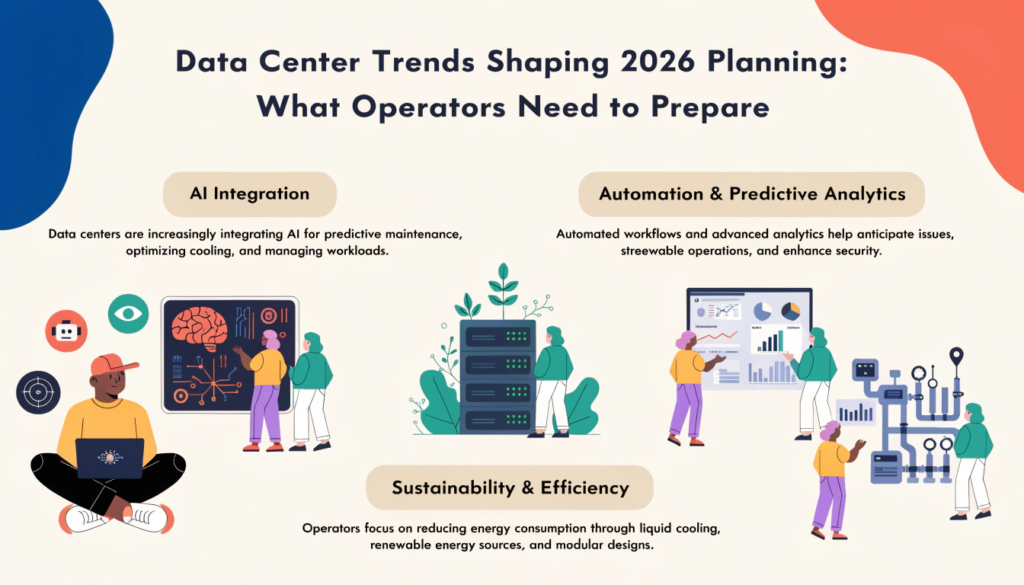
Data centers are entering a new phase of infrastructure planning. Artificial intelligence, rising power requirements, higher rack densities, sustainability targets, and growing demand for digital services are changing how facilities are designed, built, powered, and operated.
For operators, developers, facility managers, technology leaders, and investors, 2026 is not simply another year of incremental upgrades. It is becoming a planning cycle in which decisions about power, cooling, location, capacity, resilience, and efficiency can determine whether a data center remains competitive over the next decade.
The latest energy outlooks reinforce the scale of this transformation. The International Energy Agency expects global electricity demand to continue rising rapidly, with AI and data centers among the important drivers. Its analysis projects global data center electricity consumption could roughly double by 2030, reaching around 945 TWh in its base case. (IEA)
That makes understanding the data center trends 2026 landscape essential for organizations developing new facilities or modernizing existing ones.
Here are nine trends that are likely to influence data center planning decisions throughout 2026.
1. AI Will Reshape Data Center Capacity Planning
Artificial intelligence is arguably the biggest force changing data center infrastructure.
Traditional workloads typically allowed operators to plan capacity around relatively predictable rack densities and gradual increases in computing requirements. AI workloads are different. GPU-intensive training, inference, high-performance computing, and large-scale AI applications can require substantially more power and cooling capacity than conventional enterprise workloads.
As a result, data center planning is shifting from simply asking, “How much space do we need?” to asking, “How much high-density compute can this facility support?”
AI is therefore influencing everything from electrical distribution and cooling systems to floor layouts and equipment selection. The IEA expects electricity consumption from accelerated servers, largely associated with AI adoption, to grow considerably faster than conventional server consumption. (IEA)
For operators, this means future capacity should be designed around workload diversity. Facilities that only accommodate today’s average rack density may face expensive retrofits when AI requirements increase.
2. Power Availability Will Become a Core Site-Selection Factor
Location has always mattered in data center development, but power availability is becoming one of the most important factors in deciding where facilities can realistically be built.
A location may offer suitable land, strong connectivity, and attractive tax incentives, but these advantages become less meaningful if the local grid cannot provide sufficient electricity within the required development timeline.
The growth of AI is intensifying this challenge. The IEA reported that data center electricity use surged in 2025 and that investment by five major technology companies exceeded $400 billion, with further increases expected in 2026. (IEA)
This changes data center strategy planning. Developers increasingly need to evaluate utility capacity, grid connection timelines, transmission infrastructure, power availability, energy pricing, and the possibility of future expansion before committing to a site.
Power should therefore be evaluated alongside land and connectivity rather than treated as a later-stage engineering issue.
3. Liquid Cooling Will Move Further Into the Mainstream
Higher compute density creates another major planning challenge: heat.
Traditional air cooling remains appropriate for many workloads, but AI and high-performance computing are pushing rack densities beyond what conventional cooling approaches can comfortably handle.
This is driving greater interest in liquid cooling, including direct-to-chip and other liquid-based thermal management technologies.
Schneider Electric noted in a 2026 analysis that rising AI rack densities are forcing operators to coordinate power, cooling, facility design, and grid constraints more closely. (Schneider Electric Blog)
The important point for planners is that cooling cannot be considered separately from electrical infrastructure. A facility designed for high-density AI workloads may need liquid-cooling distribution, heat-rejection systems, piping infrastructure, water management, and appropriate redundancy from the beginning.
For existing facilities, operators will also need to assess whether their current floor design, power distribution, cooling capacity, and structural infrastructure can accommodate higher-density deployments.
4. Data Center Strategy Planning Will Become More Power-Centric
The traditional approach to data center strategy planning often focused on IT capacity, redundancy, physical space, and expected growth.
In 2026, power is increasingly becoming the foundation around which those decisions are made.
Operators need to understand not only how much power a facility has today, but also how much can realistically be secured in the future. This includes evaluating utility relationships, substation capacity, backup generation, energy storage, renewable energy contracts, and potential on-site generation.
The shift is significant because a facility’s theoretical IT capacity means little if sufficient power cannot be delivered to the racks.
A more effective strategy therefore connects IT growth forecasts with electrical infrastructure planning. Instead of adding power only when demand increases, operators should create staged expansion plans that align computing requirements with realistic energy availability.
5. Sustainability Will Shift From Goal to Infrastructure Requirement
Sustainability remains an important part of the data center conversation, but expectations are becoming more practical.
Operators are under pressure to reduce energy consumption, manage water use, improve efficiency, and lower emissions while continuing to provide reliable computing capacity.
This is particularly challenging because AI-driven expansion can increase energy requirements even as individual computing systems become more efficient.
Consequently, sustainability strategies are increasingly being incorporated into facility design rather than treated as an operational add-on.
Data center teams are evaluating higher-efficiency cooling systems, renewable energy procurement, heat reuse, improved power management, energy storage, and more efficient infrastructure. Site selection can also influence sustainability performance because climate, grid composition, water availability, and renewable energy access all affect long-term environmental impact.
The strongest data center trends 2026 strategies will therefore connect sustainability targets directly to capital planning and operational performance.
6. Grid Constraints Will Encourage Alternative Energy Strategies
Power demand is increasing faster than some regions can expand grid infrastructure.
This creates a difficult planning environment for large data center projects. Even when a company has secured a site and financing, grid interconnection timelines can affect when the facility can become operational.
As a result, data center developers are examining more flexible energy strategies. These can include renewable power purchase agreements, battery energy storage, microgrids, on-site generation, and other approaches that can complement utility power.
The objective is not necessarily to eliminate dependence on the grid. Instead, organizations are looking for ways to improve energy resilience and reduce exposure to power constraints.
This will make energy strategy an increasingly important part of early-stage project development.
7. Edge Data Centers Will Support Distributed Computing
Not every workload needs to be processed in a massive hyperscale facility.
As organizations deploy IoT systems, autonomous technologies, smart infrastructure, industrial automation, connected healthcare applications, and real-time analytics, processing data closer to users and devices can reduce latency.
This is supporting continued interest in edge data centers and smaller distributed facilities.
Edge infrastructure also creates different planning requirements. Operators must consider geographic distribution, physical security, remote monitoring, maintenance, connectivity, local power availability, and standardized deployment models.
Rather than replacing large centralized facilities, edge infrastructure will increasingly complement them.
For organizations planning future capacity, the question may therefore be less about choosing between centralized and edge infrastructure and more about determining which workloads belong in each environment.
8. Modular and Scalable Data Center Design Will Gain Importance
Speed and flexibility are becoming increasingly valuable in data center development.
Demand forecasts can change rapidly, particularly when AI adoption is involved. A facility planned several years ago may need significantly different computing capacity by the time construction is complete.
This makes modular and scalable designs attractive.
Instead of building maximum capacity from day one, operators can design infrastructure that expands in phases. Electrical systems, cooling capacity, white space, and supporting infrastructure can be developed around predefined expansion stages.
This approach can help organizations avoid unnecessary upfront capital expenditure while preserving the ability to scale when demand becomes clearer.
Modular construction can also help address some labor and construction scheduling challenges by shifting more work toward standardized and repeatable processes.
For 2026 planning cycles, flexibility should therefore be treated as a strategic capability rather than simply an architectural preference.
9. Resilience and Security Will Become More Integrated
Data center resilience has traditionally focused heavily on power redundancy, cooling redundancy, backup systems, and disaster recovery.
Those areas remain critical, but modern facilities face a broader range of risks.
Cybersecurity threats, supply-chain disruptions, extreme weather, physical security concerns, equipment shortages, grid instability, and changing regulatory expectations can all affect availability.
This means resilience needs to be considered across the complete infrastructure lifecycle.
For example, operators should evaluate whether critical components have adequate supply-chain alternatives, whether backup systems can operate during prolonged grid disruption, whether physical access controls are robust, and whether digital monitoring systems themselves are protected.
The rapid development of AI data centers makes this even more important because the value of the infrastructure being protected is increasing.
What These Trends Mean for 2026 Data Center Planning
The most important takeaway from these developments is that data center planning can no longer happen in isolated departments.
Power teams, IT teams, facilities managers, sustainability professionals, procurement teams, developers, and finance leaders need to work from a common infrastructure strategy.
AI affects power requirements. Power requirements affect cooling. Cooling affects facility design. Facility design affects capital expenditure. Site selection affects grid access and sustainability. All of these decisions affect the facility’s ability to scale.
This interconnected model is changing data center strategy planning from a traditional capacity exercise into a long-term business and infrastructure strategy.
Organizations should consider several questions during their 2026 planning cycles:
- Can the facility support higher-density AI workloads?
- Is sufficient power available today and during future expansion?
- Can existing cooling systems support changing rack densities?
- Does the site provide a realistic path to additional utility capacity?
- How will sustainability requirements affect infrastructure decisions?
- Can the facility scale without major retrofits?
- Are backup power and resilience strategies appropriate for future workloads?
- Can physical and cybersecurity risks be addressed together?
- Which workloads should remain centralized, and which could benefit from edge infrastructure?
Answering these questions early can help reduce the risk of costly redesigns later.
The Data Center of 2026 Will Be Designed Around Flexibility
The next generation of data centers will not simply be bigger. They will need to be smarter, more adaptable, and more closely connected to energy and infrastructure planning.
AI will continue to influence capacity requirements. Higher rack densities will accelerate cooling innovation. Power availability will increasingly influence site selection. Sustainability will become more deeply integrated into facility design, while modular infrastructure and edge computing will provide additional flexibility.
At the same time, resilience will become broader than traditional redundancy. Operators will need to prepare for interconnected risks involving energy, technology, supply chains, security, and climate.
The organizations that respond effectively will be those that plan for multiple future scenarios rather than optimizing only for today’s requirements.
That is ultimately the central message behind the data center trends 2026 outlook: the winning strategy will not simply be to build more capacity. It will be to build capacity that can adapt.
Prepare for the Next Phase of Data Center Infrastructure
The rapid convergence of AI, energy, cooling, sustainability, and digital infrastructure is creating new opportunities and new planning challenges for data center leaders.
Industry events can provide an opportunity to explore these developments, connect with professionals, and understand how infrastructure strategies are evolving.
Register interest for BMA Data Center 2026 to stay connected with discussions around the future of data center facilities, infrastructure, technology, and strategy.