
Healthcare organizations are increasingly dependent on digital systems to deliver safe, efficient, and connected patient care. Electronic health records, connected medical devices, telehealth platforms, cloud applications, pharmacy systems, diagnostic technologies, and administrative networks have transformed healthcare delivery but they have also expanded the potential attack surface for cybercriminals.
In 2026, a healthcare organization cannot treat cybersecurity as an IT-only responsibility. A cyberattack can quickly become a patient-safety, operational, financial, and reputational crisis. This makes a well-designed healthcare cybersecurity incident response plan essential for hospitals, clinics, health systems, and other healthcare organizations.
The U.S. Department of Health and Human Services (HHS) identifies basic incident planning and preparedness as an important healthcare cybersecurity priority. Its Healthcare and Public Health Cybersecurity Performance Goals emphasize preparation, response, restoration, and recovery from significant cybersecurity incidents.
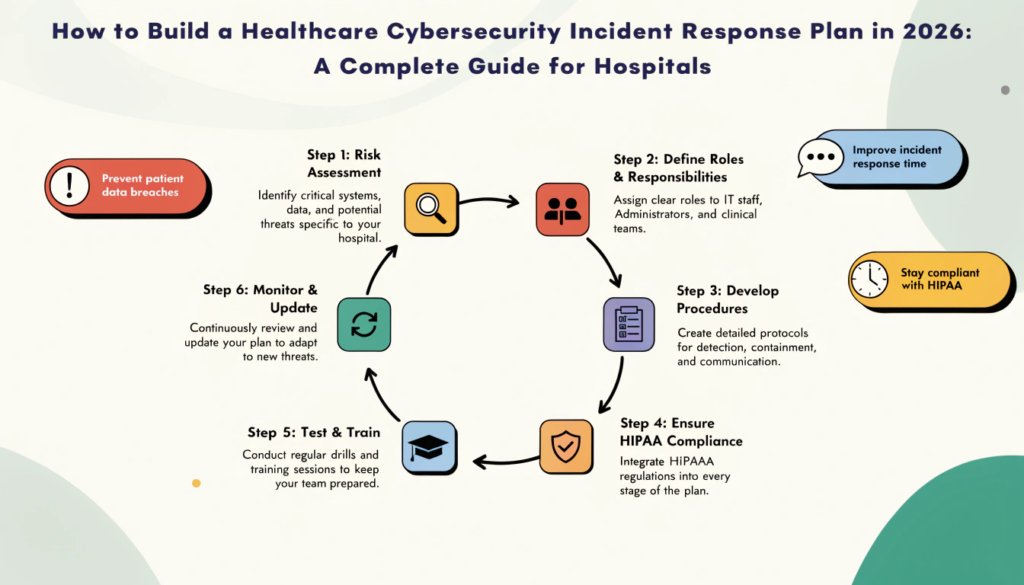
A strong incident response plan gives healthcare teams a structured way to detect threats, contain damage, maintain critical services, protect patient information, communicate with stakeholders, and recover operations. Here is how healthcare organizations can build an effective plan for 2026.
Why Healthcare Cybersecurity Incident Response Matters in 2026
Healthcare is an attractive target for cybercriminals because hospitals manage large amounts of sensitive and valuable information. Patient records can contain names, addresses, insurance information, medical histories, payment details, and other information that criminals may attempt to exploit.
At the same time, hospitals cannot simply shut down their technology infrastructure when an incident occurs. Clinical operations often depend on digital systems. An outage affecting electronic health records, laboratory systems, imaging platforms, medication systems, communications, or connected medical equipment can disrupt patient care.
Ransomware is particularly concerning because it can make critical systems and data inaccessible. HHS guidance explains that ransomware response should involve detection and analysis, containment, eradication, recovery, and post-incident activities.
Recent regulatory activity also demonstrates the importance of cybersecurity preparedness. In April 2026, HHS’s Office for Civil Rights announced four ransomware-related HIPAA Security Rule settlements involving breaches affecting more than 427,000 individuals.
For hospitals, therefore, incident response is not simply about restoring computers. It is about protecting patients, maintaining essential clinical operations, preserving evidence, meeting regulatory obligations, and restoring trust.
1. Start With a Healthcare Cybersecurity Risk Assessment
The first step in building a healthcare cybersecurity incident response plan is understanding what you need to protect.
Hospitals should identify critical systems, sensitive information, connected devices, network infrastructure, applications, cloud services, and third-party platforms. The assessment should also identify which systems are essential for patient care and which can tolerate temporary downtime.
Create an up-to-date inventory of assets such as electronic health record systems, medical imaging platforms, laboratory systems, pharmacy applications, patient portals, telehealth services, staff devices, servers, network equipment, and connected medical devices.
Healthcare organizations should also identify where protected health information is stored, processed, or transmitted. Understanding the relationship between systems makes it easier to determine which assets should be isolated if an attack occurs.
HHS’s Healthcare Cybersecurity Performance Goals specifically highlight asset inventory, vulnerability management, endpoint protection, multifactor authentication, incident planning, and centralized incident preparedness as important cybersecurity practices.
2. Define What Counts as a Cybersecurity Incident
Not every cybersecurity alert requires the same response. Your plan should establish clear incident categories and severity levels.
For example, a suspicious phishing email may initially represent a low-level security event. However, if an employee enters credentials into a malicious website and the attacker uses those credentials to access hospital systems, the situation should be escalated.
Similarly, malware on an isolated workstation may have a different priority from ransomware affecting an electronic health record environment.
Your incident response plan should define categories such as unauthorized access, ransomware, phishing, malware, data theft, credential compromise, denial-of-service attacks, insider threats, medical-device compromise, cloud account compromise, and third-party security incidents.
Each category should have predefined escalation criteria so employees do not waste valuable time deciding whether an incident is serious enough to report.
3. Create a Cross-Functional Incident Response Team
Effective healthcare cybersecurity incident response requires cooperation across departments.
The incident response team should not consist only of cybersecurity professionals. Healthcare organizations should establish clear responsibilities for IT, cybersecurity, clinical leadership, legal and compliance teams, communications, human resources, executive management, facilities, biomedical engineering, and relevant external partners.
An incident commander should coordinate the response and ensure that decisions are made quickly. IT and security teams can investigate and contain the technical incident, while clinical leaders assess how the disruption could affect patient care.
Legal and compliance teams should evaluate regulatory and contractual obligations. Communications teams should manage internal and external messaging. Executive leadership should make high-level decisions involving business continuity, resources, and organizational risk.
Hospitals should also maintain current contact details for external incident-response providers, technology vendors, cyber insurers, legal counsel, law enforcement, and other critical partners.
CISA’s healthcare ransomware response guidance similarly emphasizes having leadership, legal, technology, clinical, and external support contacts available during an incident.
4. Establish a Clear Detection and Reporting Process
A response plan is only effective when employees know how to report suspicious activity.
Healthcare organizations should establish a simple reporting process available to clinicians, administrative employees, contractors, and other workforce members. Employees should know where to report suspicious emails, unusual system behavior, lost devices, unexpected password requests, or potential unauthorized access.
Security teams should combine employee reports with technical monitoring. Logs from endpoints, servers, firewalls, identity systems, cloud environments, and security tools can provide valuable evidence when investigating an incident.
Centralized logging and monitoring can help security teams identify suspicious behavior earlier and understand how an attacker moved through the environment. HHS’s cybersecurity goals specifically recommend collecting necessary security telemetry to improve visibility and speed response.
5. Build Hospital Ransomware Protection Into the Plan
Ransomware deserves special attention because of its potential to disrupt both information systems and clinical operations.
Effective hospital ransomware protection begins before an attack. Organizations should use strong access controls, multifactor authentication, endpoint protection, network segmentation, secure configurations, vulnerability management, employee awareness training, and reliable backups.
Backups should be protected from unauthorized modification or deletion and regularly tested to confirm that they can actually be restored. A backup strategy that exists only on paper is not enough during a ransomware emergency.
Hospitals should also understand which systems must be restored first. For example, systems essential for emergency care, medication management, diagnostics, patient records, and clinical communication may require priority over less critical administrative applications.
If ransomware is detected, the response plan should clearly explain how affected systems will be isolated. HHS recommends activating security incident response procedures and taking steps to isolate infected systems to prevent further propagation.
The goal should not be simply to restore everything as quickly as possible. The organization must first establish that the environment is sufficiently secure to prevent reinfection.
6. Define Containment and Eradication Procedures
Once an incident has been confirmed, the response team needs to contain it.
Containment could involve isolating endpoints, disabling compromised accounts, restricting network connections, blocking malicious communications, temporarily suspending affected services, or separating compromised network segments.
However, healthcare organizations need to balance cybersecurity decisions with patient safety.
For example, shutting down a system without understanding its clinical role could create additional operational risks. This is why cybersecurity, IT, clinical, and biomedical teams should work together when deciding how systems should be isolated.
After containment, the organization should determine how the attacker gained access. Was the entry point phishing, stolen credentials, an unpatched vulnerability, a compromised vendor, exposed remote access, or another weakness?
Eradication should address both the immediate malware or attacker activity and the vulnerability that enabled the incident.
7. Include HIPAA and Breach Notification Requirements
A healthcare incident response plan should integrate legal and compliance processes from the beginning.
For U.S. organizations subject to HIPAA, cybersecurity incidents involving protected health information may trigger specific obligations. The organization should have a process for determining whether protected health information was accessed, acquired, disclosed, or compromised and whether notifications are required.
The response team should preserve relevant evidence and document important decisions throughout the investigation.
Importantly, cybersecurity teams should not independently make legal conclusions about breach notification. Legal and compliance professionals should participate in the assessment.
HHS explains that ransomware involving a covered entity or business associate can constitute a security incident under HIPAA and that organizations must follow their security incident response and reporting procedures.
The plan should therefore identify who evaluates regulatory obligations, who approves notifications, who communicates with affected individuals, and who manages communications with regulators and other relevant authorities.
8. Protect Third-Party and Supply-Chain Connections
Modern healthcare organizations rely heavily on vendors and service providers.
Cloud platforms, medical device manufacturers, software vendors, billing companies, laboratories, technology providers, managed service providers, and other third parties may have access to healthcare systems or information.
A cyberattack against a vendor can therefore become a healthcare organization’s cybersecurity incident.
Healthcare organizations should identify critical third parties and establish contractual requirements for cybersecurity, incident reporting, data protection, and cooperation during investigations.
HHS’s cybersecurity goals specifically include third-party vulnerability disclosure and third-party incident reporting as enhanced practices for healthcare organizations.
Incident response plans should also include a process for contacting vendors during an incident and determining whether their systems or credentials contributed to the attack.
9. Build a Downtime and Business Continuity Strategy
Cybersecurity response cannot focus entirely on technology recovery. Hospitals must continue delivering care during outages.
A robust plan should identify downtime procedures for clinical teams and define how essential operations will continue if electronic systems become unavailable.
Organizations should establish procedures for accessing critical information, documenting patient care, communicating with staff, coordinating departments, and transitioning back to normal systems.
Downtime procedures should be tested rather than simply documented. Staff members need to understand what they should do when systems are unavailable and how information will later be reconciled once systems return.
This approach connects cybersecurity with broader business continuity and disaster recovery planning.
10. Test the Plan With Tabletop Exercises
A written plan is not enough.
Healthcare organizations should conduct tabletop exercises that simulate realistic cyber incidents. Scenarios could include a ransomware attack affecting the EHR, a compromised administrator account, a phishing campaign targeting clinicians, a medical-device security incident, or a third-party vendor breach.
During an exercise, teams should practice decision-making, escalation, communication, containment, downtime procedures, recovery, and regulatory assessment.
HHS’s cybersecurity goals specifically encourage organizations to maintain, drill, and update incident response plans for relevant threat scenarios.
After every exercise, document what worked and what failed. If staff members were unsure who should authorize system isolation, that is a weakness in the plan. If contact information was outdated, update it immediately.
11. Measure Response Performance
Healthcare organizations should establish measurable incident response objectives.
Useful metrics can include mean time to detect, mean time to respond, mean time to contain, recovery time, percentage of critical systems with tested backups, employee phishing-reporting rates, and the percentage of critical vendors covered by incident response procedures.
These metrics allow leadership to determine whether cybersecurity capabilities are improving.
The goal should not be to create impressive-looking numbers. Metrics should help identify operational weaknesses and guide investment decisions.
12. Review and Update the Plan Regularly
Cyber threats, technologies, regulations, vendors, and hospital infrastructure change continuously.
An incident response plan developed several years ago may not adequately address cloud services, connected medical devices, remote access, artificial intelligence tools, new ransomware tactics, or changes in the organization’s technology environment.
Healthcare organizations should review their plans regularly and update them following major technology changes, security incidents, tabletop exercises, regulatory developments, or changes in critical vendors.
The HHS Cybersecurity Performance Goals provide a useful framework for prioritizing high-impact safeguards and improving cyber resilience across healthcare organizations.
The Future of Healthcare Cybersecurity Is Preparedness
In 2026, healthcare cybersecurity is increasingly connected to patient safety, operational resilience, regulatory compliance, and organizational reputation.
A strong healthcare cybersecurity incident response plan gives hospitals a structured process for responding when preventive controls fail. It identifies responsibilities, defines escalation procedures, protects critical systems, supports clinical continuity, and provides a path toward safe recovery.
At the same time, effective hospital ransomware protection requires more than purchasing cybersecurity software. Hospitals need tested backups, strong identity controls, employee awareness, network visibility, asset management, vendor oversight, and well-practiced response procedures.
The most resilient healthcare organizations will be those that treat incident response as an ongoing capability rather than a document stored in an IT folder.
Cybersecurity teams should continuously assess risks, test their plans, train employees, strengthen technical safeguards, and learn from incidents and exercises. When healthcare organizations combine technology with preparation and cross-functional coordination, they can reduce disruption and respond more confidently when threats emerge.
Conclusion
Building a healthcare cybersecurity incident response plan in 2026 requires a combination of preparation, technology, people, processes, and continuous testing. Healthcare organizations must know their critical assets, define incident severity, establish cross-functional response teams, strengthen ransomware defenses, protect third-party connections, maintain reliable backups, and prepare for clinical downtime.
Most importantly, organizations should regularly test their response plans. A plan that has never been practiced may fail under the pressure of a real attack.
By making cybersecurity preparedness part of everyday healthcare operations, hospitals can improve resilience, protect sensitive patient information, reduce downtime, and maintain continuity of care even when facing increasingly sophisticated cyber threats.
Enquire About BMA Conventions
Healthcare leaders, facility managers, technology professionals, cybersecurity specialists, and decision-makers can explore emerging ideas, technologies, and industry practices through BMA Conventions.
Enquire about BMA conventions: BMA Smart Healthcare Facilities Convention 2026