
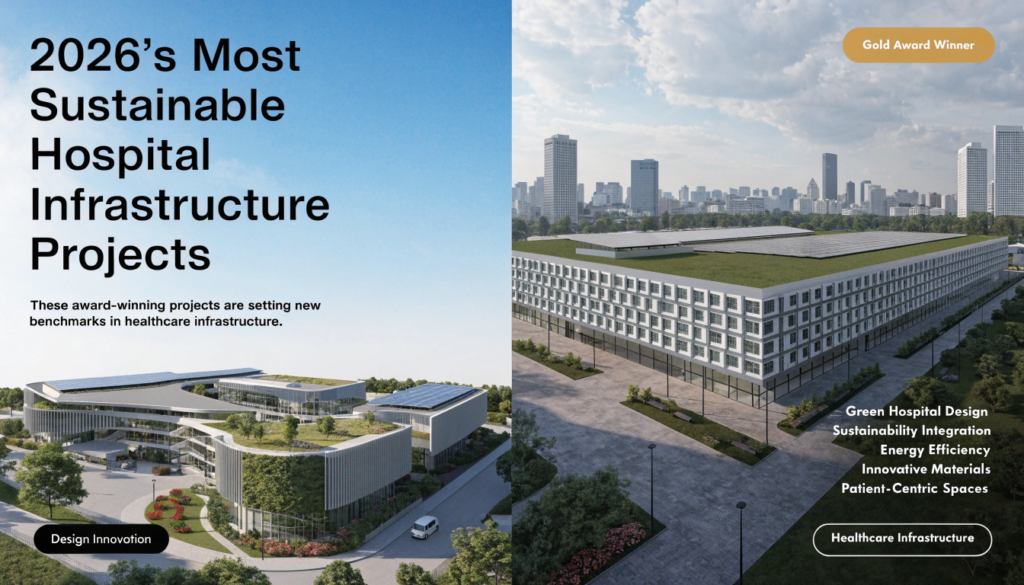
Hospitals are among the most energy- and resource-intensive buildings in the world. They operate around the clock, require sophisticated heating and cooling systems, consume significant quantities of water and electricity, and generate substantial amounts of medical and construction waste. As healthcare organizations respond to climate change, rising operating costs and growing expectations from patients and communities, sustainability is increasingly becoming a core part of hospital infrastructure planning.
The growing attention surrounding hospital sustainability awards 2026 reflects this shift. This year, healthcare organizations are being recognized not simply for installing energy-efficient equipment, but for taking a broader approach that connects sustainable buildings, resource management, climate resilience, patient well-being, and operational efficiency.
The 2026 awards landscape includes hospitals recognized for green building, environmental leadership and sustainability programs. Some recognitions are organization-wide rather than awarded to a single construction project, while others directly highlight building design and infrastructure. This distinction matters when evaluating the year’s sustainability leaders.
Among the most notable examples are UVA Health University Medical Center, Michigan Medicine’s D. Dan and Betty Kahn Healthcare Pavilion, UI Health, Lucile Packard Children’s Hospital Stanford, University of Michigan Health and other healthcare organizations recognized through major sustainability programs.
What Makes Hospital Infrastructure Sustainable in 2026?
Sustainable healthcare infrastructure has moved far beyond solar panels and recycling bins. Today’s hospital projects must balance environmental performance with infection control, patient safety, resilience, clinical functionality and financial sustainability.
A genuinely sustainable hospital may incorporate high-performance building envelopes, efficient mechanical systems, renewable energy, water conservation, low-carbon materials, green roofs, construction-waste diversion and healthier interior materials.
The same principles also apply when existing facilities are renovated.
The 2026 Environmental Excellence Awards from Practice Greenhealth illustrate how comprehensive sustainability has become. The program recognized 430 healthcare organizations with 538 awards across 11 areas, while participating organizations reported approximately $235 million in combined savings from environmental programs during 2025. Energy efficiency, greenhouse gas reduction, waste, water, green building, sustainable procurement and other categories all contribute to the broader sustainability picture.
This demonstrates why green healthcare construction is increasingly viewed as a strategic investment rather than an optional design feature.
UVA Health University Medical Center: A Standout in Green Building
One of the clearest examples in the hospital sustainability awards 2026 landscape is UVA Health University Medical Center.
In June 2026, the medical center received both a Greenhealth Champion Award and a Practice Greenhealth Circle of Excellence Award in Green Building. The Circle of Excellence recognition places it among the top-performing healthcare facilities in that sustainability category.
The recognition is particularly relevant to hospital infrastructure because the green-building work highlighted by UVA includes a greywater reuse system, healthy materials, green roofs and a focus on occupant health and wellness.
These features demonstrate an important evolution in hospital design. Sustainability is no longer limited to reducing energy consumption. Water systems, material selection and the experience of patients and staff are becoming part of the environmental performance equation.
Greywater reuse can reduce demand for potable water, while green roofs can support stormwater management and contribute to building performance. Meanwhile, healthier materials can support indoor environmental quality.
The project also demonstrates the importance of integrating sustainability into the broader hospital operating model. UVA Health’s recognition was accompanied by a Greenhealth Champion Award, indicating that infrastructure improvements work most effectively when supported by organizational leadership and operational practices.
Michigan Medicine’s Kahn Healthcare Pavilion: LEED Platinum Achievement
Another major 2026 milestone comes from Michigan Medicine.
The D. Dan and Betty Kahn Healthcare Pavilion officially achieved LEED v4 Platinum certification in May 2026. Michigan Medicine describes the facility as the world’s largest LEED v4 Platinum-certified healthcare building.
While LEED Platinum certification is not itself a Practice Greenhealth award, it represents one of the most significant green-building achievements in healthcare infrastructure in 2026.
The Kahn Pavilion was designed and built with energy efficiency and sustainability as explicit objectives while also expanding access to high-acuity and complex care.
This is an important model for future green healthcare construction. A sustainable hospital cannot sacrifice clinical performance for environmental goals. Instead, sustainability needs to be incorporated into the building from the earliest stages of planning so that environmental performance and patient care reinforce one another.
The Kahn Pavilion shows how large-scale healthcare development can pursue both objectives simultaneously.
Its achievement also reinforces the importance of third-party building certification. Certifications such as LEED provide a framework through which hospitals can assess and demonstrate performance across multiple sustainability dimensions.
UI Health: Connecting Construction and Building Operations
UI Health was another 2026 recipient of national sustainability recognition.
In June, the organization announced that it had received the Practice Greenhealth Greenhealth Leader Award and a Circle of Excellence Award for Green Building.
The Green Building recognition is particularly relevant because the category evaluates design, construction, renovation and operations.
UI Health highlighted several initiatives in its application, including retro-commissioning, building-envelope projects, new-construction LEED projects, ENERGY STAR benchmarking and reduction efforts, construction-waste diversion, and environmentally preferable flooring and furnishings.
The example demonstrates a key principle of modern green healthcare construction: sustainability does not end when a hospital opens.
A building may have an efficient design, but its real environmental performance depends on how it is commissioned, operated, maintained and upgraded over time.
Retro-commissioning can help existing systems perform closer to their intended design parameters. Energy benchmarking allows facility teams to identify trends and areas for improvement. Construction-waste diversion can reduce the amount of material sent to landfill during renovations or expansions.
Together, these measures create a lifecycle approach to sustainable hospital infrastructure.
Lucile Packard Children’s Hospital Stanford: Sustainability Across Multiple Areas
Lucile Packard Children’s Hospital Stanford also stands out in the 2026 sustainability landscape.
Stanford Medicine Children’s Health reported that Lucile Packard Children’s Hospital Stanford was named among Practice Greenhealth’s Top 25 hospitals for environmental sustainability in June 2026. The organization also received eight Circles of Excellence recognitions.
The Top 25 recognition is significant because it evaluates sustainability across multiple areas rather than focusing exclusively on one building technology.
For healthcare infrastructure leaders, this offers an important lesson: the strongest sustainability strategies are interconnected.
Energy performance affects operating costs. Water management affects resource resilience. Sustainable procurement influences the environmental footprint of products and equipment. Green building affects the physical environment in which patients and staff spend their time.
A successful hospital sustainability program therefore needs coordination between facility managers, engineers, procurement teams, clinical leaders, sustainability professionals and senior executives.
University of Michigan Health: Sustainability as a Long-Term Infrastructure Strategy
University of Michigan Health-Michigan Medicine earned Practice Greenhealth’s Top 25 Environmental Excellence award for the second consecutive year in 2026.
The recognition evaluates areas including leadership, waste, chemicals, operating-room sustainability, food, sustainable procurement, energy, water, climate, transportation and green building.
The significance of this recognition extends beyond one building. It demonstrates how sustainability can become a long-term infrastructure and operational strategy across an entire health system.
Hospitals often operate multiple buildings constructed at different times. Some may have modern mechanical systems, while others may rely on older infrastructure. A comprehensive sustainability strategy therefore needs to consider both new construction and existing assets.
This approach can involve phased retrofits, energy monitoring, water-efficiency upgrades, renewable energy integration, building automation and improvements to waste management.
For hospital executives planning capital investments, the lesson is clear: sustainability should be considered throughout the asset lifecycle rather than treated as a one-time construction objective.
The Valley Hospital: Green Roofs, Cogeneration and Campus Design
The Valley Hospital in Paramus, New Jersey, provides another example of how infrastructure can support environmental goals.
In 2026, The Valley Hospital received Practice Greenhealth’s Greenhealth Champion Award and a Circle of Excellence Award for greening the operating room.
Its campus includes more than 30% open green space and two green roofs. Green roofs can help manage stormwater runoff, support energy efficiency and create a more environmentally responsive campus.
The hospital also operates a cogeneration plant that produces approximately 30–40% of its power depending on the season. The system produces electricity alongside useful heat that can support steam, hot water and air conditioning requirements.
This is a useful illustration of why hospital sustainability cannot be reduced to a single technology. Building envelope improvements, landscape planning, energy systems and clinical operations can all contribute to a facility’s environmental performance.
For future infrastructure projects, the goal should be to identify how different systems can work together rather than implementing isolated sustainability measures.
Why Green Healthcare Construction Is Becoming a Priority
The examples recognized in 2026 reveal a common trend: sustainability is becoming deeply embedded in healthcare infrastructure.
The business case is an important reason.
Hospitals face significant energy, water, waste and maintenance costs. Improving building efficiency can therefore create environmental benefits while reducing long-term operating expenses.
There is also a resilience argument.
Hospitals cannot simply shut down during extreme weather, power disruptions or water shortages. Their infrastructure must remain operational when communities need them most. Energy efficiency, backup power, water conservation, climate-responsive design and resilient building systems can all contribute to continuity of care.
Patient wellbeing is another factor.
Natural light, improved indoor air quality, healthy materials, thermal comfort, connection with nature and quieter environments can contribute to a better healthcare experience.
The most successful sustainability strategies therefore connect three objectives: environmental responsibility, operational performance and patient-centered care.
The Role of Facility Managers in Sustainable Hospital Projects
Hospital facility managers are increasingly central to sustainability.
Architects and engineers may establish the initial design, but facility teams are responsible for keeping complex systems operating efficiently throughout the building’s life.
A facility manager may oversee HVAC systems, energy monitoring, water infrastructure, building automation, preventive maintenance, waste systems and emergency preparedness.
In a sustainable hospital, these responsibilities become even more interconnected.
For example, an energy-saving initiative must not compromise ventilation or infection-control requirements. Water-saving strategies must account for clinical hygiene. Building automation must support reliability as well as efficiency.
This means sustainability requires collaboration between facility management and clinical teams.
The 2026 award examples reinforce this principle. Recognition is increasingly being given to organizations that can demonstrate measurable, integrated and long-term environmental performance rather than isolated sustainability claims.
What Hospital Leaders Can Learn From the 2026 Award Winners
The most important lesson from the hospital sustainability awards 2026 is that sustainability is becoming a measurable performance discipline.
Hospital leaders planning new infrastructure or major renovations should begin by establishing clear targets.
These may include energy-use intensity, greenhouse-gas emissions, water consumption, construction-waste diversion, renewable-energy generation, indoor environmental quality and operational costs.
The next step is to integrate those targets into design and procurement.
A sustainability goal has little value if it is introduced after major design decisions have already been made. Engineers, architects, contractors, sustainability teams, clinicians and facility managers should collaborate from the beginning.
Hospitals should also consider lifecycle costs rather than focusing exclusively on initial construction budgets.
An efficient HVAC system, high-performance building envelope or water-reuse system may require additional upfront investment but potentially deliver operational savings over many years.
Finally, hospitals should measure performance after completion.
Commissioning, benchmarking and continuous monitoring can help organizations confirm whether the facility is performing as intended.
The Future of Hospital Sustainability Awards
The 2026 awards landscape suggests that future healthcare infrastructure recognition will increasingly focus on measurable outcomes.
Hospitals will likely face greater pressure to demonstrate reductions in energy consumption, carbon emissions, water use and waste while maintaining clinical quality.
The definition of a sustainable hospital will also become broader.
It will encompass building design, infrastructure resilience, procurement, transportation, food services, operating rooms, waste management and patient wellbeing.
This broader approach is important because hospitals are ecosystems rather than standalone buildings.
The future of green healthcare construction will therefore involve smarter integration between architecture, engineering, digital technology, facility management and clinical operations.
Smart building systems can monitor energy and equipment performance. Building automation can help optimize heating and cooling. Digital dashboards can provide facility managers with real-time information. Data-driven maintenance can help reduce unnecessary energy consumption and extend asset life.
At the same time, sustainability must remain grounded in the primary mission of healthcare: protecting and improving human health.
Conclusion
The leading examples from the hospital sustainability awards 2026 landscape demonstrate that sustainable healthcare infrastructure is becoming more sophisticated, measurable and integrated.
UVA Health University Medical Center’s recognition for green building, Michigan Medicine’s Kahn Healthcare Pavilion achieving LEED Platinum, UI Health’s green-building initiatives, Lucile Packard Children’s Hospital Stanford’s environmental recognition, University of Michigan Health’s continued sustainability leadership and The Valley Hospital’s combination of green roofs and cogeneration all illustrate different paths toward a more sustainable healthcare environment.
The key takeaway is that there is no single blueprint for a sustainable hospital.
Some organizations may prioritize energy efficiency and green building. Others may focus on water, waste, procurement, operating rooms or climate resilience. The strongest programs bring these elements together and connect them to patient care and long-term operational performance.
As healthcare organizations continue investing in new facilities and modernizing existing campuses, sustainability should be embedded into every stage of the infrastructure lifecycle from planning and design to construction, commissioning, operation and renewal.
The hospitals receiving recognition in 2026 are showing what is possible when environmental responsibility becomes part of the core healthcare strategy.
Nominate for BMA Healthcare Awards
If your hospital, healthcare facility or infrastructure team has delivered an innovative project that improves sustainability, efficiency, resilience or patient-centered facility performance, now is the time to put that work in the spotlight.
Nominate for BMA Healthcare Awards and showcase the people and projects helping shape the next generation of smarter, more sustainable healthcare facilities.