
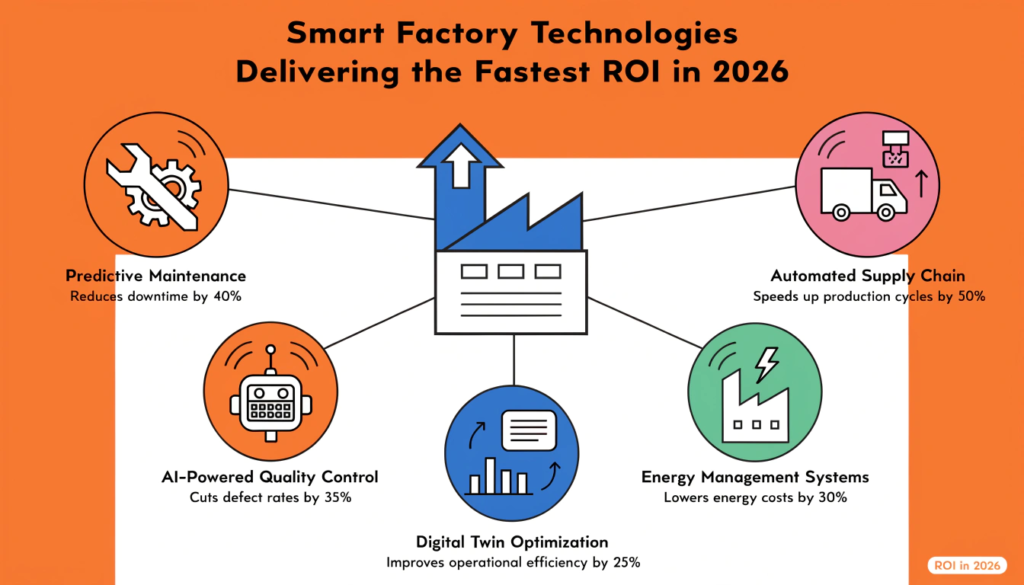
Manufacturers are entering 2026 with a clear priority: technology investments must deliver measurable business value. The era of investing in digital transformation simply because competitors are doing it is fading. Factory leaders are increasingly asking a more practical question: How quickly will this technology pay for itself?
This shift is putting smart factory ROI 2026 at the centre of manufacturing strategy. Companies are looking beyond futuristic concepts and focusing on technologies that can reduce downtime, improve productivity, lower energy consumption, strengthen quality, reduce waste, and help employees make faster decisions.
The good news is that manufacturers do not necessarily need to rebuild their entire production environment to achieve these outcomes. Many of the technologies delivering the fastest returns can be introduced incrementally, integrated with existing equipment, and scaled after the first application demonstrates value.
From AI-powered analytics and predictive maintenance to industrial IoT, robotics, machine vision, digital twins, and energy management, the strongest technologies share one characteristic: they connect investment directly to an operational or financial outcome.
Here are the smart factory technologies that manufacturers should evaluate in 2026 when prioritising speed of return.
Why Smart Factory ROI Matters More in 2026
Manufacturing technology investment is becoming increasingly strategic because operating costs remain under pressure. Labour availability, energy prices, supply chain uncertainty, quality requirements, customer expectations, and competition are forcing manufacturers to achieve more from existing assets.
A smart factory can help address these challenges by connecting machines, people, processes, and data.
However, technology alone does not guarantee ROI. A factory can purchase sophisticated software, sensors, robots, or AI platforms and still fail to generate value if the technology is poorly integrated or implemented without a defined business objective.
The strongest ROI strategies start with a measurable problem.
For example, if a production line loses 10 hours each month because of unexpected equipment failure, predictive maintenance can be evaluated against the cost of those lost hours. If energy represents a significant percentage of operating expenses, an energy-monitoring solution can be assessed based on measurable reductions in consumption.
This approach changes smart manufacturing from a technology project into a business improvement programme.
1. AI-Powered Manufacturing Analytics
Artificial intelligence is becoming one of the most valuable technologies for manufacturers because it can turn large volumes of factory data into actionable insights.
Modern production environments generate data from machines, sensors, quality systems, enterprise software, maintenance platforms, and supply chain systems. The challenge is no longer simply collecting information. It is understanding what that information means quickly enough to make better decisions.
AI-powered analytics can identify production patterns, detect anomalies, predict potential failures, analyse quality trends, and support production planning.
The ROI can come from several directions. Better production decisions can reduce waste and improve throughput, while early detection of operational problems can prevent costly disruptions.
For manufacturers considering AI in 2026, the best starting point is usually a specific business problem rather than a broad “AI transformation.” A focused application with measurable outcomes is more likely to demonstrate a fast return.
2. Predictive Maintenance
Predictive maintenance remains one of the strongest candidates for fast ROI because unplanned downtime can be extremely expensive.
Traditional preventive maintenance schedules equipment servicing according to time or usage. Predictive maintenance goes further by monitoring equipment condition and identifying signs that a component may be approaching failure.
Sensors can collect information such as vibration, temperature, pressure, current, or acoustic signals. Analytics platforms can then identify abnormal patterns and help maintenance teams intervene before a breakdown occurs.
The financial case is straightforward. Preventing one major equipment failure can potentially offset a significant portion of the technology investment.
Predictive maintenance can also improve maintenance planning by reducing unnecessary servicing, increasing asset availability, and helping technicians prioritise the equipment that requires attention most urgently.
For manufacturers seeking smart factory ROI 2026, predictive maintenance should therefore remain high on the priority list, especially for facilities where downtime has a significant financial impact.
3. Industrial IoT and Connected Sensors
Industrial Internet of Things technology is the foundation for many smart factory initiatives.
Connected sensors allow manufacturers to monitor machines and processes continuously rather than relying solely on manual inspections or periodic data collection.
A factory may use sensors to track machine performance, temperature, pressure, energy usage, environmental conditions, production speed, or equipment health.
The ROI comes from visibility.
When managers know what is happening across a production environment in near real time, they can identify inefficiencies that previously remained hidden. Connected data can reveal bottlenecks, abnormal machine behaviour, excessive energy consumption, idle equipment, or production inconsistencies.
Importantly, manufacturers do not always need to replace existing machines. Retrofitting older equipment with appropriate sensors can provide a relatively cost-effective route toward greater visibility.
This makes industrial IoT particularly attractive for companies that want to modernise existing facilities without making a massive capital investment.
4. Robotics and Collaborative Robots
Robotics continues to be a major component of smart manufacturing, but the ROI equation is becoming more sophisticated.
Traditional industrial robots can deliver significant value in repetitive, high-volume, or hazardous operations. Collaborative robots, or cobots, can offer additional flexibility for certain tasks where humans and machines work in closer proximity.
Applications can include material handling, machine tending, assembly, packaging, palletising, and repetitive inspection activities.
The fastest returns typically occur when robotics addresses a clearly defined bottleneck or repetitive task. Rather than automating an entire production line, manufacturers can begin with a single process where labour costs, cycle time, safety concerns, or throughput limitations are significant.
The resulting improvement can then be measured through labour hours saved, increased output, reduced defects, or improved workplace safety.
The key is to view automation as a productivity investment rather than simply a replacement for human labour. In many successful implementations, robots take over repetitive activities while employees move toward higher-value tasks involving supervision, troubleshooting, quality, and process improvement.
5. Machine Vision for Quality Control
Quality problems can quickly become expensive when defects are discovered late in the production process.
Machine vision systems use cameras, sensors, and AI or image-processing software to inspect products and identify defects at high speed.
Depending on the application, machine vision can detect incorrect assembly, surface defects, missing components, dimensional variations, packaging problems, or labelling errors.
Compared with manual inspection, automated vision can provide greater consistency and operate continuously at production speed.
The ROI can come from reducing scrap, rework, customer returns, and inspection labour while improving production quality.
For high-volume manufacturers, even a small reduction in defect rates can generate substantial savings over time. This makes machine vision an attractive manufacturing technology investment when quality costs are already measurable.
6. Digital Twins
Digital twins are increasingly being used to understand and optimise physical manufacturing operations through digital models.
A digital twin can represent equipment, production processes, facilities, or entire manufacturing systems. When connected with operational data, it can help manufacturers analyse performance and evaluate potential changes.
The ROI potential is particularly strong in complex environments where physical experimentation is expensive or disruptive.
Manufacturers can use digital models to explore production changes, identify bottlenecks, simulate layouts, evaluate equipment performance, and assess potential improvements before making physical changes.
Although digital twins can require more planning than simpler technologies, their value can become significant when applied to high-value assets or complicated production processes.
The most practical approach is to begin with a focused use case where simulation can directly support a capital or operational decision.
7. Automated Energy Management
Energy efficiency is becoming a major component of manufacturing profitability.
Smart energy management systems can provide detailed visibility into where, when, and how energy is being consumed throughout a facility.
Manufacturers can monitor equipment-level consumption, identify abnormal usage, analyse peak demand, and find opportunities to reduce unnecessary energy expenditure.
The technology can also support broader sustainability targets while improving operating margins.
For many facilities, energy management can offer relatively fast ROI because savings can be measured directly against utility costs.
For example, identifying machines that consume energy while idle, optimising operating schedules, reducing unnecessary heating or cooling, or identifying inefficient equipment can contribute to measurable cost reductions.
As manufacturers increasingly connect sustainability goals with financial performance, energy management is likely to become an even more important part of smart factory ROI 2026 strategies.
8. Automated Material Handling and Warehouse Systems
Production efficiency is not limited to what happens on the manufacturing line.
Material movement between storage, production, assembly, packaging, and shipping can create significant inefficiencies. Automated guided vehicles, autonomous mobile robots, conveyor systems, smart storage solutions, and warehouse software can help streamline internal logistics.
Automated material handling can reduce unnecessary movement, improve inventory visibility, minimise waiting time, and support more consistent production flow.
The fastest ROI generally occurs in facilities where material transportation consumes substantial labour time or causes production delays.
Manufacturers should first map their material flow and identify repetitive movement, bottlenecks, and areas where materials frequently wait before investing in automation.
9. Manufacturing Execution Systems
A Manufacturing Execution System, or MES, can connect production activities with broader business systems and provide greater visibility into what is happening on the factory floor.
An MES can support production tracking, work instructions, quality management, traceability, scheduling, performance monitoring, and reporting.
Its value is particularly significant when manufacturers are relying on spreadsheets, disconnected systems, or manual reporting.
Better production visibility can help management identify problems faster and improve decision-making.
An MES can also support metrics such as production output, downtime, quality, and Overall Equipment Effectiveness. This provides a foundation for identifying where future automation and optimisation investments should be made.
The ROI may not always appear as a single immediate saving. Instead, it can come from improved operational control, reduced administrative work, stronger traceability, and better production decisions.
10. Automated OEE Monitoring
Overall Equipment Effectiveness is a critical performance indicator because it combines availability, performance, and quality.
Traditional OEE measurement can involve manual data collection and spreadsheets, which may introduce delays and inaccuracies.
Automated OEE monitoring connects production equipment and systems to provide near-real-time visibility into machine performance.
Instead of discovering at the end of a shift that a machine lost several hours to minor stops, supervisors can identify losses as they occur.
This creates an opportunity for faster intervention.
Because OEE directly connects technology with measurable production performance, automated OEE monitoring can be one of the most practical technologies for manufacturers beginning their smart factory journey.
How Manufacturers Can Maximise Smart Factory ROI in 2026
Selecting the right technology is only half of the equation. Implementation strategy determines whether an investment becomes a genuine business improvement or another underused digital platform.
The first step is to establish a baseline. Manufacturers should understand current downtime, scrap, labour requirements, energy consumption, throughput, maintenance costs, and quality performance before introducing new technology.
Next, the company should identify a high-value problem that can be addressed through technology.
A pilot project is often preferable to a facility-wide rollout. A production line, machine group, or specific process can be selected and measured over a defined period.
Manufacturers should then establish clear KPIs. Depending on the project, these could include downtime reduction, productivity improvement, energy savings, defect reduction, labour hours saved, or throughput increases.
Employee involvement is equally important. Operators and maintenance professionals understand the production environment in ways that technology providers may not. Their experience can help identify practical use cases and improve adoption.
Finally, manufacturers should calculate the complete ROI rather than looking only at the purchase price. Integration, training, maintenance, cybersecurity, software subscriptions, and ongoing support should all be considered.
The Best Manufacturing Technology Investment Is Not Always the Most Advanced
One of the biggest lessons for manufacturers in 2026 is that the most sophisticated technology does not necessarily deliver the fastest return.
A basic sensor system that prevents a costly machine failure may generate more immediate value than a complex digital transformation platform.
Similarly, automated energy monitoring may produce a faster financial return than a large-scale digital twin project if energy costs are a major concern.
The right investment depends on the factory’s specific challenges.
Manufacturers should therefore prioritise technologies according to three factors: the size of the business problem, the ability to measure the improvement, and the time required to implement the solution.
This approach makes the business case more practical and reduces the risk of investing in technology without a clear purpose.
Building the Smart Factory of the Future
Smart factories are not created through a single technology purchase. They develop through connected improvements.
A manufacturer may begin with IoT sensors, use that data to improve predictive maintenance, introduce AI analytics to identify production patterns, automate a bottleneck with robotics, and eventually create a more integrated digital manufacturing environment.
Each successful project creates a foundation for the next.
This gradual approach can make smart manufacturing more financially manageable while allowing companies to learn what works in their own operating environment.
The ultimate objective is not to have the largest number of connected machines or the most advanced technology stack. It is to create a manufacturing operation that is more productive, resilient, responsive, cost-efficient, and data-driven.
Conclusion
The search for smart factory ROI 2026 is changing the way manufacturers approach digital transformation. Instead of treating Industry 4.0 as a long-term technology experiment, companies are increasingly focusing on investments that can produce measurable operational and financial benefits.
AI-powered analytics, predictive maintenance, industrial IoT, robotics, machine vision, energy management, digital twins, automated material handling, MES platforms, and OEE monitoring all have the potential to generate significant returns when applied to the right problems.
However, technology should always follow business objectives.
Manufacturers that define measurable goals, start with focused use cases, involve employees, establish performance baselines, and scale successful pilots will be better positioned to achieve meaningful returns from their manufacturing technology investment.
In 2026, the smart factory is not simply about becoming more digital. It is about becoming more profitable, productive, predictable, and competitive through smarter use of technology.
Enquire About Sponsorship
Want to connect with manufacturing leaders, technology decision-makers, automation experts, and smart factory innovators?
Enquire about sponsorship for the Smart Manufacturing & Automation Convention and position your organisation in front of professionals shaping the next generation of industrial manufacturing.