
Introduction
Data centers are no longer simply facilities designed to house servers and networking equipment. They have become strategic business assets that support cloud services, artificial intelligence, digital applications, analytics, automation, cybersecurity, and increasingly demanding workloads. As businesses become more dependent on digital infrastructure in 2026, aging data center environments can create significant operational, financial, and security challenges.
For facility managers, IT leaders, infrastructure teams, and business executives, the question is no longer whether data center infrastructure will eventually need to evolve. The bigger question is how to demonstrate that modernisation is worth the investment.
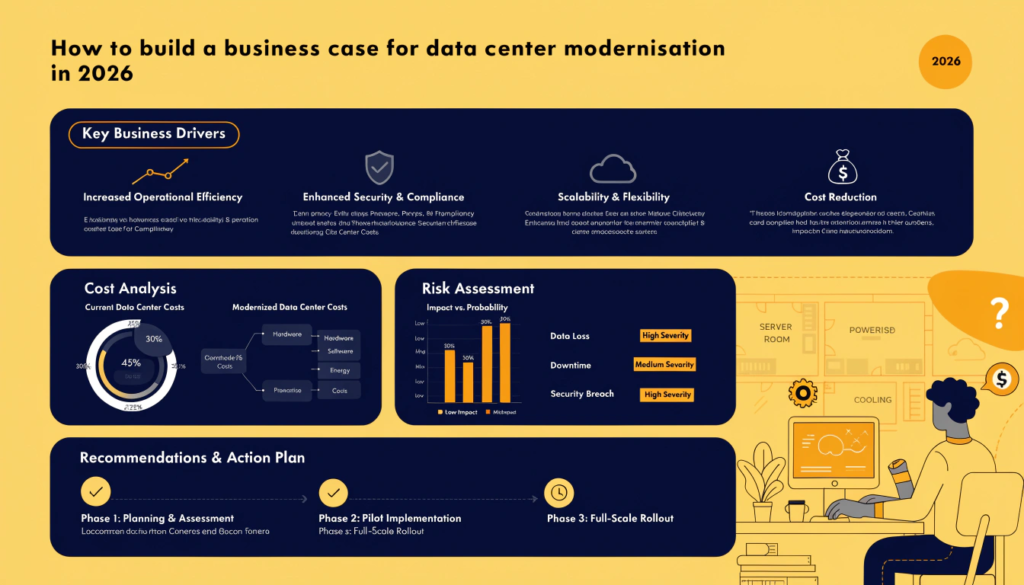
This is where a data center modernisation business case becomes essential. A well-developed business case connects infrastructure improvements with measurable business outcomes. Instead of presenting modernisation as simply an IT expense, it demonstrates how upgrading power systems, cooling infrastructure, networking, monitoring, security, and computing capacity can improve efficiency, resilience, scalability, and long-term financial performance.
Building the case requires more than estimating equipment costs. Decision-makers need a clear understanding of the current environment, existing risks, expected benefits, investment requirements, and potential return. This guide explains how organisations can develop a convincing data center modernisation business case in 2026.
Start by Assessing the Current Data Center
Before recommending new technologies, establish a clear picture of the existing data center environment. Modernisation should be based on evidence rather than assumptions.
Begin by evaluating the age, condition, capacity, and performance of critical infrastructure. This includes servers, storage systems, networking equipment, power distribution units, UPS systems, generators, cooling equipment, fire protection, physical security, monitoring platforms, and building management systems.
Operational data can provide valuable evidence. Review power consumption, cooling performance, equipment utilisation, downtime records, maintenance expenses, capacity constraints, energy costs, and incidents from previous years.
For example, if cooling equipment is approaching the end of its useful life and requires frequent maintenance, its replacement can be evaluated not only from a technical perspective but also from the perspective of operating costs and reliability.
The assessment should also identify dependencies and bottlenecks. A data center may have sufficient server capacity but inadequate power distribution or cooling capacity. Another facility may have modern servers but outdated monitoring and security systems.
This initial assessment creates the foundation for your data center upgrade justification because it establishes why change is necessary.
Identify the Business Problems Behind Modernisation
The strongest business cases focus on business problems rather than technology alone.
Instead of saying that the company needs new cooling systems, explain what the existing cooling infrastructure is causing. Is it increasing energy consumption? Is it restricting rack density? Is it creating hot spots? Is it limiting the deployment of high-performance computing or AI infrastructure?
Similarly, instead of simply proposing new networking equipment, identify the business impact of the existing network. Slow connectivity, limited bandwidth, outdated architecture, or insufficient redundancy could affect application performance and customer experience.
Common drivers for modernisation in 2026 include rising energy costs, increasing AI workloads, aging infrastructure, cybersecurity risks, limited scalability, operational inefficiencies, growing maintenance expenses, and stricter sustainability expectations.
Each problem should be connected to a measurable business consequence. This makes the data center modernisation business case easier for finance and executive teams to understand.
Establish Clear Modernisation Objectives
Once the problems have been identified, define what the modernisation programme is expected to accomplish.
Objectives should be measurable whenever possible. Instead of stating that the organisation wants a “more efficient data center,” define what efficiency means.
For example, objectives could include reducing energy consumption, improving power usage effectiveness, increasing available computing capacity, reducing unplanned downtime, improving monitoring visibility, lowering maintenance costs, strengthening cybersecurity, or creating additional capacity for future workloads.
Modernisation objectives should also reflect broader organisational priorities. If the company is expanding its digital services, scalability may be the highest priority. If energy prices represent a major operating expense, efficiency may receive greater attention. If the organisation is deploying AI workloads, high-density computing and advanced cooling could become essential.
Clear objectives make it easier to measure whether the project delivered the expected value after implementation.
Build a Detailed Cost Model
Cost is one of the most important components of any data center upgrade justification.
However, focusing only on the purchase price of new equipment can result in an incomplete business case. Modernisation costs can include hardware, software, engineering, installation, integration, construction, project management, testing, commissioning, training, maintenance, and potential migration expenses.
The organisation should also consider indirect costs. For example, upgrading infrastructure while the data center remains operational may require temporary capacity, additional staff, planned maintenance windows, or specialist contractors.
A useful cost model should distinguish between capital expenditure and operational expenditure. Capital costs may include new cooling equipment, UPS systems, servers, networking infrastructure, and electrical upgrades. Operational costs may include software licences, maintenance agreements, energy consumption, staffing, and ongoing support.
It is also important to consider the cost of implementation delays or unexpected complications. A realistic contingency allowance can make the business case more credible.
Calculate the Financial Benefits
After estimating the investment, determine how modernisation can generate financial value.
Energy savings are often one of the easiest benefits to quantify. More efficient cooling systems, improved airflow management, modern UPS equipment, and better workload management can potentially reduce electricity consumption.
Maintenance savings can also be significant. Older equipment may require frequent repairs, replacement parts, and specialist support. Modern systems may reduce maintenance requirements and improve operational visibility.
Capacity improvements should also be considered. If modernisation allows the organisation to accommodate more workloads without constructing an entirely new facility, the avoided capital cost can become an important part of the business case.
Downtime reduction has financial implications as well. Even when the exact cost of downtime is difficult to calculate, organisations can estimate potential losses involving service disruption, productivity, customer dissatisfaction, contractual penalties, and reputational damage.
These calculations should be based on realistic assumptions. Avoid exaggerated savings because financial stakeholders are likely to challenge unsupported projections.
Evaluate ROI and Payback Period
A strong data center modernisation business case should clearly communicate expected return on investment.
ROI can be evaluated by comparing the financial benefits generated by the modernisation programme against the total investment. Organisations should also calculate the payback period, which estimates how long it will take for savings and benefits to recover the initial investment.
For example, suppose an organisation invests in improved cooling, power infrastructure, and monitoring systems. The project may generate savings through reduced energy consumption, lower maintenance expenses, and improved operational efficiency.
However, financial evaluation should not stop at immediate savings. Modernisation may also create long-term value through improved scalability, reduced risk, increased capacity, and better support for emerging technologies.
A five-year or longer total cost of ownership analysis can therefore provide a more complete picture than a simple first-year ROI calculation.
Include Reliability and Business Continuity
Financial benefits are important, but they are not the only reasons to modernise.
Data center reliability directly affects business continuity. Aging power systems, insufficient redundancy, outdated cooling infrastructure, and equipment failures can increase the probability of service interruptions.
A modernisation project can introduce improved redundancy, better monitoring, stronger backup systems, and more resilient infrastructure.
This is especially important for businesses that rely on continuous digital services. A short outage can affect customer transactions, employee productivity, cloud applications, communication systems, and critical business processes.
The business case should therefore explain the risk reduction associated with modernisation. Even when risk reduction is difficult to express as a precise financial figure, decision-makers should understand the potential consequences of maintaining the existing infrastructure.
Address Cybersecurity and Compliance Risks
Cybersecurity should be integrated into the modernisation case rather than treated as a separate IT issue.
Legacy infrastructure can create security vulnerabilities because older systems may no longer receive adequate updates or may not support modern security controls. Modernisation can provide opportunities to improve access management, network segmentation, monitoring, physical security, system visibility, and incident response.
Compliance requirements may also influence the investment decision. Depending on the industry and location, organisations may need to meet specific requirements concerning data protection, availability, access controls, auditing, and operational resilience.
The data center upgrade justification should explain how modernisation can reduce security and compliance risks while improving the organisation’s ability to respond to future requirements.
Consider Sustainability and Energy Efficiency
Sustainability has become an increasingly important part of data center strategy in 2026.
Data centers consume significant amounts of electricity, making energy efficiency an important consideration for both operational costs and environmental goals.
Modernisation can include improvements such as high-efficiency power equipment, intelligent cooling, airflow optimisation, renewable energy integration, advanced monitoring, and workload optimisation.
Metrics such as Power Usage Effectiveness can help organisations measure improvements in energy efficiency. However, sustainability benefits should be connected to financial outcomes wherever possible.
Lower energy consumption can reduce operating costs, while improved efficiency can also help organisations meet internal sustainability targets and respond to increasing environmental expectations.
A business case that combines cost reduction with sustainability can therefore appeal to both financial and strategic decision-makers.
Plan for AI and High-Density Workloads
One of the most important considerations in 2026 is the rapid growth of AI and high-performance computing.
Traditional data center designs may not have been built to support the power density and thermal requirements associated with advanced AI infrastructure. Organisations considering AI deployments may therefore need to rethink rack capacity, electrical distribution, cooling technology, networking, and monitoring.
This does not mean every organisation needs to immediately invest in the most advanced infrastructure available. Instead, the business case should examine expected workload requirements and future capacity needs.
Modernisation should ideally create a flexible infrastructure foundation that can accommodate changing technology without requiring another major investment in a short period.
Future-readiness is therefore an important part of the data center modernisation business case.
Compare Modernisation Options
There is rarely only one way to modernise a data center.
An organisation may choose to upgrade its existing facility, modernise infrastructure in phases, migrate selected workloads to a colocation facility, increase the use of cloud services, or develop a hybrid infrastructure strategy.
Each option has different financial, operational, security, and scalability implications.
A useful business case should compare these alternatives rather than presenting only one proposal. The comparison should consider initial investment, operating costs, implementation complexity, scalability, risk, expected lifespan, and strategic alignment.
This approach allows executives to understand why the recommended option provides the strongest balance between cost and business value.
Create a Phased Modernisation Roadmap
Large-scale modernisation does not always need to happen at once.
A phased approach can reduce operational disruption and distribute investment over multiple years. Critical infrastructure can be prioritised based on age, risk, capacity limitations, and business impact.
For example, an organisation may begin with monitoring and infrastructure assessment, followed by power and cooling improvements, then networking and computing upgrades.
A phased strategy can also provide opportunities to test new technologies before deploying them across the entire facility.
The roadmap should establish timelines, responsibilities, budgets, dependencies, milestones, and performance indicators. This transforms the business case from a theoretical proposal into a practical implementation strategy.
Define KPIs Before Approval
The success of a modernisation project should be measurable.
Before receiving approval, establish key performance indicators that will be tracked throughout and after implementation.
These could include energy consumption, PUE, cooling efficiency, downtime, availability, maintenance costs, equipment utilisation, capacity, incident frequency, and operating expenses.
Financial KPIs may include actual savings versus projected savings, payback period, total cost of ownership, and ROI.
Tracking these metrics allows management to determine whether the investment delivered the expected results and provides useful information for future infrastructure decisions.
Present the Business Case to Decision-Makers
The final stage is communicating the business case in a way that executives can quickly understand.
Senior decision-makers generally do not need pages of technical specifications. They need to know why the investment is necessary, what it will cost, what risks it addresses, what benefits it will create, and what happens if the organisation delays the decision.
A strong executive presentation should therefore begin with the business problem and its impact. It should then explain the recommended solution, investment requirements, expected financial benefits, risk reduction, implementation timeline, and long-term strategic value.
Use clear financial data and realistic assumptions. Supporting technical information can be included for IT and engineering stakeholders, but the core proposal should remain focused on business outcomes.
Conclusion
Building a data center modernisation business case in 2026 requires organisations to look beyond equipment replacement. The strongest proposals connect infrastructure investment with measurable improvements in efficiency, reliability, security, scalability, sustainability, and financial performance.
The process begins with an honest assessment of existing infrastructure and the problems it creates. From there, organisations can establish clear objectives, calculate investment requirements, quantify financial benefits, assess risk, compare modernisation options, and develop a practical roadmap.
A comprehensive data center upgrade justification should also consider emerging requirements such as AI workloads, higher rack densities, advanced cooling, cybersecurity, energy efficiency, and long-term capacity planning.
Modernisation is ultimately not just about replacing aging technology. It is about building infrastructure that can support the organisation’s business objectives for years to come.
For data center operators and technology leaders looking to explore the latest infrastructure strategies, technologies, and industry developments, connecting with industry experts can provide valuable insights into planning and executing modernisation initiatives.
Enquire about sponsorship for the Data Center & Facilities Convention and explore opportunities to connect with professionals and decision-makers shaping the future of data center infrastructure.
For an enquiry visit: Enquire about sponsorship