
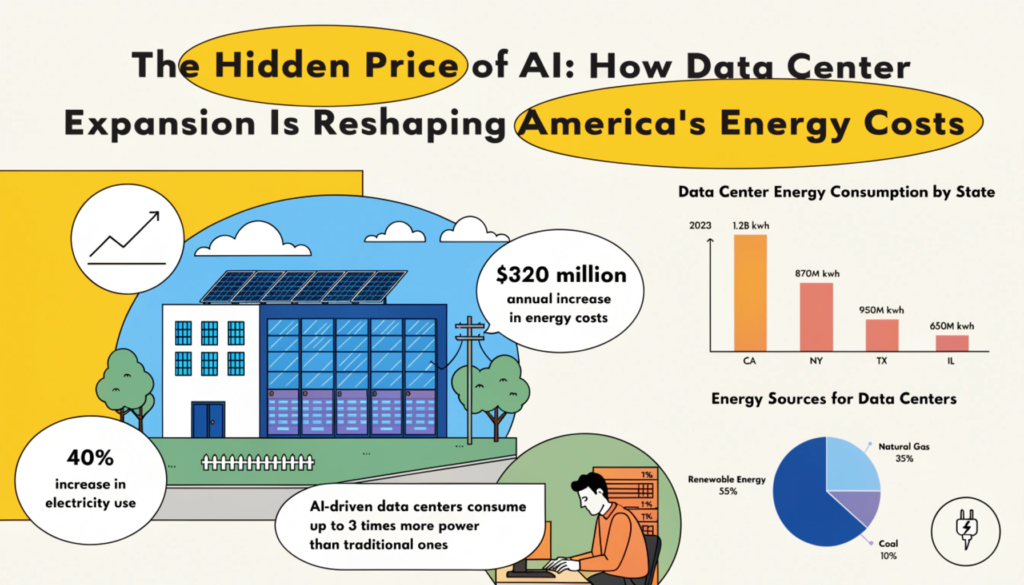
Artificial intelligence may live in the cloud, but its costs are increasingly physical. Behind every model, prompt, and automated service is a network of data centers that needs electricity, cooling, backup systems, and grid infrastructure. As U.S. AI capacity grows, the question is no longer just how much power these facilities consume. It is how the energy system should pay for the expansion and how to prevent new costs from landing unfairly on households and businesses.
AI Has a Physical Footprint and an Energy Bill
AI is often described as software, but large-scale computing depends on buildings, electrical equipment, cooling systems, network connections, and a reliable supply of energy. The larger and more demanding the workload, the more important these physical systems become.
Data centers support cloud computing, online services, enterprise applications, and AI training and inference. AI workloads can place especially high demands on computing equipment, while the heat generated by dense server installations adds complexity to cooling design. Operators must manage both electricity consumption and the conditions needed to keep equipment running reliably.
The energy bill for a data center is only one part of the picture. A new project may also require utility interconnections, substations, transmission improvements, transformers, backup power, and additional generation capacity. Some infrastructure is built specifically for one facility; other upgrades may improve service for a wider region.
That distinction matters. The cost of electricity used inside a building is relatively easy to identify. Allocating the cost of a new substation or grid expansion can be more complicated, particularly when the investment serves multiple customers or changes regional capacity needs.
The Cost That Does Not Appear on a Server Invoice
When a company builds a data center, its financial model includes land, construction, servers, cooling, staffing, and operating expenses. But the full cost of securing power may be less straightforward, especially when grid capacity is limited or utility upgrades are required.
Electricity supply and infrastructure costs can include connection charges, demand charges, capacity commitments, energy purchases, and investments approved for recovery through regulated rates. The exact mix depends on the utility, state rules, electricity market, and the terms negotiated with the customer.
If a large project requires new infrastructure, regulators must decide how the costs should be shared. A dedicated connection built almost entirely for one customer raises different questions from a regional transmission project that benefits several communities and businesses.
These costs can be overlooked when public discussion focuses only on the data center’s advertised investment or the number of jobs it may create. A more complete assessment asks what power infrastructure is needed, who finances it, how long it will take to build, and what happens if projected demand does not materialize.
Why Utilities Are Rethinking Long-Term Planning
Electric utilities plan infrastructure around forecasts of future demand, expected generation, transmission constraints, and reliability requirements. Rapid growth in data center proposals can make those forecasts more difficult.
Some facilities seek large amounts of electricity within a relatively concentrated geographic area. If several projects pursue connections in the same region, utilities may need to reassess available capacity and the timing of planned upgrades. Equipment lead times, permitting, construction schedules, and access to new generation can all affect delivery.
Planning too slowly can delay projects and limit available capacity. Building too much infrastructure too early can create financial risks if projects are delayed, downsized, or cancelled. The challenge is to match investment to credible demand while preserving the reliability of the wider system.
Better data about proposed facilities, expected connection dates, and anticipated power requirements can help utilities and grid operators make more informed decisions. Large customers can also contribute by providing realistic demand forecasts and communicating changes in project schedules early.
The Ratepayer Question: Who Benefits, and Who Pays?
The most contentious issue is whether ordinary electricity customers could bear some costs associated with infrastructure built to support large AI and cloud computing facilities.
That outcome is not automatic. The effect on household bills depends on local electricity markets, utility investment decisions, approved tariffs, contracts, and how regulators allocate costs. In some circumstances, a large customer may pay dedicated costs directly. In others, shared infrastructure may be recovered through broader rate structures if regulators determine that it benefits the system.
Consumer advocates argue that residential customers should not be left responsible for investments primarily required by large technology companies. They often support transparent contracts, minimum payment commitments, and protections against stranded costs if a major customer exits.
Utilities and developers, meanwhile, must consider how to finance infrastructure that can take years to build. They may argue that new large customers can support investment improve the economics of shared assets, and contribute to local economic activity when projects are structured appropriately.
The central policy challenge is to distinguish between costs caused by an individual project and investments that provide wider public value. Clear rules and public scrutiny can help make that distinction more transparent.
Regulation Is Catching Up With a Faster-Moving Industry
AI development can move faster than traditional electricity infrastructure. Data center projects may be announced or expanded quickly, while generation and transmission projects often require lengthy planning, permitting, equipment procurement, and construction.
That timing gap has pushed regulators to examine how large new loads connect to the grid, how their costs are allocated, and how system reliability should be protected. Federal authorities, state utility commissions, regional grid operators, and lawmakers have different roles in this process.
At the federal level, the Federal Energy Regulatory Commission oversees important aspects of interstate electricity transmission and wholesale markets. State regulators generally have major responsibilities for retail utility rates and many local utility decisions. Regional grid operators coordinate system operations and planning within their markets.
These responsibilities overlap, but they are not interchangeable. A national debate about data center power does not mean every state will adopt the same approach. The applicable rules can differ significantly by location, utility, and market structure.
For developers and operators, regulatory uncertainty is itself a planning concern. Understanding connection requirements, cost-allocation policies, and potential timelines early can reduce the risk of expensive surprises later.
What a Fairer Power Model Could Look Like
There is no single policy that fits every data center or electricity market. However, several principles can help make energy expansion more predictable and equitable.
First, large customers should receive clear information about the costs associated with their power requirements. Where infrastructure is dedicated primarily to a particular project, regulators and utilities can consider whether the customer should fund the relevant facilities or make binding financial commitments.
Second, long-term agreements can help address the risk that infrastructure is built for projected demand that never arrives. Minimum payment obligations, phased commitments, or other protections may help reduce the chance that remaining customers are left with unexpected costs.
Third, utility tariffs should reflect the scale, timing, and reliability requirements of large electricity users. Transparent pricing can make it easier to compare sites and understand the financial consequences of different operating models.
Fourth, regulators should examine both the costs and benefits of proposed investments. Some grid improvements may support broader reliability, economic development, or future electrification. Those wider benefits should be assessed rather than assumed.
Finally, public reporting can help communities understand the expected power requirements, infrastructure investments, and consumer protections associated with major projects. Transparency does not remove every disagreement, but it can make decisions easier to evaluate.
Efficiency Is Part of the Infrastructure Strategy
Adding supply and upgrading the grid are important, but reducing avoidable energy use is another part of responsible growth. Data center operators can assess computing utilization, cooling performance, electrical losses, and opportunities to shift flexible workloads.
High-density AI systems require careful thermal management. Liquid cooling and advanced air-cooling designs can help manage heat, but the best option depends on equipment, climate, water availability, and operating requirements. Efficiency should be assessed across the whole facility rather than by looking at one component in isolation.
Energy management software can help facilities teams monitor loads, identify unusual consumption, coordinate equipment, and improve maintenance planning. Battery storage and on-site generation may provide additional flexibility or resilience in suitable circumstances, although each option has costs, permitting needs, and operational limitations.
Efficiency measures cannot replace grid planning, and on-site power does not automatically mean lower total costs or emissions. Their value depends on careful engineering, realistic financial analysis, and coordination with utilities.
What Developers, Operators, and Solution Providers Should Do Next
For developers, electricity access should be a core site-selection criterion, not a detail to resolve after land acquisition. Early conversations with utilities can clarify available capacity, expected connection timelines, upgrade requirements, and potential cost exposure.
Operators should plan for changing computing needs. A facility designed around today’s load may need different electrical and cooling capabilities as AI systems evolve. Flexible design, accurate forecasting, and disciplined commissioning can help reduce operational risks.
Facilities and engineering teams should bring power, cooling, controls, and reliability planning together. Decisions about redundancy, backup generation, energy storage, and cooling architecture affect both capital costs and long-term operations.
Solution providers can support this work through power distribution equipment, transformers, switchgear, cooling systems, monitoring platforms, automation, microgrids, and energy management services. Their value is strongest when solutions address a clearly defined operational need and fit into the facility’s broader design.
Across the sector, a shared priority is emerging: projects need credible power plans, transparent cost assumptions, and infrastructure strategies that can adapt as demand changes.
The Next AI Advantage May Depend on Energy Planning
The expansion of AI will continue to test the relationship between digital innovation and physical infrastructure. Data centers need dependable electricity, utilities need confidence that investments will be used, regulators need to protect customers, and communities need to understand how projects may affect local systems.
The debate over energy costs is therefore more than a dispute over one line on an electricity bill. It is a question about how the United States finances critical infrastructure during a period of rapid technological change.
A durable approach will combine realistic demand forecasts, fair cost allocation, efficient facility design, timely grid investment, and regulatory oversight. Technology companies should be able to plan for growth, but households and smaller businesses should not be exposed to unfair costs because the rules were unclear or the risks were poorly managed.
The hidden price of AI is not inevitable. With better planning and transparent agreements, the industry can make power requirements visible, allocate costs more responsibly, and support data center growth while protecting the reliability and affordability of the broader electricity system.
Build the Next Generation of Data Center Facilities
As AI infrastructure grows, power availability, grid capacity, cooling, and energy efficiency are becoming essential parts of data center planning. Connect with industry professionals and explore the technologies and strategies shaping smarter, more resilient facilities.
Explore the Smart Data Centre Facilities Convention 2027 in Northern Virginia.