
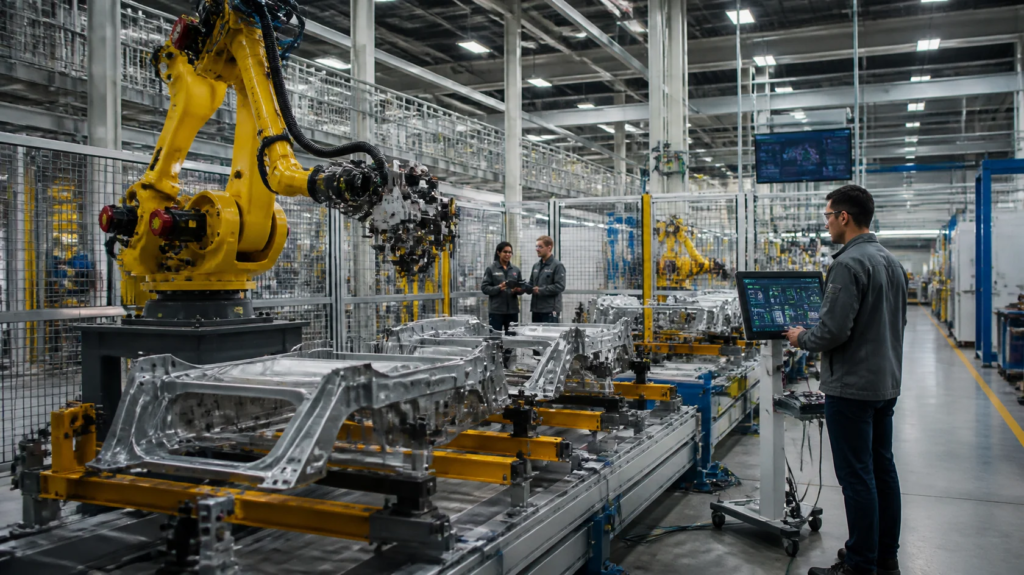
What will the American factory of the future look like? Will it rely on more robots, smarter machines, real-time data or a combination of technologies working together?
These questions are becoming increasingly important as manufacturers look for ways to improve productivity, manage operating costs and respond to changing customer expectations. Across the United States, manufacturing businesses are exploring new approaches to production, from artificial intelligence and robotics to connected equipment and advanced analytics.
The latest economic figures show why this transformation deserves attention. According to the Federal Reserve’s October 16, 2026, industrial production report, US manufacturing output increased by 0.3% in September. Semiconductor and related electronic component production recorded a particularly significant monthly increase, while motor vehicle and parts output declined. The mixed results highlight both the opportunities and the uncertainties facing American industry.
For manufacturers, the challenge is not simply to produce more. It is to build production systems that can adapt to changing demand, identify problems earlier and use resources more effectively.
This is where smart manufacturing in the USA is becoming an important part of the conversation. By connecting machines, software, people and production data, manufacturers can explore new ways to manage factory operations and make informed decisions.
But what does this shift actually involve? Which technologies matter most, and what should manufacturers consider before investing?
Let’s explore the trends shaping the next phase of American manufacturing.
1. Why Is American Manufacturing Changing?
Manufacturing has always evolved alongside technological progress. Mechanization increased production capabilities, industrial automation introduced programmable equipment, and digital systems improved planning and coordination.
Today, manufacturers are entering another stage of development in which physical production systems can work more closely with digital technologies.
Several factors are encouraging this change.
First, manufacturers face pressure to deliver products consistently while managing labor, materials, energy and equipment costs. Second, customer expectations continue to evolve, requiring businesses to balance product quality with shorter delivery timelines. Third, supply-chain disruptions have highlighted the importance of visibility and flexibility.
At the same time, advances in computing, sensors and artificial intelligence are making new manufacturing applications possible.
The result is a growing interest in US manufacturing trends 2026, particularly those involving automation, connected production and data-driven decision-making.
However, technology is not a universal solution. Each manufacturer operates under different conditions, and an investment that works for a high-volume automotive plant may not be suitable for a smaller custom fabrication business.
The most effective approach starts with understanding a specific operational challenge and selecting technology that addresses it.
2. AI in Manufacturing: Moving Beyond the Hype
Artificial intelligence has become one of the most discussed technologies in industrial production. However, its practical value depends on how effectively it is applied to real manufacturing problems.
AI in manufacturing refers to using AI-based systems to analyze production information, recognize patterns, support decisions and, in some applications, automate selected tasks.
Rather than replacing every existing process, AI can complement the expertise of engineers, operators and maintenance teams.
Predictive maintenance
Unexpected equipment failures can interrupt production, delay deliveries and increase maintenance costs.
Predictive maintenance systems analyze information such as vibration, temperature, operating hours and equipment performance to identify patterns that may indicate a developing fault.
For example, if a motor begins displaying unusual vibration levels, a monitoring system may flag the change for investigation. Maintenance personnel can then inspect the equipment and determine whether intervention is necessary.
This approach can help teams prioritize maintenance and reduce reliance on fixed schedules alone.
However, predictions are only useful when the underlying data is reliable and teams have processes in place to investigate alerts.
Quality inspection
AI-powered machine vision can help identify surface defects, dimensional irregularities and other visible quality problems.
In suitable applications, automated inspection can examine products consistently and flag items requiring further review.
This can be especially useful in high-volume production environments, where inspecting every component manually may be difficult.
Human oversight remains important, particularly when defects are complex or inspection decisions carry significant consequences.
Production planning
AI-based analytics can help manufacturers evaluate production schedules, inventory levels and changing demand.
When reliable information is available, these tools can identify potential bottlenecks, highlight scheduling conflicts and support more informed planning decisions.
The goal is not to accept every automated recommendation. It is to give production teams better information so they can make timely decisions.
3. Smart Factories: Connecting Machines, People and Data
A smart factory is not simply a building filled with robots. It is a manufacturing environment in which equipment, software and people share relevant information to improve operational coordination.
This is a central concept behind smart manufacturing in the USA and the wider Industry 4.0 movement.
Traditional factories may rely on separate systems for inventory, machine performance, quality management and production scheduling. When these systems do not communicate effectively, managers can struggle to understand what is happening across the facility.
Smart manufacturing aims to reduce these information gaps.
Real-time production monitoring
Sensors and connected equipment can provide information about machine status, operating conditions, production counts and downtime.
Managers can use dashboards to monitor performance and identify interruptions that require attention.
Instead of waiting until the end of a shift to discover a production problem, teams may be able to respond while the issue is developing.
Connected manufacturing systems
Manufacturing execution systems, enterprise resource planning software and industrial control systems perform different roles, but integrating relevant information can improve coordination between planning and production.
For example, production teams may use scheduling information alongside machine availability and inventory data to make better decisions about the sequence of work.
Integration requires careful planning, particularly when a factory contains equipment from different generations or suppliers.
Digital twins
A digital twin is a digital representation of a physical asset, process or system that can be updated using relevant data.
Manufacturers may use digital twins to explore production scenarios, study equipment performance or understand how changes could affect a production line.
The value depends on the accuracy of the model and the quality of the data used to maintain it.
When implemented appropriately, digital twins can support planning and experimentation without requiring every scenario to be tested directly on the production floor.
4. Industrial Automation Is Becoming More Flexible
Industrial automation has been part of manufacturing for decades. What is changing is the range of tasks that automated systems can perform and the flexibility available to production teams.
Modern automation can combine robotics, sensors, machine vision, programmable controllers and software to coordinate different stages of production.
Industrial automation can help manufacturers perform repetitive, hazardous or highly precise tasks while improving consistency.
Robotics on the production floor
Industrial robots are widely used in applications such as welding, painting, material handling, assembly and packaging.
Collaborative robots, often called cobots, are designed for applications where people and robots may work in closer proximity under appropriate safety measures.
The right solution depends on the task, required payload, cycle time, working environment and risk assessment.
Not every factory needs a large robotic installation. A smaller business may benefit more from automating one repetitive operation than from redesigning its entire production process.
Automated material handling
Automated guided vehicles and autonomous mobile robots can transport materials around suitable manufacturing facilities.
These systems may reduce repetitive movement and help coordinate the flow of components between workstations.
Before implementation, businesses need to consider floor layouts, traffic management, charging arrangements, safety requirements and integration with inventory systems.
Flexible production lines
Manufacturers increasingly need to manage different product configurations and changing order volumes.
Flexible automation can make it easier to adjust selected production processes without rebuilding an entire line.
Nevertheless, flexibility has limits. Product complexity, changeover requirements and integration costs must all be evaluated when selecting equipment.
5. Semiconductor Demand Is Highlighting the Importance of Advanced Manufacturing
The semiconductor industry provides an important example of how technology demand can influence manufacturing activity.
Semiconductors are essential to AI computing, data centers, communications equipment, vehicles and industrial electronics. Their production depends on specialized facilities, precise processes and advanced quality controls.
The Federal Reserve’s September 2026 figures reported a 28.4% increase in semiconductor and related electronic component output during the month. This is a notable monthly movement, although it should not be treated as a guarantee of continued growth.
Demand associated with AI infrastructure is one factor drawing attention to semiconductor production and the broader electronics supply chain.
For manufacturers, this trend has implications beyond chip fabrication itself. Semiconductor facilities require specialized machinery, electronic components, industrial control systems and reliable supporting infrastructure.
This creates opportunities for businesses involved in equipment manufacturing, component supply, precision engineering and factory technology.
It also demonstrates how demand in one technology sector can influence activity across multiple industrial supply chains.
However, advanced manufacturing investments require careful consideration of capital costs, technical expertise, energy requirements, production timelines and market demand.
Businesses should distinguish between long-term industry opportunities and short-term changes in monthly output.
6. The Workforce Question: Will Technology Replace Manufacturing Jobs?
Workforce concerns are an important part of the manufacturing technology discussion.
As automation becomes more capable, some workers worry that machines will replace their roles. In practice, the effects depend on the technology, the task and how an organization redesigns its operations.
Automation can reduce the need for people to perform certain repetitive tasks. It can also create demand for different capabilities, including robotics maintenance, industrial software support, data analysis and equipment integration.
Modern factories still depend on people to manage exceptions, maintain systems, solve problems, make judgments and ensure safe operations.
Why technical skills matter
As production equipment becomes more connected, employees may need additional training in areas such as:
- Operating and troubleshooting automated machinery.
- Understanding production dashboards and performance data.
- Maintaining robotic systems and connected sensors.
- Identifying cybersecurity risks.
- Working safely alongside automated equipment.
Training should be treated as part of the technology investment rather than an afterthought.
A factory may purchase advanced equipment, but its benefits can remain limited if employees do not understand how to operate, maintain and improve the system.
Human expertise and automation can work together
The objective of successful automation is not necessarily to remove people from every process.
Instead, businesses can examine which tasks are suitable for machines and where human judgment remains essential.
For example, a robotic system may handle repetitive welding while trained employees supervise the process, inspect results and respond to unusual conditions.
This approach can help manufacturers combine repeatability with the adaptability and problem-solving skills of their workforce.
7. The Challenges Manufacturers Must Solve Before Investing
Despite the potential benefits, adopting new manufacturing technologies involves practical challenges.
Upfront investment
Robotics, software, sensors and integration services can require substantial investment.
Manufacturers should assess the total cost of ownership, including installation, training, maintenance, software updates and potential production disruption.
A clear business case should identify expected improvements and explain how those improvements will be measured.
Legacy equipment and integration
Many factories use machinery that has operated reliably for years. Replacing all existing equipment may be unnecessary or financially impractical.
Businesses can investigate whether selected machines can be connected through appropriate sensors, gateways or other integration solutions.
Compatibility should be evaluated before purchasing technology, because disconnected systems can create new operational problems.
Cybersecurity
Connected factories introduce additional considerations around network access, software vulnerabilities and the protection of operational data.
Manufacturers should establish appropriate access controls, network segmentation, monitoring and incident-response procedures.
Cybersecurity must be considered during system design rather than added only after deployment.
Data quality
AI and analytics systems depend on useful information.
Missing readings, inconsistent measurements and poorly maintained records can reduce the reliability of automated recommendations.
Manufacturers should establish data ownership, validation procedures and clear standards before scaling data-driven applications.
Measuring return on investment
A successful technology project should improve a meaningful business outcome.
Possible measures include equipment downtime, defect rates, production cycle times, energy consumption and on-time delivery.
Tracking these indicators before and after implementation helps businesses determine whether a project is delivering its intended value.
8. How Manufacturers Can Start Their Smart Manufacturing Journey
Companies do not need to transform an entire facility at once. A phased approach can help reduce risk and demonstrate value before a larger investment.
Step 1: Identify the problem. Determine whether the main challenge involves downtime, quality, material handling, scheduling or another measurable operational issue.
Step 2: Establish a baseline. Record current performance so the business can compare results after implementation.
Step 3: Evaluate suitable technologies. Compare available solutions according to cost, compatibility, safety, scalability and maintenance requirements.
Step 4: Run a pilot project. Test the solution in a controlled area or on a specific production process before expanding across the facility.
Step 5: Train employees. Ensure operators, technicians and managers understand the new equipment and related procedures.
Step 6: Measure the results. Evaluate the pilot against the original objectives and identify any unexpected costs or limitations.
Step 7: Scale carefully. Expand the solution when results justify further investment and the organization is prepared to support it.
This approach allows manufacturers to develop practical experience while avoiding the assumption that every new technology will automatically deliver measurable improvements.
9. What Comes Next for American Manufacturing?
The next phase of American manufacturing will be shaped by more than one technology.
AI, robotics, connected equipment, advanced analytics and digital twins can help manufacturers improve different aspects of production. Their combined value will depend on how effectively businesses integrate them into existing operations.
Economic conditions will remain important, too. Recent Federal Reserve data show that US manufacturing output rose in September 2026, but growth across individual industries was uneven. Production performance, borrowing costs, energy prices, supply-chain conditions and customer demand will continue to influence investment decisions.
For manufacturers, this makes flexibility and informed planning particularly valuable.
Some businesses may prioritize predictive maintenance. Others may focus on automating repetitive tasks, improving quality inspection or connecting production data with planning systems.
There is no single technology roadmap suitable for every factory. The right approach depends on operational priorities, available resources and the capabilities of the workforce.
What matters is developing a clear understanding of the challenges ahead and evaluating technology based on its ability to address them.
Conclusion: The Next Industrial Shift Starts with Better Decisions
American manufacturing is entering an important period of technological development. AI, robotics and connected factory systems are creating new possibilities for businesses seeking to improve production performance and respond to changing industrial requirements.
However, technology alone does not guarantee success. Manufacturers must consider investment costs, workforce skills, data quality, cybersecurity and integration before introducing new systems.
The most effective modernization strategies begin with practical goals, measurable outcomes and a clear understanding of how people and machines will work together.
As smart manufacturing in the USA continues to develop, industry collaboration and knowledge-sharing can help manufacturers understand emerging solutions and make more informed investment decisions.
For manufacturing leaders, engineers, operations professionals and technology providers, staying informed about these developments is becoming an important part of preparing for the future.
Future of Smart Manufacturing with BMA Conventions
How are AI, robotics and automation changing the way factories operate? What technologies are delivering practical value, and how can manufacturers prepare for the next stage of industrial innovation?
The Smart Manufacturing & AI Automation Convention 2027 offers an opportunity to explore these questions, discover manufacturing technologies and connect with professionals interested in the future of industrial production.
Whether you are evaluating factory automation, exploring AI applications or planning your organization’s digital transformation, the event can be a valuable starting point for learning more about the evolving manufacturing landscape.
Ready to discover what’s next for manufacturing?
Explore the Smart Manufacturing & AI Automation Convention 2027 and learn more about the event, its focus areas and participation opportunities.
Discover the Smart Manufacturing & AI Automation Convention 2027
The future of manufacturing will be shaped by the decisions businesses make today. Start exploring the technologies, ideas and industry conversations that can help your organization prepare.