
Introduction: The Factory Revolution Is Moving Beyond Machines
For decades, manufacturers competed by investing in faster machines, larger production facilities, more efficient assembly lines, and better supply chains. Today, the competitive landscape is changing. The next major advantage in U.S. manufacturing may depend just as much on software, data, and artificial intelligence as it does on physical equipment.
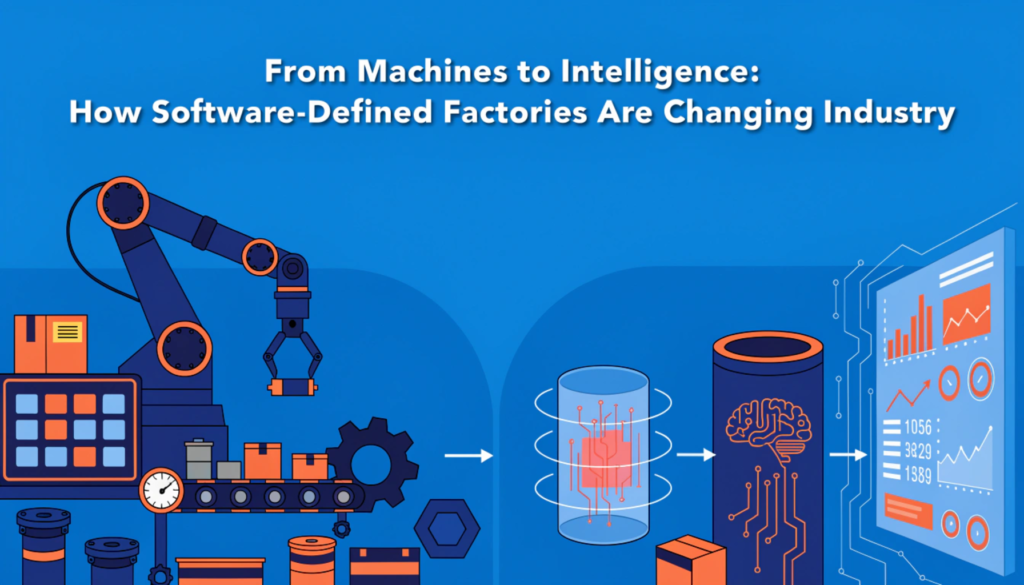
This shift is driving interest in software-defined factories, where software, connected industrial systems, real-time data, and artificial intelligence help manufacturers monitor, coordinate, and continuously improve production. Instead of relying exclusively on fixed machine settings and manual adjustments, companies can increasingly use digital tools to simulate production changes, detect problems, optimize workflows, and respond to changing demand.
The idea is particularly important as American manufacturers face pressure to strengthen domestic supply chains, improve productivity, manage labor shortages, and compete globally. Building a new factory is expensive, but making an existing facility more intelligent can also create significant opportunities.
The investment conversation surrounding this transformation is often framed in billions of dollars. However, the real question is not simply how much money manufacturers spend on technology. It is whether these investments deliver measurable improvements in production, quality, reliability, and profitability.
What Are Software-Defined Factories?
Software-defined factories are manufacturing facilities in which software plays a central role in controlling, coordinating, monitoring, and optimizing production activities.
Traditional factories often depend on a combination of programmable logic controllers, specialized machinery, industrial software, and human operators. These systems remain essential. The difference is that a software-defined approach aims to connect more of these systems into a flexible digital environment.
For example, a manufacturer could use connected sensors to collect machine performance data, analytics software to identify production bottlenecks, and artificial intelligence to recommend adjustments to production schedules. Engineers could test those adjustments in a virtual factory before implementing them on the physical production floor.
This approach does not mean eliminating machinery or replacing every existing system. Instead, it means making the factory more adaptable through better integration between equipment, software, and operational data.
Key characteristics include:
- Connected production systems: Machines, sensors, software platforms, and operational teams exchange relevant information.
- Real-time visibility: Managers can monitor production performance, equipment conditions, and quality indicators.
- Software-driven optimization: Digital tools help adjust workflows, schedules, and resource allocation.
- Virtual simulation: Engineers can test production changes before committing physical resources.
- Continuous improvement: Operational data helps teams identify recurring problems and improve processes over time.
When these capabilities work together, manufacturers can make better-informed decisions and respond more quickly to disruptions.
Why U.S. Manufacturers Are Paying Attention
The growing interest in industrial digital transformation is closely connected to the changing economics of American industry.
Manufacturers are under pressure to produce more efficiently while dealing with complex supply chains, rising operational costs, demanding customers, and competition from international producers. Businesses expanding domestic production must also consider whether their facilities have the workforce, technology, infrastructure, and capacity required to operate competitively.
A May 2026 McKinsey report, Ramping up manufacturing in America?, examined the scale of U.S. dependence on imported manufactured goods and the challenges involved in expanding domestic production. Its analysis highlighted how difficult it can be to replace concentrated or strategically important imports with domestic manufacturing capacity.
This creates an important opportunity for smart manufacturing. Companies do not necessarily need to solve every production challenge by building additional facilities. They can also improve the performance of existing assets, reduce avoidable downtime, and make better use of available capacity.
Software and automation can support these objectives by helping manufacturers identify inefficiencies that are difficult to detect through manual monitoring alone.
For example, a factory experiencing repeated delays may initially assume it needs another production line. Data analysis could reveal that the actual problem is an inefficient changeover process, inconsistent machine availability, or poor coordination between production stages.
Solving the underlying problem may deliver better results than immediately investing in additional equipment.
Industrial AI Is Becoming a Core Manufacturing Tool
Artificial intelligence is moving beyond general business applications and into industrial environments where decisions affect physical production.
Industrial AI uses artificial intelligence and machine learning to analyze manufacturing data, recognize patterns, support operational decisions, and automate selected tasks.
Its applications extend across the manufacturing lifecycle, from product design and engineering to quality inspection, equipment maintenance, inventory planning, and production scheduling.
Consider a factory producing automotive components. An AI-enabled inspection system can analyze images from production lines to identify potential surface defects. A separate analytics system can compare machine readings with historical patterns to flag conditions associated with quality problems.
Operators can investigate these warnings before defective products move further through the production process.
Industrial AI can also support production planning. When an urgent customer order arrives, software may help planners evaluate machine availability, material requirements, labor schedules, and delivery deadlines before changing the production sequence.
In January 2026, Siemens announced expanded work with NVIDIA on an Industrial AI Operating System, alongside digital twin technology and industrial copilots. Siemens also described work with PepsiCo to create detailed digital representations of selected U.S. manufacturing and warehouse facilities.
These developments illustrate how industrial technology providers are bringing simulation, operational data, and AI together to improve decision-making.
However, industrial AI is not a guaranteed solution to every manufacturing challenge. Its effectiveness depends on data quality, integration with existing equipment, appropriate testing, and human oversight.
Digital Twins: Testing the Factory Before Changing It
One of the most important technologies supporting software-defined factories is the digital twin.
A digital twin is a digital representation of a physical product, machine, production process, or facility. Depending on its design, it can incorporate engineering models, equipment specifications, sensor readings, and operational information.
Rather than experimenting directly on a live production line, engineers can use a digital model to evaluate possible changes.
Imagine that a manufacturer wants to increase output without expanding its factory building. The engineering team could simulate different machine layouts, conveyor routes, production schedules, and equipment configurations.
The simulation may reveal that moving a particular workstation or changing the sequence of operations could reduce congestion. The team can investigate the proposed change virtually before investing in physical modifications.
This is one reason digital twins in manufacturing are attracting attention from manufacturers seeking better returns on capital expenditure.
Siemens introduced its Digital Twin Composer at CES 2026, describing how digital twins, simulation, and real-world engineering data can help companies visualize and optimize facilities and production systems. Its announced PepsiCo work provides an example of applying this approach to manufacturing and warehouse operations.
Digital twins can support several objectives:
- Testing factory layouts before construction or renovation.
- Evaluating production changes before implementation.
- Identifying possible bottlenecks in material movement.
- Supporting virtual commissioning of automation systems.
- Comparing alternative equipment and process configurations.
- Improving collaboration between engineering and operations teams.
Nevertheless, a digital twin is only as useful as its underlying model and data. Incorrect assumptions, outdated equipment information, and poorly validated simulations can lead to misleading conclusions.
Manufacturers should therefore treat digital simulation as a decision-support tool that requires engineering validation.
Factory Automation Is Becoming More Intelligent
Traditional factory automation focuses on automating defined tasks, such as moving materials, welding components, packaging products, or controlling machine sequences.
Modern automation increasingly combines those capabilities with connected sensors, advanced analytics, machine vision, and AI-supported decisions.
This development is changing the role of industrial robots and automated production systems.
A conventional robotic arm may repeat a programmed movement with high precision. When integrated with suitable sensors and vision systems, an advanced robotic application may also respond to variations in product position or identify objects that require different handling.
Similarly, automated material-handling systems can use production information to coordinate the movement of components between workstations.
The objective is not simply to install more robots. It is to build a production environment in which machines, software, and people coordinate more effectively.
For American manufacturers, this can be especially valuable in repetitive, physically demanding, or hazardous operations. Automation can reduce exposure to certain workplace risks while allowing employees to focus on supervision, troubleshooting, process improvement, and more complex tasks.
However, automation decisions must account for production volume, product variability, maintenance requirements, and the cost of integrating new systems.
A technology that works well in a high-volume automotive facility may not deliver the same return in a small factory producing highly customized components.
Predictive Maintenance Can Reduce Unexpected Downtime
Unplanned equipment failure is expensive. A single breakdown can interrupt production, delay customer orders, increase overtime costs, and create problems across the supply chain.
Traditional preventive maintenance typically follows a schedule based on operating hours, calendar intervals, or manufacturer recommendations. Although useful, scheduled maintenance cannot always identify the exact condition of a machine.
Predictive maintenance uses equipment data and analytical models to identify warning signs that may indicate an emerging failure.
Sensors can monitor factors such as vibration, temperature, pressure, electrical characteristics, and operating cycles. Analytical software can then help maintenance teams identify unusual patterns and prioritize inspections.
For example, increasing vibration in a motor may indicate a developing mechanical problem. When detected early and investigated by qualified technicians, the issue may be addressed during planned maintenance rather than after a sudden breakdown.
Within software-defined factories, maintenance information can also be connected to production planning. If a machine requires attention, the production team may evaluate whether work can be reassigned to another line or rescheduled to minimize disruption.
The business benefits may include improved equipment availability, more efficient maintenance planning, and fewer avoidable interruptions.
However, predictive maintenance requires reliable sensors, useful historical data, appropriate thresholds, and skilled personnel. Not every machine requires advanced AI monitoring, and a basic preventive maintenance program may remain the most cost-effective option for some equipment.
The Business Case: Productivity, Quality, and Capital Efficiency
The success of smart manufacturing should be measured through business outcomes rather than technology adoption alone.
Manufacturers need to understand whether new software and automation systems are improving production performance enough to justify their cost.
Important measures include overall equipment effectiveness, production cycle time, defect rates, unplanned downtime, energy consumption, throughput, and on-time delivery.
A factory might invest in AI-enabled inspection, for instance. The investment should be evaluated by measuring whether the system improves defect detection, reduces rework, increases inspection capacity, or prevents defective products from reaching customers.
A digital twin project should similarly be assessed against its ability to improve engineering decisions, reduce commissioning problems, or avoid unnecessary capital expenditure.
Boston Consulting Group’s May 2026 analysis of AI-powered factories highlighted the potential for significant productivity gains from advanced manufacturing technologies. Such estimates indicate the scale of the opportunity, but individual results depend on the industry, starting conditions, implementation quality, and specific production processes.
A sensible investment strategy begins with a clearly defined operational problem.
Instead of launching a large-scale transformation immediately, manufacturers can select one production line, one maintenance challenge, or one quality-control process. They can establish a baseline, implement a targeted solution, and compare the results with the original performance.
This approach makes the business case easier to evaluate and can reduce the risk of investing in technology that does not address a meaningful operational need.
The Hidden Risks Behind the Technology Investment
Despite its potential, industrial digital transformation presents substantial challenges.
Integration with legacy equipment
Many factories operate machinery purchased years or decades ago. Some systems use proprietary communication protocols, while others may lack the sensors or connectivity required for modern analytics.
Connecting these assets can require specialized engineering, additional hardware, and careful testing.
Cybersecurity and operational resilience
As factory equipment becomes more connected, manufacturers must pay closer attention to cybersecurity. A compromised system can affect production availability, product quality, intellectual property, and worker safety.
Companies should implement appropriate network segmentation, access controls, monitoring, backup procedures, and incident-response plans. Security requirements must reflect the consequences of disrupting physical operations.
Data quality and interoperability
Different systems may use inconsistent data formats, equipment identifiers, or reporting standards. AI models cannot reliably compensate for every problem caused by incomplete or inaccurate information.
Manufacturers need a clear data strategy that supports trustworthy information exchange between operational technology and enterprise systems.
Workforce readiness
New technology also changes the skills required on the production floor. Employees may need training in digital systems, data interpretation, robotics, troubleshooting, and cybersecurity awareness.
Successful adoption depends on involving operators and maintenance teams early rather than treating technology implementation as an IT-only initiative.
Uncertain financial returns
Software licenses, integration services, connectivity, training, infrastructure, and ongoing support all contribute to the total cost of ownership.
Manufacturers must evaluate these costs alongside measurable benefits. They should also consider vendor dependence, future licensing changes, system upgrades, and the consequences of technology becoming obsolete.
The biggest risk is not necessarily spending too much on software. It is investing without a clear understanding of the problem being solved.
How Manufacturers Can Start Building a Software-Defined Factory
A practical transformation does not require every factory to become fully autonomous immediately.
The first step is to establish a reliable picture of current operations. Manufacturers should identify recurring downtime, production delays, quality issues, excessive energy use, and inefficient material movement.
Next, they should determine which problems are suitable for digital solutions. A sensor-based monitoring system may be enough for one application, while another may benefit from machine vision, advanced analytics, or a digital twin.
A phased implementation can help control risk.
Step 1: Identify a measurable problem. Choose a specific operational issue and establish a baseline using reliable performance data.
Step 2: Review existing systems. Assess machinery, control systems, software, connectivity, and the availability of useful operational information.
Step 3: Select a focused pilot. Introduce the technology on a manageable production line or within a clearly defined process.
Step 4: Train the workforce. Ensure employees understand how the system works, how to interpret its outputs, and when human intervention is required.
Step 5: Measure the results. Compare performance against the original baseline, including implementation costs and any unintended consequences.
Step 6: Scale what works. Expand successful solutions to additional lines or facilities, adapting them to local operational requirements.
This method helps organizations develop practical experience before committing to a larger transformation.
It also encourages collaboration between manufacturing leaders, engineers, IT teams, automation specialists, finance departments, and technology providers.
What Software-Defined Factories Mean for the Future of U.S. Manufacturing
The future of U.S. manufacturing will not be determined by physical equipment alone. The ability to combine machinery, software, operational data, and skilled people will increasingly influence how efficiently companies produce goods and respond to changing market conditions.
The development of AI-powered factories could help manufacturers improve production visibility, reduce avoidable downtime, strengthen quality control, and make better use of existing facilities.
Digital twins may help engineers evaluate changes before investing in physical construction. Predictive maintenance may help identify equipment problems earlier. Connected automation systems may improve coordination across production lines and supply chains.
These capabilities could become particularly valuable as manufacturers expand capacity in strategic industries and seek to improve the competitiveness of domestic production.
Yet the transition will not be uniform. Some companies will achieve meaningful improvements through relatively simple monitoring and automation projects. Others will require substantial investment in infrastructure, cybersecurity, data management, and workforce development.
The strongest approach is to view software as an enabler of operational improvement rather than a replacement for sound engineering and management.
For manufacturing executives, plant managers, automation specialists, and technology providers, the important question is how to turn these emerging capabilities into reliable, measurable business results.
The $3.7 billion gamble is therefore best understood as a symbol of the wider investment challenge facing modern industry: manufacturers must decide how to fund the technologies that could improve competitiveness while avoiding expensive projects that fail to deliver practical value.
Companies that connect their technology strategies to real production needs will be better positioned to navigate the next phase of industrial change.
Conclusion: The Next Manufacturing Advantage Will Be Built on Software and People
Software-defined factories represent a major evolution in the way manufacturing systems are designed, operated, and improved. By combining industrial AI, digital twins, connected equipment, and intelligent automation, manufacturers can develop more flexible and data-informed production environments.
But technology alone does not guarantee success. Effective implementation requires realistic investment plans, reliable data, secure systems, employee training, and clear performance targets.
For American manufacturers, the opportunity is to build factories that are not only more automated but also more adaptable, resilient, and efficient.
The companies that approach this transformation strategically can improve their ability to compete, support domestic production, and respond to the changing demands of industrial markets.
What comes next will depend on how effectively manufacturing leaders turn digital capabilities into real-world performance.
Explore the Smart Manufacturing & AI Automation Convention 2027
The future of manufacturing is being shaped by industrial AI, robotics, connected production systems, and advanced automation. These developments make collaboration between manufacturers, technology innovators, and solution providers increasingly important.
Join industry leaders and professionals at the Smart Manufacturing & AI Automation Convention 2027, taking place February 23–25, 2027, in Dallas, Texas.
Explore emerging technologies, exchange industry insights, and connect with professionals working to advance the next generation of manufacturing.
Register or explore the event details: https://bmaconventions.com/smart-manufacturing-automation-convention-2027/
Be part of the conversation shaping the future of smart manufacturing and industrial automation.