
The U.S. healthcare system is approaching a major demographic shift. As the population ages, hospitals will face increasing demand for facilities that can support older patients with more complex and long-term healthcare needs. This change will affect far more than the number of beds available. It will influence how hospitals are designed, how patients move through facilities, how technology is deployed, and how clinical and non-clinical spaces are planned.
For healthcare leaders, architects, facility managers, and planners, the question is no longer whether hospitals need to adapt. It is how quickly they can redesign infrastructure to meet the needs of an aging population.
Effective hospital facility planning 2030 will require a shift from traditional hospital design toward environments that prioritize accessibility, safety, flexibility, digital connectivity, patient independence, and staff efficiency.
The challenge is particularly important because older adults often require multiple forms of care at the same time. A patient may need emergency treatment, rehabilitation, medication management, diagnostic services, and assistance with mobility. Hospitals designed primarily around short-term acute care may struggle to accommodate these increasingly complex requirements.
Why Aging Will Transform Hospital Infrastructure
The aging of the U.S. population is expected to have a significant impact on healthcare utilization. Older adults generally have higher rates of chronic conditions, mobility limitations, and healthcare service use than younger populations.
This means hospitals must think beyond simply expanding capacity. They need to consider aging population healthcare infrastructure as a long-term planning priority.
A hospital designed for an aging population needs to answer practical questions. Can a patient using a wheelchair easily navigate the facility? Are corridors wide enough for mobility equipment? Can signage be understood quickly by patients with impaired vision or cognitive difficulties? Are waiting areas comfortable for people who may need frequent breaks? Can bathrooms accommodate patients with limited mobility?
These considerations may sound straightforward, but incorporating them across an entire hospital requires significant planning.
The facilities built or renovated over the next several years will potentially serve communities well beyond 2030. Decisions being made today will therefore influence whether hospitals can effectively respond to demographic changes tomorrow.
Hospital Facility Planning 2030 Must Put Accessibility First
Accessibility should become one of the central principles of hospital facility planning 2030.
Traditional hospital layouts often focus heavily on clinical workflows. While efficient workflows remain essential, future facilities will also need to consider how easily older patients and their caregivers can interact with the environment.
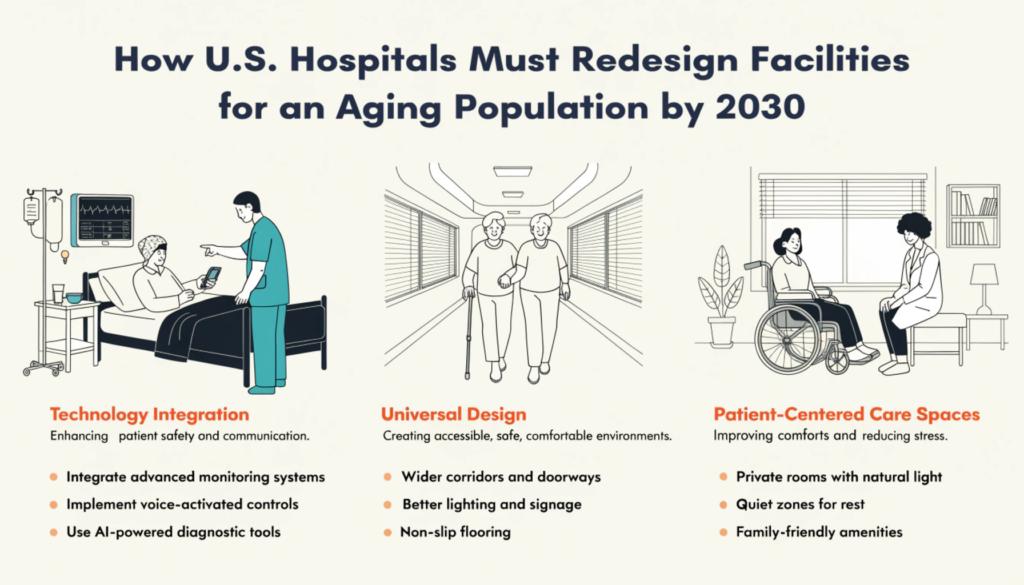
This includes wider and safer circulation routes, accessible elevators, appropriately designed patient rooms, non-slip flooring, strategically positioned handrails, accessible bathrooms, and seating throughout major circulation areas.
Lighting will also become increasingly important. Poor lighting can make navigation more difficult for older adults, particularly those with reduced vision. Hospitals can incorporate better illumination, reduced glare, clear visual contrasts, and intuitive wayfinding systems.
The goal should not simply be compliance with accessibility requirements. Instead, hospitals should aim to create environments that make patients feel confident and independent.
Designing Patient Rooms for Older Adults
The patient room is another area where hospital design can evolve significantly.
Older patients may spend longer periods in hospitals and may be more vulnerable to falls, confusion, or loss of mobility. Room design can therefore contribute directly to patient safety and recovery.
Future patient rooms could incorporate features such as easily accessible controls, adjustable lighting, visible clocks and calendars, comfortable seating for family members, accessible storage, and bathrooms designed around mobility needs.
Hospitals should also consider how technology fits into the patient environment. Digital communication systems, remote monitoring devices, smart beds, and connected medical equipment can improve care, but they must be intuitive.
Technology should simplify the patient experience rather than make it more complicated.
For older adults who are less familiar with digital interfaces, hospitals may need to combine digital tools with human assistance and simple physical controls.
Preventing Falls Through Better Facility Design
Falls represent a major concern for older patients, making fall prevention an important consideration in aging population healthcare infrastructure.
Facility design can help reduce environmental risks. Flooring should provide appropriate traction, bathrooms should include support features, and patient rooms should allow sufficient space for mobility aids.
Hospital teams can also use technology to support fall prevention. Sensors and connected monitoring systems can alert staff when a patient attempts to leave a bed without assistance. Smart lighting can provide low-level illumination during nighttime movement, reducing the need for patients to navigate dark rooms.
However, technology should complement not replace good design and attentive care.
The most effective approach combines physical safety, clinical protocols, staff awareness, and appropriate digital monitoring.
Creating Better Wayfinding for Older Patients
Large hospitals can be confusing even for healthy adults. For older patients, especially those experiencing cognitive decline or vision impairment, complicated layouts can become a serious barrier.
Future hospitals need simpler wayfinding systems.
Instead of relying entirely on written signs, facilities can use large, high-contrast lettering, recognizable symbols, consistent colors, distinct landmarks, and logical layouts.
The architectural design itself can also become part of the navigation system. Patients should be able to understand where they are and where they need to go without repeatedly asking staff for directions.
Digital wayfinding applications could provide additional assistance through smartphones, kiosks, or hospital-provided devices. But again, these systems should remain optional because not every patient will be comfortable using them.
Flexible Spaces Will Become Essential
Another major component of hospital facility planning 2030 will be flexibility.
Healthcare demand can change rapidly. A hospital may experience increased demand for emergency services, rehabilitation, outpatient care, or specialized geriatric services at different times.
Rigid facilities can make it difficult to respond to these changes.
Flexible rooms and adaptable infrastructure can allow hospitals to modify spaces as healthcare needs evolve. Movable partitions, standardized room layouts, accessible utility connections, and modular infrastructure can make renovations faster and less disruptive.
This approach is particularly valuable when planning for an aging population because healthcare requirements may continue changing as demographic trends develop.
Rather than designing facilities for a single forecast, hospitals should create infrastructure capable of adapting to multiple future scenarios.
Technology and the Future of Aging Population Healthcare Infrastructure
Technology will play a major role in supporting older patients, but hospitals should avoid adopting technology simply because it is new.
The strongest technology strategies will focus on specific patient and operational challenges.
Remote patient monitoring, artificial intelligence, connected medical devices, electronic health records, smart beds, digital twins, automated logistics, and predictive maintenance can all contribute to more efficient healthcare environments.
For example, connected monitoring systems can help clinical teams observe patients without requiring unnecessary physical checks. Smart building systems can monitor environmental conditions such as temperature and air quality. Predictive maintenance can identify equipment issues before they cause major disruptions.
Artificial intelligence can also support hospital operations by analyzing demand patterns and helping facilities plan resources.
But technology infrastructure must be reliable, secure, and easy to maintain. Hospitals should therefore consider cybersecurity, interoperability, staff training, and lifecycle costs when making technology investments.
Designing for Caregivers and Families
An aging population also changes the role of caregivers and family members within hospitals.
Older patients may depend more heavily on relatives or professional caregivers during treatment and recovery. Facilities should therefore consider these people when designing patient environments.
Comfortable family seating, overnight accommodation options, charging points, private consultation areas, and accessible amenities can improve the overall experience.
Family members can also become an important part of communication and discharge planning. Facilities should provide appropriate spaces where clinicians can discuss treatment plans, rehabilitation, medication, and post-discharge care.
This represents a broader shift toward patient- and family-centered healthcare design.
Connecting Hospitals With Long-Term Care
Hospitals cannot solve the challenges associated with an aging population alone.
Older patients frequently move between hospitals, rehabilitation facilities, assisted living environments, primary care providers, and their homes. Healthcare infrastructure should therefore support greater continuity between these settings.
Hospital planners should consider how facility design and technology can support smoother transitions.
For example, digital information systems can help clinicians access relevant patient information, while telehealth infrastructure can support follow-up care after discharge.
Hospitals may also benefit from closer collaboration with rehabilitation providers, senior care organizations, and community healthcare services.
The future of aging population healthcare infrastructure will therefore extend beyond the hospital building itself.
Sustainability Should Be Part of the 2030 Strategy
Future hospital infrastructure also needs to address sustainability.
Hospitals operate continuously and consume substantial amounts of energy and resources. As facilities expand or undergo renovations, healthcare leaders have an opportunity to improve energy efficiency while creating better environments for older patients.
Natural light, efficient HVAC systems, smart building controls, energy-efficient equipment, water conservation systems, and resilient power infrastructure can contribute to more sustainable facilities.
Importantly, sustainability and patient-centered design do not have to compete.
For example, improved natural lighting can reduce energy consumption while creating a more comfortable environment. Better building controls can improve energy performance while maintaining appropriate conditions for patients.
Preparing Staff for the Future Facility
Redesigning a hospital is not only an architectural challenge. Staff must also be prepared to work within the new environment.
Technology-enabled facilities can change workflows, introduce new monitoring systems, and alter how clinical teams interact with patients.
Healthcare organizations should therefore involve clinicians, nurses, facility managers, IT professionals, patients, and caregivers in planning discussions.
Their feedback can reveal practical issues that may not be obvious during the architectural design stage.
A successful hospital facility planning 2030 strategy should ultimately connect three areas: the physical environment, the technology environment, and the human workforce.
The 2030 Hospital Will Need to Be More Adaptable
The biggest lesson for healthcare leaders is that the hospital of 2030 cannot simply be a larger version of today’s hospital.
It needs to be more accessible, flexible, connected, resilient, and patient-centered.
The aging population will increase pressure on emergency departments, inpatient services, rehabilitation, outpatient care, and supporting infrastructure. Hospitals that begin planning early will have greater opportunities to redesign spaces strategically rather than responding to demographic pressure after capacity becomes a problem.
The strongest facilities will combine thoughtful architecture with smart technology and human-centered care.
Ultimately, hospital facility planning 2030 is about preparing healthcare environments for the people who will depend on them most. Designing around mobility, accessibility, safety, digital connectivity, caregiver involvement, and adaptability can help U.S. hospitals remain effective as the country’s demographic profile changes.
The decisions made today will shape whether hospitals are prepared for the healthcare demands of the next decade.
Conclusion
The aging of America’s population represents one of the most important long-term considerations for healthcare infrastructure. Hospitals must rethink how patients move through facilities, how rooms are designed, how technology is integrated, and how buildings can adapt to changing clinical needs.
A successful approach to aging population healthcare infrastructure will require collaboration between healthcare executives, architects, facility managers, technology providers, clinicians, and policymakers.
For hospitals, 2030 is not a distant deadline. Facility planning, capital investment, renovation strategies, and technology decisions being made today will determine how prepared healthcare organizations are for the next generation of patients.