
Manufacturing is entering a new phase of automation. As businesses face pressure to increase productivity, maintain consistent quality, reduce operating costs, and respond faster to changing customer demand, robotics is becoming an increasingly important part of modern production.
However, choosing the right robotic solution is not always straightforward. Manufacturers today can choose between traditional industrial robots and collaborative robots, commonly known as cobots. While both technologies can automate repetitive processes, they are designed for different operating environments and production requirements.
Understanding cobots vs robots manufacturing strategies can help manufacturers determine which technology delivers the best combination of productivity, flexibility, safety, and return on investment.
As manufacturing systems become more connected and intelligent in 2027, the decision will be less about simply installing robots and more about selecting the right automation architecture for a specific production line.
What Are Cobots?
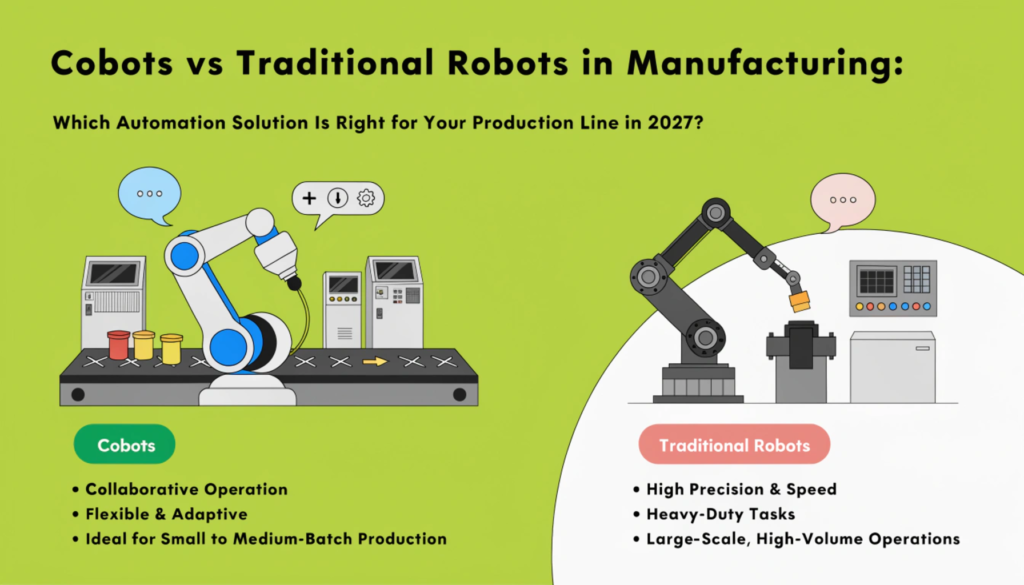
Collaborative robots, or cobots, are robotic systems designed to work alongside human employees in certain applications. Unlike many conventional industrial robots that operate within dedicated safety zones, cobots are generally designed with features that can support closer human-robot interaction.
Cobots are often used for tasks such as assembly, machine tending, packaging, quality inspection, material handling, screwdriving, and pick-and-place operations.
Their flexibility makes them particularly attractive to manufacturers that need to adapt production quickly. Cobots can often be redeployed from one task to another, making them useful for companies with multiple products, frequent changeovers, or relatively short production runs.
The growth of the collaborative robots industry is also being supported by improvements in sensors, vision systems, programming interfaces, and artificial intelligence. These developments are making robotic automation more accessible to manufacturers of different sizes.
What Are Traditional Industrial Robots?
Traditional industrial robots have been used in manufacturing for decades and remain an important part of high-volume automated production.
These robots are typically designed to perform fast, precise, and repetitive operations. They are widely used in automotive manufacturing, metal fabrication, electronics, welding, painting, palletizing, and other applications where speed and repeatability are critical.
Traditional robots generally operate within a controlled workspace that uses physical guarding, safety scanners, interlocks, or other protective systems. This approach allows robots to operate at high speeds while keeping workers outside the robot’s operating envelope.
For manufacturers producing large volumes of standardized products, traditional robots can provide significant productivity advantages.
Cobots vs Robots Manufacturing: The Key Differences
The most important distinction in cobots vs robots manufacturing is not simply the size or appearance of the machines. The major difference lies in how they are intended to interact with people and production environments.
Cobots are generally designed with flexibility and human-robot collaboration in mind. Traditional industrial robots, on the other hand, are typically optimized for speed, power, and highly repetitive automated operations.
The right choice depends on factors such as production volume, cycle time, available floor space, task complexity, safety requirements, workforce availability, and expected return on investment.
Speed and Productivity
When speed is the primary requirement, traditional industrial robots can have a significant advantage.
High-speed robots can perform repetitive tasks continuously with highly consistent cycle times. This makes them suitable for production lines where even small improvements in cycle time can create substantial increases in output.
Cobots can also improve productivity, but their operating speeds may be constrained depending on the application and the conditions required for safe collaborative operation.
For high-volume manufacturing where maximum throughput is the priority, traditional robots may therefore be the better choice.
For operations where flexibility and human involvement are more important than maximum speed, cobots can be highly effective.
Flexibility and Changeovers
Flexibility is one of the strongest advantages of cobots.
Many modern cobots are designed to be relatively easy to program and reposition. Depending on the system, manufacturers may be able to move a cobot between different workstations as production requirements change.
This can be particularly valuable for manufacturers producing multiple product variants.
Traditional robotic systems can also be flexible, but changing their application may require more engineering, programming, tooling, or production-line modifications.
For manufacturers operating in markets where product lifecycles are becoming shorter, flexible automation can become a major competitive advantage.
Installation and Floor Space
Production floor space is another important consideration.
Traditional robotic cells often require dedicated safety areas, guarding, conveyors, and additional infrastructure. As a result, the complete automation cell can require substantial floor space.
Cobots can sometimes be integrated into existing workstations with a smaller footprint. Their ability to operate near employees can allow manufacturers to redesign production layouts more efficiently, subject to a proper application-specific safety assessment.
For manufacturers working with limited factory space, this can make cobots particularly attractive.
Safety Considerations
Safety should never be treated as a simple distinction between “safe cobots” and “unsafe traditional robots.”
Both types of robotic systems require appropriate risk assessment, installation, programming, safeguarding, and compliance with applicable workplace safety requirements.
Cobots may include technologies such as force sensing, speed monitoring, safety-rated stop functions, and collision detection. However, whether a cobot can operate without additional guarding depends on the specific application, tooling, speed, payload, environment, and risk assessment.
Traditional robots typically use physical separation and engineered safeguarding to keep workers away from hazardous movement.
Therefore, manufacturers should evaluate the complete robotic application rather than selecting technology based only on the label “collaborative.”
Cost and Return on Investment
Initial investment is another major factor in the cobots vs robots manufacturing decision.
Cobots can be attractive for small and medium-sized manufacturers because some applications may require less infrastructure than a traditional robotic cell. Their programming and redeployment capabilities can also potentially reduce engineering requirements.
Traditional robots can involve higher upfront costs when the complete system includes guarding, conveyors, fixtures, safety equipment, programming, and integration.
However, cost should not be evaluated only on the initial purchase price.
A traditional robot operating at a significantly higher production rate could generate a better return on investment for a high-volume operation. Similarly, a cobot may deliver stronger value for a manufacturer that frequently changes products or needs automation that can be redeployed.
The right calculation should consider the complete lifecycle cost, including installation, maintenance, programming, downtime, labor impact, energy consumption, throughput, and expected productivity gains.
Where Cobots Make the Most Sense
Cobots can be particularly useful in production environments where employees and automation need to work in close proximity.
For example, a manufacturer may use a cobot to load and unload a CNC machine while an employee performs inspection or finishing work. Another company could use a cobot for packaging while employees manage product preparation and quality checks.
They can also be valuable for manufacturers that are taking their first steps toward automation.
Instead of redesigning an entire production line, a business can identify one repetitive or ergonomically challenging task and introduce automation at that point.
This gradual approach can help manufacturers build automation expertise while demonstrating measurable productivity benefits.
Where Traditional Robots Have the Advantage
Traditional industrial robots remain highly competitive for large-scale manufacturing operations.
Applications requiring high speed, heavy payloads, continuous operation, and extremely consistent cycle times are often better suited to conventional robotic systems.
Automotive body shops, welding lines, large-scale palletizing operations, and high-volume material-handling applications are examples where traditional robots can deliver significant advantages.
If a production line runs continuously with minimal product variation, the higher performance of a conventional robot can justify the additional infrastructure.
The Role of AI and Vision in 2027
The robotics decision in 2027 will increasingly involve technologies beyond the robot itself.
Artificial intelligence, machine vision, advanced sensors, digital twins, edge computing, and connected manufacturing platforms are changing how robots interact with production environments.
Vision-enabled robots can identify components, detect defects, determine object orientation, and adapt to variations in incoming materials.
AI can also help manufacturers analyze production data and identify opportunities to improve robotic performance.
These developments are particularly important for the collaborative robots industry, where improved perception and intelligent decision-making can expand the range of tasks that robots can support.
Rather than viewing robotics as an isolated machine investment, manufacturers should consider how robotic systems will connect with their broader smart manufacturing infrastructure.
Hybrid Automation Could Be the Future
The debate between cobots and traditional robots does not necessarily mean manufacturers must choose only one.
In many production environments, the most effective strategy may involve combining both technologies.
A manufacturer could use traditional industrial robots for high-speed, repetitive processes while deploying cobots for flexible assembly, inspection, machine tending, or packaging.
This hybrid approach allows manufacturers to match automation technology to individual production requirements.
The result can be a production line where automation is applied strategically instead of uniformly.
How to Choose the Right Robot for Your Production Line
Before investing in automation, manufacturers should examine their production requirements carefully.
Start by identifying the tasks that create the biggest productivity bottlenecks. Evaluate cycle time, product weight, required precision, production volume, changeover frequency, worker involvement, and available floor space.
Next, determine whether the task requires maximum speed or greater flexibility.
If the operation involves high production volumes and repetitive tasks, a traditional robot may offer the strongest business case. If the operation involves frequent product changes or requires humans and robots to work in close proximity, a cobot may provide greater flexibility.
Manufacturers should also evaluate integration requirements. A robot should not be viewed as an independent machine. Its value depends on how effectively it connects with CNC machines, conveyors, vision systems, manufacturing execution systems, quality systems, and other factory technologies.
What Should Manufacturers Prioritize in 2027?
In 2027, manufacturers should move beyond the idea that automation simply means replacing manual labor with machines.
The strongest automation strategies will focus on creating more resilient, flexible, data-driven production systems.
This means identifying where humans provide the greatest value and where automation can handle repetitive, dangerous, physically demanding, or highly precise tasks.
Cobots can support this model by working alongside employees in suitable applications, while traditional robots can continue to deliver high-speed automation where physical separation makes sense.
The goal is not to determine whether cobots are better than traditional robots. The goal is to determine which technology or combination of technologies best fits the production strategy.
Final Thoughts
The choice between cobots and traditional industrial robots will become increasingly important as manufacturers modernize their facilities in 2027.
Cobots vs robots manufacturing is ultimately a question of application, not simply technology preference. Cobots can provide flexibility, easier redeployment, and potential advantages for human-centric production environments. Traditional robots can deliver exceptional speed, precision, payload capacity, and throughput for demanding high-volume operations.
Manufacturers that carefully evaluate production requirements, safety, integration, lifecycle costs, and scalability will be better positioned to make the right investment.
As the collaborative robots industry continues to evolve alongside AI, machine vision, and smart factory technologies, the future of manufacturing will likely involve a combination of robotic technologies working together to create faster, more flexible, and more intelligent production environments.
Ready to explore the future of smart manufacturing and automation?
Enquire now: https://bmaconventions.com/smart-manufacturing-automation-convention-2027/