
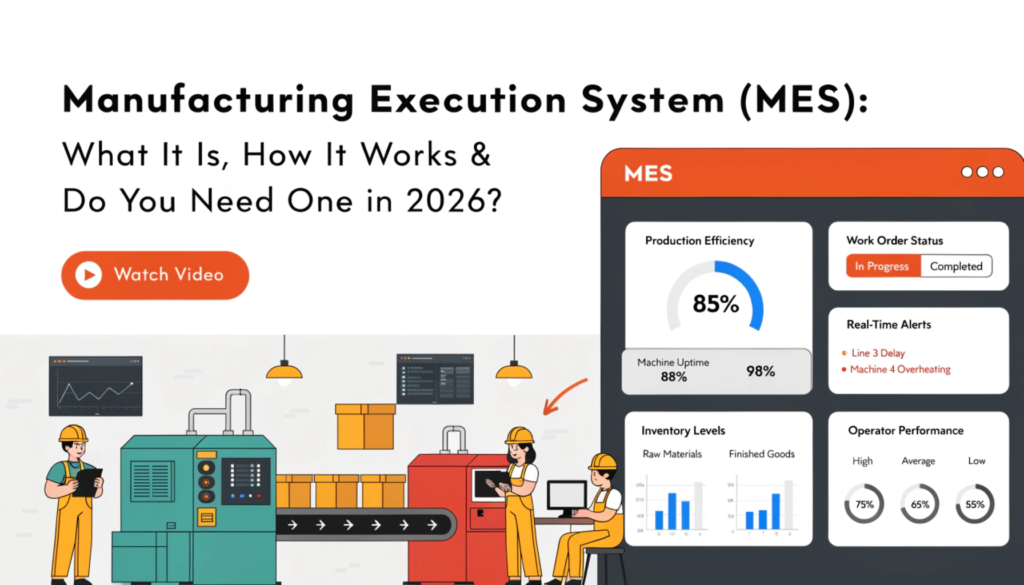
Manufacturing has become more connected, automated, and data-driven than ever before. Production teams are expected to improve efficiency, maintain quality, reduce downtime, respond faster to customer demand, and control costs all while managing increasingly complex operations. For many manufacturers, spreadsheets, paper records, and disconnected software systems are no longer enough to meet these expectations.
This is where a manufacturing execution system MES can become an important part of the digital manufacturing strategy.
An MES connects production activities with business and operational systems, giving manufacturers greater visibility into what is happening on the factory floor. From tracking production and monitoring equipment to managing quality and collecting real-time data, an MES can help organizations turn factory-floor information into actionable insights.
But does every manufacturer need one in 2026? The answer depends on the size, complexity, goals, and digital maturity of the operation.
What Is a Manufacturing Execution System (MES)?
A manufacturing execution system is software designed to monitor, manage, and control manufacturing operations in real time. It sits between enterprise-level systems, such as enterprise resource planning (ERP), and the physical production environment.
The simplest way to understand MES is to think of it as a digital connection between business planning and actual production.
An ERP system may tell a company what needs to be produced, how much inventory is available, and what orders need to be fulfilled. The MES helps translate that information into what is happening on the shop floor.
It can track which jobs are running, which machines are being used, how much has been produced, whether production is meeting targets, and whether quality requirements are being followed.
Instead of relying on delayed reports or manually collected information, manufacturers can use an MES to create a more accurate and timely view of production.
How Does MES Work?
An MES collects information from different parts of the manufacturing environment and brings it together in one system.
Depending on the implementation, it may connect with machines, sensors, industrial control systems, barcode scanners, quality systems, warehouse systems, and ERP platforms.
For example, imagine a factory producing automotive components. An order enters the ERP system, which determines production requirements. The MES can then help schedule and track the manufacturing process.
As production begins, the system can record machine activity, employee actions, material usage, production quantities, downtime, quality checks, and other important information.
If a machine stops unexpectedly, the MES can record the downtime. If a batch fails a quality inspection, the system can associate the issue with the relevant production information. If production is running behind schedule, managers can identify the problem much sooner.
This creates a continuous flow of information between production activities and management decisions.
Why Is MES Becoming More Important in 2026?
Manufacturers in 2026 are operating in an environment where speed, visibility, resilience, and efficiency are increasingly important.
Customers expect faster delivery and consistent quality. Supply chains remain vulnerable to disruptions. Energy and labor costs can significantly affect margins. At the same time, manufacturers are investing in automation, artificial intelligence, robotics, industrial IoT, and advanced analytics.
These technologies generate enormous amounts of data. However, collecting data is not enough.
Manufacturers need systems that can organize that information and connect it to actual production processes.
This is one reason the demand for MES software 2026 solutions is closely connected with the broader growth of smart manufacturing. An MES can provide the operational layer needed to turn machine and production data into useful information for supervisors, engineers, quality teams, and business leaders.
The goal is not simply to digitize existing processes. It is to create a manufacturing environment where decisions can be made using reliable, timely production information.
Key Features of a Manufacturing Execution System
Modern MES platforms can provide a wide range of capabilities. The exact features vary by software provider and industry, but several functions are commonly associated with MES.
Production Tracking
MES systems can provide visibility into production orders, work-in-progress, completed products, production quantities, and cycle times.
Instead of waiting for end-of-shift reports, managers can gain a much clearer picture of production performance while work is taking place.
Quality Management
Quality management is another major MES function.
An MES can help manufacturers record inspections, track defects, manage quality checks, and connect quality information with specific products, materials, machines, or production batches.
This can make it easier to identify recurring problems and investigate the causes of defects.
Equipment and Downtime Monitoring
Unplanned downtime can be expensive. MES platforms can help track equipment performance and downtime events, allowing manufacturers to understand how often machines stop and why.
This information can support maintenance strategies and help organizations identify opportunities to improve equipment utilization.
Traceability
Traceability is especially important in industries where manufacturers need detailed production histories.
An MES can record information about materials, batches, operators, equipment, processes, and quality checks. This creates a digital production history that can support audits, compliance, recalls, and quality investigations.
Performance Monitoring
Manufacturers can use MES data to monitor key performance indicators such as production output, cycle time, downtime, scrap, quality rates, and overall equipment effectiveness (OEE).
Having this information in a centralized environment can make it easier to identify performance gaps and prioritize improvement initiatives.
MES vs ERP: What Is the Difference?
One common question is whether MES is simply another version of ERP.
The two systems serve different but complementary purposes.
ERP generally focuses on business-level processes such as finance, procurement, sales, inventory, supply chain management, and production planning.
MES focuses more closely on the execution of manufacturing operations.
For example, an ERP system might determine that a company needs to manufacture 10,000 units of a particular product. The MES can help track how those 10,000 units are actually produced.
The systems can work together rather than replacing one another.
For manufacturers building a connected digital ecosystem, integrating ERP and MES can help create a continuous flow of information from business planning to shop-floor execution.
What Are the Benefits of MES?
The biggest advantage of a manufacturing execution system MES is improved visibility.
When production information is scattered across spreadsheets, paper documents, machine displays, and disconnected applications, it can be difficult to understand what is really happening.
An MES can bring much of this information into a centralized digital environment.
This can help manufacturers improve productivity by identifying bottlenecks, reduce downtime by analyzing equipment performance, improve quality through better process monitoring, and strengthen traceability by maintaining detailed production records.
There can also be significant benefits for decision-making.
Instead of relying entirely on historical reports, managers can use current production information to respond to problems faster.
For example, if a production line is consistently missing its target, an MES can help reveal whether the problem is related to downtime, quality issues, material shortages, long changeover times, or another factor.
The value comes from making problems more visible and therefore easier to address.
Do You Need an MES in 2026?
Not every manufacturer needs to immediately implement an MES.
A small operation with simple processes, limited production lines, and relatively low data complexity may not need a sophisticated MES platform yet.
However, the case for MES becomes stronger as manufacturing operations become more complex.
If your organization has multiple production lines, frequent changeovers, strict traceability requirements, high downtime costs, significant quality challenges, or disconnected production systems, an MES may provide considerable value.
The same applies to manufacturers investing heavily in automation.
As factories introduce robotics, sensors, connected equipment, AI-based systems, and industrial IoT technologies, the volume of production data increases. Without a strong operational software layer, much of that information may remain underused.
Manufacturers should therefore evaluate MES based on business requirements rather than adopting it simply because it is a popular Industry 4.0 technology.
Signs Your Factory May Be Ready for MES
One of the clearest signs is excessive dependence on manual data collection.
If employees spend significant amounts of time entering production information into spreadsheets or manually preparing reports, an MES could help automate some of those processes.
Another sign is a lack of real-time production visibility. If managers only discover production problems hours or days after they occur, the organization may be missing opportunities to respond quickly.
Frequent quality issues, unexplained downtime, poor traceability, and difficulties calculating accurate production performance can also indicate that existing systems are no longer sufficient.
Manufacturers should also consider MES when they are planning broader digital transformation initiatives. Implementing MES as part of a larger strategy can provide a foundation for connecting production data with analytics, automation, AI, and other technologies.
How to Choose MES Software in 2026
Choosing MES software 2026 requires more than comparing feature lists.
Manufacturers should first identify the problems they want the system to solve. The right platform should fit the company’s production processes rather than forcing the organization to completely redesign its operations around the software.
Integration capabilities are also critical.
An MES should be able to communicate with the organization’s existing ERP, machines, industrial systems, databases, and other relevant technologies. Poor integration can create another isolated data environment rather than solving the connectivity problem.
Scalability is equally important. A solution that works for one production line should ideally be capable of supporting additional facilities, machines, users, and processes as the organization grows.
Manufacturers should also evaluate usability. A technically powerful system will have limited value if operators and production teams find it difficult to use.
Finally, cybersecurity, data governance, vendor support, implementation requirements, and total cost of ownership should be considered before making a decision.
What Does MES Mean for the Future of Smart Manufacturing?
MES is increasingly becoming part of a larger smart manufacturing ecosystem.
Future factories are likely to combine MES with industrial IoT, artificial intelligence, robotics, digital twins, cloud platforms, advanced analytics, and automated decision-making.
In such environments, MES can act as an important operational layer connecting production processes with the broader digital enterprise.
The future of manufacturing will not simply be about installing more technology. It will be about connecting technologies so they can work together effectively.
A factory may have advanced robots and sensors, but without reliable production data and connected systems, it may struggle to achieve the full value of those investments.
That is why MES remains relevant in the transition toward more intelligent and connected manufacturing.
Is MES Worth the Investment in 2026?
For manufacturers with complex operations, the answer can be yes—but the return on investment should be evaluated carefully.
The potential value comes from several areas: improved productivity, reduced downtime, better quality, stronger traceability, lower administrative effort, and better production visibility.
However, successful implementation requires more than purchasing software.
Organizations need clear objectives, employee involvement, reliable data, appropriate system integration, and a well-planned implementation strategy.
Manufacturers should start by identifying their biggest operational challenges and then determine whether MES can address those challenges effectively.
Final Thoughts
A manufacturing execution system MES is no longer simply a tool for collecting shop-floor information. For many manufacturers, it can become a critical component of a broader digital transformation strategy.
In 2026, manufacturers are under growing pressure to produce faster, operate more efficiently, maintain consistent quality, and make better use of data. MES can help bridge the gap between business planning and real-world production by providing greater visibility into what is happening on the factory floor.
But MES is not automatically the right answer for every business.
The real question is not whether every manufacturer needs MES. It is whether your current systems give you the visibility, control, traceability, and data required to compete effectively.
For manufacturers moving toward automation and smart factory operations, that question is becoming increasingly important.
Register for Smart Manufacturing Convention
Discover the latest ideas, technologies, and strategies shaping the future of smart manufacturing and automation. Connect with industry professionals and explore how technologies such as MES, automation, robotics, AI, and industrial digitalization are transforming modern production.
Register for Smart Manufacturing Convention and explore the opportunities shaping the next generation of manufacturing.