
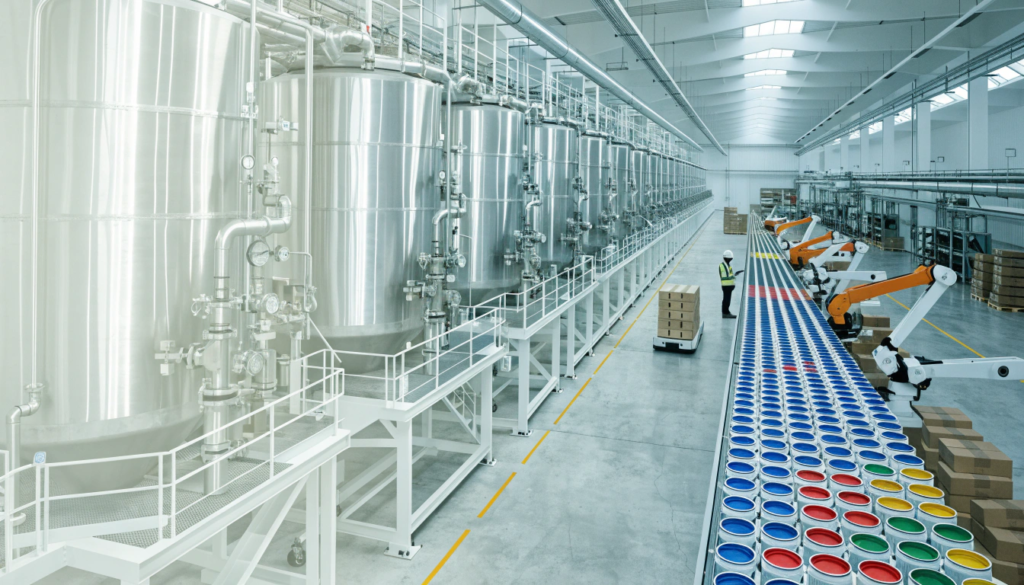
On September 30, 2026, Sherwin-Williams officially celebrated the grand opening of its massively expanded production site in Statesville, North Carolina. Representing a landmark $324 million capital investment, the project adds nearly 500,000 square feet of advanced production space alongside an 800,000-square-foot distribution hub. This expansion makes the Statesville site the company’s largest manufacturing plant in North America.
For industrial leaders and supply chain directors, this development is more than just a big building. It marks a major milestone for building a modern coatings manufacturing facility USA network. It also highlights how American manufacturers are combining smart robotics, high-speed automated packaging, and local supply chains to stay competitive. In a year defined by historic domestic factory growth, this project stands as a prime example of U.S. manufacturing investment 2026 in action.
Why Industrial Coatings Matter to the Broader Economy
Most consumers think of paint in terms of decorative wall colors. However, industrial coatings play an essential role in almost every physical product we rely on every day. From the rust-resistant primers on electric vehicles to protective seals on steel bridge beams and sterile interior coatings on beverage cans, modern manufacturing cannot run without high-performance chemical coatings.
When the global supply chain experienced major shipping delays and material shortages over the past few years, automotive assembly lines and commercial construction projects ground to a halt waiting for specialty coatings. Expanding domestic production capacity directly addresses those vulnerabilities. By manufacturing essential paints and industrial finishes close to major assembly hubs in the Southeast, companies can protect themselves against shipping bottlenecks and volatile import tariffs.
Furthermore, the geographic proximity of Statesville to key automotive, aerospace, and heavy equipment manufacturing clusters across the American South offers a strategic logistics advantage. Rather than relying on transoceanic shipping routes vulnerable to geopolitical friction and maritime bottlenecks, regional industrial clients can maintain leaner safety stock levels and leverage just-in-time delivery models for specialized liquid and powder coatings.
Beyond risk mitigation, domestic production allows chemical engineers to collaborate closely with original equipment manufacturers (OEMs) to customize formulations for novel applications. Whether developing ultra-durable thermal barrier coatings for next-generation battery enclosures or low-VOC waterborne finishes that meet stringent environmental standards, proximity accelerates the iterative testing cycle from laboratory bench to full-scale production line.
The Shift Toward Smart Automation on the Factory Floor
Traditional painting was once a labor-heavy, manual process. Workers had to physically lift heavy bags of dry pigments, pour raw chemical solvents into open vats, and manually test liquid viscosity with handheld cups. The Statesville mega-facility represents the complete modernization of this process.
In legacy batch formulation, batch-to-batch consistency was perpetually challenged by subtle ambient humidity shifts, manual measurement tolerances, and operator-dependent mixing times. Achieving identical color matching across millions of gallons across multiple production runs required frequent manual adjustments and costly reworking of off-spec product.
Today, the facility relies on end-to-end automation to improve safety, speed, and product consistency:
- Closed-Loop Automated Batching: Raw ingredients travel through sealed stainless-steel piping manifolds controlled by computerized recipe management systems. Automated valves dispense liquid resins, solvents, and liquid colorants with milligram precision, eliminating human exposure to chemical vapors.
- Continuous In-Line Quality Testing: Instead of waiting hours for lab technicians to manually test paint samples, inline optical sensors and digital viscometers check color consistency, opacity, and drying times in real time as the batch mixes.
- High-Speed Automated Packaging: Modern filling carousels can fill, seal, label, and box hundreds of containers per minute. Robotic arms then stack the boxes onto pallets with millimeter accuracy.
- Automated Storage and Retrieval Systems (ASRS): In the adjacent distribution center, tall robotic cranes move quietly along 80-foot storage racks, picking and staging pallets for outbound shipping trucks with minimal manual intervention.
Underpinning this entire physical infrastructure is an integrated Manufacturing Execution System (MES) paired with enterprise-wide Internet of Things (IoT) sensor arrays. Every pump, motor, valve, and mixing agitator continuously broadcasts telemetry metrics to central diagnostic dashboards. Predictive maintenance algorithms analyze vibration patterns, thermal signatures, and current draws to detect impending component wear weeks before a mechanical failure could cause unscheduled downtime.
This data-driven architecture extends into digital twin technology, where process engineers simulate new batch cycles in a virtual environment before running physical chemicals through the reactors. By optimizing heating schedules, agitation speeds, and additive sequences digitally, the plant minimizes energy waste and maximizes overall equipment effectiveness (OEE).
Economic Impact: Good Jobs and Regional Growth
A common question raised by executives when planning high-tech factory expansions is whether heavy automation eliminates local jobs. The Statesville project shows that smart automation actually creates better, higher-paying employment opportunities.
While robotic machines handle dangerous chemical mixing and heavy repetitive lifting, the facility created hundreds of new full-time careers. These roles include automation controls technicians, chemical process operators, mechanical reliability engineers, and digital supply chain planners. In addition, the company partnered with local community colleges to build dedicated apprenticeship programs, training the next generation of technical workers in advanced mechatronics and programmable logic controllers (PLCs).
The multiplier effect of this industrial investment expands well beyond the immediate plant perimeter. Regional suppliers of raw chemical precursors, packaging materials, maintenance equipment, and facility logistics experience direct demand surges. Local service sectors—ranging from commercial construction trades to hospitality and residential real estate—likewise benefit from the influx of stable, high-wage technical professions.
Moreover, municipal tax revenues generated by a project of this magnitude provide long-term funding for regional infrastructure upgrades, public education, and emergency services. This symbiotic relationship demonstrates how high-tech manufacturing investments serve as durable economic anchors for suburban and rural communities across North Carolina.
Sustainability and Resource Efficiency
Modern industrial facilities face intense scrutiny regarding their environmental footprint. Paint and chemical plants traditionally used large amounts of water for cleaning and generated significant waste during color changeovers between batches.
The new Statesville facility addresses these environmental challenges head-on:
- Solvent Recovery Systems: Specialized distillation units capture and purify cleaning solvents used during tank washdowns, allowing the facility to reuse over 85% of its cleaning fluids in a closed loop.
- Energy-Efficient Electric Drives: Variable frequency drives (VFDs) on heavy mixing motors automatically lower electrical draw during idle times, significantly reducing peak power consumption.
- Advanced Fume Containment: High-efficiency thermal oxidizers capture volatile organic compound (VOC) emissions before air is vented outside, keeping emissions well below clean air regulatory thresholds.
Water conservation represents another cornerstone of the plant’s environmental design. Advanced reverse-osmosis filtration and closed-loop cooling towers recycle process water, dramatically reducing wastewater discharge into local municipal treatment systems.
On the product design front, the facility is optimized to produce high-solid, waterborne, and powder coatings that inherently lower volatile organic compound emissions during customer application processes. By shifting end-users away from traditional solvent-borne formulas, the site contributes to broader industrial decarbonization and cleaner air quality across downstream supply chains.
Strategic Takeaways for Manufacturing Executives
For executive teams planning their own capital expenditures, the Statesville project provides several clear lessons:
1. Integrate Production and Distribution on a Single Campus
By connecting the 500,000-square-foot production plant directly to an 800,000-square-foot automated distribution center, the company eliminated the cost, time, and carbon emissions of trucking finished goods between separate warehouse locations. Finished cans roll straight off the production line and onto automated distribution conveyors.
2. Design for Modular Scalability
Consumer preferences and industrial requirements change rapidly. Forward-thinking plants install utility hookups, piping corridors, and electrical substations with built-in expansion capacity. This allows plant managers to add new production lines in the future without shutting down ongoing operations.
3. Prioritize Worker Safety Through Automation
Using robots for heavy lifting and automated systems for chemical transfers dramatically lowers workplace injury rates and workers’ compensation claims. Safer, cleaner work environments also make it much easier to attract and retain skilled technical talent in a competitive hiring market.
4. Embed Cyber-Resilient Industrial Networks
As manufacturing facilities become deeply interconnected through IoT sensors and automated control systems, industrial cybersecurity becomes paramount. Modern facility architectures must incorporate air-gapped operational technology (OT) networks, multi-factor authentication for control systems, and continuous network traffic monitoring to shield physical processes from cyber threats.
5. Foster Public-Private Workforce Partnerships
Technological investments must be matched by equal investments in talent pipelines. Collaborating with regional universities, technical institutes, and trade schools ensures a continuous flow of skilled workers who possess both theoretical understanding and practical training in robotics, automated control systems, and industrial chemistry.
Conclusion: The Future of American Manufacturing
The completion of the Statesville expansion proves that domestic manufacturing can thrive when companies invest in smart technology, workforce development, and operational efficiency. As supply chains continue to localize, building an advanced coatings manufacturing facility USA ecosystem strengthens national industrial resilience. For business leaders across the country, this impressive U.S. manufacturing investment 2026 offers a practical blueprint for building the agile, sustainable factories of tomorrow.
Looking forward, the convergence of advanced robotics, artificial intelligence, and sustainable chemistry will redefine global industrial standards. Facilities like the Statesville mega-plant showcase how proactive capital allocation, continuous workforce development, and environmental stewardship can unite to create world-class manufacturing ecosystems that endure for decades.
Explore Smart Manufacturing Trends at BMA Conventions
Join executive leaders, plant managers, and industrial automation specialists at our upcoming convention to share practical strategies for factory modernization, robotics integration, and supply chain resilience.