
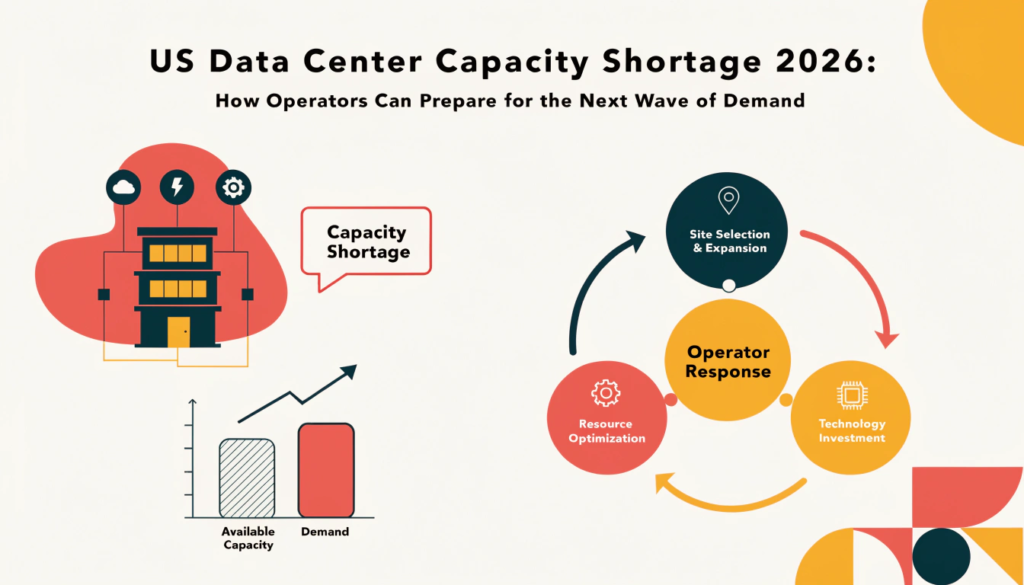
The US data center industry is entering a period of unprecedented growth. Artificial intelligence (AI), cloud computing, high-performance computing, streaming services, enterprise digital transformation, and connected technologies are all increasing demand for data center infrastructure. At the same time, operators are facing a growing challenge: finding enough power, land, cooling capacity, and suitable infrastructure to support new facilities.
The data center capacity shortage USA 2026 is becoming an important consideration for operators, developers, technology providers, and enterprise organizations planning their infrastructure strategies. While new data centers continue to be announced, bringing capacity online is becoming increasingly complex.
The issue is no longer simply about building more server rooms. Operators must think about energy availability, grid connections, construction timelines, cooling requirements, sustainability goals, equipment availability, and the changing demands of AI workloads.
Why Is Data Center Capacity Becoming Scarce?
Data center demand has increased rapidly as businesses move more workloads to cloud platforms and adopt AI-driven applications. Generative AI and machine learning workloads are particularly important because they require high-performance computing infrastructure and significantly greater power densities than many traditional workloads.
This creates a mismatch between demand and available capacity. A data center project can take years to plan, permit, construct, power, and commission. However, demand for computing resources can grow much faster.
The result is a market where organizations may have access to capital and technology but still struggle to secure suitable capacity.
The data center demand forecast for the coming years therefore needs to consider more than traditional IT growth. Operators must account for AI infrastructure, cloud expansion, digital services, edge computing, and the increasing amount of data generated by businesses and consumers.
Power Availability Is Becoming a Major Constraint
One of the biggest challenges contributing to the data center capacity shortage USA 2026 is access to electricity.
Data centers are highly energy-intensive facilities. AI-focused facilities can require substantially more power than traditional enterprise data centers because of the density of GPUs and other high-performance computing equipment.
In many locations, the electrical grid may not be able to provide the required capacity quickly enough. Grid interconnection queues, transmission constraints, permitting requirements, and infrastructure upgrades can significantly extend project timelines.
For operators, this means that selecting a site based only on land availability is no longer sufficient. Power availability must become one of the first considerations in site selection.
Operators should assess current grid capacity, expected future availability, utility timelines, transmission infrastructure, and the potential cost of upgrades before committing to a location.
AI Is Changing Data Center Capacity Planning
AI is one of the most significant forces shaping the current data center market.
Traditional workloads often involve relatively predictable computing requirements. AI workloads can be much more demanding. Training and running large models require high-performance processors, GPUs, advanced networking, and increasingly sophisticated cooling systems.
This is changing how operators think about capacity.
Instead of measuring capacity only in terms of square footage or traditional rack counts, operators increasingly need to consider power density and workload requirements. A facility designed for conventional enterprise computing may not be suitable for large-scale AI deployment without significant modifications.
The data center demand forecast must therefore account for the growing difference between conventional computing and AI infrastructure.
Operators should build flexibility into new facilities so that power distribution, cooling systems, network infrastructure, and rack configurations can adapt to future high-density workloads.
Cooling Requirements Are Increasing
Higher computing density also means greater heat generation.
Traditional air cooling remains suitable for many workloads, but high-density AI servers are accelerating interest in liquid cooling and other advanced thermal management solutions.
This creates another planning challenge. Data center operators need to consider cooling infrastructure during the earliest stages of facility design rather than treating it as an upgrade that can be added later.
Cooling systems can influence water consumption, energy efficiency, equipment layout, maintenance requirements, and operating costs.
For facilities expected to support AI workloads, operators should evaluate whether their cooling infrastructure can handle future increases in rack density. Designing for today’s requirements alone could result in expensive retrofits later.
Construction Timelines Could Become Longer
The growing demand for data center capacity is also increasing pressure on the construction ecosystem.
Data center projects require specialized electrical equipment, generators, transformers, switchgear, cooling equipment, networking systems, construction expertise, and other critical components. If demand rises faster than supply, equipment lead times can increase.
Transformers and other electrical components can be particularly important because delays in obtaining them may affect the entire project schedule.
Operators should therefore avoid treating procurement as a final-stage activity. Long-lead components should be identified and planned for early.
A strong procurement strategy can include early supplier engagement, alternative suppliers, realistic lead-time assumptions, and contingency plans for critical equipment.
Site Selection Needs a Broader Strategy
In the past, operators may have prioritized land cost, connectivity, taxes, and proximity to customers when selecting a data center location.
These factors remain important, but the data center capacity shortage USA 2026 means site selection is becoming more complex.
Operators need to evaluate several factors together, including:
- Reliable power availability and future grid capacity
- Fiber connectivity and network diversity
- Availability of suitable land
- Local permitting and regulatory requirements
- Climate and environmental conditions
- Water availability and cooling requirements
- Access to skilled labor
- Construction and equipment supply chains
- Renewable energy opportunities
A location that appears inexpensive initially may become significantly more expensive if it requires major grid upgrades or faces lengthy permitting delays.
Operators Must Plan for Energy Resilience
Power reliability is another critical concern.
Data centers support services that businesses and consumers increasingly expect to be available around the clock. Even short disruptions can create operational and financial consequences.
As facilities become more power-intensive, operators need robust strategies for maintaining resilience.
Backup generators, UPS systems, energy storage, microgrids, and diversified power sources can all play a role. However, the right combination depends on facility requirements, location, regulations, cost, and sustainability objectives.
Operators should also consider how their backup strategy aligns with environmental targets. Traditional diesel backup systems may provide resilience, but organizations increasingly want lower-carbon alternatives.
This makes energy planning an important part of long-term capacity strategy.
Sustainability Cannot Be Separated From Capacity Planning
The growth of data center infrastructure is occurring alongside increasing pressure to improve sustainability.
Customers, investors, regulators, and communities are paying greater attention to energy consumption, carbon emissions, water usage, and environmental impact.
For operators, sustainability should not be treated as a separate initiative. It should be incorporated into capacity planning from the beginning.
Renewable energy procurement, energy-efficient equipment, advanced cooling, heat reuse, water-efficient systems, and improved power management can all contribute to more sustainable operations.
The challenge is finding the right balance between sustainability, reliability, cost, and performance.
As the data center demand forecast continues to rise, operators that integrate sustainability into facility planning may be better positioned to manage both regulatory expectations and customer requirements.
Modular and Phased Expansion Can Reduce Risk
One way to respond to uncertain demand is through phased development.
Instead of building the entire planned capacity at once, operators can develop facilities in stages. This approach can allow infrastructure to expand alongside actual customer demand.
Modular designs can also help operators standardize components and reduce construction complexity.
For example, a facility may initially be designed for a specific power requirement but include infrastructure pathways that make future expansion easier. This can reduce the risk of overbuilding while preserving the ability to scale.
For operators navigating the data center capacity shortage USA 2026, flexibility can be just as valuable as raw capacity.
Workforce Planning Is Another Critical Issue
Building new facilities requires more than capital and equipment. Skilled professionals are needed to design, construct, operate, maintain, and secure data centers.
Electrical engineers, mechanical engineers, facility managers, technicians, cybersecurity professionals, controls specialists, and other skilled workers are increasingly important to the industry.
As more facilities are developed, competition for experienced workers could increase.
Operators should therefore think about workforce planning alongside physical infrastructure planning. Training programs, partnerships with educational institutions, internal development programs, and improved retention strategies can help organizations prepare for future staffing requirements.
What Should Operators Do Now?
The most effective response to the capacity shortage is proactive planning.
Operators should begin by reviewing their expected workload growth and developing a realistic data center demand forecast. This forecast should include traditional cloud and enterprise workloads as well as potential AI expansion.
They should then compare expected demand with available capacity and identify potential gaps.
The next step is evaluating where additional capacity can realistically be delivered. Power availability, grid connection timelines, cooling requirements, construction schedules, equipment availability, and permitting should all be considered.
Operators should also create multiple scenarios rather than relying on a single growth projection. AI adoption could accelerate faster than expected, while economic conditions could affect enterprise spending. Scenario planning can help operators remain prepared for both outcomes.
Preparing for the Next Phase of Data Center Growth
The US data center market is moving into an era where capacity itself can become a strategic advantage.
Organizations that wait until demand becomes urgent may face higher costs, longer project timelines, limited site availability, and greater competition for power and equipment.
The data center capacity shortage USA 2026 is therefore not simply a construction challenge. It is a planning challenge involving energy, technology, cooling, supply chains, sustainability, workforce, and long-term investment.
Operators that start planning early can improve their ability to secure power, manage project risks, support AI workloads, and deliver capacity when customers need it.
The future of data center infrastructure will belong to operators that combine scalability with resilience. Facilities must be capable of supporting rapidly changing workloads while maintaining efficiency, reliability, and sustainability.
As the data center demand forecast continues to evolve, flexibility will become increasingly important. Operators should build strategies that allow them to respond to changing technology, energy constraints, customer expectations, and market conditions.
Register as a Delegate
Want to stay ahead of the latest developments in data center infrastructure, capacity planning, power, cooling, sustainability, and facility management?
Register as a delegate and connect with industry professionals shaping the future of data center facilities.