
Introduction: The Modern Logistics Imperative
The global supply chain landscape is undergoing an unprecedented shift. Driven by the relentless expansion of e-commerce, heightened consumer expectations for same-day or next-day delivery, and widespread labor shortages, modern fulfillment centers operate under immense pressure. Facilities that relied for decades on manual labor, static shelving, and conventional forklifts now find those legacy models insufficient for handling unpredictable volume spikes and demanding throughput targets.
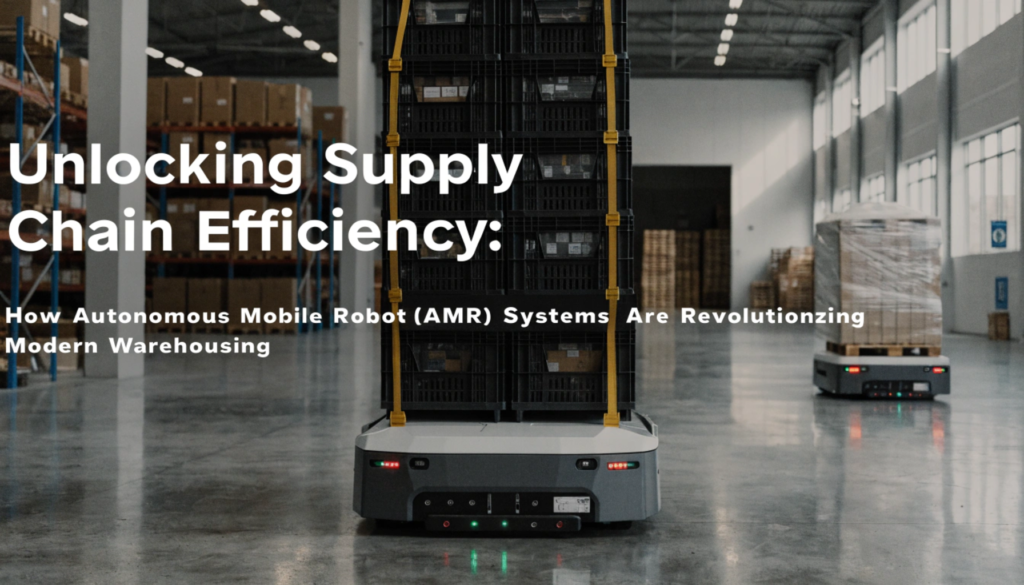
To overcome these operational bottlenecks, logistics managers and operations directors are increasingly turning to advanced industrial automation. At the forefront of this technological shift is the deployment of the autonomous mobile robot AMR. Unlike previous generations of industrial machinery that were rigid, fixed, or dependent on restrictive infrastructure, modern mobile robots introduce dynamic intelligence directly to the warehouse floor.
By serving as intelligent, adaptable assets, these systems represent a pivotal milestone within the broader landscape of warehouse automation robotics. They do not merely replace manual transport tasks; they fundamentally reimagine how goods move through a facility, enabling decentralized decision-making, optimizing travel paths, and working seamlessly alongside human teams. Understanding the mechanics, operational advantages, and strategic deployment of these robotic systems is essential for any enterprise seeking to build a resilient, future-ready logistics operation.
Defining the Technology: What Is an Autonomous Mobile Robot AMR?
An autonomous mobile robot AMR is an intelligent industrial vehicle designed to navigate and execute tasks within dynamic operational environments without requiring continuous direct human oversight or permanent physical guidance infrastructure. Equipped with an array of advanced sensors, onboard computing power, and sophisticated mapping algorithms, these robotic units build a real-time understanding of their surroundings.
At the heart of every modern unit is a sophisticated software stack that combines simultaneous localization and mapping, commonly known as SLAM, with artificial intelligence and computer vision. Rather than following a predetermined physical track, the robot creates a digital blueprint of the facility using LiDAR laser scanners, 3D depth camera arrays, and ultrasonic sensors. This enables the vehicle to identify its location within a facility continuously while simultaneously detecting dynamic obstacles such as workers, forklifts, fallen boxes, or other robotic units.
When tasked with moving inventory from a receiving dock to a storage aisle, the robot does not follow a singular, unalterable path. Instead, its internal navigation system continuously calculates the most efficient route available. If an unexpected obstacle blocks a primary aisle, the onboard intelligence dynamically reroutes the unit around the barrier, ensuring uninterrupted material flow. This capacity for self-guided adaptation distinguishes mobile robots from legacy automation frameworks and serves as the foundation for high-performing warehouse automation robotics strategies.
The Evolutionary Shift: Comparing AGVs and AMRs
To fully grasp the transformative nature of modern robotics, it is helpful to contrast them with Automated Guided Vehicles, or AGVs. While both technologies aim to automate horizontal material transport within industrial facilities, their underlying architectures and operational constraints differ significantly.
Legacy AGVs rely on fixed infrastructure for navigation. They typically follow physical tracks embedded in or applied to the warehouse floor, such as magnetic tape, optical lines, floor wires, or reflective laser targets mounted on walls. These systems execute simple, repetitive tasks reliably along designated tracks. However, their reliance on fixed pathways introduces structural rigidity. Modifying an AGV route requires altering physical infrastructure, which can be expensive, time-consuming, and disruptive to daily operations. Furthermore, if an AGV encounters an unexpected obstacle on its track, it stops and waits until the barrier is manually removed, potentially causing bottleneck delays down the line.
In contrast, an autonomous mobile robot AMR operates with complete structural flexibility. Installation requires no permanent modifications to the physical facility layout. Instead, operators simply guide the unit through the space during an initial mapping phase, allowing its sensors to register structural parameters. Once mapped, the robot navigates autonomously and adapts instantly to environment changes.
| Operational Dimension | Legacy Automated Guided Vehicle (AGV) | Autonomous Mobile Robot (AMR) |
|---|---|---|
| Navigation Mechanism | Magnetic tape, wires, physical floor tracks, or fixed targets | Onboard SLAM, LiDAR, computer vision, and AI |
| Obstacle Handling | Stops completely until the path is cleared manually | Dynamically navigates around obstacles in real time |
| Facility Infrastructure | Requires physical facility modifications and floor installation | Zero facility modifications; software-based mapping |
| Deployment & Scalability | Long deployment timeline; costly track reconfigurations | Rapid deployment; simple software updates for new routes |
| Flexibility | Rigid, single-path execution | Highly versatile, multi-point dynamic routing |
By eliminating physical infrastructure constraints, companies can deploy flexible units within days or weeks rather than months, scaling their fleet up or down as operational demands shift.
Core Operational Drivers: How AMRs Are Transforming Warehousing
The integration of intelligent robotics influences virtually every functional zone within a modern distribution center. By targeting high-frequency, low-value material transport tasks, these units optimize labor allocation and accelerate overall operational velocity.
Optimizing Order Fulfillment and Goods-to-Person Picking
Traditionally, order picking has accounted for up to fifty percent of total warehouse operating costs, with physical travel time representing the vast majority of a picker’s shift. In a traditional manual facility, human workers spend hours walking through extensive aisles, pushing carts, and retrieving items.
The implementation of warehouse automation robotics radically restructures this process through goods-to-person picking models. Mobile robots can lift and transport entire inventory racks, shelves, or specialized totes directly to ergonomic, stationary picking workstations. The worker remains at the station, selecting items prompted by digital displays while the robotic fleet manages rack transport and return storage. This workflow minimizes unnecessary walking, reduces physical fatigue, and dramatically increases picking speeds while driving accuracy rates close to perfection.
In collaborative “Person-to-Good” workflows, smaller mobile units assist human pickers by navigating autonomously to pick locations. Human workers simply place picked items onto the robot’s carrier, and the unit moves on to the next destination or packing area, allowing human operators to remain focused within optimized picking zones.
Streamlining Bulk Inventory Transport and Cross-Docking
Beyond item-level picking, heavy-duty mobile robots are increasingly replacing conventional manual forklifts for bulk horizontal transport. Modern high-payload units can handle heavy pallets, large staging containers, and custom payloads weighing thousands of pounds.
During receiving operations, these automated units accept incoming pallets directly from dock areas and transport them to putaway staging locations or specialized storage systems without human intervention. In cross-docking environments, where speed is critical, the fleet continuously transfers goods from inbound docks directly to outbound staging bays. By automating continuous horizontal travel across large facility footprints, companies drastically cut forklift traffic, lower energy consumption, and maintain consistent material throughput.
Real-Time Inventory Visibility and Integrated Fleet Management
Advanced industrial mobile units serve as mobile data-collection hubs. As they travel through facility aisles, onboard computer vision systems, RFID readers, and optical scanners can automatically scan barcode labels, register pallet positions, and verify inventory counts.
This sensory network communicates continuously with centralized systems, such as a Warehouse Management System (WMS) or Warehouse Execution System (WES). Fleet management software aggregates real-time data from every active autonomous mobile robot AMR, monitoring battery levels, tracking task progression, and dynamically assigning tasks based on location proximity and priority. Consequently, operations leaders gain complete, real-time visibility into both material locations and equipment performance across the facility.
Enhancing Workplace Safety and Ergonomic Standards
Industrial warehouses present inherent safety risks, with heavy forklift operations historically contributing to thousands of workplace injuries annually. Human error, blind spots, fatigue, and speed often factor into facility collisions.
Integrating safety-rated warehouse automation robotics dramatically lowers these risks. Mobile robots are engineered with multi-layered safety systems, including 360-degree LiDAR coverage, safety-rated optical sensors, proximity alarms, and emergency stopping mechanisms. They operate within strictly governed acceleration parameters and continuously evaluate potential safety hazards faster than human reaction speeds. By taking over repetitive, heavy-duty transport tasks, these systems prevent physical strain injuries, reduce heavy equipment collisions, and foster a safer, more predictable workplace environment.
Strategic Business Advantages and Return on Investment
Investing in automated material handling offers compelling operational benefits, driving strong financial returns and strategic advantages for forward-thinking organizations.
High Scalability and Operational Flexibility
One of the greatest operational advantages of an autonomous mobile robot AMR deployment is modular flexibility. Traditional fixed automation systems, such as complex conveyor belts or High-Bay Automated Storage and Retrieval Systems (AS/RS), require high upfront capital expenditure and rigid floor planning. Expanding or modifying those systems often requires costly building additions or lengthy downtime.
Robotic fleets offer simple scalability. Facilities can start with a modest fleet to address immediate bottlenecks and expand seamlessly as business volume grows. Peak seasonal surges can be managed by integrating additional rental units into the digital fleet layout without altering facility infrastructure.
Rapid Implementation Timelines and Faster Time-to-Value
Because mobile units require no physical tracks, floor reflective targets, or overhead structures, deployment schedules are significantly shorter than those for traditional automation systems. Facility mapping and software integration can often be completed within weeks. This shortened commissioning window minimizes operational disruption and yields a significantly faster return on investment, with many enterprises achieving full payback within 12 to 18 months through labor savings, error reduction, and throughput gains.
Human Capital Optimization and Job Elevation
Deploying robotic fleets addresses persistent labor shortages by taking over repetitive, physically demanding tasks like walking long distances, pushing heavy carts, and moving heavy pallets. Rather than eliminating human positions, these technologies allow organizations to transition workers into higher-value roles, such as inventory control, quality assurance, system operation, and fleet maintenance. Elevating human job roles improves staff retention, reduces turnover, and builds a more engaged, skilled workforce.
Navigating Implementation Considerations
While the benefits of deploying an autonomous mobile robot AMR fleet are clear, successful integration requires careful strategic planning, infrastructure evaluation, and change management.
First, establishing robust industrial network infrastructure is essential. Because robotic fleets rely on constant data exchange with central fleet management software and warehouse control systems, facilities must maintain seamless, high-availability wireless coverage, such as industrial Wi-Fi 6 or private 5G networks. Blind spots or unexpected network drops can disrupt task allocations and impact real-time fleet management.
Second, software interoperability plays a critical role in long-term success. The robotic software platform must integrate smoothly with existing enterprise infrastructure, including ERP and WMS platforms, via standardized APIs. Establishing clear data communication between platforms ensures seamless order routing, inventory updates, and fleet coordination.
Finally, organizational change management is vital. Employees should be introduced to automation early in the deployment process, emphasizing that modern warehouse automation robotics systems are designed to support human teams rather than replace them. Providing thorough training programs empowers workers to interact confidently with automated assets, accelerating system adoption and driving operational success.
Future Horizons in Autonomous Logistics
As artificial intelligence, edge computing, and sensor technology continue to advance, the capability profile of the autonomous mobile robot AMR will expand dramatically. Modern developments in generative AI and deep reinforcement learning are transforming fleet management from reactive execution to predictive coordination. Future robotic fleets will anticipate order spikes, autonomously re-align inventory staging based on predictive analytics, and self-optimize travel corridors before bottlenecks occur.
Simultaneously, mechanical design innovations are bridging the gap between horizontal transport units and articulated robotic manipulators. The integration of collaborative robotic arms directly onto mobile chassis creates mobile manipulation units capable of moving to a location, identifying specific items, picking them accurately, and transporting them across the facility without human intervention.
Furthermore, as smart manufacturing initiatives, IoT devices, and digital twin environments become standard operational practices, mobile fleet management will serve as an integral pillar of fully connected industrial ecosystems.
Staying Ahead in Industrial Innovation
Adopting automated material handling solutions is no longer just a futuristic concept—it is a critical requirement for companies seeking to remain competitive in modern supply chain management. By blending real-time spatial awareness, operational flexibility, and seamless human collaboration, intelligent robotic fleets enable facilities to achieve exceptional throughput, accuracy, and efficiency.
To stay at the forefront of these technological advancements and network with industry leaders who are reshaping modern manufacturing and logistics, explore the latest technology trends and register for upcoming events. To learn more about upcoming executive forums, session tracks, and smart factory showcases, Explore BMA convention topics and join the ongoing conversation defining the future of industrial automation.