
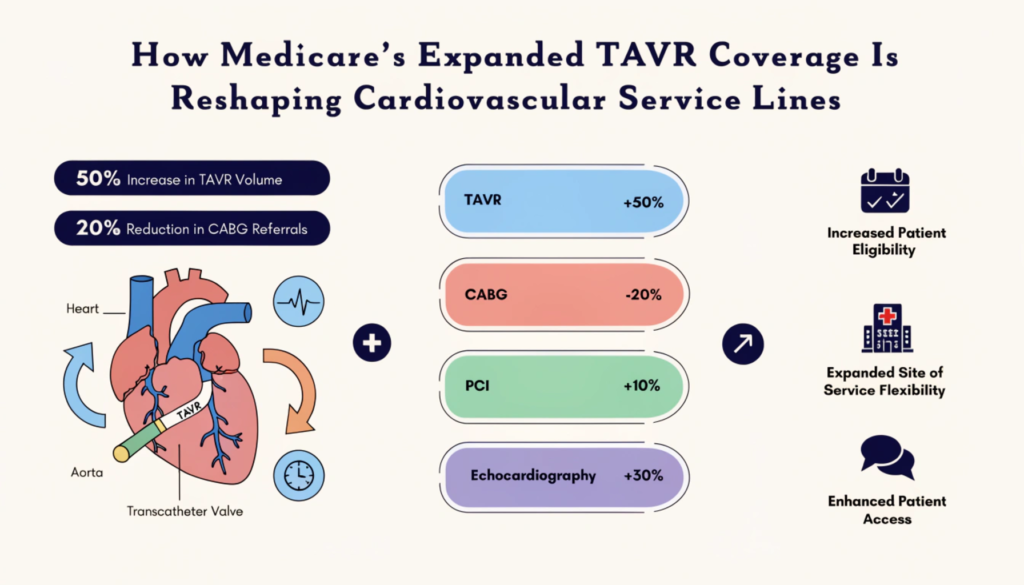
Cardiovascular medicine has long served as an economic and clinical cornerstone for American health systems. Over the past decade, few innovations have transformed inpatient care as profoundly as Transcatheter Aortic Valve Replacement (TAVR). What began as a high-risk experimental option for inoperable patients has evolved into the standard of care across low-, intermediate-, and high-risk patient populations, reshaping hospital volumes and clinical paradigms.
Now, a significant federal policy shift is opening the door to the next phase of market expansion. The Centers for Medicare & Medicaid Services (CMS) recently issued modernized National Coverage Determinations (NCDs) for transcatheter valve therapies, as detailed in recent industry analysis from DistilINFO GovHealth. The updated framework lowers regulatory barriers for qualifying community health systems while updating quality registry benchmarks and interdisciplinary heart team standards.
For healthcare system executives, chief medical officers, and cardiovascular service line directors, the Medicare TAVR coverage expansion represents a strategic inflection point. It is not merely a reimbursement update; it is an invitation to restructure cardiovascular service delivery, capture market share, and build high-efficiency clinical programs capable of meeting surging demographic demand.
The Policy Shift: Modernizing Medicare’s Coverage Framework
When CMS published its foundational National Coverage Determination for TAVR in 2012, federal regulators instituted stringent institutional and operator volume requirements. Hospitals were required to maintain high annual volumes of conventional open surgical aortic valve replacements (SAVR) and percutaneous coronary interventions (PCI) before they could even apply to launch a transcatheter valve program.
While these safeguards ensured procedural safety during early commercialization, they inadvertently created regional healthcare disparities. Smaller community health systems and rural regional medical centers were effectively blocked from offering minimally invasive valve replacements, forcing elderly patients to travel significant distances to major academic hubs.
CMS’s updated determinations modernize these requirements to reflect contemporary clinical reality:
- Rationalized Volume Thresholds: Adjusting institutional volume mandates to focus on clinical competency, risk-adjusted survival outcomes, and patient safety rather than raw surgical open-heart quotas.
- Streamlined Registry Participation: Modernizing mandatory clinical registry reporting requirements, leveraging electronic health record (EHR) data integration to minimize administrative overhead for participating hospitals.
- Emphasis on Multidisciplinary Heart Teams: Reaffirming the essential role of joint decision-making between interventional cardiologists, cardiothoracic surgeons, cardiac imaging specialists, and patient care navigators.
By easing rigid institutional restrictions while maintaining strict outcome standards, CMS has cleared the runway for community-based cardiovascular service line growth.
Strategic Implications for Hospital Service Lines
For health systems, cardiovascular services typically generate a substantial portion of overall net operating margin. However, the shift toward minimally invasive structural heart care introduces complex economic dynamics that hospital leadership must navigate.
1. The Migration from Inpatient Stays to Same-Day Discharge
In TAVR’s early years, patients routinely required multi-day stays in intensive care units followed by several days of step-down telemetry observation. Today, standard-of-care transcatheter procedures are performed using conscious sedation rather than general endotracheal anesthesia.
Leading cardiovascular programs now routinely achieve next-day or even same-day discharge for uncomplicated elective cases. This shift dramatically reduces variable hospital costs per case and frees up valuable acute inpatient bed capacity for emergency and high-complexity admissions.
2. Service Line Contribution Margins and Capital Allocation
While TAVR generates favorable procedural margins, transcatheter heart valves remain high-cost implantable medical devices. Hospital supply chain leaders and service line directors must negotiate bundled purchasing contracts and consignment inventory agreements with medical device manufacturers to protect operating margins.
Furthermore, capital allocation must be prioritized toward high-throughput hybrid catheterization suites that can support multiple vascular and interventional specialties.
3. Patient Retention and Market Competitiveness
With regional volume barriers lowered, competition for structural heart patients is shifting from super-regional academic medical centers to high-performing community health systems. Hospitals that establish comprehensive structural heart centers can retain patients within their regional network, preventing out-of-system referral leakage across cardiology, imaging, and rehabilitation service lines.
Clinical Workforce and Team Architecture
Expanding structural heart capacity requires more than acquiring advanced technology; it requires building collaborative clinical care models. The multidisciplinary Heart Team is the foundation of high-quality TAVR delivery.
Leading health systems are optimizing their workforce models through several organizational innovations:
- Dedicated Valve Clinic Coordinators: Specialized nurse navigators manage the patient journey from initial echocardiogram screening through CT sizing, pre-procedural clearance, and post-discharge follow-up. Effective navigation cuts pre-procedure evaluation times from months to weeks.
- Integrated Physician Compensation Models: Aligning incentives between cardiothoracic surgeons and interventional cardiologists through co-management agreements or shared service-line leadership structures. Removing historical fee-for-service competition between surgical and catheter-based specialties ensures patients receive the most clinically appropriate therapy.
- Advanced Practice Provider (APP) Utilization: Leveraging nurse practitioners and physician assistants to oversee pre-admission testing, vascular closure management, and post-discharge remote monitoring, allowing interventional physicians to maximize procedural throughput.
Technological Convergence Driving Procedural Efficiency
The expansion of Medicare coverage coincides with unprecedented technological innovation across structural heart hardware and digital health platforms.
Key technological advancements shaping 2026–2027 programs include:
- Pre-Procedural 3D Imaging and AI Simulation: Automated CT segmentation software creates digital twins of patient aortic root anatomy. Structural heart teams can simulate valve expansion, assess coronary obstruction risks, and choose optimal prosthesis sizing virtually before the patient enters the suite.
- Intra-Procedural Image Fusion: Advanced interventional imaging systems overlay pre-operative 3D reconstructions directly onto real-time 2D fluoroscopy screens. This eliminates redundant contrast dye injections, protects patient renal function, and accelerates procedure times.
- Next-Generation Delivery Systems and Cerebral Embolic Protection: Lower-profile delivery catheters allow transfemoral access in patients with severe peripheral vascular disease, while routine adoption of embolic protection filters reduces peri-procedural stroke risks to historic lows.
Expanding Beyond the Aortic Valve: The Broader Structural Heart Pipeline
For healthcare executives evaluating capital investments, TAVR is only the starting point of a broader structural heart revolution. The infrastructure, clinical expertise, and multidisciplinary workflows established for TAVR serve as the technological springboard for rapid growth across adjacent cardiac indications:
- Transcatheter Mitral Valve Repair and Replacement (TMVR): Catheter-based edge-to-edge repair (TEER) and dedicated replacement valves are treating high-risk mitral regurgitation patients who were previously medically managed without procedural intervention.
- Transcatheter Tricuspid Valve Therapies (TTVR): Rapidly emerging transcatheter tricuspid repair systems represent one of the fastest-growing procedural categories in cardiovascular medicine, addressing a vast, historically untreated patient demographic.
- Left Atrial Appendage Occlusion (LAAO): Expanding non-pharmacological stroke prevention for atrial fibrillation patients unable to tolerate long-term oral anticoagulation.
Health systems that design their interventional suites, supply chains, and clinical teams with this broader structural pipeline in mind will maximize capital efficiency and service line resilience over the coming decade.
Executive Action Plan for Health System Leadership
To capitalize on modernized Medicare coverage determinations and build a premier structural heart program, healthcare leadership should take concrete steps:
- Perform a Regional Market and Referral Audit: Quantify regional prevalence of severe aortic stenosis and analyze referral patterns within primary care and general cardiology networks.
- Review Capital and Facility Readiness: Determine whether existing cath lab real estate can be upgraded to hybrid interventional specifications or if new surgical construction is required.
- Establish a Cross-Disciplinary Governance Committee: Unify cardiology, cardiac surgery, administration, finance, and marketing leadership under a unified structural heart steering committee.
- Invest in Patient Navigation Infrastructure: Recruit and empower dedicated clinical coordinators to create a frictionless outpatient screening and evaluation pipeline.
Conclusion: Strategic Leadership in Modern Cardiovascular Medicine
CMS’s modernized policy for transcatheter valve therapies reflects the broader maturation of American healthcare: shifting toward minimally invasive care, outcome-driven reimbursement, and decentralized patient access.
By aligning clinical expertise, advanced imaging infrastructure, and innovative care coordination models, forward-thinking health systems can leverage Medicare TAVR coverage expansion to expand clinical reach, strengthen physician alignment, and deliver transformative outcomes to an aging population.
Looking to connect with cardiovascular clinical directors, health system executives, and hospital operational leaders shaping the future of care delivery?
Register for the Upcoming Smart Healthcare Facilities Convention 2026 and explore strategic insights into cardiovascular service line expansion, healthcare technology integration, and hospital infrastructure modernization. |